Hello! I’m your Daily Hangul Editor.
Phase 1: The ‘Escape’ Reality Check
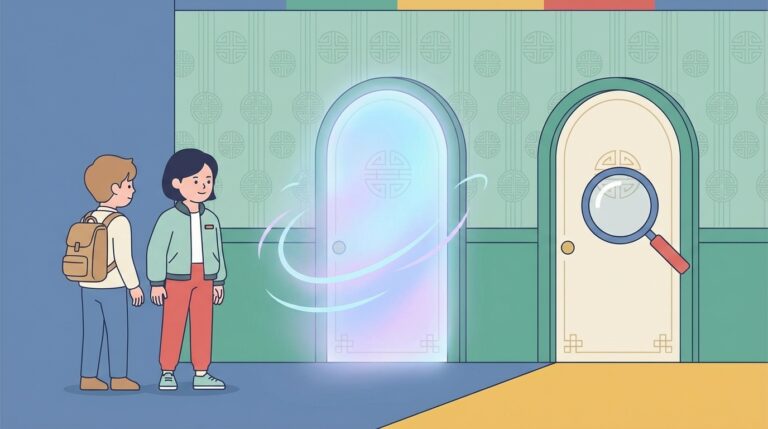
Imagine this: It’s a Friday night in the vibrant streets of Hongdae. You and your Korean friends just had some amazing K-BBQ, and suddenly, someone shouts, “Let’s go to a Bang-tal-chul (Escape Room)!” You arrive at a dimly lit, mysterious cafe. Your friend points to a poster with a bloody handprint and says, “Let’s do this one!”
Inside, you’re screaming, “No! I just want a nice, smart detective game!” but you don’t know how to say it in Korean. You end up spending 60 minutes huddled in a dark corner while a zombie actor chases you.
Korean escape rooms (방탈출) are world-class. They are highly immersive, story-driven, and sometimes, terrifyingly realistic! If you don’t know how to speak up and choose the right theme (테마), you might end up in a horror movie you didn’t audition for.
Don’t worry. This guide is built from the real tears of my expat students who accidentally booked a horror room. Let’s learn how to navigate the theme selection like a true K-Drama detective!
Phase 2: Core Expressions Deep Dive
Here are the lifesaver phrases you need at the escape room counter.
1. 공포 테마 말고 다른 거 없어요?
- Pronunciation: gongpo tema malgo dareun geo eopseoyo? [gong-po teh-ma mal-go da-reun guh uhp-suh-yo?]
- Meaning: Literal: Is there nothing else besides the horror theme? / Real nuance: Please, I am begging you, let’s do anything but horror.
- K-Culture Moment: Picture a K-Variety show like The Great Escape (대탈출). The cast members are standing outside a scary building, desperately asking the staff if there’s a non-scary option.
- Editor’s Insight: This phrase sounds slightly pleading but very natural. ‘말고’ (malgo) means ‘instead of’ or ‘excluding’. It’s the perfect way to politely veto your friend’s scary choice.
- Situation Spectrum:
[🚫 절대 금지] ———— [⚠️ 주의] ———— [✅ 자유롭게]
- Close Friends (Casual): ✅ (Drop the ‘요’ at the end: 공포 테마 말고 다른 거 없어?)
- Escape Room Staff (Semi-formal): ✅
- Boss/Elders (Formal): ⚠️ (You probably aren’t doing escape rooms with your boss, but if you do, use a more formal structure!)
- 🤔 Think About It: Why do Koreans use “Is there nothing else?” instead of directly saying “I hate horror”? It reflects the cultural preference for softening negative opinions to maintain group harmony (기분 – gibun).
2. 추리 테마로 할게요.
- Pronunciation: churi temaro halgeyo. [choo-ree teh-ma-ro hal-ggeh-yo.]
- Meaning: Literal: We will do it as the mystery theme. / Real nuance: We choose the mystery theme.
- K-Culture Moment: You adjust your imaginary glasses like a genius detective in a K-Drama. You are ready to show off your ‘Brain Sexy’ (뇌섹남/녀 – someone attractive because of their intellect) charm.
- Editor’s Insight: ‘~로 할게요’ (-ro halgeyo) is your ultimate decision-making phrase. You can use this everywhere in Korea—at cafes, restaurants, or ticket counters. “아메리카노로 할게요” (I’ll do the Americano).
- Situation Spectrum:
[🚫 절대 금지] ———— [⚠️ 주의] ———— [✅ 자유롭게]
- Close Friends (Casual): ✅ (추리 테마로 할게)
- Escape Room Staff (Semi-formal): ✅
- Boss/Elders (Formal): ⚠️
- 🤔 Think About It: Notice how it’s “We will do it AS” rather than “I take”. Does your language focus more on the object itself or the action of choosing?
3. 난이도가 어떻게 돼요?
- Pronunciation: nanidoga eotteoke dwaeyo? [na-nee-do-ga uh-ttuh-keh dweh-yo?]
- Meaning: Literal: How does the difficulty level become? / Real nuance: How hard is this room?
- K-Culture Moment: The moment before booking. Your Korean friend looks at the poster showing 5 out of 5 stars. They look at you, sizing up your puzzle-solving skills, and ask the staff this question.
- Editor’s Insight: If you translate “What is the difficulty?” directly, it sounds robotic. Koreans use “어떻게 돼요?” (How does it become?) to ask for information gently. You can also use this for age: “나이가 어떻게 되세요?” (How old are you?).
- Situation Spectrum:
[🚫 절대 금지] ———— [⚠️ 주의] ———— [✅ 자유롭게]
- Close Friends (Casual): ✅ (난이도가 어떻게 돼?)
- Escape Room Staff (Semi-formal): ✅
- Boss/Elders (Formal): ⚠️
- 🤔 Think About It: Why does Korean use “How does it become?” instead of “What is it?” Indirectness is polite in Korean! Direct “What” questions can sound aggressive.
Phase 3: Textbook vs Real Korean
Let’s see how real people talk in Hongdae compared to your A2 textbook.
| Situation | 📖 Textbook Korean | 🗣️ Real Korean | 💡 Why is it different? |
|---|---|---|---|
| Rejecting Horror | 공포 테마는 무섭습니다. (Horror theme is scary.) | 저 쫄보라서 공포는 절대 안 돼요! (I’m a coward, horror is an absolute NO!) | ‘쫄보’ (jjolbo) is a fun slang word for a scaredy-cat. Self-deprecating humor is highly appreciated in Korea! |
| Choosing Mystery | 추리 테마를 선택하겠습니다. (I will select the mystery theme.) | 추리 테마로 할게요. (We’ll go with the mystery theme.) | Textbook sounds like a military declaration. ‘~로 할게요’ is the everyday conversational standard. |
| Asking Difficulty | 난이도가 무엇입니까? (What is the difficulty?) | 별 몇 개짜리예요? (How many stars is it?) | Escape room difficulties are usually rated in stars (별). Real conversation focuses on the visual rating system. |
Bottom Note: For A2 learners, using “쫄보” (jjolbo) with your Korean friends will instantly make them laugh and treat you like a local. Just don’t use it in a business meeting!
Phase 4: K-Culture Deep Dive
4-1. Non-verbal Cue: The Nunchi Game
When choosing a theme with a group of Korean friends, Nunchi (눈치) is crucial. Nunchi is the subtle art of reading the room. If three of your friends are excitedly pointing at the “Haunted Asylum” poster, firmly shouting “NO HORROR!” might ruin the vibe. Instead, subtly point at the “Sherlock Holmes” poster and say, “Wow, this one looks so cool! My Korean reading isn’t fast enough for horror anyway…” Let them connect the dots!
4-2. The “Brain Sexy” Culture in K-Variety
Why are escape rooms so popular in Korea? They tap into the Korean love for intellectual games. Programs like The Great Escape (대탈출) or Crime Scene (크라임씬) are massive hits. In Korea, being smart and capable of solving complex logic puzzles under pressure makes you 뇌섹남/뇌섹녀 (A man/woman with a sexy brain). Choosing a ‘Mystery’ (추리) theme is your chance to shine. Just remember to yell “찾았다!” (I found it!) dramatically when you discover a hidden key.
Phase 5: Real-Life Roleplay Scenario
Setting: Saturday afternoon, Gangnam. You and your Korean co-worker Min-su are at “Secret Code Escape Room”. The walls are lined with polaroids of successful teams.
Characters:
– YOU: An expat who loves puzzles but hates jump scares.
– Min-su (30): Friendly, energetic, and completely fearless. Thinks horror is the only way to have fun.
Dialogue:
Min-su: 우리 저주받은 병원 테마 어때요? 완전 재밌을 것 같은데! 👻
(uri jeojubadeun byeongwon tema eottaeyo? wanjeon jaemisseul geot gateunde!)
[How about the Cursed Hospital theme? It looks super fun!]
(🎭 Stage Direction: Min-su points excitedly at a poster with a bloody nurse.)
You: 헉… 저 공포 테마는 진짜 못해요.
(heok… jeo gongpo temaneun jinjja motaeyo.)
[Gasp… I really can’t do horror themes.]
Min-su: 에이~ 안 무서워요! 제가 지켜줄게요.
(ei~ an museowoyo! jaega jikyeojulgeyo.)
[Ayy~ It’s not scary! I’ll protect you.]
You: 아니에요, 공포 테마 말고 다른 거 없어요?
(anieyo, gongpo tema malgo dareun geo eopseoyo?)
[No, really, is there anything else besides the horror theme?]
Min-su: 음… 그럼 스파이 테마나 추리 테마가 있어요.
(eum… geureom seupai temana churi temaga isseoyo.)
[Hmm… Then there’s a spy theme or a mystery theme.]
🔀 Your Turn! How should you respond?
– A) “추리 테마로 할게요!” (I’ll go with the mystery theme!)
– B) “무서운 거 합시다.” (Let’s do the scary one.)
– C) “집에 갈래요.” (I want to go home.)✅ Best Choice: A — You successfully established your boundaries and made a solid choice!
⚠️ Choice B Analysis: If you say this, prepare to cry inside the room. Min-su won’t hold back.
You: 추리 테마로 할게요! 제가 범인 꼭 잡을게요. 🕵️
(churi temaro halgeyo! jaega beomin kkok jabeulgeyo.)
[We’ll do the mystery theme! I will definitely catch the culprit.]
Min-su: 오~ 좋아요. (To the staff) 저기요, 이거 난이도가 어떻게 돼요?
(o~ joayo. [To the staff] jeogiyo, igeo nanidoga eotteoke dwaeyo?)
[Oh~ nice. (To the staff) Excuse me, what is the difficulty level for this?]
Staff: 별 네 개입니다. 조금 어려워요.
(byeol ne gaeimnida. jogeum eoryeowoyo.)
[It is four stars. It’s a bit difficult.]
Phase 6: 10-Second Shadowing Drill
Speak out loud! Pay attention to the pauses (/) and emotions.
- 🥺 Pleading: 공포 테마 말고 / 다른 거 없어요?
(gongpo tema malgo / dareun geo eopseoyo?) - 😤 Confident: 우리는 / 추리 테마로 / 할게요!
(urineun / churi temaro / halgeyo!) - 🤔 Curious: 저기요, / 이 테마 난이도가 / 어떻게 돼요?
(jeogiyo, / i tema nanidoga / eotteoke dwaeyo?)
Phase 7: K-Culture Mini Dictionary
| Korean | Romanization | English | Context |
|---|---|---|---|
| 방탈출 | bangtalchul | Escape Room | Literally “Room Escape”. A massive leisure industry in Korea. |
| 공포 | gongpo | Horror | Avoid this word if you get scared easily! |
| 추리 | churi | Mystery / Deduction | Think Sherlock Holmes or Detective Conan. |
| 쫄보 | jjolbo | Scaredy-cat / Coward | Cute slang. Use it to describe yourself to avoid scary themes playfully. |
| 꽃길 | kkotgil | Flower path | Slang for a highly recommended, beautifully designed escape room. (vs. 흙길 – dirt path, a bad room) |
Phase 8: Traveler Survival Kit
If you are visiting Korea and want to try an escape room, you MUST know these.
🆘 Survival Phrases for Escape Rooms
– 🇰🇷 “영어 버전 있어요?” (yeongeo beojeon isseoyo?)
– 🗣️ English: Is there an English version?
– 📍 Where to use: At the counter before paying.
– 💡 Pro Tip: Not all rooms are English-friendly. Many puzzles require reading Korean wordplay. Always ask this first!📌 Editor’s Travel Note
– Booking: Koreans rarely walk into an escape room without a reservation. Popular “Flower path” (꽃길) rooms in Gangnam or Hongdae are fully booked weeks in advance. Use Naver Maps to find their website and book online.
– Inside the room: If you are stuck, use the intercom to ask the staff: “힌트 하나 쓸게요!” (We will use one hint!)
Phase 9: Critical Thinking — “One Step Deeper”
Media vs Reality: The Extreme Immersion of Korean Play Culture
If you’ve played escape rooms in the US or Europe, you might be used to a simple room with padlocks and math puzzles. In Korea, escape rooms are a reflection of the fast-paced, highly competitive, yet collaborative society. Korean escape rooms often feature complex electronics, multiple hidden rooms, paid actors, and deep emotional storylines.
Why? Koreans take their “play” very seriously. In a high-stress society, when people spend money to decompress, they expect a 100% immersive experience that completely disconnects them from reality. The teamwork required to escape also mirrors the collective ‘we-first’ mindset built into Korean work and school culture.
💬 Your Turn: Do people in your country take recreational games this seriously? Or is it more laid-back? Share your thoughts below!
Phase 10: FAQ & Avoiding Misunderstandings
Q: Can I call the staff “아저씨” (Mister) or “아줌마” (Ma’am)?
No! Escape room staff are usually university students in their 20s. Call them by saying “저기요~” (Excuse me~).
Q: If I get too scared inside the horror room, what do I do?
Look straight into the CCTV camera in the corner, cross your arms in an ‘X’ shape, and say “포기할게요!” (I give up!). The staff will turn on the lights and rescue you.
❌ Common Mistake #1: Saying “무서워 테마” (Scary theme).
✅ Do this instead: The noun for the genre is “공포” (Horror). Always say “공포 테마” (gongpo tema).
Phase 11: Summary & Action Items
One-Liner Summary: To survive a Korean escape room selection, admit you’re a jjolbo and confidently say “추리 테마로 할게요!” (We’ll do the mystery theme!).
Action Mission:
– 🥉 Bronze: Stand in front of a mirror and dramatically point while saying “추리 테마로 할게요!”
– 🥈 Silver: Search “홍대 방탈출 꽃길” (Hongdae Escape Room Flower Path) on Instagram or Google and see the crazy themes they have.
– 🥇 Gold (For travelers): Visit an escape room in Korea, ask “영어 버전 있어요?” and successfully escape!
Phase 12: Quiz — Interactive Challenge
1. Situational Judgment: Your friend insists on the zombie horror theme. You hate jump scares. What is the most natural Korean way to refuse playfully?
– A) 저는 쫄보라서 공포 테마는 안 돼요!
– B) 공포 테마는 아주 나쁩니다.
– C) 난이도가 어떻게 돼요?
2. True or False – K-Culture Edition:
– “You can easily walk into any famous escape room in Gangnam on a Friday night without a reservation.” (True / False)
(Answers: 1. A – Using ‘jjolbo’ is funny and natural. B sounds like a robot. C is asking about difficulty. / 2. False – You almost always need a reservation for good rooms!)
How did you do? Let me know in the comments if you are a ‘쫄보’ or a ‘뇌섹남/녀’! See you in the next lesson.
Frequently Asked Questions (FAQ)
Q: What does "공포 테마 말고 다른 거 없어요?" mean in Korean and how do you pronounce it?
A: In Korean, "공포 테마 말고 다른 거 없어요?" is pronounced [gongpo tema malgo dareun geo eopseoyo? [gong-po teh-ma mal-go da-reun guh uhp-suh-yo?] and means: Literal: Is there nothing else besides the horror theme? / Real nuance: Please, I am begging you, let's do anything but horror.
Q: What does "추리 테마로 할게요." mean in Korean and how do you pronounce it?
A: In Korean, "추리 테마로 할게요." is pronounced [churi temaro halgeyo. [choo-ree teh-ma-ro hal-ggeh-yo.] and means: Literal: We will do it as the mystery theme. / Real nuance: We choose the mystery theme.
Q: What does "난이도가 어떻게 돼요?" mean in Korean and how do you pronounce it?
A: In Korean, "난이도가 어떻게 돼요?" is pronounced [nanidoga eotteoke dwaeyo? [na-nee-do-ga uh-ttuh-keh dweh-yo?] and means: Literal: How does the difficulty level become? / Real nuance: How hard is this room?