Phase 1: Empathy & The K-Culture Scene
Hello! This is the Lead Editor of Daily Hangul.
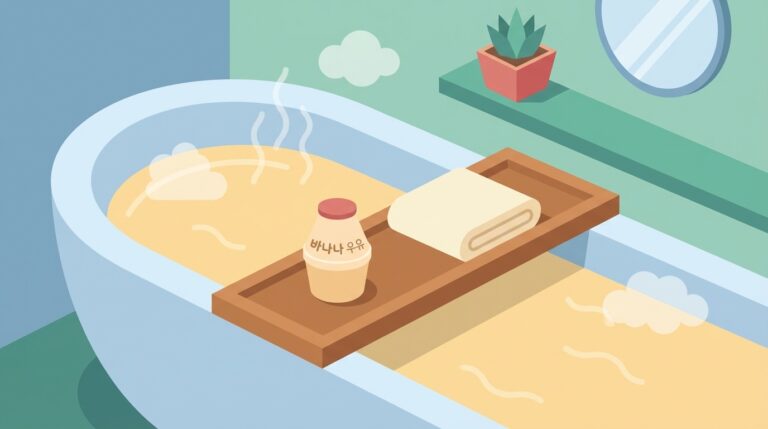
Have you ever noticed this recurring scene in K-Dramas? The protagonist, exhausted from navigating intense corporate politics or recovering from a dramatic breakup, goes home, fills the bathtub exactly halfway, and sighs deeply. They might have a glass of wine, a cold beer, or even a sheet mask on. The subtitles might simply read, “I’m taking a bath,” but my friends, it is so much more than that.
At a C1 level, you already know the word 목욕하다 (to take a bath). But if you tell a Korean friend you’re going home to “목욕하다,” they might picture you rigorously scrubbing yourself in a public bathhouse. What the K-Drama protagonist is actually doing is 반신욕 (Bansinyok)—a half-body bath that is less about hygiene and entirely about mental and physical healing.
Without understanding this specific vocabulary and the wellness culture behind it, you miss out on a massive piece of modern Korean self-care. This guide is crafted from real conversations with advanced learners who wanted to talk about their weekend downtime like true locals. Let’s dive in!
Phase 2: Core Expressions Deep Dive
1. 반신욕 하다 (To take a half-body bath)
- Pronunciation: [Bansinyok hada] + Sounds like ‘bahn-sheen-yoke’
- Meaning: (Literal) Half-body bath / (Real nuance) A therapeutic bath where water only reaches the belly button to promote circulation and relieve stress.
- K-Culture Moment: This is the ultimate “소확행” (Small but certain happiness) moment. It’s what K-Pop idols often mention in V-Live when fans ask, “How do you relax after a concert tour?”
- Editor’s Insight: We don’t just ‘take’ a Bansinyok; we do it as a wellness practice. It’s almost a sacred ritual for stressed-out modern Koreans.
- Situation Spectrum:
[🚫 Formal/Taboo] ———— [⚠️ Caution] ———— [✅ Free to use]
- Casual with friends: ✅
- Semi-formal (Co-workers): ✅ (Great Monday morning small talk!)
- Formal (Boss/Elders): ✅ (Perfectly fine, as it’s seen as a health practice)
- 🤔 Think About It: Why is immersing only half the body so important? It roots back to Eastern traditional medicine principles. Does your culture have a specific temperature-related wellness ritual?
2. 피로가 싹 풀리다 (Fatigue completely melts away)
- Pronunciation: [Piroga ssak pullida] + ‘Ssak’ sounds like a swift brush sweeping away dust.
- Meaning: (Literal) Fatigue is completely untangled / (Real nuance) My exhaustion just melted/washed away.
- K-Culture Moment: Imagine a K-Drama character stepping out of the tub, wrapping a towel around their neck, taking a sip of cold banana milk, and exhaling a long, satisfied “크으~” (Kkeu~). This phrase immediately follows.
- Editor’s Insight: You know the verb 풀다 (to untangle). Koreans view stress and fatigue as physical knots in the body. When you do Bansinyok, you aren’t just resting; you are actively untangling your fatigue. The adverb ‘싹’ (completely/without a trace) adds that native-speaker flavor.
- Situation Spectrum:
[🚫 Formal/Taboo] ———— [⚠️ Caution] ———— [✅ Free to use]
- Casual with friends: ✅
- Semi-formal (Co-workers): ✅
- Formal (Boss/Elders): ✅ (You can say “피로가 싹 풀렸습니다”)
- 🤔 Think About It: Koreans often use tactile verbs like ‘untangle’ (풀다) or ‘extract/sweat out’ (빼다) for invisible things like stress. How does your native language visualize stress relief?
3. 노곤해지다 (To feel pleasantly drowsy/relaxed)
- Pronunciation: [Nogonhaejida] + Sounds like a soft, sleepy sigh: no-gon…
- Meaning: (Literal) To become languid / (Real nuance) That heavy, warm, fuzzy feeling of relaxation right before you fall into a deep sleep after a warm bath.
- K-Culture Moment: You’re at a Jimjilbang (Korean sauna) or chilling at home after a hot bath. You sink into the sofa, your limbs feel like warm noodles. That is the exact feeling of ‘노곤하다’.
- Editor’s Insight: This is a fantastic C1 vocabulary word. It’s different from 피곤하다 (tired/exhausted in a bad way). 노곤하다 is the good kind of tired—the deep relaxation of muscles.
- Situation Spectrum:
[🚫 Formal/Taboo] ———— [⚠️ Caution] ———— [✅ Free to use]
- Casual with friends: ✅
- Semi-formal (Co-workers): ✅
- Formal (Boss/Elders): ⚠️ (A bit too personal/casual for highly formal settings)
- 🤔 Think About It: Why do we need a specific word to differentiate ‘exhausted from work’ and ‘exhausted from relaxation’?
Phase 3: Textbook vs Real Korean
| Situation | 📖 Textbook Korean | 🗣️ Real Korean | 💡 Why is it different? |
|---|---|---|---|
| Telling your plans | 주말에 목욕을 할 거예요. | 이번 주말엔 집에서 반신욕이나 하려고요. | ‘이나’ adds a laid-back nuance (“I’ll just do a half-bath or something”). |
| Expressing relief | 정말 편안합니다. | 와, 피로가 싹 풀리네요. | Real Korean relies heavily on idiomatic adverbs (싹) and sensory verbs (풀리다). |
| Describing the feeling | 목욕 후 졸려요. | 따뜻한 물에 들어가 있으니까 몸이 노곤해지네요. | At a C1 level, specifying why you are sleepy (warm water making muscles relax) shows fluency. |
Phase 4: Cultural Context — K-Culture Deep Dive
4-1. The Non-Verbal Rituals of Bansinyok
When doing Bansinyok, the unspoken rule is the Temperature Dichotomy. The water must be perfectly warm (around 38-40°C), but the air should ideally be a bit crisp, and what you consume must be ice cold. Never look someone straight in the eye and say you drank hot tea during a half-bath—you might get a strange look!
4-2. The K-Beauty & K-Food Connection
Bansinyok is essentially the home version of the beloved Jimjilbang (Korean Sauna) culture.
– K-Beauty: It is the prime time for skincare. The steam opens your pores, making it the perfect moment to apply a K-Beauty sheet mask (마스크팩) or use a luxurious bath bomb (입욕제).
– K-Food: What completes the Bansinyok experience? As soon as you step out, you must drink a Binggrae Banana Milk (바나나맛 우유) or an ice-cold beer. The shock of the cold, sweet liquid after sweating in warm water is what Koreans consider the true completion of the healing ritual.
Phase 5: Practical Roleplay Scenario
Setting: It’s Friday, 6:30 PM. You are wrapping up work at a café with your Korean friend/co-worker, Minji. It’s been an incredibly stressful week of overtime.
Characters:
– YOU: A foreign professional working in Seoul, desperate for relaxation.
– Minji (29): Your Korean friend, a K-Beauty enthusiast who loves home-care.
Minji: 아, 드디어 금요일이네요. 이번 주 진짜 스트레스 장난 아니었죠? 주말에 뭐 할 거예요? 😩
(A, deudieo geumyoirineyo. Ibeon ju jinjja seuteureseu jangnan anieotjyo? Jumare mwo hal geoyeyo?)
[Ah, it’s finally Friday. The stress this week was no joke, right? What are you doing this weekend?]
YOU: (Stretching) 전 이번 주말에 약속 다 취소했어요. 그냥 집에서 반신욕 하면서 피로 좀 싹 풀려고요.
(Jeon ibeon jumare yaksok da chwisohaesseoyo. Geunyang jibeseo bansinyok hamyeonseo piro jom ssak pullyeogoyo.)
[I canceled all my plans for this weekend. I’m just going to stay home, do a half-bath, and completely melt my fatigue away.]
Minji: 오, 반신욕! 완전 좋죠. 저도 어제 올리브영에서 입욕제 새로 샀거든요. (🎭 Stage Direction: Minji pulls out her phone to show you a picture)
(O, bansinyok! Wanjeon jotjyo. Jeodo eoje ollibeuyeong-eseo ibyokje saero satgeodeunyo.)
[Oh, a half-bath! That’s totally awesome. I actually just bought a new bath bomb from Olive Young yesterday.]
🔀 Your Turn! How should you respond?
– A) 올리브영이 뭡니까? (What is Olive Young?)
– B) 아 진짜요? 저도 추천 좀 해주세요! 땀 쫙 빼고 싶어요.
– C) 저는 샤워만 합니다.✅ Best Choice: B — “Oh really? Please recommend one to me! I want to sweat it all out.” By using the idiom “땀을 쫙 빼다” (sweat it completely out), you instantly sound like a C1 native speaker who deeply understands Korean wellness culture.
⚠️ Choice A & C Analysis: Choice A breaks the immersion (everyone in Korea knows Olive Young). Choice C is grammatically correct but culturally dry and kills the conversation.
Minji: 이거 진짜 좋아요. 라벤더 향인데, 물에 풀고 30분만 있으면 몸이 엄청 노곤해져서 꿀잠 예약이에요!
(Igeo jinjja joayo. Rabendeo hyang-inde, mure pulgo 30bunman isseumyeon momi eomcheong nogonhaejyeoseo kkuljam yeyagieyo!)
[This one is really good. It’s lavender-scented, and if you dissolve it in the water and stay in for just 30 minutes, your body gets so relaxed you are guaranteed a sweet sleep!]
Phase 6: 10-Second Shadowing Drill
Read this out loud, mimicking the rhythm and emotion!
😩 하아… / 이번 주는 / 너무 힘들어서 / (ha-a… / ibeon ju-neun / neomu himdeureoseo /)
🛀 따뜻한 물에 / 반신욕 하면서 / (ttatteutan mure / bansinyok hamyeonseo /)
😌 피로 좀 / 싹~ 풀려고요! (piro jom / ssak~ pullyeogoyo!)
(Emotion guide: Start with a heavy, exhausted sigh (😩), transition to anticipation (🛀), and end with a bright, relieved tone emphasizing ‘ssak’ (😌).)
Phase 7: K-Culture Mini Dictionary
| Korean | Romanization | English | Contextual Meaning |
|---|---|---|---|
| 수승화강 | su-seung-hwa-gang | Water up, Fire down | A traditional Korean medicine principle: keeping the head cool and the lower body warm for optimal health. This is the whole scientific basis behind Bansinyok! |
| 입욕제 | ib-yok-je | Bath bomb / Bath salt | Must-have items you’ll find at Olive Young. Great souvenirs! |
| 때밀이 | ttae-mil-i | Exfoliating towel / scrub | The abrasive green towels used in public bathhouses (not typically used during a relaxing Bansinyok at home). |
| 소확행 | so-hwak-haeng | Small but certain happiness | A popular lifestyle trend in Korea. A quiet home bath perfectly embodies this. |
Phase 8: Traveler’s Survival Kit
If you are traveling in Korea, you might want to buy bath supplies or ensure your hotel has a bathtub to recreate this K-Drama moment.
🆘 Survival Expressions
– 🇰🇷 “여기 혹시 욕조 있는 방으로 바꿀 수 있나요?” (Yeogi hoksi yokjo inneun bang-euro bakkul su innayo?)
– 🗣️ Meaning: Is it possible to change to a room with a bathtub?
– 📍 Where to use: Hotel Front Desk
- 🇰🇷 “반신욕 할 때 쓰는 입욕제는 어디 있어요?” (Bansinyok hal ttae sseuneun ibyokjeneun eodi isseoyo?)
- 🗣️ Meaning: Where are the bath bombs used for half-baths?
- 📍 Where to use: Olive Young, LUSH, or cosmetics stores.
📌 Editor’s Travel Note
Many modern business hotels in Seoul only have shower booths to save space. If you specifically want to do Bansinyok, always double-check for a “욕조” (Bathtub) when booking. If your room doesn’t have one, this is the perfect excuse to visit a luxury Jimjilbang (찜질방) instead!
Phase 9: Critical Thinking Corner — “One Step Deeper”
🧠 Think Deeper: The “Ppalli-ppalli” Culture vs. Extreme Relaxation
Why is Bansinyok such a celebrated ritual in modern Korea? Korea is famous for its “빨리빨리” (Hurry-hurry) culture. The work hours are long, the internet is lightning fast, and trends change overnight.
Because the daytime culture is extremely high-tension, the methods of relaxation must be equally extreme and intentional. Koreans don’t just “rest”; they “detox” (땀을 빼다) and “untangle” (풀다) their bodies. Bansinyok is a dedicated rebellion against the fast-paced society—a sacred 30 minutes where no one can rush you, forcing your body to slow down.💬 Your Turn: Does your culture have a “work hard, rest hard” dichotomy? How do people in your country intentionally slow down? Share in the comments!
Phase 10: FAQ & Avoiding Misunderstandings
Q: Can I use “목욕하다” (take a bath) instead of “반신욕 하다”?
Yes, but at a C1 level, nuance is everything. “목욕하다” focuses on the act of cleaning dirt off your body. “반신욕 하다” focuses on the act of wellness and stress relief. If you are having a deep conversation about mental health and self-care, “반신욕” is the correct term.
Q: Should I use honorifics when talking about this?
You can tell your boss, “주말에 반신욕을 했습니다” (I took a half-bath over the weekend). It’s viewed positively as you are taking care of your health to work better!
❌ Common Mistake: Confusing 반신욕 (Bansinyok) with 목욕탕 (Mogyoktang – Public bathhouse).
✅ Do this instead: If you are at home, you are using a 욕조 (Bathtub) to do 반신욕. Don’t tell your friends you have a 목욕탕 in your house unless you are a billionaire with a commercial bathhouse in your basement!
Phase 11: Summary & Action Items
One-Liner Summary: Swap the generic ‘목욕하다’ for ‘반신욕 하다’ and ‘피로가 싹 풀리다’ to express deep relaxation like a true native speaker.
Action Mission:
– 🥉 Bronze (Solo): Stand in front of a mirror and dramatically sigh while saying “피로가 싹 풀린다~” 3 times.
– 🥈 Silver (Online): Leave a comment in Korean below or on a language exchange app: “요즘 너무 피곤해서 오늘 밤엔 반신욕을 해야겠어요.”
– 🥇 Gold (Real Life): Visit a Korean cosmetics store (or Olive Young if you’re in Korea) and ask the staff: “반신욕 할 때 좋은 입욕제 추천해 주세요!” (Please recommend a good bath bomb for a half-bath!)
K-Culture Mission:
Tonight, fill up your tub halfway, play your favorite K-Drama OST, put on a face mask, and experience the ‘노곤해지는’ feeling for yourself!
Phase 12: Quiz — Interactive Challenge
1. Fill in the Blank (Situational):
You just stepped out of a warm half-bath, drank a cold banana milk, and you feel incredibly relaxed and ready for sleep. What is the most natural thing to say?
“아~ 물에 들어갔다 오니까 몸이 너무 ___________.”
(A) 피곤해지네요 (B) 노곤해지네요 (C) 심심해지네요
2. True or False – K-Culture Edition:
During a traditional Korean Bansinyok, you should fill the bathtub entirely to your neck to keep your upper body hot. (T / F)
3. Scenario Judgment:
Your boss asks you how you relieved your stress over the weekend. Which response shows advanced (C1) Korean proficiency?
(A) 목욕탕에서 샤워를 씻었습니다.
(B) 집에서 반신욕 하면서 피로를 싹 풀었습니다.
(C) 욕조에서 때밀이를 했습니다.
(Check your answers in the comments below!)
Frequently Asked Questions (FAQ)
Q: What does "반신욕 하다 (To take a half-body bath)" mean in Korean and how do you pronounce it?
A: In Korean, "반신욕 하다 (To take a half-body bath)" is pronounced [Bansinyok hada] and means: (Literal) Half-body bath / (Real nuance) A therapeutic bath where water only reaches the belly button to promote circulation and relieve stress.
Q: What does "피로가 싹 풀리다 (Fatigue completely melts away)" mean in Korean and how do you pronounce it?
A: In Korean, "피로가 싹 풀리다 (Fatigue completely melts away)" is pronounced [Piroga ssak pullida] and means: (Literal) Fatigue is completely untangled / (Real nuance) My exhaustion just melted/washed away.
Q: What does "노곤해지다 (To feel pleasantly drowsy/relaxed)" mean in Korean and how do you pronounce it?
A: In Korean, "노곤해지다 (To feel pleasantly drowsy/relaxed)" is pronounced [Nogonhaejida] and means: (Literal) To become languid / (Real nuance) That heavy, warm, fuzzy feeling of relaxation right before you fall into a deep sleep after a warm bath.