

Phase 1: Empathy (The “Neon Lights & Panic” Open)
Hello! I’m your Daily Hangul Editor.
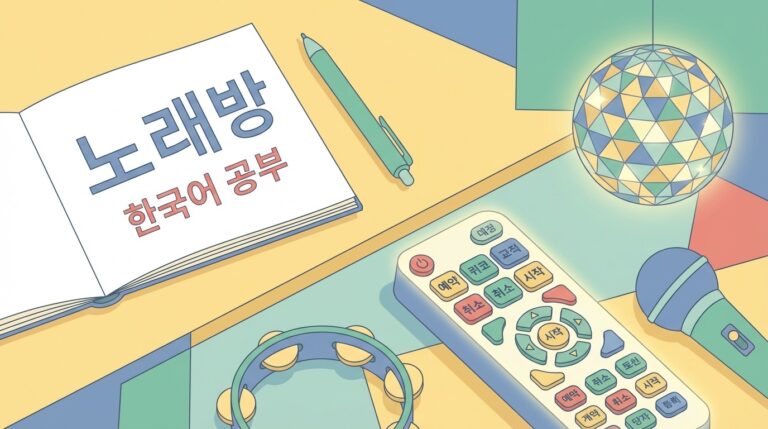
Picture this: It’s 10 PM in Hongdae. You’ve just finished a hearty meal of Korean BBQ with your friends, and someone yells, “노래방 가자!” (Let’s go to Noraebang!). Fast forward 10 minutes, and you are sitting in a dark room illuminated by a dizzying disco ball. The music is blasting, tambourines are shaking, and then… someone hands you a massive remote control that looks like a spaceship dashboard.
You want to sing your favorite K-Pop song, but all the buttons are in Korean. You panic. The time is ticking down, and you don’t want to waste a single minute. Sound familiar?
In K-Dramas, characters always seem to effortlessly punch in a 5-digit code while dramatically crying or chugging a beer. But in reality, navigating the Noraebang remote (리모컨) is a survival skill every K-Culture enthusiast needs. This guide is based on real SOS calls from my students who accidentally canceled their boss’s song instead of reserving their own. Let’s make sure you become the “Insider” (인싸) of your next Noraebang party!
Phase 2: Core Expressions Deep Dive
Here are the absolute must-know phrases when you are holding that intimidating remote.
1. “이거 예약해 줘.” (Reserve this for me.)
- Pronunciation: [igeo yeyakhae jwo] (Sounds like: ee-geo ye-yak-hae jwo)
- Meaning: Literal: Reserve this for me. / Real nuance: Put this song in the queue for me.
- K-Culture Moment: You finally found your song in the massive songbook or on your phone app. You toss the number to your friend who is controlling the remote like a DJ.
- Editor’s Insight: The word 예약 (reservation) is usually used for hotels or restaurants, but in a Noraebang, it simply means “add to queue.” If you press 시작 (Start) instead of 예약 (Reserve) while someone is singing, you will abruptly cut off their song. That’s a huge party foul!
- Situation Spectrum:
[🚫 Never] ———— [⚠️ Be Careful] ———— [✅ Freely]
- Close friends (Casual): ✅ (이거 예약해 줘)
- Coworkers (Semi-formal): ⚠️ (이거 예약해 주시겠어요?)
- Boss/Elders (Formal): 🚫 (Let them pick first!)
- 🤔 Think About It: Why does Korean use the formal-sounding word “예약” (reservation) for a casual queue in a karaoke room? Does your language have a specific word for “queueing a song”?
2. “가수 이름으로 찾아봐.” (Search by the singer’s name.)
- Pronunciation: [gasu ireumeuro chajabwa] (Sounds like: gah-soo ee-reum-eu-ro cha-ja-bwa)
- Meaning: Literal: Try finding it by the singer’s name. / Real nuance: Just search the artist.
- K-Culture Moment: Someone is desperately flipping through the heavy Noraebang book, looking for a specific K-Pop track. You, the savvy friend, suggest they use the remote’s search function instead.
- Editor’s Insight: The remote has a button called ‘검색’ (Search). You can toggle between 제목 (Title) and 가수 (Singer). Knowing this makes you look like a true Noraebang veteran.
- Situation Spectrum:
[🚫 Never] ———— [⚠️ Be Careful] ———— [✅ Freely]
- Close friends (Casual): ✅
- Coworkers (Semi-formal): ⚠️ (가수 이름으로 찾아볼까요?)
- Boss/Elders (Formal): 🚫
- 🤔 Think About It: Korean verbs often end with “~아/어 보다” (to try doing something). How does adding “try to” soften the command compared to just saying “Search the singer!”?
3. “간주 점프 눌러!” (Hit the ‘skip intro’ button!)
- Pronunciation: [ganju jeompeu nulleo] (Sounds like: gahn-joo jump-eu nool-leo)
- Meaning: Literal: Press interlude jump! / Real nuance: Skip the boring instrumental part!
- K-Culture Moment: The mood is high, the timer is running out. Your song starts, but there’s a 45-second instrumental intro. To save precious Noraebang time, someone yells this phrase.
- Editor’s Insight: Noraebang time is money! Koreans are famous for their “빨리빨리” (Hurry up) culture, and it absolutely applies here. The ‘간주 점프’ (Skip Interlude) button is your best friend to keep the energy high.
- Situation Spectrum:
[🚫 Never] ———— [⚠️ Be Careful] ———— [✅ Freely]
- Close friends (Casual): ✅
- Coworkers (Semi-formal): ✅ (Usually okay as it keeps the party moving)
- Boss/Elders (Formal): ⚠️ (Wait for them to ask for it)
- 🤔 Think About It: How does the “Skip Intro” feature reflect modern media consumption habits, and how does it tie into Korea’s fast-paced society?
Phase 3: Textbook vs Real Korean
| Situation | 📖 Textbook Korean | 🗣️ Real Korean | 💡 Why is it different? |
|---|---|---|---|
| Asking to queue a song | “이 노래를 예약해 주시겠어요?” (Could you reserve this song?) | “야, 이거 번호 좀 눌러줘.” (Hey, punch in these numbers for me.) | Noraebang is loud and fast-paced; efficiency and casual bonding take priority. |
| Asking to cancel | “취소 버튼을 눌러주세요.” (Please press the cancel button.) | “아, 취소 취소!” (Ah, cancel, cancel!) | Repetition conveys urgency when you accidentally click the wrong song. |
| Speeding up the song | “다음 부분으로 넘어가 주세요.” (Please skip to the next part.) | “1절만 하고 끄자.” (Let’s just do the 1st verse and cut it.) | “1절만” (first verse only) is a common strategy to sing more songs before time runs out. |
Phase 4: Cultural Context — K-Culture Deep Dive
4-1. Non-verbal Elements of the Remote
In a Korean Noraebang, holding the remote is a form of subtle power and responsibility. If you are the youngest (막내) at a company dinner (회식), it’s often your unspoken job (눈치 – Nunchi) to hold the remote, look up songs for your seniors, and ensure the music never stops. You must never let the screen go back to the default wallpaper!
4-2. K-Drama & K-Pop Connections
K-Drama Trope: Have you seen the classic scene where the protagonist is heartbroken, goes to a Noraebang alone (코인 노래방 – Coin Noraebang), and furiously types in the song number for “Tears” by So Chan-whee from memory? Knowing the 5-digit number of your favorite K-Pop anthem by heart is a massive flex in Korea.
The Reality Check: While dramas show people crying gracefully, real Noraebang sessions with friends involve jumping on the couches, screaming the lyrics, and fighting over the remote to use the “우선예약” (Priority Queue) button to hijack the playlist!
Phase 5: Real-life Roleplay Scenario
Setting: Friday, 11 PM. A neon-lit Noraebang in Gangnam. You are at an after-party (2차) with your Korean coworkers. The disco ball is spinning, and half a watermelon is on the table. You are holding the tambourine.
Characters:
– YOU: A foreign employee who just wants to sing a BTS song.
– Minsu: Your 32-year-old coworker. He’s the designated “mood maker” and currently holding the almighty remote control.
Dialogue:
Minsu: 자, 다음 누구야? (ja, daeum nuguya?)
[Translation] Alright, who’s next?
YOU: 저 부를게요! (jeo bureulgeyo!)
[Translation] I’ll sing!
Minsu: 오~ 좋아요! 무슨 노래? 번호 알아? (o~ joayo! museun norae? beonho ara?)
[Translation] Oh~ Nice! What song? Do you know the number?
YOU: 아니요, 번호는 몰라요. (aniyo, beonhoneun mollayo.)
[Translation] No, I don’t know the number.
Minsu: 그럼 내가 검색해 줄게. 제목이 뭐야? (geureom naega geomsaekhae julge. jemogi mwoya?)
[Translation] Then I’ll search it for you. What’s the title?
YOU: 다이너마이트요! (daineomaiteuyo!)
[Translation] Dynamite!
Minsu: 오케이, 찾았다. 예약 버튼 누를까? (okei, chajatda. yeyak beoteun nureulkka?)
[Translation] Okay, found it. Should I press the reserve button?
🔀 Your Turn! How should you respond?
– A) “네, 지금 바로 시작해 주세요!” (Yes, please start it right now!)
– B) “아니요, 부장님 먼저 하시죠.” (No, let the boss go first.)
– C) “네, 예약해 주세요!” (Yes, please reserve it!)✅ Best Choice: C or B.
Choice C is perfect if it’s casually your turn. Choice B shows high-level Nunchi (social awareness) if the boss hasn’t sung yet.
⚠️ Why A is dangerous: If someone else’s song is still playing or finishing up, pressing “시작” (Start) will cut their song off! Always use “예약” (Reserve) to put it in the queue.
Phase 6: 10-Second Shadowing Drill
Practice these lines with the right emotion and timing!
- 😊 아, / 이 노래 / 예약해 주세요! (ah, / i norae / yeyakhaejuseyo!)
Polite but excited request. - 😤 빨리 / 간주 점프 / 눌러! (ppal-li / ganju jeompeu / nulleo!)
Urgent, telling your friend to skip the boring intro. - 🥺 헐, / 실수로 / 취소 눌렀어… (heol, / silsuro / chwiso nulleosseo…)
Guilty, realizing you just canceled someone’s song.
Phase 7: K-Culture Mini Dictionary
| Korean | Romanization | English | Context |
|---|---|---|---|
| 노래방 | noraebang | Karaoke room | Lit: “Song room.” A staple of Korean nightlife and stress relief. |
| 리모컨 | rimokeon | Remote control | Konglish for “Remote Control.” The Noraebang remote is huge! |
| 예약 | yeyak | Reserve / Queue | Pressing this adds your song to the playlist without interrupting. |
| 취소 | chwiso | Cancel | The button you pray you never hit by accident. |
| 우선예약 | useonyeyak | Priority Queue | Puts your song at the very next spot. Use with caution! |
| 서비스 | seobiseu | Service (Free time) | The owner will often give “service” (extra time) if you are having fun. |
Phase 8: Traveler Survival Kit
Even if you’re not at a company dinner, you might visit a Coin Noraebang (코인 노래방) during your travels. Here is your survival kit!
🆘 Survival Phrases for Noraebang
– 🇰🇷 “한 시간 얼마예요?” (han sigan eolmayeyo?)
– 🗣️ English: How much for one hour?
– 📍 Where to use: At the front desk of a traditional Noraebang.
- 🇰🇷 “영어 지원 되나요?” (yeongeo jiwon doenayo?)
- 🗣️ English: Is English supported?
- 📍 Where to use: Asking if the remote or machine can switch languages.
📌 Editor’s Travel Note
– Coin Noraebang vs Traditional: Traditional ones charge by the hour (great for groups). “Coin” ones charge per song or per 30 mins (great for solo travelers or small groups).
– Finding Songs: You don’t need the heavy book! Download the ‘TJ 노래방’ or ‘KY 금영’ app on your phone to search for song numbers easily before you even touch the remote.
Phase 9: Critical Thinking Corner — “A Step Deeper”
🧠 Think Deeper: Language & Power in the Noraebang
In Korea, a Noraebang isn’t just a place to sing; it’s a microcosm of social hierarchy and bonding. The person holding the remote (리모컨) is usually the youngest or lowest-ranking person in the room. They use polite language (존댓말) to ask seniors what they want to sing, carefully curating the queue (예약) to ensure the boss sings their favorite trot song, while the younger staff play the tambourine. It shows how deeply embedded respect for age and rank is, even in a seemingly chaotic party environment. However, once the “Service” time hits and everyone is exhausted, those formal barriers often melt away into genuine camaraderie.
💬 Your Turn: Does your culture have a “karaoke” tradition? Is it a collective bonding activity or a solo performance? Share in the comments!
Phase 10: FAQ & Avoiding Mistakes
Q: Can I sing a slow ballad at a Noraebang?
Yes, BUT timing is everything (Nunchi!). If everyone is jumping around to energetic K-Pop, suddenly queuing a sad ballad might “kill the mood” (갑분싸 – a sudden drop in atmosphere). Save ballads for the end of the night!
Q: What if I don’t know any Korean songs?
The remote has a ‘Pop’ (팝송) button! You can search for English songs easily.
❌ Common Mistake #1: Hitting “시작” (Start) instead of “예약” (Reserve).
✅ How to fix it: If you do this, apologize profusely! Always double-check the button color. (Usually, Start is Red, Reserve is Green).
Phase 11: Summary & Action Items
One-Liner Summary: To survive a Korean Noraebang, never press “시작” (Start) when someone is singing—always use “예약” (Reserve) to queue your song!
Action Mission:
– 🥉 Bronze: Say “이거 예약해 줘” out loud 3 times while pretending to hold a remote.
– 🥈 Silver: Look up your favorite K-Pop song on a Korean Noraebang app (TJ or KY) and find its 5-digit number.
– 🥇 Gold: Next time you are in Korea or a Koreatown, go to a Coin Noraebang and successfully queue a song using only the Korean buttons!
K-Culture Mission: Watch a K-Drama this week. Try to spot a Noraebang scene and see who is holding the remote. Are they the youngest? Are they using the priority queue?
Phase 12: Quiz — Interactive Challenge
1. Situational Judgment: Your boss is currently singing. You want to sing BTS “Dynamite” next. Which button should you press on the remote?
– A) 시작 (Start)
– B) 취소 (Cancel)
– C) 예약 (Reserve)
2. Fill in the Blank: The song has a very long instrumental intro. Your friend yells, “____ 점프 눌러!”
– A) 시작 (Sijak)
– B) 간주 (Ganju)
– C) 노래 (Norae)
3. True or False (K-Culture Edition): In a traditional Noraebang, the machine will abruptly shut off the exact second your paid hour is over, with no exceptions.
– False! Owners often give “서비스” (Service/Extra time) if the room isn’t booked, sometimes adding 20-30 minutes for free!
(Answers: 1: C, 2: B, 3: False)
Frequently Asked Questions (FAQ)
Q: What does ""이거 예약해 줘." (Reserve this for me.)" mean in Korean and how do you pronounce it?
A: In Korean, ""이거 예약해 줘." (Reserve this for me.)" is pronounced [igeo yeyakhae jwo] and means: Literal: Reserve this for me. / Real nuance: Put this song in the queue for me.
Q: What does ""가수 이름으로 찾아봐." (Search by the singer's name.)" mean in Korean and how do you pronounce it?
A: In Korean, ""가수 이름으로 찾아봐." (Search by the singer's name.)" is pronounced [gasu ireumeuro chajabwa] and means: Literal: Try finding it by the singer's name. / Real nuance: Just search the artist.
Q: What does ""간주 점프 눌러!" (Hit the 'skip intro' button!)" mean in Korean and how do you pronounce it?
A: In Korean, ""간주 점프 눌러!" (Hit the 'skip intro' button!)" is pronounced [ganju jeompeu nulleo] and means: Literal: Press interlude jump! / Real nuance: Skip the boring instrumental part!







