

Hello! I am the Lead Editor at Daily Hangul, your premium tutoring brand.
Imagine this: You finally ordered that highly anticipated K-Pop album, or maybe a huge box of Korean snacks from Coupang. Your phone buzzes. It’s a text message from a strange number entirely in Korean. It’s the Taekbae (delivery) driver! Panic sets in. Where is your package? Is it lost?
I’ve been living in Seoul for over 10 years, and let me tell you—navigating the Korean apartment delivery system is a rite of passage. Korea is the absolute superpower of speedy deliveries. But knowing how to use the 무인 택배함 (Muin Taekbae-ham, Unmanned Parcel Locker) or simply telling the driver where to leave your box will save you from a lot of stress.
Don’t worry, my beginner friends (A1 level). You don’t need complex grammar to survive this. Let’s learn exactly what you need to say to get your precious packages safely! 📦✨
Phase 2: Core Expressions Deep Dive
Here are the 3 golden phrases you need when dealing with Korean deliveries.
1. 문 앞에 두고 가세요. (Leave it in front of the door.)
- Pronunciation: [Mun ape dugo gaseyo.]
(Sound guide: ‘Mun’ sounds like ‘Moon’. ‘Ape’ sounds like ‘Ah-peh’. So, “Moon ah-peh”!) - Meaning: Literal = Put it in front of the door and go. / Real nuance = Please leave it at my door.
- K-Culture Moment: You’ve probably seen K-Dramas where characters open their front door and stumble over a mountain of delivery boxes. This is the phrase that makes that happen!
- Editor’s Insight: This is the most common delivery instruction in Korea. Because Korea is a very high-trust society (we leave our laptops on cafe tables, right?), 99% of people just ask for packages to be left right at their apartment door.
- Situation Spectrum:
[🚫 Never] ———— [⚠️ Be Careful] ———— [✅ Freely]- To friends (Casual): 🚫 (We don’t talk like this to friends)
- To Delivery Drivers via App/Text (Semi-formal): ✅
- To your Boss (Formal): 🚫
- 🤔 Think About It: Does your home country have “porch pirates” (people who steal packages)? Why do you think Koreans feel so safe leaving expensive things in the hallway?
2. 무인 택배함에 넣어 주세요. (Please put it in the unmanned parcel locker.)
- Pronunciation: [Muin taekbae-hame neo-eo-juseyo.]
(Sound guide: ‘Moo-in’ sounds like a cow saying ‘Moo’ + ‘in’. ‘Taekbae’ sounds like ‘Tech-bae’—think of your technology babe bringing you gifts!) - Meaning: Literal = Please put it in the unmanned delivery box. / Real nuance = Please leave it in the parcel locker.
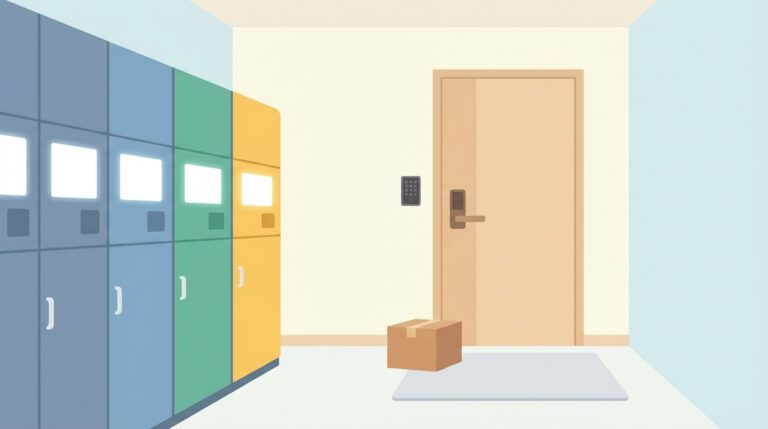
- K-Culture Moment: Many modern Korean apartments have a wall of digital lockers on the ground floor. It looks like a high-tech spaceship dashboard. You use this when you don’t want boxes at your door or if it’s a very expensive item.
- Editor’s Insight: “Muin” (무인) means “unmanned” or “no people.” You will see this word everywhere in Korea now—Muin ice cream shops, Muin cafes, Muin photo booths!
- Situation Spectrum:
[🚫 Never] ———— [⚠️ Be Careful] ———— [✅ Freely]- To Delivery Drivers/Security Guards (Semi-formal): ✅
- 🤔 Think About It: Why is the “Muin” (unmanned) culture growing so fast in Korea? Is it just for convenience, or does it reflect a society that values speed and avoiding unnecessary small talk?
3. 비밀번호는 1234 별표입니다. (The password is 1234 star.)
- Pronunciation: [Bimil-beonhoneun il-i-sam-sa byeolpyo-imnida.]
(Sound guide: ‘Bimil’ sounds like ‘Bee-meal’. ‘Byeol’ sounds like saying ‘by-all’ very fast.) - Meaning: Literal = The secret number is 1234 star symbol. / Real nuance = The door passcode is 1234*.
- K-Culture Moment: In K-Dramas, you always hear that iconic beep-beep-beep-beep-tara-ring! sound when someone opens a door. Almost all Korean apartments use digital keypads.
- Editor’s Insight: The most crucial part here is the 별표 (Star symbol, *). If you don’t press the star or pound (#) key at the end, the door won’t open! Always include it in your text to the driver.
- Situation Spectrum:
[🚫 Never] ———— [⚠️ Be Careful] ———— [✅ Freely]- To Delivery Drivers for the common entrance (Semi-formal): ✅
- Giving your personal house password to strangers: 🚫 (Only give the common ground-floor entrance password!)
Phase 3: Textbook vs. Real Korean
When texting a busy delivery driver, Koreans drop the formal grammar and use super short survival phrases.
| Situation | 📖 Textbook Korean | 🗣️ Real Korean Text | 💡 Why the difference? |
|---|---|---|---|
| Choosing delivery spot | 현관문 앞에 두고 가세요. (Please leave it at the front door.) | 문 앞이요. (Door front, please.) | Drivers are in a rush. Short noun + 이요/요 is polite but fast! |
| Requesting locker | 무인 택배함에 넣어 주세요. (Please put it in the locker.) | 택배함 1번요. (Locker #1, please.) | Efficiency is key in Bali-bali (hurry-hurry) culture. |
| Password | 비밀번호는 1234입니다. (The password is 1234.) | **공동현관 1234*** (Common entrance 1234*) | They just need the numbers to get in the building fast. |
(Bottom Note for A1: You don’t need to write long, perfect sentences. Just using nouns + “yo” (요) is perfectly fine and polite enough!)
Phase 4: Cultural Context — K-Culture Deep Dive
4-1. Non-verbal Communication: The Art of the “App Note”
In Korea, you rarely actually speak to the delivery driver. Everything is handled through the delivery app (like Coupang, Baemin, or Yogiyo). There is always a text box that says 배송 요청사항 (Delivery Requests). You just select “문 앞” (Front door) from the drop-down menu. Korean introverts love this—no phone calls required!
4-2. The “Dawn Delivery” (새벽배송) Magic
If you live in a Korean apartment, you must experience K-Food Dawn Delivery. Apps like Market Kurly or Coupang Fresh allow you to order groceries at 11:00 PM, and by 7:00 AM the next day, fresh milk, strawberries, and meal kits are sitting perfectly insulated in front of your door. It feels like Christmas morning every day. But remember, for them to deliver at 4 AM, they absolutely need your ground-floor password!
Phase 5: Real-Life Roleplay Scenario
Setting: It’s 2:00 PM on a Tuesday. You are sitting in your Korean language class. Your phone vibrates. It’s a call from an unknown number. You step out to answer it. It’s the Coupang delivery driver (Gisanim)!
Characters:
– YOU: An excited exchange student waiting for your new K-Beauty skincare set.
– Gisanim (Driver): A fast-talking, busy delivery driver who is currently standing in front of your apartment building.
Dialogue:
Gisanim: 여보세요, 택배입니다. 집에 계신가요? 📦
(Yeoboseyo, taekbae-imnida. Jibe gyesingayo?)
[Hello, it’s delivery. Are you at home?]
YOU: 아, 아니요. 지금 학교에 있어요.
(Ah, aniyo. Jigeum hakgyoe isseoyo.)
[Ah, no. I am at school right now.]
Gisanim: 아 네, 그럼 물건 어디에 둘까요?
(Ah ne, geureom mulgeon eodie dulkkayo?)
[Ah okay, then where should I leave the item?]
🔀 Your Turn! How should you answer?
– A) “내일 다시 오세요!” (Please come back tomorrow!)
– B) “문 앞에 놔주세요.” (Please leave it at the door.)
– C) “제가 지금 갈게요!” (I will go there right now!)✅ Best Choice: B — Reason: In Korea, drivers have hundreds of packages to deliver. Asking them to come back tomorrow (A) messes up their route, and waiting for you (C) wastes their time. Leaving it at the door is 100% safe and the standard response!
Gisanim: 공동현관 비밀번호가 어떻게 되죠?
(Gongdong-hyeongwan bimil-beonhoga eotteoke doejo?)
[What is the password for the common entrance?]
YOU: 1234 별표입니다. 감사합니다!
(Il-i-sam-sa byeolpyo-imnida. Gamsahamnida!)
[It’s 1234 star. Thank you!]
Phase 6: 10-Second Shadowing Drill
Let’s practice speaking! Read out loud and follow the pauses (/) and emotions.
- 😊 Bright & Polite:
문 앞에 / 두고 / 가세요!
(mun ape / dugo / gaseyo!) -
😌 Clear & Informative:
비밀번호는 / 일 이 삼 사 / 별표입니다.
(bimil-beonhoneun / il i sam sa / byeolpyo-imnida.) -
🥺 Grateful (When texting):
기사님, / 감사합니다!
(gisanim, / gamsahamnida!)
Phase 7: K-Culture Mini Dictionary
| Korean | Romanization | English | Context |
|---|---|---|---|
| 택배 | taekbae | Parcel / Delivery | The lifeblood of modern Korean society. |
| 기사님 | gisanim | Driver / Engineer | A polite title to call delivery drivers or taxi drivers. NEVER call them “Ajusshi” (middle-aged man)! |
| 무인 | muin | Unmanned | Found on parcel lockers, cafes, and 24hr shops. |
| 공동현관 | gongdong-hyeongwan | Common Entrance | The main glass door at the ground floor of a Korean apartment building. |
| 빨리빨리 | ppalli-ppalli | Hurry-hurry | The Korean cultural mindset of doing things fast, which makes next-day delivery possible. |
Phase 8: Traveler’s Survival Kit
Even if you are just staying in an Airbnb or a hotel, you might order food delivery (Baemin) or buy things online.
🆘 Survival Phrases for Deliveries
– 🇰🇷 “1층에 두고 가세요.” (il-cheung-e dugo gaseyo.)
– 🗣️ Meaning: Please leave it on the 1st floor (lobby).
– 📍 Where to use: Hotels or Airbnbs where drivers can’t go upstairs.
– 💡 Pro Tip: If you don’t know Korean numbers yet, just text “1 F 요” in the delivery app. They will understand!
📌 Editor’s Travel Note
– Helpful Apps: Download Papago for translating texts from drivers. If you order food via Yogiyo or Baemin, you can pay with an international card on the app, so you never have to exchange cash with the driver!
– Tipping Culture: There is absolutely ZERO tipping for delivery drivers in Korea. Do not try to give them cash; it will just confuse them!
Phase 9: Critical Thinking — “One Step Deeper”
🧠 Think Deeper: High-Trust Society vs. CCTV Power
Why is it that a Korean delivery driver can leave a brand-new $2,000 laptop sitting outside your apartment door for 10 hours, and no one will steal it? Part of it is the Korean cultural emphasis on collective morality—stealing is highly shameful. But let’s be realistic: Korea is also the land of CCTVs. Every hallway, elevator, and street corner is monitored. If someone steals your taekbae, the police will find them in less than 24 hours using camera footage! It’s a fascinating mix of high social trust backed by high-tech surveillance.
💬 Your Turn: Does your culture trust leaving packages outside? What happens to deliveries if you aren’t home? Share in the comments!
Phase 10: FAQ & Avoiding Misunderstandings
- Q: Can I just reply in English to the driver?
A: Most drivers are older and might not read English well. It’s much better to copy/paste a simple Korean phrase like “문 앞에 놔주세요” (Leave it at the door) to save everyone time! -
Q: What do I call the delivery driver if I see them in the hallway?
A: Always say “기사님” (Gisa-nim).
❌ Common Mistake #1: Calling the driver “아저씨” (Ajusshi).
✅ Do this instead: While “Ajusshi” means middle-aged man, it can sound slightly rude or too casual in a professional setting. Always use “Gisa-nim” (Respected driver/engineer) to show appreciation for their hard work!
Phase 11: Summary & Action Items
🎯 One-Liner Summary: When receiving a package in Korea, just remember “Mun ape” (Front door) or “Muin Taekbae-ham” (Parcel Locker)!
🚀 Action Missions:
– 🥉 Bronze (Solo): Look at your front door and say “문 앞이요” (Mun ap-i-yo) 3 times out loud.
– 🥈 Silver (Online): Find the Korean address format for your dream apartment in Seoul on Google Maps.
– 🥇 Gold (Real Life): Next time you order food or a package in Korea, successfully type the Korean instruction in the app’s request box!
🎬 K-Culture Mission:
Watch an episode of any modern K-Drama (like Crash Landing on You or Hospital Playlist). Pay attention to the background when they are in the apartment hallway. I guarantee you will see at least three brown Taekbae boxes sitting casually in front of someone’s door!
Phase 12: Quiz — Interactive Challenge
Let’s test your Nunchi (Korean situational awareness)!
1. Situational Judgment: The food delivery app asks for your instruction. You are in your pajamas and don’t want to see anyone. What do you type?
– A) 기사님 안녕하세요! (Hello driver!)
– B) 문 앞에 두고 가세요. (Leave it at the door.)
– C) 아저씨 빨리빨리! (Ajusshi hurry hurry!)
2. True or False – K-Culture Edition:
“It is polite to hand the delivery driver a 2,000 KRW tip when they hand you your package.”
– (T / F)
3. Fill in the Blank:
My ground floor password is 2024. I must text the driver: “비밀번호는 2024 ____ 입니다.”
– A) 달표 (Moon)
– B) 별표 (Star / *)
– C) 우주 (Space)
(Answers: 1. B – Polite and clear! C is very rude. / 2. False – Korea has no tipping culture! / 3. B – Always remember the star key!)
Frequently Asked Questions (FAQ)
Q: What does "문 앞에 두고 가세요. (Leave it in front of the door.)" mean in Korean and how do you pronounce it?
A: In Korean, "문 앞에 두고 가세요. (Leave it in front of the door.)" is pronounced [Mun ape dugo gaseyo.] and means: Literal = Put it in front of the door and go. / Real nuance = Please leave it at my door.
Q: What does "무인 택배함에 넣어 주세요. (Please put it in the unmanned parcel locker.)" mean in Korean and how do you pronounce it?
A: In Korean, "무인 택배함에 넣어 주세요. (Please put it in the unmanned parcel locker.)" is pronounced [Muin taekbae-hame neo-eo-juseyo.] and means: Literal = Please put it in the unmanned delivery box. / Real nuance = Please leave it in the parcel locker.
Q: What does "비밀번호는 1234 별표입니다. (The password is 1234 star.)" mean in Korean and how do you pronounce it?
A: In Korean, "비밀번호는 1234 별표입니다. (The password is 1234 star.)" is pronounced [Bimil-beonhoneun il-i-sam-sa byeolpyo-imnida.] and means: Literal = The secret number is 1234 star symbol. / Real nuance = The door passcode is 1234*.







