

Phase 1: Empathy (Immersive Opening)
Hello! It’s your Daily Hangul Editor.
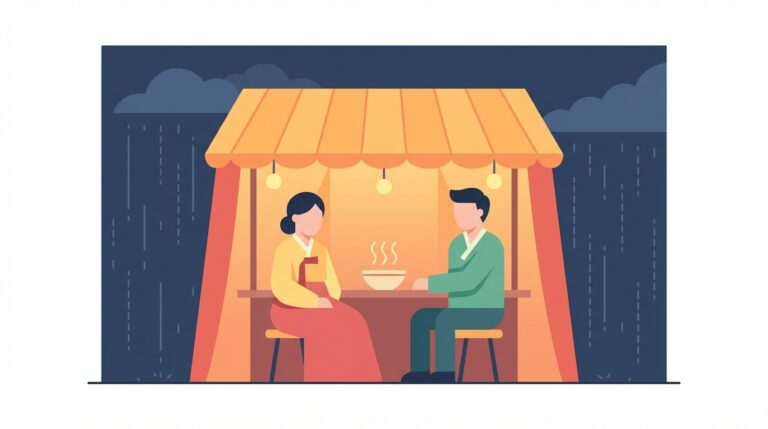
Imagine a scene from a K-Drama like My Mister (나의 아저씨) or Itaewon Class. The protagonist has just hit rock bottom. They’ve lost their job, their dream, or maybe their heart is broken. They are sitting in a dimly lit Pojangmacha (포장마차, street food tent), the sound of rain hitting the tarpaulin roof. Their mentor sits across from them, pours a shot of Soju, and says a single, heavy phrase. The subtitles simply read: “Cheer up” or “It’s okay.”
But as an advanced learner, you know that “Cheer up” doesn’t even begin to cover the emotional weight of that moment.
When dealing with trauma, psychological hardship, and the journey to resilience, textbook Korean often falls short. Telling someone deeply depressed to simply “힘내세요” (Cheer up) can actually feel like toxic positivity. In Korean culture, true resilience isn’t just about smiling through the pain; it’s about acknowledging the shared suffering and enduring it together. Today, we are diving deep into the raw, authentic phrases Koreans use to navigate trauma, offer genuine comfort, and build resilience.
(Note: This guide is crafted from real counseling contexts, late-night heart-to-hearts among Korean adults, and advanced learners’ desire to move beyond surface-level empathy.)
Phase 2: In-Depth Analysis of Core Expressions
1. 훌훌 털어버리다
- Pronunciation: [hul-hul teo-reo-beo-ri-da] + [hul-hul sounds like the gentle whoosh of blowing dust off an old book]
- Meaning: (Literal) To briskly brush off / (Real nuance) To let go of lingering pain or trauma and move on.
- K-Culture Moment: You’ll hear this often in K-Pop lyrics about breakups or K-Dramas when a character finally throws away items from a toxic relationship. It’s the verbal equivalent of a deep exhale.
- Editor’s Insight: This phrase uses the mimetic word (의태어) ‘훌훌’ which mimics the action of shaking something off lightly. It’s perfect for resilience because it implies that the trauma was just dust on your jacket—it doesn’t define you, and you can brush it off.
- Situation Spectrum:
[🚫 절대 금지] ———— [⚠️ 주의] ———— [✅ 자유롭게]
- Casual (Friends): ✅ “야, 훌훌 털어버려!” (Hey, just brush it off!)
- Semi-formal (Colleagues): ✅ “이번 실수는 훌훌 털어버리세요.”
- Formal (Boss/Elders): ⚠️ Use with caution. Telling an elder to “brush it off” can sound slightly condescending unless you are very close.
- 🤔 Think About It: Why does Korean rely so heavily on mimetic words (like 훌훌) to describe psychological states? Does visualizing an emotion as a physical action make it easier to process?
2. 마음을 추스르다
- Pronunciation: [ma-eu-meul chu-seu-reu-da] + [chu-seu-reu-da sounds soft, like pulling a warm blanket tightly around your shoulders]
- Meaning: (Literal) To gather one’s mind / (Real nuance) To pull oneself together, to heal emotionally after a shock or trauma.
- K-Culture Moment: This is the phrase used in official statements when a celebrity halts activities due to mental health issues or grief: “마음을 추스를 시간이 필요합니다” (They need time to heal emotionally).
- Editor’s Insight: ‘추스르다’ originally means to lift up and adjust things that are falling apart (like pulling up slipping pants or gathering scattered papers). Psychologically, it beautifully captures the act of picking up your shattered feelings and slowly putting yourself back together.
- Situation Spectrum:
[🚫 절대 금지] ———— [⚠️ 주의] ———— [✅ 자유롭게]
- Casual (Friends): ✅ “천천히 마음 추슬러.”
- Semi-formal (Colleagues): ✅ “주말 동안 마음 잘 추스르시길 바랍니다.”
- Formal (Boss/Elders): ✅ Perfect for formal condolences.
- 🤔 Think About It: Notice how Korean treats ‘the mind’ (마음) as a physical object that can be scattered and gathered. How does your native language conceptualize emotional recovery?
3. 버티는 거야 (존버)
- Pronunciation: [beo-ti-neun geo-ya] / [jon-beo]
- Meaning: (Literal) It’s about enduring / (Real nuance) Resilience is simply surviving the storm; hold on for dear life.
- K-Culture Moment: In the masterpiece drama Misaeng (미생), the ultimate lesson of corporate survival and life is summed up as “버텨라” (Endure). In modern slang, younger Koreans use “존버” (존나 버티기 – holding on fiercely) for everything from crypto crashes to mental breakdowns at work.
- Editor’s Insight: Western resilience often focuses on ‘bouncing back’ (like a spring). Korean resilience historically focuses on ‘endurance’ (like a deep-rooted tree weathering a typhoon).
- Situation Spectrum:
[🚫 절대 금지] ———— [⚠️ 주의] ———— [✅ 자유롭게]
- Casual (Friends): ✅ “우리 그냥 존버하자.”
- Semi-formal (Colleagues): ⚠️ ‘버티다’ is fine, but NEVER use ‘존버’ in professional settings.
- Formal (Boss/Elders): 🚫
- 🤔 Think About It: Is endurance always a virtue? How has the culture of “just enduring” both built Korea’s rapid growth and contributed to its modern mental health crisis?
Phase 3: Textbook vs. Real Korean
| Situation | 📖 Textbook Korean | 🗣️ Real Korean | 💡 Why the difference? |
|---|---|---|---|
| Comforting a friend who failed an exam | 슬퍼하지 마세요. 다음에 잘할 거예요. (Don’t be sad. You’ll do well next time.) | 야, 고생했어. 맛있는 거나 먹으러 가자. (Hey, you worked hard. Let’s go eat something good.) | Koreans often bypass direct emotional talk and use food (sharing a meal) as the ultimate medium of empathy. |
| Cheering someone who is burnt out | 힘내세요! (Cheer up!) | 무리하지 마. 쉬엄쉬엄 해. (Don’t overdo it. Take it easy.) | “힘내” implies they aren’t trying hard enough. Acknowledging their limits is true empathy. |
| Advising someone to let go of trauma | 과거는 잊으세요. (Forget the past.) | 그냥 훌훌 털어버려. 다 지나갈 거야. (Just brush it off. This too shall pass.) | Metaphorical, indirect language softens the blow and feels more poetic and less commanding. |
Bottom Note: As a C1 learner, drop “힘내세요” when someone is truly traumatized. Validating their pain with “고생 많았어” (You’ve been through a lot) is the mark of a highly fluent, emotionally intelligent speaker.
Phase 4: Cultural Context — K-Culture Deep Dive
4-1. Non-Verbal Elements: The Art of Silent Nunchi
When someone is dealing with trauma, Koreans often practice an advanced form of Nunchi (눈치). Instead of asking invasive questions like “What exactly happened?” or “How does that make you feel?”, a true Korean friend will simply show up. They might pour you a drink using two hands, tap their own glass against yours lower than yours (a sign of respect and care), and wait in silence until you are ready to speak. The silence is the conversation.
4-2. Food as Emotional Medicine
Why do Koreans always ask “밥은 먹었어?” (Did you eat?) even in the middle of a crisis? In Korea, warm food is the antithesis of trauma. A steaming bowl of Gukbap (국밥, hot soup with rice) isn’t just a meal; it’s a soul-restoring ritual. By ensuring you are fed, they are anchoring you back to the physical world. If a Korean friend orders spicy food (like Tteokbokki or Buldak) when you are stressed, it’s a deliberate psychological tactic: the physical heat triggers endorphins, creating a momentary, cathartic release from mental pain.
Phase 5: Real-Life Roleplay Scenario
Setting: Friday night, 9 PM. A quiet, slightly worn-down barbecue restaurant in Euljiro. The sound of meat sizzling. You are sitting with Min-su (32, your close Korean colleague). Min-su just found out he was passed over for a promotion he desperately needed after working 80-hour weeks for a year. He looks completely defeated, staring blankly at his empty Soju glass.
Dialogue:
Min-su: 하아… 내가 그동안 뭘 위해 이렇게 달렸나 싶다. 멍청하지, 진짜.
(Haa… naega geudongan mwol wihae ireoke dallieonna sipda. Meongcheonghaji, jinjja.)
[Sigh… I don’t even know what I’ve been running toward all this time. I’m so stupid, really.]
(🎭 Stage Direction: Min-su lets out a deep sigh and pours himself a shot of Soju without waiting for you to pour it—a sign of deep distress in Korean drinking culture)
YOU: (Takes the bottle from his hand gently) 선배님, 제가 따를게요.
(Seonbaenim, jega ttareulgeyo.)
[Senior, let me pour that for you.]
Min-su: 고맙다. 다 포기하고 싶네. 내 멘탈이 이렇게 약했나…
(Gomapda. Da pogihago simne. Nae mentari ireoke yakaenna…)
[Thanks. I just want to give up on everything. Was my mental strength always this weak?]
🔀 Your Turn! How do you respond?
– A) 선배님, 힘내세요! 긍정적으로 생각하면 좋은 일이 있을 거예요. (Senior, cheer up! If you think positively, good things will happen.)
– B) 멘탈이 약한 게 아니라, 너무 오래 버티셔서 그런 거예요. 오늘 진짜 고생 많으셨습니다.
– C) 에이, 그냥 훌훌 털어버리세요! 원래 회사가 다 그런 거죠.✅ Best Choice: B — “It’s not that your mental strength is weak; it’s because you’ve endured for too long. You truly worked hard today.” This validates his pain, uses the concept of ‘버티다’ (enduring), and shows deep emotional intelligence.
⚠️ Choice A Analysis: Pure toxic positivity. Telling someone who is traumatized to “think positively” will make them shut down.
⚠️ Choice C Analysis: Too dismissive for the gravity of the situation. “훌훌 털어버리다” is good, but it’s too early for him to brush it off. He needs validation first.
(If you chose B…)
Min-su: (Eyes tearing up slightly) …고맙다. 진짜. 오늘까지만 좀 무너질게.
(…Gomapda. Jinjja. Oneulkkajiman jom muneojilge.)
[…Thank you. Really. I’m just going to let myself fall apart for today.]
Phase 6: 10-Second Shadowing Drill
Master the intonation of a highly empathetic Korean speaker.
🥺 선배님은 / 그동안 / 충분히 / 잘 버티셨어요. (seonbaenimeun / geudongan / chungbunhi / jal beotisyeosseoyo.)
😊 오늘은 / 다 잊고 / 푹 쉬세요. (oneureun / da itgo / puk swiseyo.)
Guide: Pause slightly at the slashes. Emphasize ‘충분히’ (enough) with a warm, reassuring tone.
Phase 7: K-Culture Mini Dictionary (Psychology & Resilience)
| 한국어 | Romanization | English | Contextual Explanation |
|---|---|---|---|
| 위로 | wiro | Consolation / Comfort | The act of comforting someone. In Korea, wiro is often an action (a meal, a drink) rather than just words. |
| 멘붕 | menbung | Mental breakdown | Slang (멘탈 붕괴). Used heavily when someone’s resilience cracks under sudden stress or shock. |
| 한 | han | Deep, unresolved sorrow | A unique Korean cultural concept of collective and individual trauma, sorrow, and resilience intertwined. |
| 번아웃 | beon-aut | Burnout | The English loanword is now the standard medical and social term for complete emotional exhaustion in Korea. |
| 토닥토닥 | todak-todak | Pat-pat (mimetic) | The sound of gently patting someone’s back. Often sent as text messages to comfort a friend. |
Phase 8: Traveler’s Survival Kit (When Travel Trauma Hits!)
Even in a psychology module, we must talk about travel! What happens when you face a sudden crisis in Korea—like losing your passport or missing the last train? You need resilience and these survival phrases.
🆘 Survival Phrase #1: Expressing your distress to get sympathy
– 🇰🇷 “제가 지금 지갑을 잃어버려서 완전 멘붕이에요…”
– 🗣️ (jega jigeum jigabeul ireobeoryeoseo wanjeon menbungieyo…)
– 📍 Use when: Seeking help from police, hotel staff, or locals.
– 💡 Pro Tip: Using “멘붕” (Mental breakdown) shows you speak real Korean, which often makes locals even more eager to help you out of sympathy!🆘 Survival Phrase #2: Calming down and seeking a solution
– 🇰🇷 “일단 마음을 추스르고 다시 찾아볼게요.”
– 🗣️ (ildan maeumeul chuseureugo dasi chajabolgeyo.)
– 📍 Use when: You are trying to calm yourself down in front of others who are worried about you.
📌 Editor’s Travel Note
– If you lose something in Korea, your resilience doesn’t have to be tested too hard! Korea has an incredibly high rate of returning lost items.
– Useful Portal: Visit the ‘LOST112’ (Police Lost and Found) website.
– Local comfort: If you cry in a local market because you lost your bag, a grandmother (할머니) might literally feed you while you wait for the police. That’s Jeong (정).
Phase 9: Critical Thinking — “One Step Deeper”
Mental Health: Media vs. Reality in Modern Korea
🧠 Think Deeper:
If you watch older K-Dramas, trauma is almost always cured by a dramatic monologue, a fight, or drinking Soju until passing out. Seeking therapy was heavily stigmatized, viewed as a permanent “scar” on your record. However, the Korea of 2024 is undergoing a massive psychological revolution. The younger generation (MZ) openly discusses “심리상담” (psychological counseling), “우울증” (depression), and “회복 탄력성” (resilience). TV shows feature famous psychiatrists analyzing celebrities’ traumas. The language is shifting from the tough, unyielding “무조건 버텨” (Just endure it unconditionally) to “네 마음부터 챙겨” (Take care of your mind first). The Korean language is actively expanding to include softer, more validating vocabulary to replace the harsh endurance-focused words of the past.💬 Your Turn: How is mental health and trauma portrayed in the media of your culture? Are people shifting toward more empathetic language like in Korea? Share in the comments!
Phase 10: FAQ & Avoiding Common Mistakes
Q: Can I use “고생했어” (You worked hard) to comfort my boss?
No! It sounds like you are evaluating their performance. To comfort a superior, use “상심이 크시겠습니다” (You must be feeling a great loss/sorrow) or simply pour them a drink and listen.
Q: Is it okay to hug a Korean friend who is crying?
Physical touch can be tricky. While the younger generation is more open to hugging, traditional Korean comfort is less physical. A light pat on the back/shoulder (토닥토닥) is safer than a full bear hug, unless you are very close.
❌ Common Mistake #1: Saying “다 괜찮아질 거야” (Everything will be fine) too quickly.
✅ Do this instead: Validate first. Say “진짜 힘들었겠다” (That must have been really hard). In Korean psychology, validation (Gonggam, 공감) must precede optimism.
Phase 11: Summary & Action Items
One-Liner Summary: True Korean comfort moves beyond “Cheer up” to sharing the weight of endurance and offering validation through phrases like “고생 많았어” and silent Nunchi.
Action Mission:
– 🥉 Bronze (Solo): Stand in front of a mirror and practice saying “충분히 잘 버티셨어요” with the warmest eyes you can make.
– 🥈 Silver (Online): Find a K-Pop idol’s Weverse or YouTube video where they talk about their struggles, and leave a comment: “마음 잘 추스르고 푹 쉬세요!” (Heal your heart and rest well!).
– 🥇 Gold (Real World): Notice a Korean friend or language partner who looks stressed. Don’t say “Cheer up.” Say “요즘 고생 많죠?” and offer them a small snack or coffee.
K-Culture Mission: Watch an episode of a healing K-Drama (like My Liberation Notes or Daily Dose of Sunshine). Notice how the characters comfort each other. Is it with words, silence, or food?
Phase 12: Interactive Challenge Quiz
1. Situational Judgment: Your friend failed their job interview for the 5th time. They are crying. What is the most culturally appropriate initial response?
– A) “왜 떨어졌어? 다음엔 더 열심히 해.” (Why did you fail? Work harder next time.)
– B) “진짜 멘붕이겠다. 일단 밥 먹으러 가자.” (You must be completely devastated. Let’s go eat first.)
– C) “어차피 잊어버리게 될 거야. 훌훌 털어버려.” (You’ll forget it anyway. Brush it off.)
(Check Answer: B. Acknowledging their ‘menbung’ and suggesting food is the ultimate Korean empathy. C is too dismissive right after the failure.)
2. True or False — K-Culture Edition:
“If a Korean friend says ‘존버하자’ (Let’s jonbeo), they mean ‘Let’s quit and find an easier path.'”
(Check Answer: False. ‘존버’ means to hold on fiercely and endure the hardship to the bitter end!)
3. Fill in the Blank:
“충격이 클 텐데, 주말 동안 잘 마음을 ( ) 월요일에 봬요.”
(The shock must be great, so over the weekend well ______ your mind, and see you Monday.)
(Check Answer: 추스르고. Meaning to gather your mind/pull yourself together.)
Frequently Asked Questions (FAQ)
Q: What does "훌훌 털어버리다" mean in Korean and how do you pronounce it?
A: In Korean, "훌훌 털어버리다" is pronounced [hul-hul teo-reo-beo-ri-da] and means: (Literal) To briskly brush off / (Real nuance) To let go of lingering pain or trauma and move on.
Q: What does "마음을 추스르다" mean in Korean and how do you pronounce it?
A: In Korean, "마음을 추스르다" is pronounced [ma-eu-meul chu-seu-reu-da] and means: (Literal) To gather one's mind / (Real nuance) To pull oneself together, to heal emotionally after a shock or trauma.
Q: What does "버티는 거야 (존버)" mean in Korean and how do you pronounce it?
A: In Korean, "버티는 거야 (존버)" is pronounced [beo-ti-neun geo-ya] and means: (Literal) It's about enduring / (Real nuance) Resilience is simply surviving the storm; hold on for dear life.







