

Phase 1: Empathy (The K-Culture Cold Open)
Hello! Daily Hangul Editor here.
Picture this: You are watching a K-Drama set in a sleek Seoul marketing firm. The chaebol heir slams a folder on the table and yells about “market share” (점유율). But if you step into a real-life, trendy startup office in Seongsu-dong today, the conversation sounds entirely different. They aren’t talking about mere consumers; they are talking about building a fandom.
Or think about your favorite K-Pop group on Weverse. The intense loyalty, the shared inside jokes, the way fans coordinate to support their idols—Korean brands have realized this is the ultimate marketing strategy. At the C2 level, understanding consumer psychology (소비자 심리) in Korea means moving beyond transactional vocabulary. If you want to truly grasp how modern Korean society operates—whether you’re a marketer, an advanced learner, or just someone trying to understand why a local bakery has a line wrapping around the block—you need to speak the language of ‘Brand Community’.
This guide is built from real-life consulting experiences and advanced business Korean tutoring sessions. Let’s dive into the words that turn casual buyers into lifelong advocates.
Phase 2: Core Expressions Deep Dive
1. 찐팬 (Jjin-paen)
- Pronunciation: [jjin-pan] (The ‘jj’ is a tense, sharp sound, like the ‘j’ in ‘jump’ but with more pressure behind your teeth.)
- Meaning: Literal: True fan. Real nuance: Hardcore brand loyalist / Ride-or-die advocate.
- K-Culture Moment: Think of the die-hard fans of the delivery app Baedal Minjok who attend the brand’s annual “Chimaek (Chicken & Beer) Festival.” They aren’t just users; they defend the brand online and proudly wear its quirky merchandise.
- Editor’s Insight: ‘찐’ (jjin) comes from ‘진짜’ (real/genuine) and has become a massive prefix in modern Korean. Calling someone a ‘충성 고객’ (loyal customer) sounds like a textbook. Calling them a ‘찐팬’ implies an emotional, almost parasocial relationship with the brand.
- Situation Spectrum:
[🚫 절대 금지] ———— [⚠️ 주의] ———— [✅ 자유롭게]
- Casual marketing brainstorming: ✅
- Pitching to a trendy Gen Z brand: ✅
- Formal board meeting with conservative executives: ⚠️ (Stick to 충성 고객 here)
- 🤔 Think About It: Why do you think the language of idol culture (팬) has completely infiltrated corporate marketing in Korea? What does this say about the Korean desire for belonging (소속감)?
2. 세계관 (Se-gye-gwan)
- Pronunciation: se-gye-gwan [seh-gyeh-gwan]
- Meaning: Literal: Worldview. Real nuance: Brand Lore / Universe.
- K-Culture Moment: K-Pop fans know all about SM Entertainment’s ‘KWANGYA’ universe. Now, brands do this too. Binggrae (the banana milk company) created an entire anime-style Instagram universe ruled by “Prince Binggrae.” To engage with the brand, you must understand its lore.
- Editor’s Insight: A ‘세계관’ is the narrative glue of a community. If a brand just sells a product, they have customers. If they sell a ‘세계관’, they build a community. It’s the difference between buying a coffee and buying into a lifestyle.
- Situation Spectrum:
[🚫 절대 금지] ———— [⚠️ 주의] ———— [✅ 자유롭게]
- Creative agency meetings: ✅
- Casual conversations about media/brands: ✅
- Traditional B2B manufacturing: 🚫 (They will look at you like you’re crazy)
- 🤔 Think About It: Does your culture have brands with deep “lore” that consumers actively participate in, or is this highly localized to Korean internet culture?
3. 돈쭐내다 (Don-jjul-nae-da)
- Pronunciation: don-jjul-nae-da [don-jjool-nae-da]
- Meaning: Literal: To scold with money. Real nuance: To aggressively patronize a socially responsible business to reward their good deeds.
- K-Culture Moment: A news story airs about a small fried chicken shop owner who gave free food to a hungry child. The next day, the local community forum rallies together, placing hundreds of delivery orders (sometimes without even asking for the food) to “scold the owner with money” for being a good person.
- Editor’s Insight: This is the ultimate expression of Korean community solidarity (연대감). It’s a playful threat—”You were too kind, so we are going to make you exhaustingly rich today.”
- Situation Spectrum:
[🚫 절대 금지] ———— [⚠️ 주의] ———— [✅ 자유롭게]
- Social media & online communities: ✅
- Chatting with friends/colleagues: ✅
- Formal academic writing on economics: ⚠️ (Use ‘가치 소비’ – Value-based consumption instead)
- 🤔 Think About It: “Cancel culture” destroys businesses, but “Don-jjul” elevates them. How does collective purchasing power reflect a society’s moral compass?
Phase 3: Textbook vs. Real Korean
| 상황 | 📖 교과서 한국어 | 🗣️ 진짜 한국어 | 💡 왜 다를까? |
|---|---|---|---|
| Referring to loyal customers | 충성 고객 (Loyal customer) | 찐팬 (True fan) / 단골 (Traditional regular) | Corporate jargon feels cold; “Jjin-paen” captures the emotional intimacy modern brands crave. |
| Creating a brand identity | 브랜드 정체성 (Brand identity) | 세계관 (Brand universe/lore) | Identity is static; a “universe” invites consumers to actively play and participate. |
| Ethical consumerism | 가치 소비 (Value consumption) | 돈쭐내다 (To punish with money) | Online communities prefer witty, action-oriented slang over dry academic terms. |
| A highly sought-after item | 인기 상품 (Popular product) | 품절대란템 (Out-of-stock crisis item) | Koreans love the dramatic flair of a “crisis” (대란) to describe extreme hype. |
Phase 4: Cultural Context — K-Culture Deep Dive
4-1. Non-verbal Cue: The “Manner Temperature” (매너온도)
In Korea, community loyalty isn’t just felt; it’s quantified. If you use Danggeun Market (Karrot), Korea’s hyper-local community app, you’ll see a “Manner Temperature” on user profiles. Starting at 36.5°C (human body temperature), it goes up when you are polite and down when you aren’t. In Korean brand communities, building trust is exactly like raising this temperature. You don’t just push sales; you must show Nunchi (눈치)—reading the room and engaging authentically before asking for loyalty.
4-2. The K-Pop to Brand Pipeline
Why does Korean consumer psychology mirror idol fandoms? Because K-Pop perfected the community monetization model.
* Streaming = Repurchasing: Fans stream songs to keep idols on the charts; “Jjin-paen” buy products to keep indie brands afloat.
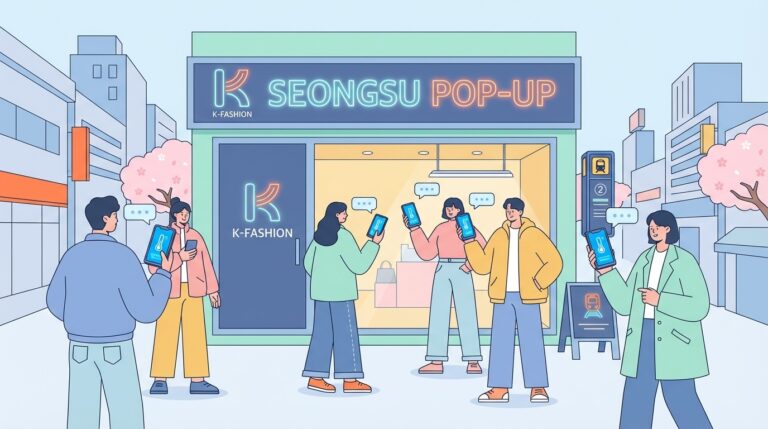
* Fanmeetings = Pop-ups: Seongsu-dong is packed with immersive pop-up stores that act exactly like idol fan meetings. You go to take photos, get limited photocards (or brand merch), and prove your loyalty.
If you want to understand Korean marketing, study how BTS or NewJeans built their communities. The mechanics are identical.
Phase 5: Real-Life Roleplay Scenario
Setting: Friday afternoon, 3 PM. A sunlit, aesthetic meeting room in a Seongsu-dong marketing agency. You are the Expat Marketing Director for a new vegan skincare brand. You are brainstorming community strategies with Ji-yoon (28, Trend-savvy Gen Z marketer).
Dialogue:
지윤: 디렉터님, 요즘 뷰티 시장은 제품력만으로는 살아남기 힘들어요. 우리도 커뮤니티 전략이 필요해요.
(Direkteo-nim, yojeum byuti sijangeun jepumnyeongmaneuroneun saranapgi himdeureoyo. Urido keomyuniti jeollyagi piryohaeyo.)
[Director, these days in the beauty market, it’s hard to survive on product quality alone. We need a community strategy too.]
YOU: 맞아요. 단순한 구매자를 넘어서 우리 브랜드를 지지해 줄 사람들이 필요하죠.
(Majayo. Dansunhan gumaejareul neomeoseo uri beuraendeureul jijihae jul saramdeuri piryohajyo.)
[Right. We need people who will support our brand, going beyond simple buyers.]
지윤: 네! 그래서 저는 우리 브랜드만의 독특한 세계관을 만들었으면 좋겠어요. 고객들이 거기에 몰입하게요.
(Ne! Geuraeseo jeoneun uri beuraendeumanui dokteukan segyegwaneul mandeureosseumyeon jokesseoyo. Gogaekdeuri geogie moripageyo.)
[Yes! So I think we should create our brand’s own unique lore/universe. So customers can immerse themselves in it.]
🔀 당신의 차례! 어떻게 대답할까요? (Your Turn!)
– A) “세계관이요? 그냥 할인 쿠폰이나 많이 뿌리는 게 낫지 않을까요?” (Lore? Wouldn’t it be better to just scatter discount coupons?)
– B) “좋은 생각이에요! 고객들을 우리의 찐팬으로 만들 스토리를 기획해 봅시다!” (Good idea! Let’s plan a story that will turn our customers into our true fans!)
– C) “세계관은 K-Pop 아이돌이나 하는 거 아니에요?” (Isn’t lore just something K-Pop idols do?)✅ Best Choice: B — This shows you perfectly grasp the C2-level consumer trend. You validate the idea and use the advanced slang ‘찐팬’ naturally.
⚠️ Choice A & C Analysis: Choice A is an outdated “push marketing” tactic that misses the point of community building. Choice C is a valid question, but in modern Korean marketing, it shows a lack of awareness of current industry trends.
지윤 (Reacting to B): 아, 역시 디렉터님! 딱 제가 원하던 방향이에요. 환경을 지키는 히어로 컨셉 어때요?
(A, yeoksi direkteonim! Ttak jega wonhadeon banghyang-ieyo. Hwangyeongeul jikineun hieoro keonsep eottaeyo?)
[Ah, as expected, Director! That’s exactly the direction I wanted. How about an eco-hero concept?]
(🎭 Stage Direction: Ji-yoon rapidly starts sketching out a universe map on the whiteboard.)
Phase 6: 10-Second Shadowing Drill
Master the rhythm and intonation of a confident marketer!
😤 우리 브랜드도 / 확실한 세계관이 / 필요해요! (u-ri beu-raen-deu-do / hwak-sil-han se-gye-gwa-ni / pi-ryo-hae-yo!)
(Emotion: 😤 Determined and persuasive)
😊 할인보다 / 소속감을 주는 게 / 핵심입니다. (ha-rin-bo-da / so-sok-ga-meul ju-neun ge / haek-si-mim-ni-da.)
(Emotion: 😊 Professional and insightful)
Phase 7: K-Culture Mini Dictionary
| 한국어 | Romanization | English | Context & Usage |
|---|---|---|---|
| 소속감 | sosokgam | Sense of belonging | The ultimate goal of brand communities. Humans crave this, and brands provide it via memberships and exclusive events. |
| 덕질 | deokjil | Fangirling / Stanning | Originally for anime or idols, now used for intensely loving a brand. E.g., “I’m ‘deokjil-ing’ this new perfume brand.” |
| 단골 | dangol | Regular customer | The traditional offline version of a “Jjin-paen.” Implies an old-school, warm relationship with a local shop owner. |
| 품절대란 | pumjeoldaeran | Out-of-stock crisis | A marketing buzzword used to trigger FOMO (Fear Of Missing Out) within a brand community. |
Phase 8: Traveler’s Survival Kit (The Pop-Up Store Edition)
To see brand communities in action, you must visit a pop-up store in Seongsu-dong or The Hyundai Seoul. Here is your C2 survival kit for navigating these high-hype environments.
🆘 서바이벌 표현 TOP 3
1. 🇰🇷 “웨이팅 등록은 어디서 하나요?” (weiting deungnogeun eodiseo hanayo?)
– 🗣️ Meaning: Where do I register for the waiting list?
– 📍 Use it: When you see a massive crowd outside a trendy brand’s pop-up.
2. 🇰🇷 “이거 팝업 한정판인가요?” (igeo papeop hanjeongpaningayo?)
– 🗣️ Meaning: Is this a pop-up exclusive limited edition?
– 📍 Use it: To figure out if an item is worth the hype (and price).
3. 🇰🇷 “앱 깔면 굿즈 주시나요?” (aep kkalmyeon gutjeu jusinayo?)
– 🗣️ Meaning: Do you give out merch if I install the app?
– 📍 Use it: Brands often “bribe” you into their digital community with free goods.📌 Editor’s Travel Note
– Digital Queues: You rarely wait in a physical line in Korea anymore. You must use a tablet at the entrance to register your phone number (apps like Catch Table or Tabling are essential).
– No Phone Number? If you are a tourist without a Korean number, confidently approach the staff: “외국인이라 번호가 없는데, 어떻게 대기하나요?” (I’m a foreigner without a number, how do I wait?).
Phase 9: Critical Thinking Corner — “One Step Deeper”
🧠 Think Deeper: The Evolution of ‘Jeong’ (정) into ‘Fandom’ (팬덤) in the Global Era
Traditional Korean culture was defined by Jeong (정)—a passive, deep-rooted affection built over time through shared physical spaces (like being a ‘단골’ at a neighborhood restaurant). However, in the hyper-capitalist, digital global era, Jeong has evolved into Fandom (팬덤). Fandom is aggressive, active, and hyper-localized. Consumers now form “tribes” around brands, using highly specific language (like ‘세계관’) to exclude outsiders and solidify their in-group identity. This tribalism in marketing shows how modern Koreans still desperately crave community, but they now seek it through curated, aesthetic capitalist channels rather than traditional villages.💬 Your Turn: Does modern consumerism in your country create a sense of true community, or is it just a marketing illusion? Share your thoughts below!
Phase 10: FAQ & Avoiding Misunderstandings
Q: Can I tell my boss we should “돈쭐내다” (Don-jjul) our competitors?
No! Don-jjul is strictly positive. You are “scolding them with money” because they did something good. You cannot use it to mean financially ruining a competitor.
Q: Is calling someone a ‘덕후’ (Deok-hu / Otaku) an insult in Korean business?
Ten years ago, yes. Today, no. In modern marketing, finding a ‘뷰티 덕후’ (beauty nerd) or ‘IT 덕후’ is highly prized because they are the seeds of your brand community.
❌ Common Mistake: Confusing ‘단골’ and ‘찐팬’.
✅ How to fix it:
Use ‘단골’ (dangol) for physical, local businesses: “I’m a dangol at this cafe.”
Use ‘찐팬’ (jjin-paen) for digital brands, tech apps, or broader loyalty: “I’m a jjin-paen of Apple products.”
Phase 11: Summary & Action Items
One-Liner Summary: To win the Korean market, don’t just sell a product—build a ‘세계관’ (universe) and cultivate ‘찐팬’ (true fans) who will ‘돈쭐내다’ (reward) your brand.
Action Mission 3단계:
– 🥉 Bronze: Say “우리는 찐팬이 필요해!” (We need true fans!) out loud in front of a mirror 3 times with executive-level confidence.
– 🥈 Silver: Go to the Instagram page of a Korean brand you like (e.g., Gentle Monster, Tamburins, Musinsa). Can you spot how they build their ‘세계관’?
– 🥇 Gold: Use the term ‘찐팬’ or ‘세계관’ in your next Korean language exchange or business meeting!
Phase 12: Quiz — Interactive Challenge
1. Situational Judgment: Your startup recently donated 10% of its profits to an animal shelter. Suddenly, orders are skyrocketing from people who don’t even own pets. What is the Korean community doing?
A) 점유율을 높이다 (Increasing market share)
B) 돈쭐내다 (Scolding with money)
C) 세계관을 만들다 (Making a lore)
2. Fill in the Blank: “단순한 구매가 아니라, 이 브랜드의 ( )에 몰입하는 것이 중요합니다.” (It’s not just a simple purchase; immersing in this brand’s [lore/universe] is important.)
A) 단골
B) 소속감
C) 세계관
3. True or False – K-Culture Edition:
In modern Korean brand marketing, the term ‘충성 고객’ (loyal customer) is considered more trendy and impactful than ‘찐팬’ (true fan). (T/F)
(Answers: 1. B, 2. C, 3. False – ‘찐팬’ is the trendy term!)
Frequently Asked Questions (FAQ)
Q: What does "찐팬 (Jjin-paen)" mean in Korean and how do you pronounce it?
A: In Korean, "찐팬 (Jjin-paen)" is pronounced [jjin-pan] and means: Literal: True fan. Real nuance: Hardcore brand loyalist / Ride-or-die advocate.
Q: What does "세계관 (Se-gye-gwan)" mean in Korean and how do you pronounce it?
A: In Korean, "세계관 (Se-gye-gwan)" is pronounced [se-gye-gwan [seh-gyeh-gwan] and means: Literal: Worldview. Real nuance: Brand Lore / Universe.
Q: What does "돈쭐내다 (Don-jjul-nae-da)" mean in Korean and how do you pronounce it?
A: In Korean, "돈쭐내다 (Don-jjul-nae-da)" is pronounced [don-jjul-nae-da [don-jjool-nae-da] and means: Literal: To scold with money. Real nuance: To aggressively patronize a socially responsible business to reward their good deeds.







