

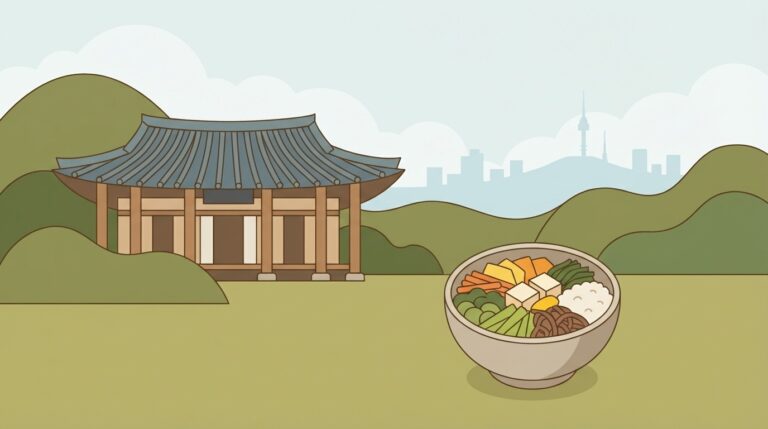
Phase 1: Empathy (Immersive Opening)
Hello there! It’s your Lead Editor at Daily Hangul.
Imagine this scene: You are watching a K-Drama where the overworked, burnt-out CEO protagonist abruptly drives off into the misty mountains, leaving their smartphone buzzing on a mahogany desk. The next scene? They are sweeping the courtyard of a serene, centuries-old Buddhist temple at dawn, dressed in baggy grey cotton clothes.
For many Koreans living in the hyper-competitive, pali-pali (hurry-hurry) society of Seoul, a Temple Stay (템플스테이) isn’t just a weekend getaway—it’s an absolute necessity for mental survival. As an advanced Korean speaker (C2), you already know how to book a fancy hotel or order room service. But do you know how to talk about escaping the secular world? Do you know the fierce reality of booking a spot at a popular temple (yes, it’s like trying to get front-row seats at a K-Pop concert), or the profound philosophy behind the monastic meal, Baru Gongyang?
If you simply say “I want to go to a temple” (저는 절에 가고 싶어요), you sound like a textbook. Today, we are going to dive into the deep, culturally rich vocabulary Koreans use when they truly need to unplug. This guide is built from the real experiences of advanced learners who wanted to experience the true ‘Zen’ of Korea, only to realize that navigating temple etiquette is an entirely new linguistic realm.
Phase 2: Core Expressions Deep Dive
Here are the top expressions you need to sound like a native Korean seeking spiritual healing.
1. 속세를 벗어나다
- Pronunciation: sok-se-reul beo-seo-na-da [The ‘sok’ sounds like ‘soak’ but cut short with a sharp ‘k’. ‘se’ sounds like ‘set’ without the ‘t’.]
- Meaning: (Literal) To escape the secular world. (Real nuance) To get away from the stressful, worldly life (work, social media, drama) and seek absolute peace.
- K-Culture Moment: You’ll hear this a lot among office workers on a Friday evening. A colleague staring blankly at their monitor might sigh, “아… 속세를 벗어나고 싶다” (Ah… I want to escape the secular world).
- Editor’s Insight: This is a dramatic but incredibly common exaggeration. It shows you understand the poetic, slightly self-deprecating humor Koreans use when they are stressed out.
- Situation Spectrum:
[🚫 Never] ———— [⚠️ Be Careful] ———— [✅ Freely]
- Close Friends (Casual): ✅ (Perfect for exaggerating your burnout)
- Co-workers (Semi-formal): ✅ (Great for bonding over shared stress)
- Formal/Boss (Formal): ⚠️ (Might sound like you are planning to quit your job and become a monk!)
- 🤔 Think About It: Why does Korean vocabulary have such deep Buddhist roots for everyday stress? Words like In-yeon (인연, karma/ties) and Sok-se (속세, secular world) show how deeply Buddhism has influenced the Korean psyche over centuries. Does your language have religious terms that are casually used in the workplace?
2. 피켓팅을 뚫다 (Applying K-Pop Slang to Temples)
- Pronunciation: pi-ket-ting-eul ttul-ta [pi-ket-ting sounds like ‘blood ticketing’ spoken very quickly.]
- Meaning: (Literal) To pierce through blood-ticketing. (Real nuance) To successfully book something that is insanely competitive.
- K-Culture Moment: You might think Temple Stays are easy to book because they are ‘peaceful.’ Think again. Famous temples in Seoul (like Jogyesa or Bongeunsa) or beautiful mountain temples (like Baekyangsa, home of the famous Netflix chef Jeong Kwan) are fully booked months in advance.
- Editor’s Insight: By combining a hyper-modern slang word like ‘피켓팅’ (Blood + Ticketing) with a traditional concept like a Temple Stay, you instantly demonstrate C2-level cultural fluency.
- Situation Spectrum:
[🚫 Never] ———— [⚠️ Be Careful] ———— [✅ Freely]
- Close Friends/Co-workers: ✅
- Older Monks: 🚫 (They won’t understand the slang!)
- 🤔 Think About It: Isn’t it ironic that finding peace requires engaging in a hyper-competitive booking war? This paradox perfectly encapsulates modern Korean society.
3. 발우공양
- Pronunciation: ba-ru-gong-yang [ba-roo-gong-yang]
- Meaning: Traditional Buddhist monastic meal where you eat in absolute silence and leave zero food waste—not even a grain of rice or a drop of water.
- K-Culture Moment: This isn’t just a meal; it’s a practice of mindfulness. When Koreans talk about trying Baru Gongyang, they focus on the verb 비우다 (to empty). “마음도 비우고, 그릇도 비웠어요” (I emptied my mind, and I emptied my bowl).
- Editor’s Insight: Using this specific Hanja (Sino-Korean) term instead of simply saying ‘절밥’ (temple food) elevates your Korean instantly. It shows respect for the ritual.
- Situation Spectrum:
[🚫 Never] ———— [⚠️ Be Careful] ———— [✅ Freely]
- Any situation: ✅ (It’s a formal noun, safe to use everywhere)
Phase 3: Textbook vs. Real Korean
| Situation | 📖 Textbook Korean | 🗣️ Real Korean (C2) | 💡 Why the difference? |
|---|---|---|---|
| Explaining why you’re going | 저는 스트레스가 많아서 절에 갑니다. (I am stressed so I go to a temple.) | 주말에 템플스테이로 속세 좀 탈출하려고요. (I’m escaping the secular world this weekend via temple stay.) | Koreans love using dramatic, poetic metaphors (escaping the world) to express mundane exhaustion. |
| Commenting on the booking difficulty | 예약하기가 아주 어렵습니다. (It is very hard to reserve.) | 유명한 절은 완전 피켓팅이에요. 자리 잡기 빡세요. (Famous temples are total ‘blood ticketing’. It’s intense to grab a spot.) | Blending modern internet culture/slang with traditional activities shows native-level adaptation. |
| Describing the meal | 밥을 다 먹었습니다. (I ate all the food.) | 발우공양 하면서 밥풀 하나까지 싹 비웠어요. (Doing Baru Gongyang, I completely emptied it down to a single grain of rice.) | Using the culturally specific term (Baru Gongyang) acknowledges the ritualistic nature of the meal. |
Phase 4: Cultural Context — K-Culture Deep Dive
4-1. Non-Verbal Communication: 묵언 (Mugeon – Noble Silence) and 눈치 (Nunchi)
In a Korean temple, silence is a heavy, physical presence. The concept of 묵언 (Noble Silence) is strictly enforced in many areas. Here, your 눈치 (Nunchi – the ability to read the room) will be tested to the max. You must walk softly (don’t drag your slippers), avoid making eye contact to initiate casual small talk with meditating monks, and during meals, you shouldn’t even let your chopsticks clink against the bowl. It is the ultimate exercise in self-awareness.
4-2. The K-Food Connection: Global Haute Cuisine Born from Asceticism
If you’ve watched Netflix’s Chef’s Table, you know Jeong Kwan, the philosophical nun who elevated Korean Temple Food (사찰음식 – Sachal Eumsik) to global fame.
Temple food strictly forbids meat and the 오신채 (Osinchae – the five pungent roots: garlic, green onion, leek, chive, and wild chive), as they are believed to hinder spiritual practice by generating heat and desire in the body.
Critical Viewpoint: Interestingly, modern Koreans—who usually cannot survive a meal without copious amounts of garlic and spicy red pepper—are now flocking to temple stays and high-end vegan restaurants to eat this exact food. It’s a fascinating socio-cultural shift: ascetic, humble temple food is now consumed as a premium ‘wellness’ and ‘detox’ experience by the urban elite.
Phase 5: Real-Life Roleplay Scenario
Setting: A trendy, noisy cafe in Gangnam. Friday lunchtime. You are holding an iced Americano, looking visibly exhausted. Your Korean colleague, Ji-yoon (30s, trendy, a master of weekend ‘healing’ trips), notices your dark circles.
YOU: 하아… 진짜 다 던지고 산으로 들어가고 싶네요. 😩
(Ha-a… jinjja da deonjigo saneuro deureogago simneyo.)
[Sigh… I really just want to throw everything away and go into the mountains.]
Ji-yoon: OO씨, 요즘 야근 너무 많이 하더라. 번아웃 온 거 아니에요? 템플스테이 갈래요? 제가 기가 막힌 곳 아는데.
(OO-ssi, yojeum yageun neomu mani hadeora. Beonaut on geo anieyo? Tempeulseutei gallaeyo? Jega giga makhin got aneunde.)
[You’ve been working overtime too much lately. Are you burned out? Do you want to go to a temple stay? I know an amazing place.]
YOU: 오, 진짜요? 안 그래도 속세 좀 탈출하고 싶었는데. 예약하기 안 빡세요?
(O, jinjjayo? An geuraedo sokse jom talchulhago sipeonneunde. Yeyakhagi an ppakseyo?)
[Oh, really? I actually wanted to escape the secular world anyway. Isn’t it tough to book?]
Ji-yoon: 완전 피켓팅이긴 한데, 제가 취소표 하나 잡아놓은 거 있어요! 근데 거기가 규율이 엄청 엄격해요. 새벽 4시에 예불 드려야 하고, 밥도 완전 FM으로 발우공양 해야 돼요.
(Wanjeon piketting-igin hande, jega chwisopyo hana jabanoeun geo isseoyo! Geunde geogiga gyuyuri eomcheong eomgyeokhaeyo. Saebyeok nesie yebul deuryeoya hago, bapdo wanjeon FM-euro barugongyang haeya dwaeyo.)
[It’s total blood-ticketing, but I grabbed a cancelled ticket! But the rules there are super strict. You have to attend the morning chant at 4 AM, and the meals are strictly Baru Gongyang (by the book).]
🔀 Your Turn! How will you respond?
– A) “아, 새벽 4시는 좀… 그냥 호텔 갈게요.”
– B) “오, 오히려 좋아요! 이번 기회에 그릇도 비우고 마음도 싹 비우고 올게요!”
– C) “근데 발우공양 할 때 핸드폰으로 사진 찍어도 되나요? 인스타에 올려야 되는데.”✅ Best Choice: B — Reason: You embrace the challenge using the poetic expression of “emptying the bowl and emptying the mind” (비우다), showing deep cultural understanding.
⚠️ Choice C Analysis: Asking to take Instagram photos during the sacred Baru Gongyang shows a severe lack of nunchi. Monks will definitely not appreciate it!
Phase 6: 10-Second Shadowing Drill
Let’s practice the rhythm of a burnt-out but hopeful urbanite. Follow the slashes for pauses and match the emotional tags!
😩 이번 주말에는 / 폰도 끄고 / 속세 좀 / 완~전 탈출하려고요.
(ibeon jumareneun / pondo kkeugo / sokse jom / wan~jeon talchulharyeogoyo.)
This weekend, I’m going to turn off my phone and completely escape the secular world.🧘♂️ 마음도 비우고, / 그릇도 싹 / 비우고 오겠습니다.
(maeumdo biugo, / geureutto ssak / biugo ogetseumnida.)
I will go empty my mind, and completely empty my bowl.
Phase 7: K-Culture Mini Dictionary
| Korean | Romanization | English | Context & Nuance |
|---|---|---|---|
| 속세 | sokse | Secular world | Used humorously by stressed workers to describe the chaotic modern world they wish to escape. |
| 피켓팅 | piketting | Blood ticketing | Slang for fiercely competitive bookings. Originally for K-Pop, now used for popular Temple Stays or hot restaurants. |
| 예불 | yebul | Buddhist chanting/ceremony | The daily ritual. The 4 AM Yebul is the ultimate test of willpower for Temple Stay participants. |
| 불멍/물멍 | bulmeong/mulmeong | Spacing out looking at fire/water | ‘멍 때리다’ (spacing out) is a huge wellness trend. At temples, you do ‘산멍’ (spacing out looking at mountains). |
| 108배 | baek-pal-bae | 108 bows | The physical meditation practice of bowing 108 times to shed 108 worldly defilements. Prepare for sore thighs! |
Phase 8: Traveler Survival Kit (Temple Edition)
Even as a C2 speaker, specialized vocabulary can catch you off guard. Keep these in your mental pocket.
🆘 Survival Expressions for the Temple
– 🇰🇷 “혹시 묵언 수행 구역이 따로 있나요?” (hoksi mugeon suhaeng guyeogi ttaro innayo?)
– 🗣️ English: Are there designated noble silence zones?
– 📍 Where to use: During orientation.
– 💡 Pro Tip: Temples often have areas where absolutely no talking is allowed. Asking this shows deep respect.
- 🇰🇷 “식사하실 때 오신채를 아예 안 쓰시나요?” (siksahasil ttae osinchaereul aye an sseusinayo?)
- 🗣️ English: Do you completely exclude the five pungent roots when cooking?
- 📍 Where to use: Discussing the temple food.
📌 Editor’s Travel Note
– Clothing: Many temples provide comfortable grey uniforms, but you must bring plain socks (bare feet are disrespectful in the main halls).
– Digital Detox: Some strictly traditional temples will actually confiscate your smartphone upon arrival. Embrace the panic!
– Types of Stays: Look out for ‘휴식형’ (Relaxation type – you do whatever you want) vs. ‘체험형’ (Experiential type – you must wake up at 4 AM, do 108 bows, and make lotus lanterns).
Phase 9: Critical Thinking — “One Step Deeper”
🧠 Think Deeper: Food & Identity (The Paradox of Temple Food)
Historically, Korean temple food was born from supreme asceticism—monks eating wild greens and avoiding stimulating ingredients (like garlic and meat) purely to sustain their meditation practice without exciting their worldly desires. Yet today, this absolute minimalism has been rebranded globally as the pinnacle of luxury, wellness, and vegan haute cuisine. A meal that costs a monk nothing but foraging time is now sold in Michelin-starred restaurants in Seoul.This reflects a fascinating shift in global consumer identity: in an era of extreme excess, “absence” (no meat, no garlic, no noise) has become the ultimate luxury commodity. When we book a temple stay, are we truly seeking spiritual enlightenment, or are we just consuming ‘peace’ as another premium experience?
💬 Your Turn: How is traditional asceticism or religious food viewed in your culture? Has it been commercialized, or does it remain strictly religious? Share your thoughts below!
Phase 10: FAQ & Avoiding Misunderstandings
Q: Is it okay to use “속세 탈출” (escaping the secular world) in front of an actual monk?
Yes, absolutely! Monks generally have a great sense of humor about it. They understand the struggles of modern city life and will probably smile and welcome you warmly.
Q: I am vegetarian, but I don’t eat certain vegetables. Can I ask the temple to alter my food?
Temple food is already vegan. However, asking a temple to customize the Baru Gongyang for your personal taste (e.g., “No mushrooms please”) goes against the core philosophy of the meal, which is to accept the universe’s offerings with gratitude and zero complaints. Try your best to eat what is given!
❌ Common Mistake #1: Pointing your feet toward the Buddha statue when sitting on the floor.
✅ Do This Instead: Always sit cross-legged (양반다리) or tuck your feet under or behind you. Pointing the soles of your feet at the altar is highly disrespectful in Korean Buddhism.
Phase 11: Summary & Action Items
- One-Liner Summary: A Korean Temple Stay is not just a vacation; it’s a profound cultural dive where you escape the secular world (속세), engage in fierce ticketing (피켓팅), and find peace by emptying your bowl and mind (발우공양).
-
Action Mission:
- 🥉 Bronze (Solo): Look at your busy calendar right now and sigh dramatically while saying, “속세를 벗어나고 싶다” to the mirror.
- 🥈 Silver (Online): Look up ‘Jeong Kwan Chef’s Table’ or a Korean temple stay vlog on YouTube. Leave a comment in Korean using the word ‘발우공양’.
- 🥇 Gold (Action): Visit the official Korean Temple Stay website (templestay.com). Find a temple near Seoul, check if they offer ‘휴식형’ (relaxation) or ‘체험형’ (experiential), and plan a mock itinerary!
- K-Culture Mission: Next time you eat a meal at home or a Korean restaurant, try your own mini Baru Gongyang. Eat without looking at your phone, chew silently, and leave absolutely zero grains of rice in your bowl.
Let me know in the comments: Are you Team ‘Relaxation Type’ (just sleeping in the mountains) or Team ‘Experiential Type’ (waking up at 4 AM to do 108 bows)?
Phase 12: Quiz — Interactive Challenge
1. Situational Judgment: You are eating at the temple. The food given to you includes a piece of pickled radish that you don’t like. What is the culturally appropriate C2 action?
– A) Politely ask the monk to take it back.
– B) Hide it under your napkin.
– C) Use the pickled radish to wipe the bowl clean with a little water at the end of the meal, then drink the water, completing the Baru Gongyang.
(Toggle for Answer: C. This is the traditional way to clean your bowl during Baru Gongyang—leaving absolutely zero waste!)
2. Fill in the Blank:
“유명한 템플스테이는 경쟁이 너무 심해서 완전 ________ 이에요.”
(Famous temple stays have such intense competition, it’s a total ________.)
(Answer: 피켓팅 – blood ticketing)
3. True or False — K-Culture Edition:
“At a traditional Korean temple, the food heavily features garlic and green onions for flavor.”
(Answer: FALSE. Temple food strictly avoids ‘오신채’ – the five pungent roots – to keep the mind calm.)
4. Roleplay Outcome: In Phase 5, if you chose Option C (asking to take Instagram photos during the sacred meal), what would be the result?
(Answer: You would break the ‘Mugeon’ (Noble Silence), show a lack of ‘Nunchi’, and completely miss the philosophical point of emptying your mind of worldly desires—like social media validation!)
Frequently Asked Questions (FAQ)
Q: What does "속세를 벗어나다" mean in Korean and how do you pronounce it?
A: In Korean, "속세를 벗어나다" is pronounced [sok-se-reul beo-seo-na-da [The 'sok' sounds like 'soak' but cut short with a sharp 'k'. 'se' sounds like 'set' without the 't'.] and means: (Literal) To escape the secular world. (Real nuance) To get away from the stressful, worldly life (work, social media, drama) and seek absolute peace.
Q: What does "피켓팅을 뚫다 (Applying K-Pop Slang to Temples)" mean in Korean and how do you pronounce it?
A: In Korean, "피켓팅을 뚫다 (Applying K-Pop Slang to Temples)" is pronounced [pi-ket-ting-eul ttul-ta [pi-ket-ting sounds like 'blood ticketing' spoken very quickly.] and means: (Literal) To pierce through blood-ticketing. (Real nuance) To successfully book something that is insanely competitive.
Q: What does "발우공양" mean in Korean and how do you pronounce it?
A: In Korean, "발우공양" is pronounced [ba-ru-gong-yang [ba-roo-gong-yang] and means: Traditional Buddhist monastic meal where you eat in absolute silence and leave zero food waste—not even a grain of rice or a drop of water.







