

Phase 1: Empathy (The K-Culture Cold Open)
Hello! I am your Daily Hangul Editor, your local guide to surviving and thriving in Korea.
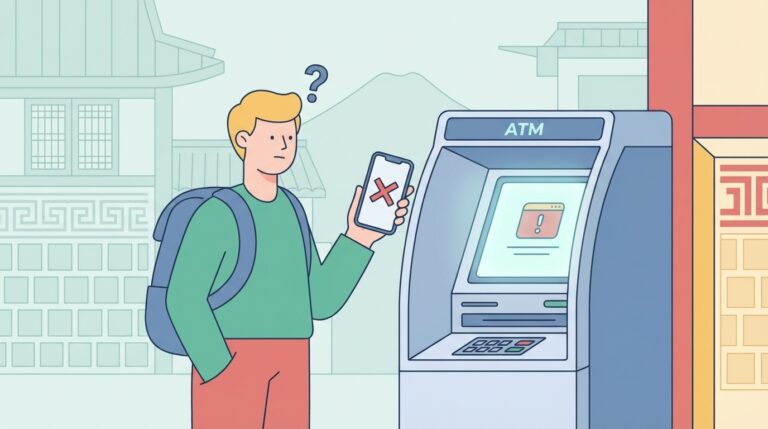
Picture this: You are having an amazing time in Seoul. You just finished a delicious plate of Tteokbokki at a lively street market. The vendor tells you the price, but oh no—they only take cash or an account transfer (계좌 이체). You quickly open your Korean banking app, confident you can handle this. You type your 4-digit PIN. Beep! A red warning pops up.
In K-Dramas, this is usually the exact moment the main character realizes their wealthy parents have frozen their bank account. But for you? You just typed the wrong password. The line behind you is getting longer, the vendor is looking at you, and panic sets in. What do you do? What does that red text even mean?
Don’t worry! As someone who has helped hundreds of beginners navigate life in Korea, I know exactly how stressful this can be. Today, we are going to learn how to handle a password error (비밀번호 오류) like a pro. These simple phrases will save you from sweating at the ATM or the checkout counter!
Phase 2: Core Expressions Deep Dive
Let’s look at the survival phrases you need when your password just will not work.
1. 비밀번호 (Password / PIN)
- Pronunciation: [bi-mil-beon-ho] -> Sounds like ‘bee-meal-bun-ho’
- Meaning: Secret number (Password or PIN)
- K-Culture Moment: You will see this word everywhere in Korea—not just at banks! From opening the digital lock on your Airbnb door to connecting to a cafe’s Wi-Fi, ‘bi-mil-beon-ho’ is a word you must know to survive in Seoul.
- Editor’s Insight: Koreans love efficiency. In daily conversations, we almost never say the full word. We just say ‘비번’ (bi-beon)!
- Situation Spectrum:
[🚫 Do Not Use] ———— [⚠️ Caution] ———— [✅ Freely Use]
- Casual with friends: ✅ (Use ‘비번’)
- Formal/Bank staff: ✅ (Use ‘비밀번호’)
- 🤔 Think About It: In Korean, ‘비밀’ means secret and ‘번호’ means number. Does your native language combine words in a similar, literal way?
2. 틀렸어요 (It is wrong / Incorrect)
- Pronunciation: [teul-lyeot-seo-yo] -> The ‘teul’ sounds like you are breathing out heavily while saying ‘T’.
- Meaning: To be incorrect or wrong.
- K-Culture Moment: Imagine taking a Korean language test on a variety show like Running Man. When someone gives the wrong answer, the host shouts ‘땡!’ (Ddaeng!) and ‘틀렸어요!’. At the ATM, you won’t hear a buzzer, but the feeling is the same.
- Editor’s Insight: This is polite but clear. If your app shows a red error, you can show your screen to a Korean friend and say, ‘비밀번호 틀렸어요’ (The password is wrong).
- Situation Spectrum:
[🚫 Do Not Use] ———— [⚠️ Caution] ———— [✅ Freely Use]
- Casual with friends: ✅ (Can say ‘틀렸어’)
- Formal/Bank staff: ✅
- 🤔 Think About It: Instead of saying ‘I made a mistake,’ Koreans often say ‘The password became wrong.’ How does this reflect the way Koreans view responsibility or situations?
3. 도와주세요 (Please help me)
- Pronunciation: [do-wa-ju-se-yo] -> ‘Dough-wa-joo-say-yo’
- Meaning: Please help me.
- K-Culture Moment: When a K-Drama character is lost in the rain or facing a huge problem, this is the desperate line they use. But for you, it is simply a polite way to ask a bank teller or a friend for assistance.
- Editor’s Insight: This is the ultimate A1 survival phrase. Even if your grammar is broken, if you hold out your phone and say ‘도와주세요’, Koreans will instantly try to figure out what is wrong.
- Situation Spectrum:
[🚫 Do Not Use] ———— [⚠️ Caution] ———— [✅ Freely Use]
- Anyone, anywhere: ✅
Phase 3: Textbook vs. Real Korean
| Situation | 📖 Textbook Korean | 🗣️ Real Korean | 💡 Why is it different? |
|---|---|---|---|
| App Error Message | 비밀번호를 잘못 입력하셨습니다. (You entered the password incorrectly.) | 비밀번호 오류 (Password error) / 비번 오류 | Apps use short, noun-based phrases for quick reading on small screens. |
| Telling a friend | 제 비밀번호가 틀렸습니다. (My password is wrong.) | 아, 비번 틀렸어. (Ah, PIN is wrong.) | Friends use casual language and shortened slang (비번) to speak faster. |
| Asking to try again | 다시 한 번 입력해 주십시오. (Please enter it once again.) | 다시 해볼게요. (I’ll try again.) | Real conversation focuses on your action (‘I will try’) rather than strict commands. |
Phase 4: Cultural Context — K-Culture Deep Dive
4-1. Non-verbal Signals
When typing your ‘비밀번호’ in Korea, always cover the keypad with your other hand. Koreans are very respectful of digital privacy. If you are with a Korean friend and they need to type their PIN for a bank transfer, it is polite to physically turn your head away or look at the ceiling!
4-2. The ‘Ppalli-Ppalli’ (Hurry Up) ATM Culture
If your password fails at a Korean ATM, you will feel an invisible pressure. This is Korea’s famous ‘빨리빨리’ (Ppalli-ppalli / Hurry up) culture! If you get a ‘비밀번호 오류’ (Password Error) and you need time to remember it, it is best to step out of the line, figure it out, and line up again. If you stand there staring at your phone for 3 minutes, the people behind you might start sighing!
Phase 5: Real-Life Roleplay Scenario
Setting: Friday night, 8:00 PM. A loud, bustling Korean BBQ restaurant in Gangnam. You just finished a great team dinner. The bill is huge, and everyone agreed to split it via bank transfer (Dutch pay).
Characters:
– YOU: A beginner in Korean, trying to pay your share.
– Min-su (32): Your friendly Korean coworker who is organizing the payment.
Dialogue:
Min-su: 자, 여러분! 만 원씩 계좌 이체해 주세요! 💸
(Ja, yeoreobun! Man won-ssik gyejwa iche-hae juseyo!)
(Everyone! Please bank transfer 10,000 won each!)
YOU: 네! 지금 보낼게요.
(Ne! Jigeum bonaelgeyo.)
(Yes! I will send it now.)
(🎭 Stage Direction: You open your app and type your PIN. BEEP. A red warning pops up: 비밀번호 3회 오류 – Password wrong 3 times.)
YOU: 헐…
(Heol…)
(Oh my god…)
Min-su: 왜 그래요? 안 돼요?
(Wae geuraeyo? An dwaeyo?)
(What’s wrong? Is it not working?)
🔀 Your Turn! How should you respond?
– A) “저는 바보예요.” (I am a fool.)
– B) “비밀번호 틀렸어요. 현금 있어요?” (My password is wrong. Do you take cash?)
– C) “경찰 불러주세요!” (Call the police!)✅ Best Choice: B — It explains the problem clearly and offers a practical solution (cash).
⚠️ Choice A & C Analysis: ‘I am a fool’ is funny but doesn’t explain the problem. ‘Call the police’ is definitely an overreaction to a bank app error!
Min-su: 아, 비밀번호 오류요? 천천히 다시 해봐요.
(Ah, bimil-beon-ho oryu-yo? Cheon-cheon-hi dasi haebwayo.)
(Ah, password error? Take your time and try again.)
YOU: 잠시만요… 아, 됐어요! 보냈어요!
(Jamsimanyo… Ah, dwaesseoyo! Bonaesseoyo!)
(Just a moment… Ah, it’s done! I sent it!)
Phase 6: 10-Second Shadowing Drill
Practice saying this out loud. Pay attention to the pauses (/) and the emotion tags!
😢 아… / 비밀번호가 / 틀렸어요. (Ah… / bi-mil-beon-ho-ga / teul-lyeot-seo-yo.)
🥺 저기요, / 이것 좀 / 도와주세요. (Jeo-gi-yo, / i-geot jom / do-wa-ju-se-yo.)
Phase 7: K-Culture Mini Dictionary
| Korean | Romanization | English | Context |
|---|---|---|---|
| 비번 | bi-beon | PIN / Password | Short for 비밀번호. Very commonly used in texts and speaking. |
| 계좌 이체 | gye-jwa i-che | Bank Transfer | The standard way friends split bills or pay for street food. |
| 더치페이 | deo-chi-pe-i | Dutch Pay | Splitting the bill. Even though it’s English, Koreans use it constantly! |
| 오류 | o-ryu | Error | What you see on screens when something goes wrong. |
| 송금 | song-geum | Remittance | Another word for transferring money, often used in banking apps. |
Phase 8: Traveler Survival Kit
If your banking app fails and you need to use an ATM in Korea, look out for these words!
🆘 Survival Phrases for the ATM
– 🇰🇷 ‘영어 버튼 어디 있어요?’ (yeong-eo beoteun eodi isseoyo?)
– 🗣️ Meaning: Where is the English button?
– 📍 Where to use: Inside a bank when asking a security guard for help.
– 💡 Pro Tip: Almost all ATMs in Korea have a ‘Language’ or ‘English’ button at the bottom right of the screen. Always press this first!📌 Editor’s Travel Note
– PIN Length: Most foreign cards use a 4-digit PIN. Some Korean ATMs might ask for a 6-digit PIN. If this happens, try adding ’00’ to the end of your 4-digit PIN!
– Locked Out: If you get the ‘비밀번호 오류’ (Password Error) more than 3 or 5 times, your card or app might get locked (잠김). Be very careful after the 2nd try!
Phase 9: Critical Thinking — A Step Deeper
Technology and Convenience in Korea
Korea is basically a cashless society. People pay for everything from a 1,000 won street snack to a taxi ride using banking apps or cards. Because of this extreme convenience, security is intensely strict. To set up a bank transfer app, Koreans often go through multiple layers of identity verification, passwords, and fingerprint scans.
🧠 Think Deeper:
The frustration of a ‘비밀번호 오류’ (Password Error) is a shared national experience in Korea! The strict security ensures safety in a fast-paced digital world, but it can be overwhelming for foreigners.💬 Your Turn: Does your country use cash more, or is it fully digital like Korea? How easy is it to transfer money to a friend in your culture? Tell us in the comments!
Phase 10: FAQ & Avoiding Misunderstandings
- Q: Can I ask a stranger on the street ‘비밀번호 도와주세요’ (Please help with my password)?
- No! Never share your PIN with anyone. If you need help, ask a bank teller or a convenience store worker to help you change the language on the ATM, but type the PIN yourself.
- Q: Do I say ‘오류’ (Error) when speaking?
- Maybe. ‘오류’ is usually a written word on screens. When speaking, it’s more natural to say ‘안 돼요’ (It’s not working) or ‘틀렸어요’ (It’s wrong).
❌ Common Mistake #1: Saying ‘내가 틀렸어요’ (I am wrong) at the ATM.
✅ Do this instead: Say ‘비밀번호가 틀렸어요’ (The password is wrong). In Korean, we blame the password, not the person!
Phase 11: Summary & Action Items
- One-Liner Summary: When your PIN fails, stay calm and say ‘비밀번호 틀렸어요’ (My password is wrong) and ask for help with ‘도와주세요’.
Your Missions for Today:
– 🥉 Bronze (Solo): Look at your phone’s lock screen and say ‘비밀번호’ out loud 3 times.
– 🥈 Silver (Online): Change your phone or a non-essential app’s language setting to Korean for 10 minutes and try to find the word ‘비밀번호’.
– 🥇 Gold (Action): The next time you are with a Korean friend and need to connect to Wi-Fi, ask them: “와이파이 비번 뭐예요?” (What is the Wi-Fi PIN?)
Phase 12: Interactive Quiz
1. You are at an ATM and type your PIN incorrectly. What will the screen most likely say?
– A) 비밀번호 맞습니다 (Password is correct)
– B) 비밀번호 오류 (Password error)
– C) 식사하셨어요? (Did you eat?)
2. Fill in the blank: Your friend asks for the Wi-Fi password. You can say “와이파이 __ 뭐예요?”
– A) 비번
– B) 송금
– C) 더치페이
3. True or False: If you forget your ATM PIN in Korea, you should stand at the machine for 10 minutes trying to remember it while a line forms behind you.
– (Hint: Remember the ‘Ppalli-ppalli’ culture!)
(Answers: 1: B / 2: A / 3: False – Please step aside so others can use the machine!)
Great job today! You are now one step closer to surviving the Korean digital world. See you in the next lesson!
Frequently Asked Questions (FAQ)
Q: What does "비밀번호 (Password / PIN)" mean in Korean and how do you pronounce it?
A: In Korean, "비밀번호 (Password / PIN)" is pronounced [bi-mil-beon-ho] and means: Secret number (Password or PIN)
Q: What does "틀렸어요 (It is wrong / Incorrect)" mean in Korean and how do you pronounce it?
A: In Korean, "틀렸어요 (It is wrong / Incorrect)" is pronounced [teul-lyeot-seo-yo] and means: To be incorrect or wrong.
Q: What does "도와주세요 (Please help me)" mean in Korean and how do you pronounce it?
A: In Korean, "도와주세요 (Please help me)" is pronounced [do-wa-ju-se-yo] and means: Please help me.







