

Phase 1: Empathy (The K-Culture Cold Open)
Hello! I’m your Daily Hangul Editor.
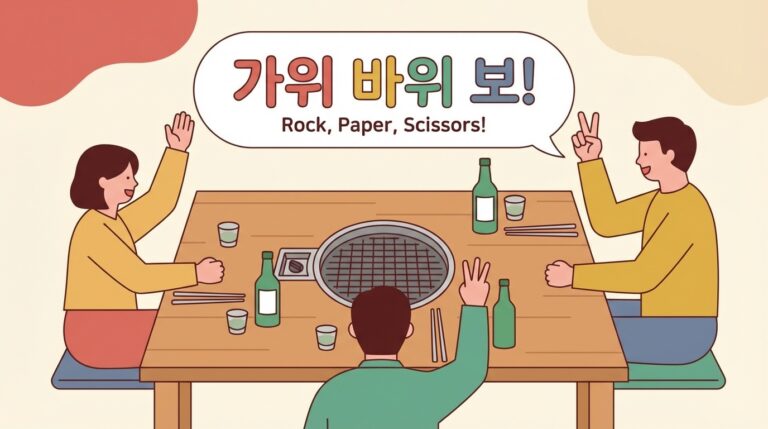
Picture this: You are at a bustling Korean BBQ restaurant in Gangnam. Sizzling pork belly, clinking green soju bottles, and a lively atmosphere. Suddenly, someone at your table randomly yells, “1!” and jumps slightly. Before you can even process what’s happening, someone else shouts, “2!” Then, silence. Everyone slowly turns to look at you, grinning mischievously. You didn’t do anything, but somehow… you just lost.
Welcome to the infamous 눈치 게임 (Nunchi Game).
If you’ve watched any Korean variety show like Running Man or Earth Arcade, you’ve seen this chaotic game. It’s the ultimate icebreaker at any Korean university gathering (MT) or company dinner (hoesik). Not knowing the rules might leave you drinking a lot of penalty shots! But don’t worry—this guide, built from the hilarious real-life mistakes of my foreign students, will turn you from a confused observer into a true K-Culture insider.
Phase 2: Core Expressions Deep Dive
1. 눈치 게임 시작! (Nunchi Game Start!)
- Pronunciation: [nunchi ge-im si-jak!] (si-jak sounds like “she” + “jack”)
- Meaning: Let the Nunchi game begin! (Literal: Nunchi game start!)
- K-Culture Moment: Someone usually shouts this out of nowhere when the conversation dies down or when the vibe needs a boost. There is no countdown. The moment you hear “시작 (sijak)”, the game has begun!
- Editor’s Insight: The key here is the delivery. It’s never said politely or quietly. It’s usually shouted with high energy to catch everyone off guard.
- Situation Spectrum:
[🚫 Formal] ———— [⚠️ Semi-formal] ———— [✅ Casual]
- Close Friends (Casual): ✅
- Coworkers (Semi-formal): ⚠️ (Okay during a casual hoesik)
- Boss/Elders (Formal): 🚫 (Let them initiate games!)
- 🤔 Think About It: “Nunchi” translates roughly to “reading the room” or “emotional intelligence.” Why do you think a culture deeply rooted in reading others’ feelings turned this concept into a drinking game?
2. 걸렸다! (You’re caught! / You lost!)
- Pronunciation: [geol-lyeot-da!] (geol sounds like “gull”)
- Meaning: You got caught! / You’re the loser! (Literal: It has been caught.)
- K-Culture Moment: If you and someone else shout the same number at the same time, or if you are the last person remaining, the whole table will point at you and gleefully shout, “걸렸다!”
- Editor’s Insight: This isn’t just for drinking games. You can playfully use this when you catch a friend lying or sneaking a piece of meat from the grill before it’s fully cooked.
- Situation Spectrum:
[🚫 Formal] ———— [⚠️ Semi-formal] ———— [✅ Casual]
- Close Friends (Casual): ✅
- Coworkers (Semi-formal): ⚠️
- Boss/Elders (Formal): 🚫
- 🤔 Think About It: In English, we say “I caught you,” but in Korean, “걸렸다” is in the passive form (It/You got caught). How does this subtle grammatical difference shift the focus of the situation?
3. 마셔 마셔! (Drink, drink!)
- Pronunciation: [ma-syeo ma-syeo!] (syeo sounds like “shuh”)
- Meaning: Drink up! (Used as a penalty chant)
- K-Culture Moment: Once you lose, the penalty (벌칙) is drinking a shot. Koreans rarely just watch you drink; they chant! The most classic chant is “마셔라~ 마셔라~ 마셔라~ 마셔라! (Drink~ drink~ drink~ drink!)”
- Editor’s Insight: The tone is festive, not aggressive. It’s about collective participation. If you really can’t drink alcohol, you can drink water or soda, but the chant remains the same!
- Situation Spectrum:
[🚫 Formal] ———— [⚠️ Semi-formal] ———— [✅ Casual]
- Close Friends (Casual): ✅
- Coworkers (Semi-formal): ⚠️ (Depends on the company culture)
- Boss/Elders (Formal): 🚫
- 🤔 Think About It: Drinking chants are essentially mini-songs. How does adding rhythm and music to a penalty change the group dynamic?
Phase 3: Textbook vs. Real Korean
| Situation | 📖 Textbook Korean | 🗣️ Real Korean | 💡 Why is it different? |
|---|---|---|---|
| Suggesting a game | 우리 게임 할까요? (Shall we play a game?) | 아, 눈치 게임 시작! (Ah, Nunchi game start!) | Drinking games require spontaneity, so formal suggestions are dropped for sudden declarations. |
| Telling someone to drink | 벌칙으로 술을 마시세요. (Please drink alcohol as a penalty.) | 벌주 원샷! (Penalty drink, bottoms up!) | “원샷” (Konglish for One Shot) is universally used over formal instructions. |
| Cheering someone on | 빨리 마시세요! (Drink quickly!) | 마셔 마셔 먹고 뒤져! (Drink, drink, drink till you drop!) | Warning: The real Korean phrase is extreme slang/chant used only among very close, young friends to hype the mood. |
Bottom Note: As a B2 learner, you don’t need to use aggressive slang like “먹고 뒤져”. Sticking to a cheerful “마셔 마셔!” or “원샷!” shows perfect cultural fluency without crossing the line.
Phase 4: Cultural Context — K-Culture Deep Dive
4-1. The Non-Verbal Art of Nunchi
Language is only half the battle. In the Nunchi game, eye contact is everything. The rule is simple: call out numbers in sequential order (1, 2, 3…). But if two people call the same number simultaneously, they both lose. Therefore, you must use your Nunchi—darting your eyes around the table, reading people’s body language, and predicting who is about to open their mouth. Pro tip: Slightly half-standing from your chair while shouting your number is a classic Korean reflex!
4-2. The K-Drama Connection: The “Hoesik” Trope
If you’ve watched K-Dramas like Misaeng or Work Later, Drink Now, you know the 회식 (Hoesik – company dinner) is a central pillar of Korean corporate life.
In these dramas, you’ll often see the strict, scary boss suddenly loosen their tie and initiate a drinking game. Why? Because games temporarily dissolve the rigid hierarchical structure. For those 10 minutes, the junior employee and the senior manager are just players trying not to drink the penalty shot.
Critical Viewpoint: Dramas often romanticize this. In reality, junior employees (막내 – maknae) sometimes pretend to lose the game intentionally to drink on behalf of their bosses. Now that is high-level Nunchi!
Phase 5: Real-Life Roleplay Scenario
Setting: A smoky BBQ restaurant in Gangnam, Friday 8 PM. You are 3 days into your new job in Seoul, attending your first team dinner. Soju glasses are filled.
Characters:
– YOU: The foreign newbie, eager to impress.
– Min-su (32): Your outgoing, slightly tipsy senior coworker.
– Ji-eun (28): The energetic junior who loves games.
Dialogue:
Min-su: 자, 분위기도 좋은데 게임 하나 할까? 🍻
(Ja, bunwigido joeunde geim hana halkka?)
[Well, the mood is great, shall we play a game?]
Ji-eun: 좋아요! 제가 먼저 할게요. 눈치 게임, 시~작!
(Joayo! Jega meonjeo halgeyo. Nunchi geim, si~jak!)
[Sounds good! I’ll go first. Nunchi game, st~art!]
Min-su: 일! (1!)
(🎭 Stage Direction: Min-su shoots his hand up instantly.)
YOU: (Panicking internally) 이! (2!)
Ji-eun: 이! (2!)
(🎭 Stage Direction: You and Ji-eun shout “2” at the exact same time.)
Min-su: 오케이! 둘 다 걸렸다!
(Okei! Dul da geollyeotda!)
[Okay! You both got caught!]
Ji-eun: 아악! 내 눈치!
(Aak! Nae nunchi!)
[Ahhh! My nunchi (failed me)!]
Min-su: 벌주 준비~ 마셔라! 마셔라! 마셔라! 마셔라!
(Beolju junbi~ Masyeora! Masyeora!)
[Prepare the penalty drinks~ Drink! Drink! Drink! Drink!]
Ji-eun: (Drinks her shot) 캬~ 씁니다. 자, 외국인 동료님 차례!
(Kya~ Sseumnida. Ja, oegugin dongnyonim charye!)
[Kya~ It’s bitter. Now, our foreign colleague’s turn!]
🔀 Your Turn! How should YOU react to the penalty?
– A) “I’m sorry, I cannot drink this.” (Formal and slightly buzz-killing)
– B) “원샷!” (Shouts enthusiastically and drinks)
– C) “저 대신 마셔줄 흑기사 있나요?” (Is there a Black Knight who can drink for me?)✅ Best Choice: B or C.
Choice B will earn you massive cheers. However, if you genuinely cannot or don’t want to drink, Choice C is a genius cultural move! A 흑기사 (Heuk-gisa – Black Knight) is someone who volunteers to drink your penalty shot in exchange for a wish later. It keeps the mood fun without forcing you to drink.
Bonus Roleplay: The Subway Nunchi
Nunchi isn’t just for drinking. It’s an everyday survival skill.
Setting: Crowded Seoul Subway Line 2. A passenger stands up.
Stranger A: (Steps toward the empty seat)
YOU: (Also steps toward the seat. You make brief eye contact with Stranger A.)
YOU: 아, 앉으세요. (Ah, anjeuseyo. – Ah, please sit.)
Stranger A: 감사합니다. (Gamsahamnida. – Thank you.)
Editor’s Note: This silent negotiation of “who gets the seat” is also playfully called the Subway Nunchi Game.
Phase 6: 10-Second Shadowing Drill
Practice the rhythm and intonation! Remember, drinking games are all about the vibe.
- 😤 Confident: 눈치 게임 / 시~작!
(nunchi ge-im / si~jak!) - 😆 Playful: 아하! / 너 걸렸다!
(Aha! / neo geollyeotda!) - 🥳 Hype: 자, / 원샷! / 마셔 마셔!
(Ja, / won-syat! / masyeo masyeo!)
Phase 7: K-Culture Mini Dictionary
| Korean | Romanization | English | Cultural Context |
|---|---|---|---|
| 눈치 | nunchi | Social intelligence / reading the room | The core of Korean social dynamics. Having “fast nunchi” means you catch on quickly. |
| 회식 | hoesik | Company dinner | Bonding time for coworkers, often involving BBQ and alcohol. |
| 벌칙 | beolchik | Penalty | The consequence of losing a game. In hoesik, it’s usually drinking a shot of soju. |
| 원샷 | won-syat | Bottoms up | Konglish for “one shot.” To drink the entire glass in one continuous gulp. |
| 흑기사 | heuk-gisa | Black Knight | Someone who takes your drinking penalty for you, usually in exchange for a favor. |
Phase 8: Traveler’s Survival Kit
Since drinking games happen at restaurants and bars, here are essential phrases you’ll need when navigating Korean nightlife!
🆘 Survival Phrases for K-BBQ & Bars
– 🇰🇷 “여기 소주 한 병 더 주세요!” (yeogi soju han byeong deo juseyo!)
– 🗣️ English: One more bottle of soju here, please!
– 🇰🇷 “소주잔 세 개 주세요.” (sojujan se gae juseyo.)
– 🗣️ English: Three soju glasses, please.
– 🇰🇷 “물 좀 주시겠어요?” (mul jom jusigesseoyo?)
– 🗣️ English: Could I get some water?📌 Editor’s Travel Note
– Calling the staff: In Korea, you don’t wait for a waiter to make eye contact. You loudly call out “사장님! (Boss!)” or “여기요! (Over here!)”, or simply press the call button (벨) on the table.
– Pouring etiquette: Never pour your own drink! Pour for others (using two hands for elders), and let them pour for you.
Phase 9: Critical Thinking Corner — “One Step Deeper”
Language & Power (언어와 권력)
Korean language is deeply structured around hierarchy, age, and respect. Yet, the moment someone shouts “눈치 게임 시작!”, all those rules temporarily vanish. During the game, junior employees don’t use honorifics (존댓말) to call out numbers, and everyone becomes an equal player trying to survive.
🧠 Think Deeper:
Drinking games in Korea act as a “social equalizer.” In a high-pressure society where your title and age dictate how you speak and act, these chaotic games provide a socially acceptable loophole to let off steam and interact with your bosses as equals. It builds 정 (Jeong – deep emotional connection).💬 Your Turn: Does your culture have a specific setting (like a pub, a sports game, or a festival) where societal rules and hierarchies are temporarily ignored? Share it in the comments!
Phase 10: FAQ & Mistake Prevention
Q: Do I have to drink alcohol if I lose?
Absolutely not! While older generations were stricter about drinking, modern Korean culture respects personal boundaries. You can fill your shot glass with water or cider. The important thing is participating in the act of “cheers” (건배) and drinking together.
Q: Can I initiate a drinking game with people I just met?
Maybe. If it’s a university orientation (OT) where the goal is to break the ice, yes! If it’s a formal business dinner with older executives, let the seniors take the lead.
❌ Common Mistake #1: Forcing someone to drink.
✅ Do this instead: If someone says “저는 술 못 마셔요 (I can’t drink),” offer them a soft drink (콜라 or 사이다) and say, “그럼 음료수로 짠 해요! (Then let’s cheers with soda!)”
Phase 11: Summary & Action Items
One-Liner Summary: The Nunchi game is Korea’s favorite icebreaker where reading the room is everything, and “마셔 마셔!” is the ultimate penalty chant.
Action Mission 3 Steps:
– 🥉 Bronze (Solo): Stand up and shout “눈치 게임 시작!” with full dramatic energy in your room.
– 🥈 Silver (Online): Find a video of K-Pop idols playing the Nunchi game on YouTube and comment “누가 걸렸어요? (Who got caught?)”.
– 🥇 Gold (Real World): Next time you are at a Korean restaurant or eating with Korean friends, jokingly suggest, “우리 눈치 게임 할까요?”
K-Culture Mission:
Watch an episode of Going Seventeen, Run BTS, or Earth Arcade. Count how many times the cast uses the word “눈치” or plays a variation of the Nunchi game!
Phase 12: Interactive Quiz
1. Situational Judgment: You and your Korean manager shout “3” at the exact same time during the Nunchi game. What happens next?
– A) You politely tell your manager they won.
– B) You both get pointed at while everyone shouts “걸렸다!” and you both drink a penalty.
– C) The game restarts automatically.
Tip: B is the correct answer! In the game, everyone is equal.
2. Fill in the Blank:
When someone loses, the table starts chanting: “____ ____, 먹고 뒤져!” (Wait, let’s keep it safe!) “____ ____, 원샷!”
Answer: 마셔 마셔 (Masyeo masyeo)
3. True or False – K-Culture Edition:
“If you cannot drink alcohol, it is considered rude to participate in Korean drinking games.”
Answer: False! Modern Korean drinking culture is very inclusive. You can drink water or soda, or call a Black Knight (흑기사) to take your penalty!
Frequently Asked Questions (FAQ)
Q: What does "눈치 게임 시작! (Nunchi Game Start!)" mean in Korean and how do you pronounce it?
A: In Korean, "눈치 게임 시작! (Nunchi Game Start!)" is pronounced [nunchi ge-im si-jak!] and means: Let the Nunchi game begin! (Literal: Nunchi game start!)
Q: What does "걸렸다! (You're caught! / You lost!)" mean in Korean and how do you pronounce it?
A: In Korean, "걸렸다! (You're caught! / You lost!)" is pronounced [geol-lyeot-da!] and means: You got caught! / You're the loser! (Literal: It has been caught.)
Q: What does "마셔 마셔! (Drink, drink!)" mean in Korean and how do you pronounce it?
A: In Korean, "마셔 마셔! (Drink, drink!)" is pronounced [ma-syeo ma-syeo!] and means: Drink up! (Used as a penalty chant)







