

Phase 1: 공감 — Immersive Hook
Hello! I’m your Daily Hangul Editor, your friendly neighborhood Korean tutor and local culture guide.
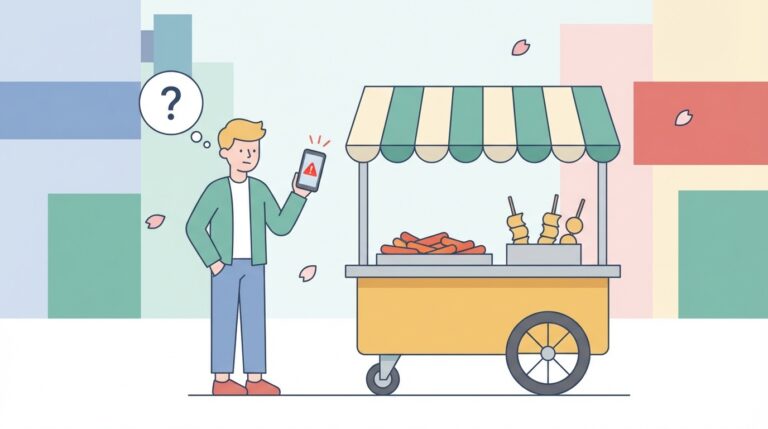
Picture this: You just finished a delicious plate of late-night Tteokbokki at a pojangmacha (Korean street food stall). It’s time to pay, but they only accept cash or 계좌 이체 (Bank Transfer). No problem, you think! You open your shiny new Korean banking app, type in your 4-digit or 6-digit PIN, and press send.
Suddenly, the screen flashes red. A pop-up appears: “비밀번호 오류”.
The line behind you is getting longer. The owner is looking at you. Your mind goes blank. In a K-Drama, this is the moment the camera does a dramatic zoom on the protagonist’s sweaty forehead with intense background music.
Don’t panic! As an absolute beginner (A1), banking terms can look like alien codes. But once you know these essential words, you’ll be transferring money like a true Seoulite. Today, we are going to learn how to survive a password error during a bank transfer in Korea.
Phase 2: 핵심 표현 심층 분석 (Deep Dive)
Let’s break down the red warning text on your screen into three bite-sized pieces.
1. 비밀번호 (Password / PIN)
- Pronunciation: bi-mil-beon-ho [Sounds like: “bee-meal” (a secret meal) + “bun-ho” (a hot dog bun)]
- Meaning: Secret number (비밀 = secret, 번호 = number)
- K-Culture Moment: You’ll see this everywhere in Korea! Not just on banking apps, but on digital door locks. Every Korean apartment has a keypad, and sharing your ‘비밀번호’ with someone in a K-Drama is a huge sign of intimacy.
- Editor’s Insight: It’s literally the key to your digital life in Korea. Young people often shorten it to ‘비번’ (bi-beon).
- Situation Spectrum:
[🚫 절대 금지] ———— [⚠️ 주의] ———— [✅ 자유롭게]
- Asking for a Wi-Fi password: ✅
- Asking for someone’s phone password: 🚫
- 🤔 Think About It: Why do Koreans prefer digital number locks over physical keys? Could it be related to Korea’s ultra-fast, convenient tech culture?
2. 오류 (Error)
- Pronunciation: o-ryu [Sounds like: “Oh, you (ryu)” made a mistake!]
- Meaning: Error, glitch, or mistake.
- K-Culture Moment: When ticketing for your favorite K-Pop idol’s concert, the website crashes because millions of fans clicked at once. The screen screams “서버 오류” (Server Error). It’s a K-Pop fan’s worst nightmare.
- Editor’s Insight: This is a formal word usually seen on screens or paper. You wouldn’t use it to say “I made a mistake” in conversation.
- Situation Spectrum:
[🚫 절대 금지] ———— [⚠️ 주의] ———— [✅ 자유롭게]
- Reading an app error message: ✅
- Saying “My bad” to a friend: 🚫 (Use “내가 틀렸어” instead)
- 🤔 Think About It: Does your language use a different word for a ‘computer error’ versus a ‘human mistake’?
3. 다시 입력해 주세요 (Please enter it again)
- Pronunciation: da-si im-nyeok-hae ju-se-yo [da-shee / eem-nyuck-hae / joo-seh-yo]
- Meaning: Again (다시) Input (입력해) Please give (주세요).
- K-Culture Moment: The polite robotic voice at the ATM tells you this when your thumb slips on the screen.
- Editor’s Insight: ‘주세요’ (Please give / Please do for me) is the magical word you will use 100 times a day in Korea.
- Situation Spectrum:
[🚫 절대 금지] ———— [⚠️ 주의] ———— [✅ 자유롭게]
- Reading it on an ATM screen: ✅
- Telling your boss to re-type something: ⚠️ (Requires more formal business Korean)
- 🤔 Think About It: Notice how Korean machines are always so polite? Even an ATM uses respectful grammar!
Phase 3: 교과서 vs 진짜 한국어 (Textbook vs Real Life)
| 상황 | 📖 교과서 한국어 | 🗣️ 진짜 한국어 | 💡 왜 다를까? |
|---|---|---|---|
| App says… | 비밀번호가 일치하지 않습니다. (The password does not match.) | 비밀번호 오류 (Password error) | System text is short and direct for quick reading. |
| You mess up | 비밀번호를 잘못 입력했습니다. (I inputted the password incorrectly.) | 아, 비번 틀렸다. (Ah, got the p-word wrong.) | ‘비번’ is the ultimate everyday slang for password. |
| Trying again | 다시 시도하겠습니다. (I will try again.) | 다시 해볼게요. (I’ll give it a go again.) | Using ‘~볼게요’ (try to do) softens your sentence! |
Bottom Note for A1: Just stick to “아, 틀렸다!” (Ah, it’s wrong!) when you mess up. It sounds super natural!
Phase 4: 문화적 맥락 — K-Culture Deep Dive
4-1. 비언어적 요소 (Non-verbal Communication: The ATM Pressure)
In Korea, there is a strong culture called 빨리빨리 (Pali-pali / Hurry, hurry). When you get a password error at an ATM or a store, you might feel the piercing gaze of the person waiting behind you. This is a great time to use your 눈치 (Nunchi). Just give a quick bow of your head to the person behind you and step aside to fix your app, or say “먼저 하세요” (Please go first). They will deeply appreciate it!
4-2. K-Culture Connection: The Cashless Society
Korea is basically a cashless society. Even tiny street food carts in Myeongdong have little signs with their bank account numbers. Koreans usually split the bill for food (K-BBQ, cafes) by having one person pay the whole amount, and the rest send their share via a banking app like Toss or KakaoPay. This is called 엔빵 (N-bbang / splitting by N people). If you get a password error during N-bbang, your friends might jokingly tease you, “Are you pretending to forget your password so you don’t have to pay?”
Phase 5: 실전 롤플레이 시나리오 (Immersive Roleplay)
시나리오 A: The K-BBQ Aftermath
Setting: Friday night, 8 PM. A smoky Samgyeopsal (pork belly) restaurant in Gangnam. You and your Korean coworker, Minsu, just finished a massive meal with soju. Minsu paid with his shiny credit card at the counter. Now, you are outside the restaurant trying to transfer your half of the money to him.
Characters:
– YOU: Foreigner in Korea, A1 Korean learner. Trying your best!
– Minsu (30): Friendly Korean coworker. Very patient, loves teaching you slang.
Dialogue:
Minsu: 배부르다! 오늘 삼겹살 진짜 맛있었죠?
(baebureuda! oneul samgyeopsal jinjja masisseotjyo?)
[I’m full! Today’s pork belly was really delicious, right?]
YOU: 네! 제가 돈 보낼게요.
(ne! jega don bonaelgeyo.)
[Yes! I will send the money.]
Minsu: 천천히 해요.
(cheoncheonhi haeyo.)
[Take your time.]
(🎭 Stage Direction: You open your banking app. You type the PIN. The screen shakes and turns red.)
YOU: 어? 안 돼요.
(eo? an dwaeyo.)
[Huh? It’s not working.]
Minsu: 왜요? 무슨 일 있어요?
(waeyo? museun il isseoyo?)
[Why? Is something wrong?]
YOU: 앱에 ‘비밀번호 오류’라고 나와요.
(aebe ‘bimilbeonho oryu’rago nawayo.)
[The app says ‘Password Error’.]
Minsu: 아, 비번 까먹었어요?
(a, bibeon kkameogeosseoyo?)
[Ah, did you forget your password?]
YOU: 네… 기억이 안 나요.
(ne… gieogi an nayo.)
[Yes… I can’t remember.]
Minsu: 괜찮아요. 5번 틀리면 안 되니까 조심해요.
(gwaenchanayo. daseot-beon teullimyeon an doenikka josimhaeyo.)
[It’s okay. If you get it wrong 5 times it will lock, so be careful.]
🔀 당신의 차례! 어떻게 대답할까요? (Decision Point)
– A) “비밀번호가 너무 어려워요.” (The password is too hard.)
– B) “현금으로 줄게요!” (I’ll give it to you in cash!)
– C) “민수 씨가 다 내세요!” (Minsu, you pay for everything!)✅ Best Choice: B — Offering cash is the quickest fix to avoid holding up your friend!
⚠️ Choice C 분석: Unless you are extremely close friends with Minsu, telling him to pay for everything might come off as rude, even as a joke!
Phase 6: 10초 섀도잉 드릴 (Shadowing Drill)
Practice making your panic sound natural! Follow the slashes for pauses and match the emotion.
- 😰 Panicked but trying to stay calm:
어? / 앱에 / 비밀번호 오류가 / 떴어요.
(eo? / aebe / bi-mil-beon-ho o-ryu-ga / tteot-seo-yo.)
Huh? A ‘password error’ popped up on the app. -
🥺 Asking for patience:
잠시만요! / 다시 / 해볼게요.
(jam-si-man-yo! / da-si / hae-bol-ge-yo.)
Just a moment! I will try again.
Phase 7: K-Culture 미니 사전 (K-Culture Glossary)
| 한국어 | Romanization | 영어 | 맥락 설명 |
|---|---|---|---|
| 비밀번호 (비번) | bi-mil-beon-ho (bi-beon) | Password / PIN | ‘비번’ is the casual abbreviation. Use it to sound like a local. |
| 계좌 이체 | gye-jwa i-che | Bank Transfer | The lifeline of Korean transactions. Used for everything from rent to splitting food bills. |
| 엔빵 | en-bbang | Dutch Pay / Split the bill | Derived from ‘1/N’. The cultural norm for paying with friends. |
| 오류 | o-ryu | Error / Glitch | Formal word seen on digital screens. |
| 송금 | song-geum | Remittance / Sending money | Another word for transferring money, often seen in apps like Toss or KakaoPay. |
Phase 8: 여행자 서바이벌 키트 (Traveler’s Survival Kit)
Even if you are just a tourist and don’t have a Korean bank app, you will use ATMs! Here is how to survive.
🆘 서바이벌 표현 TOP 3
– 🇰🇷 “비밀번호가 뭐예요?” (bi-mil-beon-ho-ga mwo-ye-yo?)
– 🗣️ English: What is the password?
– 📍 Where to use: Asking for Wi-Fi at a cafe or hotel.
– 🇰🇷 “현금 되나요?” (hyeon-geum doe-na-yo?)
– 🗣️ English: Do you accept cash?
– 📍 Where to use: When your card gets an error and you need to pay quickly.
– 🇰🇷 “ATM이 어디 있어요?” (에이티엠-이 eo-di it-seo-yo?)
– 🗣️ English: Where is the ATM?
– 📍 Where to use: When you run out of cash at a street market.📌 Editor’s Travel Note
– Global ATMs: Not all Korean ATMs accept foreign cards. Look for ATMs with a “Global ATM” sign (usually found in convenience stores like CU, GS25, or big bank branches).
– PIN Length: Most Korean ATMs require a 4-digit PIN. If yours is 6 digits, try entering your 4 digits + 00.
– Card Heaven: Korea is a card heaven. You can pay for a 1,000 won ($0.75) pack of gum with a credit card. But always carry some cash for street food and T-money (transit card) reloads!
Phase 9: 비판적 사고 코너 — “한 발 더 깊이” (Think Deeper)
🧠 Think Deeper: The Digital Pressure in a Cashless Society
Korea’s internet is arguably the fastest in the world, and digital banking is deeply woven into daily life. From splitting a $3 coffee to paying rent, it’s all done on smartphones within seconds. But this extreme convenience comes with a hidden stress: when technology fails, humans panic. A simple “비밀번호 오류” (Password error) makes us feel like we are breaking the social contract of “Pali-pali” (speed).💬 Your Turn: How digitalized is banking in your country? Do people still prefer cash, or do you feel the same pressure when your payment app takes too long to load? Let me know in the comments!
Phase 10: FAQ & 오해 방지 (Troubleshooting)
Q: “My banking app got locked after 5 tries. What do I do?”
A: You will usually see the message “5회 오류” (5 times error). In Korea, security is very strict. If you lock your banking app, you often have to physically visit the bank branch with your ARC (Alien Registration Card) or verify your identity via a Korean phone number. Be careful!
Q: “Can I use ‘오류’ when I make a mistake speaking Korean?”
A: No! ‘오류’ is strictly for system or logical errors. If you make a mistake speaking, just say “실수했어요” (I made a mistake).
❌ 흔한 실수 #1: Confusing your App Password with your Account PIN.
✅ 이렇게 하세요: Korean banks often require two passwords. An App Login Password (often 6 digits or Face ID), and an Account Transfer PIN (계좌 비밀번호 – 4 digits). Make sure you know which one the app is asking for!
Phase 11: 요약 및 액션 아이템 (Wrap-up)
💡 One-Liner Summary: When your screen says 비밀번호 오류 (Password error), take a deep breath and gently tap 다시 해볼게요 (I’ll try again).
🎯 Action Mission:
– 🥉 Bronze (혼자서): Look at your phone lock screen and say “비밀번호!” out loud before you type it.
– 🥈 Silver (온라인): Change your phone’s language to Korean for 10 minutes and try to find the word ‘비밀번호’ in your settings.
– 🥇 Gold (실전): Next time you go to a Korean cafe, ask for the Wi-Fi password in Korean: “와이파이 비밀번호가 뭐예요?”
🇰🇷 K-Culture Mission:
Watch any K-Drama involving an office setting. Watch how they go out for team dinners (회식). I guarantee someone will say “내가 살게!” (I’ll pay!) and someone else will insist on sending money (계좌 이체). Spot the moment!
Phase 12: 퀴즈 — 인터랙티브 챌린지 (Interactive Quiz)
Q1. You are at a cafe and want to use the internet. What do you ask the barista?
A) 와이파이 오류가 뭐예요? (What is the Wi-Fi error?)
B) 와이파이 비밀번호가 뭐예요? (What is the Wi-Fi password?)
C) 와이파이 엔빵 되나요? (Can we Dutch pay the Wi-Fi?)
Q2. True or False – K-Culture Edition:
“In Korea, if your payment app shows ‘비밀번호 오류’, the cashier will yell at you.”
Q3. Fill in the blank:
Ah, I got my password wrong again. Let me try ____.
아, 비밀번호 틀렸다. ______ 해볼게요.
(Scroll down for answers!)
.
.
.
Answers:
1. B (You need the ‘비밀번호’ to connect!)
2. False (Koreans might love speed, but cashiers are polite. They will usually just ask you to try again or ask if you have another card.)
3. 다시 (da-si / again)
Frequently Asked Questions (FAQ)
Q: What does "비밀번호 (Password / PIN)" mean in Korean and how do you pronounce it?
A: In Korean, "비밀번호 (Password / PIN)" is pronounced [bi-mil-beon-ho [Sounds like: "bee-meal" (a secret meal] and means: Secret number (비밀 = secret, 번호 = number)
Q: What does "오류 (Error)" mean in Korean and how do you pronounce it?
A: In Korean, "오류 (Error)" is pronounced [o-ryu [Sounds like: "Oh, you (ryu] and means: Error, glitch, or mistake.
Q: What does "다시 입력해 주세요 (Please enter it again)" mean in Korean and how do you pronounce it?
A: In Korean, "다시 입력해 주세요 (Please enter it again)" is pronounced [da-si im-nyeok-hae ju-se-yo [da-shee / eem-nyuck-hae / joo-seh-yo] and means: Again (다시) Input (입력해) Please give (주세요).







