

Phase 1: Immersive Hook
Hello there! It’s your lead editor at Daily Hangul.
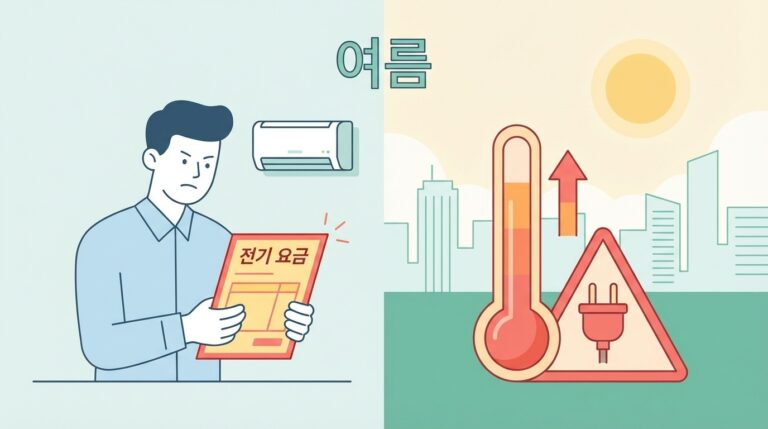
Picture this: You’re watching a classic K-Drama. The protagonist, a hardworking student, lives in a tiny rooftop room (옥탑방). It’s mid-August, the cicadas are screaming outside, and the air is thick with humidity. The character is sweating profusely but only turns on their tiny wall-mounted air conditioner for exactly one hour before quickly shutting it off with a sigh.
Why don’t they just leave it on? Is it purely for environmental reasons?
If you live in Korea, you know the real villain of the summer isn’t just the heat—it’s the dreaded 누진세 (progressive electricity tax) and the fear of the 냉방비 폭탄 (cooling bill bomb).
At the C2 level, you’re not just ordering iced Americanos anymore. You are tuning into prime-time news, discussing socio-economic policies with your Korean colleagues, and experiencing the societal anxiety when the national news anchor announces that the “power reserve margin has dropped to single digits.”
Today, we are diving deep into the advanced vocabulary of Korea’s summer energy management, government cooling subsidies, and the cultural nuances of surviving the scorching heat. This guide is built from real questions asked by advanced learners who wanted to understand the deeper context behind Korean summer news. Let’s turn up the AC and dive in!
Phase 2: Deep Dive into Core Expressions
At the C2 level, your goal is to master idiomatic expressions heavily used in media and high-level adult conversations. Here are the must-know phrases for the Korean summer.
1. 냉방비 폭탄을 맞다
- Pronunciation: [naengbangbi poktaneul matda] + [sounds like: neng-bang-bee pohk-tah-neul maht-dah]
- Meaning: (Literal) To be hit by a cooling expense bomb. / (Real Nuance) To receive a shockingly high electricity bill due to using the air conditioner.
- K-Culture Moment: It’s late August. Your Korean coworker walks into the office looking utterly defeated. They slap their utility bill on the desk and sigh. They didn’t literally step on a landmine; they just saw their electricity bill after running the AC during a two-week heatwave.
- Editor’s Insight: The word ‘폭탄 (bomb)’ is frequently attached to bills in Korean to indicate a sudden, shocking financial burden (e.g., 세금 폭탄 – tax bomb). It carries a sense of victimhood—you didn’t just spend the money; the bill attacked you.
- Situation Spectrum:
[🚫 절대 금지] ———— [⚠️ 주의] ———— [✅ 자유롭게]
- Casual with friends: ✅
- Semi-formal (Coworkers commiserating): ✅
- Formal (Official news reports): ✅ (It’s surprisingly common even in news headlines!)
- 🤔 Think About It: Korea uses a progressive billing system (누진세) for residential electricity, meaning the unit price jumps significantly the more you use. Why do you think residential power is heavily taxed while industrial power is often subsidized in Korea? How does this reflect Korea’s history of rapid industrialization?
2. 전력 예비율에 비상이 걸리다
- Pronunciation: [jeollyeok yebiyure bisangi geollida] + [sounds like: juhl-lyuhk ye-bee-yu-re bee-sang-ee guhl-lee-dah]
- Meaning: (Literal) An emergency is triggered on the power reserve margin. / (Real Nuance) The national electricity reserve has dropped to dangerously low levels, raising the risk of blackouts.
- K-Culture Moment: You’re in a crowded restaurant. Suddenly, the TV news switches to a bold red graphic showing a percentage dropping below 10%. The government sends out an emergency alert to all smartphones, urging citizens to unplug unused appliances.
- Editor’s Insight: “비상이 걸리다” is a fantastic advanced idiom. It means a state of emergency has been declared or a critical situation has arisen. In the context of the national grid, it’s the ultimate buzzword of late July and early August.
- Situation Spectrum:
[🚫 절대 금지] ———— [⚠️ 주의] ———— [✅ 자유롭게]
- Casual with friends: ⚠️ (A bit too formal for grabbing beers, unless you’re debating politics)
- Semi-formal/Workplace: ✅
- Formal/Academic/News: ✅
- 🤔 Think About It: The fear of a “Blackout (블랙아웃)” is a recurring summer theme in Korea. How does the Korean collective mindset respond to these national alerts compared to how individualistic cultures might react to government requests to limit personal energy use?
3. 에너지 취약계층을 지원하다
- Pronunciation: [eneoji chwiyakgyecheungeul jiwonhada] + [sounds like: eh-nuh-jee chwee-yak-gye-cheung-eul jee-wuhn-ha-dah]
- Meaning: (Literal) To support energy-vulnerable social classes. / (Real Nuance) To provide government subsidies (like Energy Vouchers) to low-income households who cannot afford heating or cooling.
- K-Culture Moment: A documentary shows elderly citizens spending their summer days at local banks or subway stations just to enjoy the free air conditioning, as they cannot afford to turn on fans or ACs in their small ‘jjokbang’ (tiny single rooms) or rooftop apartments.
- Editor’s Insight: “취약계층 (vulnerable class)” is a high-frequency C2 vocabulary word. When discussing welfare policies, this phrase instantly elevates your Korean to a near-native, educated level.
- Situation Spectrum:
[🚫 절대 금지] ———— [⚠️ 주의] ———— [✅ 자유롭게]
- Casual with friends: ⚠️ (Too academic for light chat)
- Formal/Debate/News: ✅
- 🤔 Think About It: In Korean policy-making, “energy” is increasingly viewed as a basic human right rather than just a commodity. Is “energy poverty” a topic of discussion in your home country?
Phase 3: Textbook vs Real Life
How do these formal concepts translate into everyday complaints? Let’s take a look.
| Situation | 📖 Textbook / News Korean | 🗣️ Real Life / Conversational Korean | 💡 Why the difference? |
|---|---|---|---|
| Shock over a high bill | 이번 달 전기요금이 많이 나왔습니다. | 와, 이번 달 에어컨 틀었더니 냉방비 폭탄 맞았어. | Everyday Korean heavily utilizes dramatic metaphors (like ‘bomb’) to emphasize emotional distress over expenses. |
| Government asking to save energy | 전력 예비율이 낮아 에너지 절약이 필요합니다. | 오늘 예비율 간당간당하대. 블랙아웃 오는 거 아냐? | ‘간당간당하다’ (barely hanging on/precarious) is a highly native, expressive way to describe a tight power reserve. |
| Discussing welfare for the poor | 에너지 취약계층에게 냉방비를 지원합니다. | 뉴스 보니까 이번에 저소득층 에너지 바우처 준다더라. | In daily speech, Koreans often use Konglish like ‘바우처 (voucher)’ alongside colloquial quoting grammar (-다더라). |
Bottom Note: At the C2 level, weaving words like “간당간당하다” into a serious discussion about the power grid shows true mastery of tone-shifting.
Phase 4: Cultural Deep Dive
4-1. Non-verbal Communication: The Collective Sweat
If you work in a Korean corporate office or a government building during summer, you will experience the “쿨비즈” (Cool Biz) culture and government-mandated AC limits (usually set strictly to 26°C or 28°C).
The Nunchi Game: You might feel roasting hot, but turning down the AC thermostat in a shared office is a delicate game of Nunchi (눈치). You don’t just change it. You gently fan yourself, maybe dab your forehead, and wait for a senior colleague to say, “아우, 좀 덥지 않아? 에어컨 온도 좀 낮출까?” (Wow, isn’t it a bit hot? Should we lower the AC?). Only then is it socially acceptable to touch the dial.
4-2. K-Culture Connection: The Paradox of “Open-Door Cooling”
K-Travel & K-Business: Walk through Myeongdong on a 35°C day, and you’ll notice an incredible phenomenon: cosmetic shops and clothing stores with their doors wide open, blasting freezing air onto the street. This is called 개문냉방 (Open-door cooling).
However, when the power reserve margin (전력 예비율) drops, the government sends inspectors to fine stores doing this. At the C2 level, you’ll see news editorials criticizing this practice: “Why do citizens have to suffer the progressive tax at home while commercial stores waste electricity?” Understanding this tension is key to grasping Korean summer social dynamics.
Phase 5: Immersive Roleplay Scenario
Scenario A: The Office Heatwave
Setting: It’s 2:00 PM on a sweltering Tuesday in mid-August. You are working at a Korean firm. The government has just issued an energy warning, and the building management has centrally locked the AC at 27°C. Your team is sweating.
Characters:
– YOU: The foreign manager, well-versed in Korean news.
– Jimin (지민): A junior employee, fanning herself with a file.
– Manager Choi (최 부장): Your senior manager, sipping a hot Americano (because… 이열치열, fighting heat with heat).
Dialogue:
지민: 아… 진짜 너무 덥지 않아요? 숨이 턱턱 막히네요. 🥵
(a… jinjja neomu deopji anayo? sumi teokteok makineyo.)
[Ah… isn’t it seriously too hot? I can barely breathe.]
(🎭 Stage Direction: Jimin aggressively fans herself)
YOU: 맞아요. 사무실 온도가 27도에 맞춰져 있어서 더 그런 것 같아요.
(majayo. samusil ondoga isipchildoe matchwojyeo isseoseo deo geureon geot gatayo.)
[You’re right. I think it’s worse because the office temperature is set to 27 degrees.]
최 부장: 뉴스 보니까 오늘 전력 예비율에 비상이 걸렸대잖아. 블랙아웃 될까 봐 건물 전체에서 통제하는 모양이야.
(nyuseu bonikka oneul jeollyeok yebiyure bisangi geollyetdaejana. beullaegaut doelkka bwa geonmul jeoncheeseo tongjehaneun moyangiya.)
[I saw on the news that the power reserve margin is in a state of emergency today. Looks like the whole building is controlling it in case of a blackout.]
🔀 Your Turn! How do you respond to Manager Choi?
– A) “아, 그렇군요. 어쩔 수 없네요.” (Ah, I see. It can’t be helped.)
– B) “그래도 상점들은 문 열어놓고 에어컨 빵빵하게 틀던데, 우리만 고생이네요.”
– C) “최 부장님, 너무 더운데 그냥 집에 가도 될까요?”✅ Best Choice: B — This shows advanced cultural and linguistic competence. You are commiserating with your colleagues by bringing up a relevant social critique (commercial vs. residential/office energy use).
⚠️ Choice C Analysis: Even as a joke, asking to go home because it’s hot will definitely trigger a “Latte is horse (라떼는 말이야 – Back in my day)” lecture from Manager Choi about how they used to work without AC in the 90s.
최 부장: (Chuckles) 내 말이! 가정용 누진세만 무섭고, 상업용 전기는 싼 게 참 아이러니하지.
(nae mari! gajeongyong nujinseman museopgo, sangeobyong jeongineun ssan ge cham aieoreonihaji.)
[That’s what I’m saying! It’s quite ironic that only residential progressive tax is scary, while commercial electricity is cheap.]
Scenario B: Bonus – The Rooftop Room Reality
Setting: Chatting with a Korean friend who just moved into a cheap rooftop room (옥탑방).
Friend: 나 이번 달 에어컨 요금 보고 기절할 뻔했어…
(na ibeon dal eeokeon yogeum bogo gijeolhal ppeonhaesseo…)
[I almost passed out looking at my AC bill this month…]
YOU: 왜? 냉방비 폭탄 맞았어?
(wae? naengbangbi poktan majasseo?)
[Why? Did you get hit by a cooling bill bomb?]
Friend: 어. 누진세 무서운 줄 모르고 밤새 틀었다가 20만 원 나왔어. 😭
(eo. nujinse museoun jul moreugo bamsae teureotdaga isipman won nawasseo.)
[Yeah. I didn’t realize how scary the progressive tax was and left it on all night… it came out to 200,000 won.]
Phase 6: 10-Second Shadowing Drill
Practice this sentence to sound like an educated local discussing the news.
😤 올여름은 / 폭염 때문에 / 냉방비 폭탄을 / 맞을까 봐 / 무섭네요.
(ollyeoreumeun / pogyeom ttaemune / naengbangbi poktaneul / majeulkka bwa / museomneyo.)
Emotion: Sighing, slightly worried, shaking your head.
🤔 정부에서 / 에너지 취약계층에 대한 / 지원을 / 더 늘려야 한다고 / 생각해요.
(jeongbueseo / eneoji chwiyakgyecheunge daehan / jiwoneul / deo neullyeoya handago / saenggakaeyo.)
Emotion: Serious, analytical, persuasive.
Phase 7: K-Culture Glossary
| Korean | Romanization | English | Contextual Meaning |
|---|---|---|---|
| 누진세 | nujinse | Progressive Tax | The system where the electricity rate per kWh increases as you use more power. The ultimate fear of Korean households in summer. |
| 블랙아웃 | beullaegaut | Blackout | A large-scale power outage. A heavily used media buzzword when the energy reserve drops. |
| 대프리카 | Daepurika | Daegu + Africa | A slang term combining the city of Daegu (the hottest city in Korea) and Africa, used to describe extreme summer heat. |
| 이열치열 | iyeolchiyeol | Fight heat with heat | An ancient philosophy (still practiced today) of eating boiling hot foods like Samgyetang (ginseng chicken soup) on the hottest days of summer to regulate body temperature. |
| 쿨비즈 | kulbijeu | Cool Biz | Campaigns encouraging office workers to wear short sleeves and no ties to save AC energy. |
Phase 8: Traveler & Expat Survival Kit
Even if you’re engaging in C2 level debates, you still need to survive the heat practically. If you are living or traveling in Korea during July and August, memorize these.
🆘 Survival Expressions
– 🇰🇷 “에어컨 좀 빵빵하게 틀어주실 수 있나요?” (eeokeon jom ppangppanghage teureojusil su innayo?)
– 🗣️ Meaning: Could you blast the AC a bit more?
– 📍 Where to use: Taxis, small cafes.
– 💡 Pro Tip: ‘빵빵하게’ is a fantastic onomatopoeia/mimetic word meaning ‘fully/strongly’.
- 🇰🇷 “두꺼비집이 내려갔어요.” (dukkeobijibi naeryeogasseoyo.)
- 🗣️ Meaning: The circuit breaker tripped. (Literally: The toad house went down).
- 📍 Where to use: Calling your landlord or building management.
- 💡 Pro Tip: Due to AC overuse, circuit breakers trip often. In Korea, the fuse box is affectionately called a ‘toad house’ (두꺼비집) because old ceramic fuse boxes looked like toads!
📌 Editor’s Travel Note
– Public Transportation: Korean subways are heavily air-conditioned. If you get cold easily, look for the “약냉방차” (Mild Cooling Car), usually the 4th or 5th carriage of the train, where the temp is kept slightly warmer.
– Gov Buildings/Banks: Don’t expect freezing AC in government-affiliated buildings. They strictly adhere to the national energy conservation limits.
Phase 9: Think Deeper — “One Step Further”
🧠 Think Deeper: Media vs Reality (The Romanticized Rooftop)
In K-Dramas, the Ok-tap-bang (rooftop room) is often portrayed as a romantic, cozy space where young protagonists drink beer while looking at the Seoul skyline. However, the socio-economic reality is starkly different. Rooftop rooms are poorly insulated, making them freezing in winter and literal ovens in summer. When the media discusses 에너지 취약계층 (the energy-vulnerable class), rooftop dwellers and the elderly in jjokbang (cubicle-like rooms) are the primary focus. They cannot escape the heat due to the fear of the progressive tax (누진세). Therefore, what you see as a cute drama trope is actually the frontline of Korea’s urban energy crisis.💬 Your Turn: Does your country have a specific housing type that media romanticizes, but reality shows is actually a sign of economic struggle? Share your thoughts in the comments!
Phase 10: Troubleshooting & FAQ
Q: Can I use “폭탄 (bomb)” in a professional setting? Like telling my boss we got a “tax bomb”?
Yes and No. If you are commiserating about personal electricity bills, saying “저 냉방비 폭탄 맞았습니다” to your boss is perfectly fine and shows natural fluency. However, do NOT use it in official B2B communications or formal presentations to describe corporate expenses.
Q: I heard the news say “전력 대란” (jeollyeok daeran). Is that the same as “블랙아웃”?
Great catch! “대란” means a massive crisis or chaos. “전력 대란” (power crisis) is the broader situation of extreme energy shortage, which could lead to a “블랙아웃” (the actual physical outage).
❌ Common Mistake #1: Trying to directly translate “I can’t afford the AC bill.”
You might want to say, “에어컨 요금을 낼 돈이 없어요” (I don’t have money to pay the AC bill). While grammatically correct, Koreans naturally say, “전기세 무서워서 에어컨을 못 틀겠어요” (I can’t turn on the AC because I’m scared of the electricity bill).
Phase 11: Wrap-up & Action Items
One-Liner Summary: Surviving the Korean summer requires understanding the delicate balance between escaping the heat, fearing the progressive tax (누진세), and watching the national power reserve (전력 예비율).
Your Action Mission:
– 🥉 Bronze: Stand in front of a mirror and dramatically sigh while saying, “이번 달 냉방비 폭탄 맞았어!”
– 🥈 Silver: Go to a Korean news portal (like Naver News) and search for the keyword “전력 예비율”. Try to read the headline of one article!
– 🥇 Gold (Real Life): The next time you are sweating with a Korean friend or colleague, initiate the Nunchi game by saying, “뉴스 보니까 오늘 예비율 간당간당하다던데, 에어컨 틀어도 될까요?” (I heard on the news the power reserve is precarious today, is it okay if we turn on the AC?)
K-Culture Mission: Watch any modern K-Drama set in summer. Spot the scene where a character receives a bill in the mail or checks their phone, gasps, and yells about the “전기요금” (electricity bill).
How do you survive the summer heat in your country? Let me know in the comments below!
Phase 12: Interactive Quiz
1. Situational Judgment:
Your Korean friend shows you their August electricity bill of 300,000 won and looks like they might cry. What is the most culturally appropriate native response?
– A) “전기 에너지를 너무 많이 낭비했네요.” (You wasted too much electrical energy.)
– B) “와… 완전 냉방비 폭탄 맞았네. 어떡해?”
– C) “에너지 취약계층이군요.”
Answer: B. (A is too robotic and judgmental. C is an academic/political term and insulting to say to a friend’s face!)
2. Fill in the blank:
정부는 올여름 덥고 습한 날씨로 인해 (________) 우려가 커지자, 상점들의 개문냉방을 단속하기로 했습니다.
(The government decided to crack down on stores’ open-door cooling as concerns over ________ grew due to the hot and humid weather this summer.)
– A) 누진세 (Progressive tax)
– B) 블랙아웃 (Blackout)
– C) 이열치열 (Fighting heat with heat)
Answer: B. (The government cracks down on energy waste to prevent blackouts).
3. True or False – K-Culture Edition:
If you go to a public bank or local government office in Korea during a heatwave, you might see elderly people sitting in the lobby just to enjoy the AC.
*Answer: True! Banks are famous
Frequently Asked Questions (FAQ)
Q: What does "냉방비 폭탄을 맞다" mean in Korean and how do you pronounce it?
A: In Korean, "냉방비 폭탄을 맞다" is pronounced [naengbangbi poktaneul matda] and means: (Literal) To be hit by a cooling expense bomb. / (Real Nuance) To receive a shockingly high electricity bill due to using the air conditioner.
Q: What does "전력 예비율에 비상이 걸리다" mean in Korean and how do you pronounce it?
A: In Korean, "전력 예비율에 비상이 걸리다" is pronounced [jeollyeok yebiyure bisangi geollida] and means: (Literal) An emergency is triggered on the power reserve margin. / (Real Nuance) The national electricity reserve has dropped to dangerously low levels, raising the risk of blackouts.
Q: What does "에너지 취약계층을 지원하다" mean in Korean and how do you pronounce it?
A: In Korean, "에너지 취약계층을 지원하다" is pronounced [eneoji chwiyakgyecheungeul jiwonhada] and means: (Literal) To support energy-vulnerable social classes. / (Real Nuance) To provide government subsidies (like Energy Vouchers) to low-income households who cannot afford heating or cooling.






