

Phase 1: Immersive Hook
Hello there! I’m your lead editor at Daily Hangul.
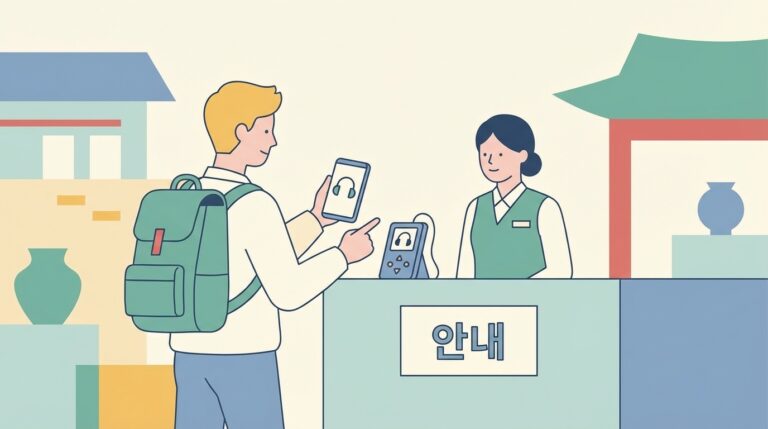
Picture this: You are walking through the grand halls of the National Museum of Korea, or perhaps a trendy modern art gallery in Seoul. It feels just like that iconic scene from a K-Drama where the main characters accidentally brush hands while reaching for the same brochure. The lighting is perfect, the artifacts are mesmerizing, but… you have no idea what the descriptions say. The English text is either too short or non-existent.
You see other people walking around with sleek headsets, completely immersed. You want one too! But walking up to the information desk, your mind goes blank.
Don’t worry! Today, we are going to learn exactly how to ask for an audio guide in Korea. Whether you are a K-Art enthusiast or just trying to survive the Seoul summer heat inside an air-conditioned museum, these simple A2-level phrases will make you look like a seasoned expat. Let’s dive in!
Phase 2: Deep Dive into Core Expressions
Let’s break down the essential phrases you will actually use at the front desk.
1. 오디오 가이드 있어요?
- Pronunciation: o-di-o ga-i-deu i-sseo-yo? (‘eo’ sounds like the ‘uh’ in ‘uh-oh’. ‘sseo’ is a sharp, hissing ‘s’.)
- Meaning: Do you have an audio guide? (Literal: Audio guide exists?)
- K-Culture Moment: You can use “[Item] 있어요?” anywhere in Korea! From asking for a specific album at a K-Pop pop-up store to asking for extra napkins at a BBQ joint.
- Editor’s Insight: This is the most natural, stress-free way to ask for something. You don’t need complex verbs like “I would like to acquire…”. Just ask if it exists!
- Situation Spectrum:
[🚫 절대 금지] ———— [⚠️ 주의] ———— [✅ 자유롭게]
- Close Friends (Casual): ⚠️ (Drop the ‘yo’ and just say ‘isseo?’)
- Staff/Clerks (Semi-formal): ✅
- Formal/Business (Formal): ✅ (Perfectly polite for service situations!)
- 🤔 Think About It: Why do Koreans ask “Does it exist?” instead of “Do you have?” Korean language focuses less on who owns the object and more on the situation itself. Does your native language focus on the person (I have) or the object (It is)?
2. 영어 지원 되나요?
- Pronunciation: yeong-eo ji-won doe-na-yo? (‘doe’ sounds exactly like ‘dway’ in ‘dwight’.)
- Meaning: Is English supported? / Is it available in English?
- K-Culture Moment: You’ll see the word ‘지원’ (support/application) a lot in Korea, especially regarding tech. Whether you are using a self-checkout kiosk at a convenience store or renting a bike, this phrase is a lifesaver.
- Editor’s Insight: Instead of trying to say “Can I listen in English?”, Koreans simply ask if English is “supported” (지원). It sounds very local and tech-savvy!
- Situation Spectrum:
[🚫 절대 금지] ———— [⚠️ 주의] ———— [✅ 자유롭게]
- Casual: ⚠️
- Staff/Clerks: ✅
- Formal/Business: ✅
- 🤔 Think About It: Korea is a highly digitized society. Notice how everyday language heavily borrows terms from technology and software (like ‘지원’ – support)?
3. 신분증 맡겨야 돼요?
- Pronunciation: sin-bun-jeung mat-gyeo-ya dwae-yo?
- Meaning: Do I have to leave my ID?
- K-Culture Moment: In Korea, trust is high, but collateral is still a thing! When renting an audio guide, a locker key, or even a picnic mat at the Han River, you will often be asked to leave your ID (신분증) as a deposit.
- Editor’s Insight: ‘맡기다’ means ‘to entrust’ or ‘to leave something with someone’. It implies you will definitely come back to get it!
- Situation Spectrum:
[🚫 절대 금지] ———— [⚠️ 주의] ———— [✅ 자유롭게]
- Casual: ⚠️
- Staff/Clerks: ✅
- Formal/Business: ✅
Phase 3: Textbook vs Real Life
Let’s see how the Korean you learn in traditional textbooks differs from what you hear at the Seoul Museum of Art.
| Situation | 📖 Textbook Korean | 🗣️ Real Korean | 💡 Why is it different? |
|---|---|---|---|
| Asking to rent | 오디오 가이드를 대여하고 싶습니다. (I would like to rent…) | 오디오 가이드 하나 빌릴게요. (I’ll rent one guide.) | ‘대여하다’ is a formal written word. In speech, Koreans prefer the easier native verb ‘빌리다’. |
| Asking the price | 요금이 얼마입니까? (How much is the fee?) | 이거 얼마예요? (How much is this?) | Efficiency! “이거 얼마예요?” works for literally everything with a price tag. |
| Handing over ID | 여기 제 신분증이 있습니다. (Here is my ID.) | 네, 여기요. (Yes, here you go.) | Shorter is sweeter in fast-paced service interactions. |
Bottom Note for A2 Learners: Don’t stress about using big, formal words. The polite ‘-요’ (-yo) form is your best friend. It’s respectful but natural!
Phase 4: Cultural Deep Dive
4-1. Non-verbal Communication: The “Two-Hand” Rule
When the museum staff asks for your ID (passport or Alien Registration Card), how should you hand it to them? In Korea, giving or receiving items with one hand can seem a bit rude, especially to someone you don’t know.
Always use two hands to hand over your ID or credit card. If you are holding your phone in one hand, you can use your free hand to give the card, while placing your other hand lightly under your own elbow. It is a subtle gesture of respect that will instantly make Koreans think, “Wow, this person really understands our culture!”
4-2. K-Travel Connection: The App Revolution
Here’s a crucial cultural context: Korea is insanely high-tech. Ten years ago, museums handed out bulky MP3 players. Today? Don’t be surprised if the staff simply points to a QR code and says, “어플 다운받으세요” (Please download the app).
Many major museums (like the National Museum of Modern and Contemporary Art) now use their own smartphone apps for audio guides.
Survival Tip: Make sure your phone is charged, and definitely bring your own earphones! Using a speaker in a quiet Korean gallery will earn you some serious 눈치 (nunchi – awkward glares).
Phase 5: Immersive Roleplay Scenario
Setting: A quiet Tuesday afternoon at the Leeum Museum of Art. The lobby is echoey, modern, and sleek. You walk up to the information desk.
Characters:
– YOU: An art lover who really wants to understand the meaning behind a traditional Korean vase.
– Staff (Jiwon): A polite, soft-spoken museum employee.
Jiwon: 안녕하세요! 관람권 도와드릴까요?
(an-nyeong-ha-se-yo! gwal-lam-gwon do-wa-deu-ril-kka-yo?)
[Hello! Can I help you with an admission ticket?]
YOU: 안녕하세요. 오디오 가이드 있어요?
(an-nyeong-ha-se-yo. o-di-o ga-i-deu i-sseo-yo?)
[Hello. Do you have an audio guide?]
Jiwon: 네, 있습니다. 한국어, 영어, 일본어 지원됩니다.
(ne, it-seum-ni-da. han-gu-geo, yeong-eo, il-bo-neo ji-won-doem-ni-da.)
[Yes, we do. Korean, English, and Japanese are supported.]
YOU: 오, 영어로 하나 빌릴게요. 얼마예요?
(o, yeong-eo-ro ha-na bil-lil-ge-yo. eol-ma-ye-yo?)
[Oh, I’ll rent one in English. How much is it?]
Jiwon: 무료입니다. 신분증 하나 맡겨주세요.
(mu-ryo-im-ni-da. sin-bun-jeung ha-na mat-gyeo-ju-se-yo.)
[It is free. Please leave one ID with me.]
🔀 Your Turn! How do you respond and act?
– A) Slide your ID across the desk with one hand and say “Here.”
– B) Hand your ID over with two hands and say, “네, 여기요.” (Yes, here you go.)
– C) Say “여권 없어요!” (I don’t have a passport!) and walk away.✅ Best Choice: B — Remember the Two-Hand Rule! Also, “네, 여기요” is the perfect, polite phrase when handing something over.
⚠️ Choice A Analysis: Sliding cards or using one hand can come off as slightly arrogant in Korea.
Bonus K-Culture Scenario: The Heavy Bag
You got the guide, but your backpack is too heavy for a 2-hour art tour.
YOU: 저기요… 물품보관소 어디 있어요?
(jeo-gi-yo… mul-pum-bo-gwan-so eo-di i-sseo-yo?)
[Excuse me… where is the locker/baggage storage?]
Jiwon: 아, 저쪽 끝에 있습니다. 100원 동전 필요해요.
(a, jeo-jjok kkeu-te it-seum-ni-da. bae-gwon dong-jeon pi-ryo-hae-yo.)
[Ah, it’s at the end over there. You need a 100 won coin.]
Phase 6: 10-Second Shadowing Drill
Practice speaking out loud! Follow the slashes for natural pauses, and match the emotion tag.
😊 밝게 (Brightly)
저기요, / 오디오 가이드 / 있어요?
(jeo-gi-yo, / o-di-o ga-i-deu / i-sseo-yo?)
🤔 궁금하게 (Curiously)
영어 / 지원 되나요?
(yeong-eo / ji-won doe-na-yo?)
🙏 정중하게 (Politely)
네, / 여기 제 신분증이요.
(ne, / yeo-gi je sin-bun-jeung-i-yo.)
Phase 7: K-Culture Glossary
| Korean | Romanization | English | Cultural Context |
|---|---|---|---|
| 신분증 | sinbunjeung | ID Card | A must-have for rentals. A passport or foreign registration card works! |
| 무료 | muryo | Free (of charge) | Koreans love ‘무료’! Many national museums in Korea are actually free to enter. |
| 물품보관소 | mulpumbogwanso | Locker / Storage | Korean museums usually have amazing locker facilities, often free or requiring just a refundable 100-won coin. |
| 눈치 | nunchi | Social awareness | Reading the room. E.g., not playing your audio guide out loud without earphones. |
| 어플 | eopeul | App (Application) | Konglish for mobile applications. Audio guides are increasingly app-based. |
Phase 8: Traveler’s Survival Kit
🆘 Survival Phrases for the Museum / Rentals
– 🇰🇷 “이거 무료예요?” (i-geo mu-ryo-ye-yo?) – Is this free?
– 🇰🇷 “와이파이 비밀번호 뭐예요?” (wa-i-pa-i bi-mil-beon-ho mwo-ye-yo?) – What is the Wi-Fi password?
– 🇰🇷 “사진 찍어도 돼요?” (sa-jin jji-geo-do dwae-yo?) – Is it okay to take pictures?📌 Editor’s Travel Note:
– Photos: Always ask if photos are allowed! Some special exhibits strictly prohibit photography.
– Lockers: Always carry a 100-won coin if you plan to visit museums or subway stations. Most lockers require it to lock, but you get the coin back when you return the key!
– Wi-Fi: You will need Wi-Fi to download the audio guide app. Luckily, Korean public Wi-Fi is incredibly fast and usually free.
Phase 9: Think Deeper
Global Era vs. Local Tech: The Disappearing Audio Guide
If you visit Korea today, you might notice something surprising: physical audio guide machines are disappearing. Thanks to Korea’s ultra-fast internet and smartphone obsession, many museums assume everyone will just scan a QR code and use their personal phone. While this is eco-friendly and hygienic, it can sometimes be a barrier for tourists who might not have roaming data or Korean app store access. This shift shows how deeply technology is woven into the Korean lifestyle—efficiency and speed (‘빨리빨리’ – ppalli ppalli culture) often override traditional methods.
💬 Your Turn: Does your country still use physical audio guide devices, or has everything moved to smartphones? Share your thoughts in the comments!
Phase 10: FAQ & Troubleshooting
Q: Can I use my home country’s driver’s license as a 신분증 (ID)?
Usually, yes! For simple rentals like an audio guide, they just need something with your name and photo to hold onto. However, a passport or an Alien Registration Card (ARC) is always the safest bet.
Q: Is it rude to ask “얼마예요?” (How much is it?) if the sign is right there?
Not at all. Sometimes signs are confusing or in fine print. It’s totally fine to ask to confirm.
❌ Common Mistake #1: Saying “영어 오디오 가이드 사요?” (Do I buy an English audio guide?)
✅ Do this instead: Use “빌려요?” (rent) or simply ask “있어요?” (Do you have it?). You aren’t buying the device to take home!
Phase 11: Wrap-up & Action Items
One-Liner Summary: To rent an audio guide like a local, simply ask “오디오 가이드 있어요?” (Do you have an audio guide?) and be prepared to leave your ID!
Your Action Missions for Today:
– 🥉 Bronze (Solo): Stand in front of a mirror and practice handing over an imaginary ID with two hands while saying, “네, 여기요!”
– 🥈 Silver (Online): Go to our Daily Hangul community and write “I want to visit [Museum Name] in Korea!” using the vocabulary you learned.
– 🥇 Gold (Real World): Next time you are in Korea (or at a local Korean event), try asking if an English guide/pamphlet is supported: “영어 지원 되나요?”
🎨 K-Culture Mission: Go to the App Store or Google Play Store and search for the “National Museum of Korea” (국립중앙박물관) app. You can explore the English audio descriptions from your bed right now!
Phase 12: Interactive Quiz
Let’s test your museum survival skills!
1. Fill in the blank: You are at the museum desk. You want to ask if they have an audio guide.
“오디오 가이드 _________?”
A) 없어요 (eop-seo-yo)
B) 있어요 (i-sseo-yo)
C) 먹어요 (meo-geo-yo)
2. True or False – K-Culture Edition:
When the museum staff asks for your ID, you should casually toss it on the counter with one hand to look cool and relaxed.
3. Situational Judgment: You want to download the audio guide app, but you don’t have internet. What is the best phrase to ask the staff?
A) 사진 찍어도 돼요? (Can I take a picture?)
B) 신분증 맡겨야 돼요? (Do I have to leave my ID?)
C) 와이파이 비밀번호 뭐예요? (What is the Wi-Fi password?)
(Answers: 1. B – Does it exist/Do you have it, 2. False – Always use two hands for respect!, 3. C – You need Wi-Fi!)
Great job today! See you in the next lesson where we explore more hidden corners of Korea. 👋
Frequently Asked Questions (FAQ)
Q: What does "오디오 가이드 있어요?" mean in Korean and how do you pronounce it?
A: In Korean, "오디오 가이드 있어요?" is pronounced [o-di-o ga-i-deu i-sseo-yo? ('eo' sounds like the 'uh' in 'uh-oh'. 'sseo' is a sharp, hissing 's'.] and means: Do you have an audio guide? (Literal: Audio guide exists?)
Q: What does "영어 지원 되나요?" mean in Korean and how do you pronounce it?
A: In Korean, "영어 지원 되나요?" is pronounced [yeong-eo ji-won doe-na-yo? ('doe' sounds exactly like 'dway' in 'dwight'.] and means: Is English supported? / Is it available in English?
Q: What does "신분증 맡겨야 돼요?" mean in Korean and how do you pronounce it?
A: In Korean, "신분증 맡겨야 돼요?" is pronounced [sin-bun-jeung mat-gyeo-ya dwae-yo?] and means: Do I have to leave my ID?







