

Phase 1: Immersive Hook
Hello there! This is your Lead Editor from Daily Hangul.
Picture this: You are watching your favorite K-Drama. The main character looks out the window at a gray, hazy Seoul skyline, sighs heavily, and checks their phone. Or maybe you are scrolling through Weverse, and your favorite K-Pop idol posts a selfie with the caption: “마스크 꼭 쓰세요!” (Make sure to wear a mask!).
Are they just being overly cautious about catching a cold? Not quite. Welcome to the reality of the Korean spring and winter seasons. Beyond the beautiful cherry blossoms and cozy snowfalls, there is a modern-day villain every Korean battles daily: 미세먼지 (Fine Dust).
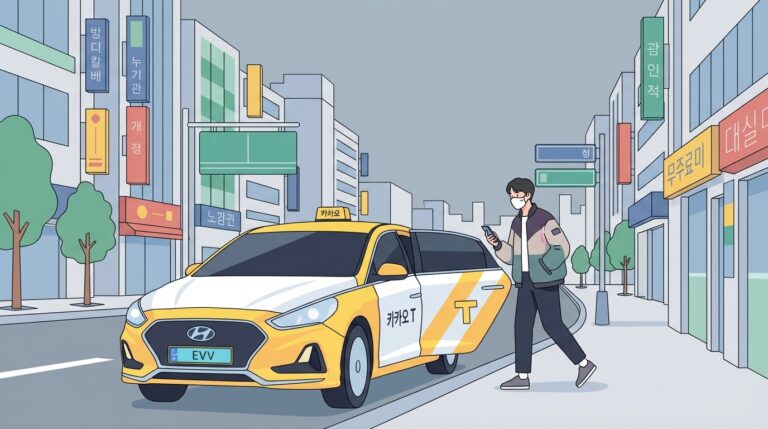
But Korea isn’t just sitting back. If you step onto the streets of Gangnam today, you will notice something fascinating. The city is incredibly quiet. Why? Because a massive chunk of cars—especially those sleek Kakao Taxis with blue license plates—are 전기차 (Electric Vehicles).
If you want to sound like a true local, you need to know how to navigate conversations about air pollution and eco-friendly living. This module is built from real questions asked by intermediate learners just like you. Let’s dive in!
Phase 2: Deep Dive into Core Expressions
1. 오늘 미세먼지 장난 아니에요.
- Pronunciation: [oneul mise-meonji jangnan anieyo] / ‘mise’ sounds like ‘me-say’, ‘meon’ sounds like ‘mun’ in mundane.
- Meaning: Literal: Today’s fine dust is no joke. / Real nuance: The air quality is absolutely terrible today.
- K-Culture Moment: You walk into the office or a cafe, taking off your mask. Your Korean friend or coworker immediately greets you with this phrase while shaking their head. It’s the ultimate modern Korean small talk.
- Editor’s Insight: Koreans love the phrase “장난 아니에요” (It’s no joke). It adds a dramatic, empathetic flair to complaints. It feels much more authentic than simply saying “미세먼지가 많아요” (There is a lot of fine dust).
- Situation Spectrum:
[🚫 절대 금지] ———— [⚠️ 주의] ———— [✅ 자유롭게]
- Close Friends (Casual): ✅ (Say “장난 아니야”)
- Coworkers (Semi-formal): ✅
- Boss/Elders (Formal): ⚠️ (Better to say “오늘 미세먼지가 아주 심하네요”)
- 🤔 Think About It: Why has checking the air quality app become as common as checking the weather forecast in Korea? Does your home country have a specific weather phenomenon that everyone bonds over?
2. 마스크 꼭 챙기세요.
- Pronunciation: [maseukeu kkok chaenggiseyo] / ‘kkok’ is a sharp, tense ‘k’ sound, like the ‘k’ in ‘skip’.
- Meaning: Literal: Please definitely pack a mask. / Real nuance: Don’t forget to wear your mask (out of care for your health).
- K-Culture Moment: Idols ending their live streams on bad air days will almost always say this to their fans. It’s a sign of affection and care, deeply rooted in Korean “정” (Jeong – deep connection/affection).
- Editor’s Insight: Note the verb “챙기다” (to pack/to take care of). It sounds much warmer than just “쓰다” (to wear). It implies, “I care about you, so prepare yourself before you go out.”
- Situation Spectrum:
[🚫 절대 금지] ———— [⚠️ 주의] ———— [✅ 자유롭게]
- Close Friends (Casual): ✅ (마스크 꼭 챙겨!)
- Coworkers (Semi-formal): ✅
- Boss/Elders (Formal): ✅ (마스크 꼭 챙기십시오)
- 🤔 Think About It: In Korean culture, telling someone to take care of their health (eating well, wearing warm clothes, wearing masks) is a primary way to say “I love you.” How do people show casual affection in your language?
3. 파란 번호판이네요. 전기차예요?
- Pronunciation: [paran beonhopanineyo. jeongichayeyo?] / ‘jeon’ sounds like ‘John’ but with a softer ‘j’.
- Meaning: Literal: It’s a blue license plate. Is it an electric car? / Real nuance: Oh, I see you have an EV!
- K-Culture Moment: You hail a taxi. It pulls up completely silently. You notice the light-blue license plate (which is legally required for all eco-friendly vehicles in Korea). You ask the driver this, and he proudly starts bragging about how much he saves on gas.
- Editor’s Insight: Recognizing the “파란 번호판” (blue license plate) is the ultimate insider flex. It shows you really pay attention to Korean society’s shift towards “친환경” (eco-friendly).
- Situation Spectrum:
[🚫 절대 금지] ———— [⚠️ 주의] ———— [✅ 자유롭게]
- Taxi Driver / Strangers (Polite): ✅
- Friends (Casual): ✅ (전기차 뽑았어? / Did you buy an EV?)
Phase 3: Textbook vs Real Life
| Situation | 📖 Textbook Korean | 🗣️ Real Korean | 💡 Why the difference? |
|---|---|---|---|
| Complaining about bad air | 대기 오염이 심각합니다. (Air pollution is serious.) | 밖 공기 완전 최악이에요. (The air outside is totally the worst.) | “최악” (the worst) is a highly expressive, dramatic slang word Koreans love to use for minor and major inconveniences. |
| Suggesting eco-friendly actions | 친환경 자동차를 이용합시다. (Let’s use eco-friendly cars.) | 요즘 대세는 전기차죠. (EVs are the main trend these days.) | “대세” (the main trend) reflects the fast-paced, trend-conscious nature of Korean consumer culture. |
| Buying a new EV | 저는 전기 자동차를 샀습니다. (I bought an electric car.) | 나 이번에 전기차 뽑았어. (I pulled out an EV this time.) | “뽑다” (to pull out) is a widely used slang for buying a brand-new car or gadget, originating from pulling a ticket/item from a machine. |
Phase 4: Cultural Deep Dive
4-1. Non-verbal Communication: The Angry Mask Apps
When a Korean friend says “장난 아니에요” about the fine dust, they will usually shove their smartphone screen in your face. They are showing you a micro-dust app (like the famous ‘미세미세’). These apps use color-coded, expressive faces. If the screen is red with an angry face, or black with a gas mask, you know it’s a day to cancel your outdoor picnic.
4-2. K-Culture Connection: The Blue-Plate Taxi Revolution
If you visit Korea, you will definitely use Kakao T, the dominant taxi-hailing app. Over the last few years, the government heavily subsidized EVs for taxi drivers to combat “대기 오염” (air pollution). Now, a huge percentage of taxis are modern EVs like the Hyundai Ioniq 5 or Kia EV6.
Survival Tip: Because EVs accelerate very smoothly but quickly, some foreigners say they get motion sickness in EV taxis! If you feel dizzy, politely say: “기사님, 조금만 천천히 가주세요.” (Driver, please go a little slower.)
Phase 5: Immersive Roleplay
Scenario A: The Silent Kakao Taxi
- Setting: A hazy Tuesday afternoon in Seoul. The Lotte World Tower is barely visible through the gray smog. You just got into a Kakao Taxi to head to Hongdae.
- Characters:
- YOU (The Reader): An expat living in Seoul, intermediate Korean learner.
- Driver Kim (50s): A chatty, friendly taxi driver driving a brand-new EV6.
Driver Kim: 어휴, 손님. 오늘 밖에 공기가 너무 안 좋죠? 😷
(eohyu, sonnim. oneul bakke gonggiga neomu an jotjyo?)
[Sigh, passenger. The air outside is really bad today, right?]
YOU: 네, 맞아요. 목이 좀 아프네요.
(ne, majayo. mogi jom apeuneyo.)
[Yes, that’s right. My throat hurts a bit.]
Driver Kim: 미세먼지 장난 아니에요. 아, 제 차는 어때요? 조용하죠? 이번에 새로 바꿨어요!
(mise-meonji jangnan anieyo. a, je chaneun eottaeyo? joyonghajyo? ibeone saero bakkwosseoyo!)
[The fine dust is no joke. Ah, how is my car? It’s quiet, right? I just changed it recently!]
🔀 Your Turn! How do you respond?
– A) “네, 전기 자동차입니다.” (Yes, it is an electric vehicle.)
– B) “우와, 파란 번호판이네요! 전기차 승차감이 너무 좋아요!”
– C) “대박! 차 엄청 비싸죠?”✅ Best Choice: B — “Wow, it has a blue license plate! The EV ride quality is so good!” This shows you know local culture (the blue plate) and uses advanced vocabulary (승차감 – ride quality). The driver will be thrilled!
⚠️ Choice C Analysis: Asking directly about the price (비싸죠?) can be a bit too direct for a first-time conversation with an older stranger, though some friendly drivers might not mind.
Scenario B: Idol’s Weverse Post
- Setting: You get a push notification. Your ultimate bias just posted a photo from their car window showing the gray sky.
- Idol’s Post: “우리 팬들! 오늘 초미세먼지 최악이래요 ㅠㅠ 나갈 때 마스크 꼭 챙겨요!”
- Your Reply (Drop this in the comments!): “오빠/언니도 꼭 챙기세요! 😷 친환경 대세니까 스케줄 갈 때 전기차 타고 가요~ ㅎㅎ”
Phase 6: 10-Second Shadowing Drill
Repeat this sentence focusing on the rhythm and emotion!
😤 오늘 / 미세먼지가 / 장난 아니니까 / 🥺 마스크 / 꼭~~~ 챙기세요!
(oneul / mise-meonjiga / jangnan aninikka / maseukeu / kkok~~~ chaenggiseyo!)
Tip: Drag out the “꼭~~” to emphasize how much you care about their health!
Phase 7: K-Culture Glossary (Eco-Edition)
| Korean | Romanization | English | Context |
|---|---|---|---|
| 미세먼지 | mise-meonji | Fine dust | PM 10 particles. The bane of Korean springs. |
| 초미세먼지 | cho-mise-meonji | Ultrafine dust | PM 2.5 particles. Even worse, triggers emergency alerts on phones. |
| 공기청정기 | gonggi-cheongjeonggi | Air purifier | A mandatory home appliance in every modern Korean household. |
| 친환경 | chin-hwangyeong | Eco-friendly | A massive marketing buzzword in Korea for everything from cars to cosmetics. |
| 파란 번호판 | paran beonhopan | Blue license plate | The exclusive light-blue plates given to EVs and hydrogen cars in Korea. |
Phase 8: Traveler’s Survival Kit
If you are traveling to Korea during spring (March-May), you will experience fine dust days. Be prepared!
🆘 Survival Phrases for the Pharmacy/Convenience Store
– 🇰🇷 “KF94 마스크 있어요?” (KF-gusa maseukeu isseoyo?)
– 🗣️ Pronunciation Guide: kay-eff-gu-sa ma-seu-keu eess-eo-yo?
– 📍 Where to use: Olive Young, CU, GS25, Pharmacies (약국).
– 💡 Pro Tip: Don’t just buy any mask. You need the ones labeled KF94 (Korea Filter 94) or KF80 to actually block out the ultrafine dust. A simple cloth mask won’t work against 미세먼지!
📌 Editor’s Travel Note
– App to Download: “미세미세” (MiseMise). It has English support and tells you exactly when you should stay indoors.
– EV Taxis: You don’t need a special app for them. When you call a standard Kakao T, an EV will randomly arrive about 30-40% of the time!
Phase 9: Think Deeper — “One Step Further”
Korean in the Global Era & Eco-Trends
🧠 Think Deeper:
The concept of “친환경” (eco-friendly) is rapidly transforming Korean language and K-Pop culture. Historically, K-Pop generated massive plastic waste through physical album sales (fans buying hundreds of CDs just for photocards). Recently, facing global environmental criticism, companies introduced 친환경 앨범 (Eco-friendly albums) made of biodegradable paper or digital-only “Nemo” albums. Language evolves with societal guilt and progress; words like “그린워싱” (greenwashing) and “제로 웨이스트” (zero waste) are now common in Korean daily news.💬 Your Turn: Does your favorite artist or your country have a specific trend or slang word related to fighting climate change? Share it in the comments!
Phase 10: FAQ & Troubleshooting
Q: Can I use “최악이에요” (It’s the worst) to my boss?
Editor says: Maybe. If you are complaining about the weather/fine dust, yes! Sharing mutual hatred for the bad air is great bonding. Just don’t use it to describe a project or a person in front of your boss.
Q: Is 황사 (Yellow dust) the same as 미세먼지 (Fine dust)?
Editor says: No! 황사 is the natural yellow sand blowing in from deserts in the spring. 미세먼지 is industrial pollution. They are both bad, but “미세먼지” is the more modern, everyday concern.
❌ Common Mistake: Translating “Air Purifier” literally as “공기 깨끗한 기계” (Clean air machine).
✅ Do this instead: Memorize the exact term: 공기청정기. If you go to a Korean electronics store like Hi-Mart, just say “공기청정기 보러 왔어요” (I came to look at air purifiers).
Phase 11: Wrap-up & Action Items
Summary: Surviving Korean fine dust requires KF94 masks, complaining with “장난 아니에요,” and embracing the smooth ride of “파란 번호판” EV taxis!
Your Action Missions:
– 🥉 Bronze (Solo): Look at the weather outside your window right now and say out loud: “오늘 미세먼지 장난 아니에요!”
– 🥈 Silver (Online): Go to YouTube, search for “한국 전기차 택시” (Korean EV taxi) and leave a comment like “저도 타보고 싶어요!” (I want to ride one too!).
– 🥇 Gold (Real Life): Next time you are in Korea and an EV taxi pulls up, ask the driver: “기사님, 이거 전기차예요? 승차감이 너무 좋네요!”
K-Culture Mission: Download the ‘미세미세’ app or check your phone’s weather app for Seoul right now. Is the face smiling or angry?
Drop a comment below: What’s the air quality like in your city today?
Phase 12: Interactive Quiz
1. Situation Judgment: You are in a Kakao Taxi. The driver suddenly speeds up, and because it’s an electric vehicle (EV), you feel a bit dizzy. What should you say?
A) “차단기 내려주세요.”
B) “기사님, 조금만 천천히 가주세요.”
C) “미세먼지가 심하네요.”
2. True or False – K-Culture Edition:
“In Korea, a light-blue license plate means the car is a designated taxi for foreigners.” (T/F)
3. Fill in the Blank:
오늘 밖에 공기가 너무 안 좋아요. 나갈 때 꼭 ( _____ ) 챙기세요!
(Hint: You need this to protect your lungs!)
🚨 Click here for the answers!
1. B (A means ‘Please lower the circuit breaker’, C means ‘The fine dust is bad’.)
2. False (Blue plates are strictly for eco-friendly vehicles like EVs and hydrogen cars, regardless of who drives them!)
3. 마스크 (Mask)
Frequently Asked Questions (FAQ)
Q: What does "오늘 미세먼지 장난 아니에요." mean in Korean and how do you pronounce it?
A: In Korean, "오늘 미세먼지 장난 아니에요." is pronounced [oneul mise-meonji jangnan anieyo] and means: Literal: Today's fine dust is no joke. / Real nuance: The air quality is absolutely terrible today.
Q: What does "마스크 꼭 챙기세요." mean in Korean and how do you pronounce it?
A: In Korean, "마스크 꼭 챙기세요." is pronounced [maseukeu kkok chaenggiseyo] and means: Literal: Please definitely pack a mask. / Real nuance: Don't forget to wear your mask (out of care for your health).
Q: What does "파란 번호판이네요. 전기차예요?" mean in Korean and how do you pronounce it?
A: In Korean, "파란 번호판이네요. 전기차예요?" is pronounced [paran beonhopanineyo. jeongichayeyo?] and means: Literal: It's a blue license plate. Is it an electric car? / Real nuance: Oh, I see you have an EV!







