

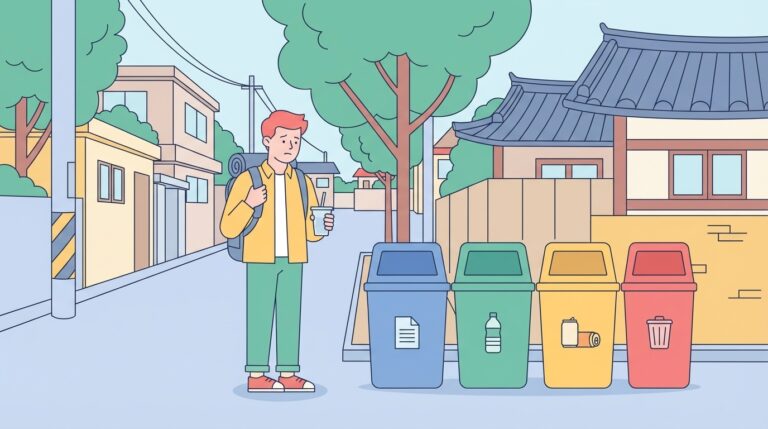
Phase 1: Immersive Hook – Welcome to the ‘Trash Nunchi’ Game
Hello! I am the Lead Editor at Daily Hangul, your premium guide to mastering real-life Korean.
Picture this: You are watching your favorite K-Drama. It is 11 PM. The handsome male lead walks out of his apartment in a comfy tracksuit, holding a very specific, brightly colored plastic bag. He goes to the building’s recycling area, and bam! He bumps into the female lead. Cue the romantic music.
But wait… what was in that bag? And why is the recycling area so complicated?
Welcome to the intense, highly organized, and slightly intimidating world of Korean Garbage Disposal (분리수거 – Bun-ri-su-geo). If you are staying at an Airbnb, studying at a dorm, or living in Korea, you will quickly realize that sorting your trash is a national sport. If you get it wrong, you might face the angry glare of a local building manager!
Don’t worry. As an A1 beginner, you don’t need a PhD in waste management. You just need a few magical phrases to ask for help and show you are trying. Let’s learn how to take out the trash like a true local!
Phase 2: Deep Dive – Core Expressions
Here are the 4 essential expressions you must know to survive the Korean recycling system.
1. 분리수거 (Recycling / Trash Sorting)
- Pronunciation: bun-ri-su-geo [boon-ree-soo-guh]
- Meaning: (Literal) Separate collection / (Real Nuance) Sorting out the recycling
- K-Culture Moment: Watch any K-Pop idol reality show where they live in a dorm. You will always see a mountain of delivery boxes in the corner. Eventually, the youngest member (막내 – Maknae) gets scolded: “Hey, do the bun-ri-su-geo!”
- Editor’s Insight: This word sounds scary, but it just means “separating your trash.” You don’t usually say this to strangers, but you will hear your Airbnb host or friends say it a lot.
- Situation Spectrum:
[🚫] ———— [⚠️] ———— [✅ 자유롭게]
- Casual (Friends): ✅
- Semi-formal (Co-workers): ✅
- Formal (Boss): ✅ (It’s just a noun!)
- 🤔 Think About It: Why is “separating” such a big deal in Korea? Because Korea is a small country with a huge population. Space is limited, so recycling is a community duty!
2. 일반 쓰레기 (General Waste)
- Pronunciation: il-ban sseu-re-gi [eel-bahn ssoo-ray-gee] (Tip: ‘sseu’ sounds like the hissing noise you make when stepping on a Lego!)
- Meaning: (Literal) General trash / (Real Nuance) Things that cannot be recycled or eaten by animals.
- K-Culture Moment: You are eating delicious Korean fried chicken (치킨). You finish it. Where do the bones go? They go into the il-ban sseu-re-gi!
- Editor’s Insight: This is the trash that goes into the special colored bags you buy at the store (more on that later!).
- Situation Spectrum:
[🚫] ———— [⚠️] ———— [✅ 자유롭게]
- Any situation: ✅
3. 음식물 쓰레기 (Food Waste)
- Pronunciation: eum-sing-mul sseu-re-gi [oom-shing-mool ssoo-ray-gee]
- Meaning: Food waste
- K-Culture Moment: K-Drama characters are often seen squeezing the water out of leftover food before throwing it away. That’s because food waste is weighed, or has its own special paid bag!
- Editor’s Insight: The golden rule of Korean food waste: “If an animal can eat it, it is food waste. If an animal can’t eat it (like onion skins, eggshells, or chicken bones), it is general waste!”
- Situation Spectrum:
[🚫] ———— [⚠️] ———— [✅ 자유롭게]
- Any situation: ✅
4. 이거 어디에 버려요? (Where do I throw this away?)
- Pronunciation: i-geo eo-di-e beo-ryeo-yo? [ee-guh uh-dee-eh buh-ryuh-yo?]
- Meaning: (Literal) This, where do I throw? / (Real Nuance) Help! Which bin does this go into?
- K-Culture Moment: You are holding a weird plastic cup with a paper sleeve at a cafe. You look at the 4 different bins. Panic sets in. You turn to the barista, show the cup, and say this magic phrase.
- Editor’s Insight: This is your #1 survival phrase. Say it with slightly wide, panicked eyes, and any Korean will instantly feel bad for you and help you sort it.
- Situation Spectrum:
[🚫] ———— [⚠️] ———— [✅ 자유롭게]
- Casual (Friends): ⚠️ (Drop the ‘yo’ and say: 이거 어디에 버려?)
- Semi-formal (Strangers/Staff): ✅
- Formal (Boss/Elders): ✅
Phase 3: Textbook vs Real Life
How do actual Koreans talk at the trash bins?
| Situation | 📖 Textbook Korean | 🗣️ Real Korean | 💡 Why the difference? |
|---|---|---|---|
| Asking where to throw it | 이것은 어디에 버립니까? (i-geo-seun eo-di-e beo-rim-ni-kka?) | 이거 어디다 버려요? (i-geo eo-di-da beo-ryeo-yo?) | Koreans love efficiency. They drop subject markers and shorten ‘어디에’ to ‘어디다’ in speech. |
| Handing over a box | 재활용 쓰레기입니다. (jae-hwal-yong sseu-re-gi-im-ni-da.) | 이거 재활용이에요. (i-geo jae-hwal-yong-i-e-yo.) | ‘입니다’ (im-ni-da) sounds like a robot or a news anchor. ‘이에요’ (i-e-yo) is soft and natural. |
| Asking if it’s general waste | 일반 쓰레기입니까? (il-ban sseu-re-gi-im-ni-kka?) | 일반이죠? (il-ban-i-jyo?) | In daily life, Koreans drop ‘쓰레기’ (trash) and just say “It’s general, right?” |
Bottom Note: As an A1 learner, stick to the “Real Korean” column. It makes you sound naturally polite but not like a walking dictionary!
Phase 4: Cultural Deep Dive
4-1. Non-verbal Communication: The Art of “Nunchi” at the Bins
When you are at the neighborhood recycling spot, you must use your 눈치 (Nunchi)—the Korean superpower of reading the room. Don’t just toss your bag and run. Look around. Are the older ladies (Ajummas) crushing their plastic bottles? Crush yours too. Are they peeling the labels off the bottles? You better peel yours off too! Mimicry is your best friend here.
4-2. K-Culture Connection: The Infamous “Jongnyangje” Bags
If you watch a slice-of-life K-Drama, you will notice people putting their trash in specific blue, white, or green plastic bags. You cannot use a regular grocery bag for your trash in Korea! You must use a 종량제 봉투 (Jongnyangje bongtu)—a volume-based waste fee bag. Every district in Seoul has its own color. If you use a Gangnam bag in Hongdae, the trash collectors will not take it, and you might get fined. This shows how strict and community-focused Korean society is!
Phase 5: Immersive Roleplay – Late Night Trash Run
Setting: Friday night, 10 PM. You are staying at an Airbnb in Mapo-gu, Seoul. You just finished a delicious iced Americano. You walk out to the building’s parking lot where the bins are. You meet Min-su (60s), the friendly but strict building manager (경비 아저씨).
YOU: 안녕하세요! (Hello!)
(an-nyeong-ha-se-yo!)
Min-su: 네, 학생. 분리수거 하러 왔어요? 📦
(ne, hak-saeng. bun-ri-su-geo ha-reo wa-sseo-yo?)
[Yes, student. Did you come to do the recycling?]
(🎭 Stage Direction: Min-su looks at the plastic coffee cup in your hand, which still has ice inside.)
YOU: 네! 그런데… 이거 어디에 버려요? 🤔
(ne! geu-reon-de… i-geo eo-di-e beo-ryeo-yo?)
[Yes! But… where do I throw this?]
Min-su: 아, 플라스틱 컵이네. 저기 파란 통에 넣어요. 🗑️
(a, peul-la-seu-tik keo-bi-ne. jeo-gi pa-ran tong-e neo-eo-yo.)
[Ah, it’s a plastic cup. Put it in the blue bin over there.]
🔀 YOUR TURN! Decision Point: What do you do with the cup that still has ICE in it?
– A) Smile, say “감사합니다!” and throw the whole cup (with ice) into the plastic bin.
– B) Ask “이거 일반 쓰레기예요?” (Is this general waste?) and put it in the general bag.
– C) Point to the ice, look confused, and pour the ice into the nearby sink/drain first, then throw the empty cup into the plastic bin.✅ Best Choice: C.
Why? In Korea, you absolutely MUST empty all liquids and food residue before recycling! If you choose A, Min-su will definitely shout “안돼요! (No!)” and make you fish it out.
(Assuming you chose C)
Min-su: 오~ 맞아요. 얼음은 버리고 컵만. 잘하네! 👍
(o~ ma-ja-yo. eo-reu-meun beo-ri-go keom-man. jal-ha-ne!)
[Oh~ that’s right. Throw away the ice, just the cup. You’re good at this!]
YOU: 감사합니다! 안녕히 계세요. 🙇♂️
(gam-sa-ham-ni-da! an-nyeong-hi gye-se-yo.)
[Thank you! Goodbye.]
Phase 6: 10-Second Shadowing Drill
Practice saying this out loud. Focus on the pauses (/) and the emotion!
🥺 (Holding up a strange piece of trash)
이거 / 일반 쓰레기 / 맞아요?
(i-geo / il-ban sseu-re-gi / ma-ja-yo?)
Translation: Is this / general waste / right?
Tip: Raise your pitch at the end on “요?” to make it sound like a polite question!
Phase 7: K-Culture Glossary
| 한국어 (Korean) | Romanization | English | Cultural Context |
|---|---|---|---|
| 눈치 | nunchi | Social awareness | The art of observing others to know what to do at the recycling bins. |
| 분리수거 | bun-ri-su-geo | Recycling | The strict Korean system of sorting paper, plastic, cans, and glass. |
| 종량제 봉투 | jong-nyang-je bong-tu | Standard trash bag | You must buy these at the local convenience store to throw away general trash. |
| 배달 | bae-dal | Delivery | Korea has amazing food delivery, which means lots of plastic containers to wash and recycle! |
| 아저씨 | a-jeo-ssi | Middle-aged man | Often used to politely refer to building managers or store clerks. |
Phase 8: Traveler’s Survival Kit
If you are traveling and need to buy the official trash bags at a convenience store, show this to the cashier!
🆘 Survival Expression #1: Buying the Bag
– 🇰🇷 “종량제 봉투 하나 주세요.”
– 🗣️ Pronunciation: jong-nyang-je bong-tu ha-na ju-se-yo.
– 💬 Meaning: “Please give me one general waste bag.”
– 📍 Where to use: Any convenience store (CU, GS25, 7-Eleven).
– 💡 Pro Tip: The cashier might ask “몇 리터요?” (How many liters?). Just say “십 리터요” (10 Liters – sip li-teo-yo), which is a perfect size for a few days’ stay.📌 Editor’s Travel Note
– Don’t bring trash from outside! Unlike some countries, there are very few public trash cans on Korean streets. Why? Because people used to dump their household trash in them to avoid buying the official bags! If you buy street food, hand the empty stick/cup back to the vendor you bought it from.
Phase 9: Think Deeper – Community & Rules
🧠 Think Deeper: Food, Trash, and Identity
Have you noticed how strict Korea is about “General” vs “Food” waste? This isn’t just about protecting the environment. Korea is a densely populated peninsula. Decades ago, massive garbage became a huge crisis. The government introduced this strict system, and the entire nation had to adapt together. When you wash your spicy tteokbokki container before recycling it, you aren’t just cleaning plastic—you are participating in a massive, nationwide community effort. It shows respect for the collective whole over individual convenience.💬 Your Turn: Does your country have strict rules about recycling, or is it more relaxed? Do you think you could adapt to the Korean system? Tell us in the comments!
Phase 10: FAQ & Troubleshooting
Q: Do I really have to wash my delivery food containers?
A: YES! If a plastic container is heavily stained with red chili paste (고추장) and won’t wash off, it is NO LONGER recycling. It becomes 일반 쓰레기 (General Waste).
Q: I am staying in an Airbnb. Where do I get the food waste bags?
A: Ask your convenience store for “음식물 쓰레기 봉투” (eum-sing-mul sseu-re-gi bong-tu). But check with your host first; some modern apartments have digital food waste bins where you tap an RFID card!
❌ Common Mistake #1: Throwing chicken bones or eggshells into the Food Waste.
✅ How to fix it: Remember the animal rule! Animals can’t digest bones or shells, so they go into 일반 쓰레기 (General Waste).❌ Common Mistake #2: Taking your leftover trash to another city.
✅ How to fix it: Trash bags are district-specific. A bag bought in Seoul cannot be used in Busan. Buy only what you need!
Phase 11: Wrap-up & Action Items
Today’s One-Liner: Surviving Korean recycling is easy if you know how to ask: “이거 어디에 버려요? (Where do I throw this?)”
Your Action Missions:
– 🥉 Bronze (Solo): Look at a piece of trash near you right now. Point at it and say “이거 어디에 버려요?” out loud 3 times.
– 🥈 Silver (Online): Next time you watch a K-Drama, look closely at the background of the street scenes. Can you spot the colorful Jongnyangje trash bags?
– 🥇 Gold (Real Life): Go to a Korean cafe, finish your drink, and try sorting your trash perfectly. If you get stuck, use today’s phrase with the staff!
⭐ K-Culture Mission:
Go to YouTube and search “K-Pop dorm recycling.” You will see your favorite stars struggling with the exact same boxes and bottles you learned about today!
Phase 12: Interactive Quiz
Test your new ‘Nunchi’ skills!
1. Fill in the Blank:
You are at a cafe and don’t know where to put your napkin. You ask the staff:
“이거 ______ 버려요?”
A) 어떻게 (how)
B) 어디에 (where)
C) 왜 (why)
2. True or False – K-Culture Edition:
“Chicken bones are soft when cooked, so you should throw them in the Food Waste (음식물 쓰레기).” (T / F)
3. Situational Judgment:
You bought a bright blue trash bag in Gangnam (Seoul). You travel to a friend’s house in Hongdae (Mapo-gu) and try to use it there. What will happen?
A) Nothing, trash is trash.
B) The trash collectors will leave it there because the district bags don’t match.
C) You get a discount.
(Answers: 1. B, 2. False – bones are ALWAYS general waste! 3. B – Bags are district-specific!)
Frequently Asked Questions (FAQ)
Q: What does "분리수거 (Recycling / Trash Sorting)" mean in Korean and how do you pronounce it?
A: In Korean, "분리수거 (Recycling / Trash Sorting)" is pronounced [bun-ri-su-geo [boon-ree-soo-guh] and means: (Literal) Separate collection / (Real Nuance) Sorting out the recycling
Q: What does "일반 쓰레기 (General Waste)" mean in Korean and how do you pronounce it?
A: In Korean, "일반 쓰레기 (General Waste)" is pronounced [il-ban sseu-re-gi [eel-bahn ssoo-ray-gee] and means: (Literal) General trash / (Real Nuance) Things that cannot be recycled or eaten by animals.
Q: What does "음식물 쓰레기 (Food Waste)" mean in Korean and how do you pronounce it?
A: In Korean, "음식물 쓰레기 (Food Waste)" is pronounced [eum-sing-mul sseu-re-gi [oom-shing-mool ssoo-ray-gee] and means: Food waste
Q: What does "이거 어디에 버려요? (Where do I throw this away?)" mean in Korean and how do you pronounce it?
A: In Korean, "이거 어디에 버려요? (Where do I throw this away?)" is pronounced [i-geo eo-di-e beo-ryeo-yo? [ee-guh uh-dee-eh buh-ryuh-yo?] and means: (Literal) This, where do I throw? / (Real Nuance) Help! Which bin does this go into?






