

Hello there! This is your Lead Editor at Daily Hangul.
Imagine a classic K-Drama corporate scene: The charismatic, impeccably dressed CEO slowly walks down the aisle of an open-plan office. He doesn’t say a word, but his mere presence makes the employees sit up straighter, type faster, and nervously adjust their ties. He measures their ‘dedication’ by how late they stay at the office—the infamous 야근 (yageun, night overtime) culture.
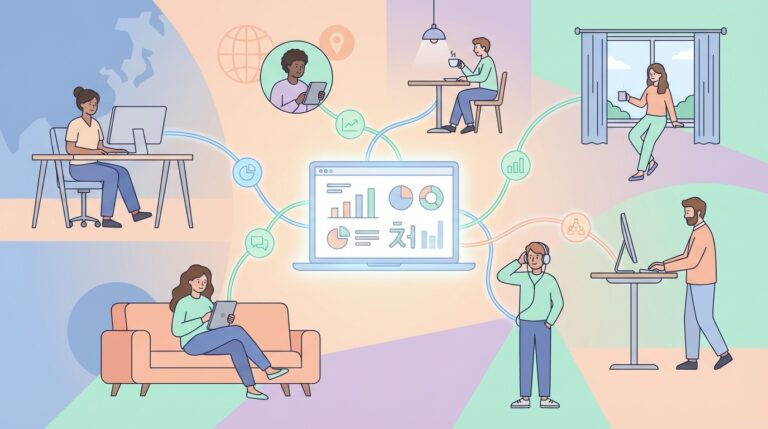
But let’s snap back to reality. You are a global leader managing a Korean team from a completely different time zone. Your only window into their world is a green dot on Slack or a yellow speech bubble on KakaoTalk. You can’t see them sweating over a keyboard. So, how do you track their KPIs and manage their progress without sounding like a micromanaging K-Drama villain?
At the C2 (Advanced) level, mastering Korean business communication isn’t just about knowing the formal vocabulary; it’s about mastering Virtual Nunchi (눈치). It’s the art of giving constructive feedback, tracking performance metrics, and showing empathy across digital borders.
Let’s dive into the sophisticated, modern Korean leadership phrases that will make your remote team trust you completely.
Phase 2: Core Expressions Deep Dive
Forget the rigid textbook commands like “보고서를 제출하십시오” (Submit the report). Modern Korean tech companies and startups use a much more collaborative vocabulary.
1. “혹시 업무하시면서 병목(bottleneck) 생기는 부분 있으신가요?”
- Pronunciation: [Hoksi eommuhasimyeonseo byeongmok saenggineun bubun isseusingayo?]
- Sound analogy: Say “byeong-mok” like you’re saying “young-mock” but with a ‘b’.
- Meaning: (Literal) Are there any bottleneck parts arising while you work? -> (Real nuance) Are you facing any blockers? How can I help?
- K-Culture Moment: In traditional companies, delays were met with a harsh “왜 늦어집니까?” (Why is this late?). But in modern ‘Pangyo’ (Korea’s Silicon Valley) startups, leaders use terms like 병목 (bottleneck) or 블로커 (blocker) to shift the blame from the person to the process.
- Editor’s Insight: This phrase is absolute gold for remote managers. It shows you are checking on their progress but positioning yourself as a facilitator, not an interrogator.
- Situation Spectrum:
[🚫 Never] ———— [⚠️ Caution] ———— [✅ Freely]
- Close Colleagues (Casual): ✅ (You can just say “블로커 있어요?”)
- Subordinates/Team members (Semi-formal): ✅ (Perfect fit)
- Boss/Seniors (Formal): ⚠️ (A bit too presumptuous to ask your boss if they have a bottleneck)
- 🤔 Think About It: Why does modern Korean corporate culture borrow so much English terminology (like ‘sync’, ‘blocker’, ‘agile’)? How does using an English loanword soften the hierarchical blow of traditional Korean business terms?
2. “이번 분기 성과 지표는 결과물 위주로 얼라인(align) 하겠습니다.”
- Pronunciation: [Ibeon bungi seonggwa jipyoneun gyeolgwamul wijuro eollain hagetseumnida.]
- Meaning: (Literal) We will align this quarter’s performance indicators based on deliverables. -> (Real nuance) I will evaluate you based on your actual output, not how many hours you appear to be online.
- K-Culture Moment: For decades, Korean performance was often judged by “눈도장” (nundojang)—literally “eye-stamps,” meaning making sure the boss sees your face at the office late at night. By explicitly stating you evaluate based on 결과물 (deliverables), you instantly relieve the remote worker’s anxiety about having to instantly reply to Slack messages at 9 PM to ‘prove’ they are working.
- Editor’s Insight: The word 얼라인 (align) is universally used in Korean corporate settings today to mean “getting on the same page.”
- Situation Spectrum:
- Team members (Formal setting): ✅
- 🤔 Think About It: If “face time” used to equal loyalty, how does a Korean remote worker demonstrate loyalty today?
3. “가볍게 티타임 겸 싱크(sync) 맞추는 거 어떨까요?”
- Pronunciation: [Gabyeopge titaim gyeom singkeu matchuneun geo eotteolkkayo?]
- Meaning: (Literal) How about we do a light tea-time and sync up? -> (Real nuance) Let’s have a quick 1-on-1 video call to check on progress without making it a heavy, stressful meeting.
- K-Culture Moment: “티타임” (Tea time) in Korean business doesn’t literally mean drinking Earl Grey with scones. It’s a culturally established code word for a low-stakes, informal 1-on-1 chat.
- Editor’s Insight: If you suddenly send a calendar invite saying “Performance Review” or “Status Check,” your Korean team member might panic. Calling it a “티타임” lowers their defensive walls immediately.
- Situation Spectrum:
- Subordinates: ✅
- Peers/Cross-functional teams: ✅
Phase 3: Textbook vs. Real Life
| Situation | 📖 Textbook Korean | 🗣️ Real Corporate Korean | 💡 Why is it different? |
|---|---|---|---|
| Asking for an update | 진행 상황을 보고해 주세요. (Please report the progress.) | 현재 진행 상황 가볍게 공유 부탁드립니다. | “보고 (Report)” implies strict hierarchy. “공유 (Share)” implies horizontal teamwork. |
| Checking a delay | 왜 일정이 지연됩니까? (Why is the schedule delayed?) | 혹시 일정에 차질이 생길 만한 이슈가 있을까요? | Softens the accusation. Assumes external “issues” are causing the delay, saving face. |
| Concluding a meeting | 회의를 마치겠습니다. 수고하셨습니다. (I end the meeting. Good job.) | 네, 그럼 이 방향으로 얼라인하고 진행하시죠. 고생하셨습니다! | Action-oriented ending. Emphasizes consensus (“얼라인”) over top-down orders. |
Phase 4: Cultural Deep Dive
4-1. Non-verbal Communication: The “Virtual Nunchi” (랜선 눈치)
When managing a remote Korean team, you can’t read their physical Nunchi. Instead, you must read their text messages. In Korea, the way someone types “Yes” tells you exactly how they are feeling regarding their workload:
– 네 (Ne): Emotionless, potentially stressed or annoyed. If a usually cheerful employee just replies “네.”, they are likely overwhelmed.
– 네~ (Ne~): Friendly, standard polite acknowledgment.
– 넵! (Nep!): The gold standard of Korean corporate communication. Brisk, energetic, and professional. (This is so common there is a joke called “넵병”—the “Nep-disease”, where office workers reflexively type 넵 to everything).
– 넹 / 넴 (Neng / Nem): Very casual, slightly cute. Only use with close peers.
4-2. K-Culture Connection: The Evolution of “Hoesik” (회식)
If you’ve watched K-Dramas like My Mister or Misaeng, you know that 회식 (Hoesik, company dinners) used to be the primary way leaders bonded with their teams and resolved conflicts. With the rise of remote work, how do leaders build trust?
Welcome to the era of 랜선 회식 (Virtual company dinners) or the “KakaoTalk Gift Culture” (카카오톡 선물하기). Great remote leaders in Korea often send a small digital coupon—like an Iced Americano or a Fried Chicken set—via KakaoTalk with a message like, “이번 스프린트 고생 많으셨어요!” (You worked hard this sprint!). It’s the modern, introversion-friendly evolution of buying your team a drink.
Phase 5: Immersive Roleplay Scenario
Scenario A: The Virtual 1-on-1
- Setting: Wednesday, 2:00 PM (KST). You are on a Zoom call from your home office.
- Characters:
- YOU: The remote manager looking at a KPI dashboard that is flashing red for the current sprint.
- Minsu (32): Your lead developer in Seoul. Usually a top performer, but he looks a bit tired on camera today.
YOU: 민수 님, 안녕하세요! 요즘 날씨 많이 덥죠?
(Minsu nim, annyeonghaseyo! Yojeum nalssi mani deopjyo?)
[Hi Minsu! The weather is quite hot these days, right?]
Minsu: 네, 진짜 너무 덥네요. 매니저님 계신 곳은 어때요?
(Ne, jinjja neomu deomneyo. Maenijeonim gyesin goseun eottaeyo?)
[Yes, it’s really hot. How is it where you are?]
YOU: 여기도 비슷해요. (Smiles) 오늘 가볍게 티타임 하자고 한 건, 이번 스프린트 진행 상황 좀 싱크 맞추려고요.
(Yeogido biseutaeyo. Oneul gabyeopge titaim hajago han geon, ibeon seupeurinteu jinhaeng sanghwang jom singkeu matchuryeogoyo.)
[It’s similar here. The reason I suggested a quick tea time today is to sync up on the progress of this sprint.]
Minsu: 아, 네… 그 프론트엔드 작업 말이죠. 사실 그게 생각보다 시간이 좀 걸리고 있습니다.
(A, ne… geu peuronteu-endeu jageop marijyo. Sasil geuge saenggakboda sigani jom geolligo itseumnida.)
[Ah, yes… about the front-end task. Actually, it’s taking a bit more time than expected.]
🔀 Your Turn! How should you respond to keep morale high while addressing the KPI?
– A) “왜 늦어지는 거죠? KPI 달성이 위험합니다.” (Why is it late? Our KPI achievement is at risk.)
– B) “그렇군요. 혹시 작업하시면서 블로커가 되는 부분이 있을까요? 제가 서포트할게요.” (I see. Are there any blockers while you’re working? I will support you.)
– C) “아, 괜찮아요! 천천히 하세요.” (Ah, it’s okay! Take your time.)✅ Best Choice: B — It addresses the issue directly but focuses on removing obstacles (블로커) rather than assigning blame. It shows true leadership.
⚠️ Choice A Analysis: Too aggressive for a modern remote setting. You will lose Minsu’s trust.
⚠️ Choice C Analysis: Bad management. You still need to meet the KPIs!
Minsu: (Relieved) 아, 감사합니다. 사실 타 부서에서 API 키 전달이 늦어지고 있어서 대기 중이었습니다.
(A, gamsahamnida. Sasil ta buseo-eseo API ki jeondari neujeojigo isseoseo daegi jung-ieotseumnida.)
[Ah, thank you. Actually, the API key delivery from the other department is delayed, so I’ve been waiting.]
YOU: 아, 그런 이슈가 있었군요. 그럼 그 부분은 제가 타 부서 리더와 얼라인 해보겠습니다.
(A, geureon isyuga isseotgunyo. Geureom geu bubuneun jaega ta buseo rideowa eollain haebogetseumnida.)
[Ah, there was an issue like that. Then I will align with the other department’s leader regarding that part.]
Phase 6: 10-Second Shadowing Drill
Need to jump on a quick call with a remote team member without sounding alarming? Master this exact intonation:
😊 민수 님, / 지금 잠깐 통화 / 가능하신가요? (Minsu nim, / jigeum jamkkan tonghwa / ganeunghasingayo?)
(Raise your pitch slightly at the end to make it sound like a gentle request, not a summons!)
Phase 7: K-Culture Glossary (Remote Work Edition)
| Korean | Romanization | English | Contextual Meaning |
|---|---|---|---|
| 워라밸 | worabael | Work-Life Balance | Crucial for modern Korean employees. Remote managers must respect “worabael” by not messaging after hours. |
| 재택근무 | jaetaek geunmu | Working from home | Literally “home-residence work.” |
| 눈도장 | nundojang | Eye-stamp | The old-school method of making sure the boss sees you working hard. Becoming obsolete with remote KPIs. |
| 넵병 | neppyeong | ‘Nep’ disease | The habit of universally replying “넵!” to superiors in text channels to sound enthusiastic but obedient. |
| 랜선 회식 | raenseon hoesik | Virtual LAN-cable dinner | Hanging out via Zoom with food/drinks, often paid for by the company. |
Phase 8: Traveler’s Survival Kit (Workation Edition)
Many remote leaders eventually travel to Seoul for a 워케이션 (Workation). If you find yourself leading a Zoom meeting from a sleek cafe in Gangnam, you’ll need these essential survival phrases!
🆘 Survival Phrases for the Remote Worker in Seoul
– 🇰🇷 “혹시 콘센트 있는 자리 있나요?” (Hoksi konsenteu inneun jari innayo? – Are there any seats with power outlets?)
– 🇰🇷 “와이파이 비밀번호가 영수증에 있나요?” (Waipai bimilbeonhoga yeongsujeung-e innayo? – Is the Wi-Fi password on the receipt?)
– 🇰🇷 “너무 시끄럽지 않은 구석 자리로 부탁드려요.” (Neomu sikkeureopji aneun guseok jariro butakdeuryeoyo. – A quiet corner seat, please.)📌 Editor’s Travel Note:
– Wi-Fi Heaven: Korea is a remote worker’s paradise. Almost every cafe has lightning-fast free Wi-Fi. (Look for the password near the pickup counter or on your receipt!).
– Leaving your laptop: Yes, the rumors are true. You can leave your MacBook on the cafe table to go to the restroom, and no one will touch it. Koreans are fiercely protective of “reserved” seats but care zero about stealing your electronics.
Phase 9: Think Deeper — “Language & Power”
🧠 Think Deeper: Erasing Hierarchy Through Titles?
In traditional Korean corporate culture, titles are everything: 부장님 (General Manager), 차장님 (Deputy General Manager). These titles instantly establish a rigid hierarchy. However, to foster the “Agile” mindset needed for remote work, many Korean tech companies have banned these titles, forcing everyone—even the CEO—to use “이름 + 님” (Name + Nim, e.g., 민수 님) or even English names (e.g., “Hey, David”).
But does changing the language instantly erase centuries of Confucian hierarchy? While “님” culture has certainly democratized communication and made remote collaboration smoother, the underlying Nunchi remains intact. A junior developer might call the CEO “Jay,” but they will still use the utmost polite honorific verbs (존댓말) at the end of their sentences.💬 Your Turn: In your culture, do remote teams communicate more casually than in-office teams? Does using a boss’s first name actually change the power dynamic? Let us know in the comments!
Phase 10: Troubleshooting (FAQ)
Q: Is it okay to message my Korean team over Slack after 6:00 PM?
A: A resounding NO.
Korea actually debated a “카톡 금지법” (Ban on KakaoTalk after work hours) because the stress of remote micromanagement became a national issue. Unless the server is literally on fire, schedule your messages for 9:00 AM KST the next day. Respecting their off-hours is the fastest way to build loyalty.
Q: My employee just replied “네…” to my feedback. Are they mad?
A: Not necessarily mad, but likely demotivated.
In the text-based world of remote work, ellipses (…) often convey hesitation or deflation. It might be time to schedule a quick “가벼운 티타임” (light tea-time call) to check on their morale.
❌ Common Mistake #1: Delivering negative KPI feedback bluntly via text.
✅ Do this instead: Korean business culture is “High-Context.” Criticism should be delivered verbally (via voice or video call) where tone and empathy can be conveyed, protecting the employee’s “기분” (kibun, mood/pride). Use text only for positive reinforcement and factual updates.
Phase 11: Wrap-up & Action Items
📌 One-Liner Summary:
Mastering remote leadership in Korea means shifting from evaluating “face-time” to tracking deliverables (결과물) while using empathetic language (블로커, 티타임) to maintain high morale and Virtual Nunchi.
🚀 Action Mission:
– 🥉 Bronze: Practice saying “블로커 되는 부분 있으신가요?” out loud 3 times with a warm, supportive smile.
– 🥈 Silver: Review your recent text messages to your Korean colleagues. Did you use “공유 부탁드립니다” (Please share) or the commanding “보고하세요” (Report to me)?
– 🥇 Gold: During your next Zoom call, suggest a “가벼운 티타임” to check in on a team member’s well-being!
🇰🇷 K-Culture Mission:
Try experiencing the “Virtual Hoesik” vibe! If you have the means, use a service like ‘KakaoTalk Gifts’ (if you have a Korean account) or send a digital Starbucks gift card to a Korean team member who hit their KPIs this week. Watch how much it boosts their motivation!
Phase 12: Interactive Quiz
1. Situational Judgment: Your Korean remote worker has missed a deadline. What is the most culturally appropriate way to initiate a conversation via Slack?
– A) “이 프로젝트 언제 끝납니까?” (When will this project end?)
– B) “지금 당장 줌으로 들어오세요.” (Get on Zoom right now.)
– C) “민수 님, 혹시 일정에 차질 생기는 부분 있을까요? 잠깐 통화 가능하실 때 알려주세요.”
2. True or False – K-Culture Edition:
Because Korean tech companies use “님” (Nim) after names to flatten the hierarchy, it is totally acceptable to use casual language (반말) with your manager on Slack. (T/F)
👉 Click here for the answers!
1. Correct Answer: C. It gives them the benefit of the doubt (“차질 생기는 부분”), respects their time, and gently requests a call. Choice A is too blunt, and Choice B sounds like they are about to be fired.
2. Answer: False. While the title is flattened to “Name + Nim,” you must absolutely still use formal polite language (존댓말) in your verbs and grammar. Mixing casual language (반말) in a business setting, even a startup, is a huge faux pas!
Happy leading, and see you in the next lesson of Daily Hangul! 💻🇰🇷
Frequently Asked Questions (FAQ)
Q: What does ""혹시 업무하시면서 병목(bottleneck) 생기는 부분 있으신가요?"" mean in Korean and how do you pronounce it?
A: In Korean, ""혹시 업무하시면서 병목(bottleneck) 생기는 부분 있으신가요?"" is pronounced [Hoksi eommuhasimyeonseo byeongmok saenggineun bubun isseusingayo?] and means: (Literal) Are there any bottleneck parts arising while you work? -> (Real nuance) Are you facing any blockers? How can I help?
Q: What does ""이번 분기 성과 지표는 결과물 위주로 얼라인(align) 하겠습니다."" mean in Korean and how do you pronounce it?
A: In Korean, ""이번 분기 성과 지표는 결과물 위주로 얼라인(align) 하겠습니다."" is pronounced [Ibeon bungi seonggwa jipyoneun gyeolgwamul wijuro eollain hagetseumnida.] and means: (Literal) We will align this quarter's performance indicators based on deliverables. -> (Real nuance) I will evaluate you based on your actual output, not how many hours you appear to be online.
Q: What does ""가볍게 티타임 겸 싱크(sync) 맞추는 거 어떨까요?"" mean in Korean and how do you pronounce it?
A: In Korean, ""가볍게 티타임 겸 싱크(sync) 맞추는 거 어떨까요?"" is pronounced [Gabyeopge titaim gyeom singkeu matchuneun geo eotteolkkayo?] and means: (Literal) How about we do a light tea-time and sync up? -> (Real nuance) Let's have a quick 1-on-1 video call to check on progress without making it a heavy, stressful meeting.







