

Phase 1: Immersive Hook
Hello! I’m your Daily Hangul Editor, your resident veteran tutor and Seoul local.
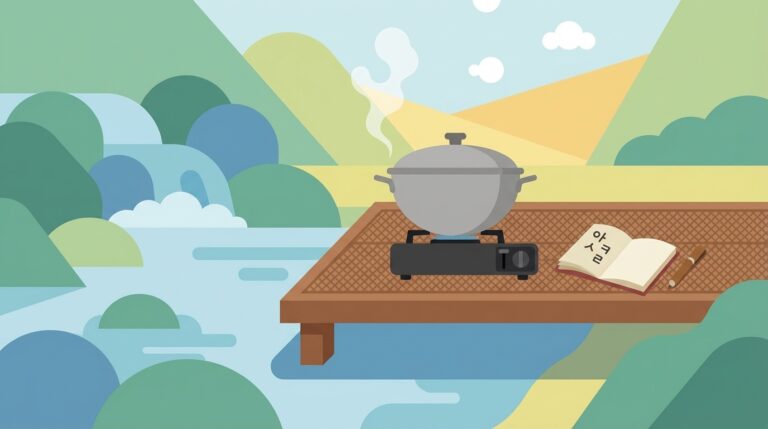
Picture this: You are watching a classic K-Drama summer MT (Membership Training) scene. The characters are splashing around in a crystal-clear mountain stream. They sit on a large wooden platform right over the water, laughing as a massive pot of steaming, herbal boiled chicken arrives. It looks like the ultimate, idyllic summer getaway.
But wait… when the camera cuts away, how much do you think that chicken cost?
If you tune into Korean news every August, you won’t see romanticized drama scenes. Instead, you’ll see heated debates about the “Gyegok Baeksuk Controversy” (계곡 백숙 논란). People complaining about paying 100,000 KRW (about $75 USD) for a single chicken, and vendors illegally occupying public streams.
If you’re planning a summer trip to Korea, or just want to understand what native speakers are really complaining about online during the sweltering heat, you need to know this cultural phenomenon. Today, we are diving deep into the vocabulary of the Korean summer vacation—and the fine art of not getting ripped off.
(Note: This guide is built from the real experiences of my students who ventured out of Seoul and encountered the wild world of Korean mountain valleys!)
Phase 2: Deep Dive into Key Expressions
Let’s break down the essential vocabulary you need to navigate this fiery summer topic.
1. 바가지 씌우다 / 바가지 쓰다
- Pronunciation: ba-ga-ji ssui-u-da / ba-ga-ji sseu-da [Sounds like: baa-gaa-jee ssee-oo-da. Think of the ‘baa’ of a sheep, a soft ‘ga’, and a sharp ‘jee’.]
- Meaning: Literal: To put a gourd bowl over someone’s head. Real nuance: To overcharge someone / To get ripped off.
- K-Culture Moment: This is the most crucial word for tourist traps. If you read Korean reviews on KakaoMap for summer valley restaurants, you will see the word “바가지” everywhere. It’s the exclamation of pure frustration when the bill arrives and it’s double what it should be.
- Editor’s Insight: The feeling here is indignation. It’s not just “expensive” (비싸다); it implies you were tricked or taken advantage of because you are a tourist or a captive audience.
- Situation Spectrum:
[🚫 절대 금지] ———— [⚠️ 주의] ———— [✅ 자유롭게]
- To friends (Casual): ✅ “야, 우리 완전 바가지 썼어!” (Hey, we got totally ripped off!)
- To colleagues (Semi-formal): ⚠️ “거기 바가지가 좀 심하대요.” (I heard the rip-off there is quite bad.)
- To the restaurant owner (Formal): 🚫 (Never say this to their face unless you want a shouting match!)
- 🤔 Think About It: Historically, merchants used gourd bowls (바가지) to measure grains. If they manipulated the bowl, they cheated the customer. How do you describe “getting ripped off” in your native language? Does it have a historical origin?
2. 자릿세
- Pronunciation: ja-rit-se [Sounds like: ja-reet-seh]
- Meaning: Literal: Seat tax. Real nuance: A table charge or fee for occupying a spot.
- K-Culture Moment: In the mountain valleys (계곡), restaurants set up wooden platforms (평상 – pyeongsang) right in the public water. Often, the exorbitant price of the chicken (백숙) is justified by the owners as a hidden “자릿세” for letting you play in the water all day.
- Editor’s Insight: It feels like a “forced” fee. You’re paying for the privilege of sitting in nature, which technically belongs to the public.
- Situation Spectrum:
[🚫 절대 금지] ———— [⚠️ 주의] ———— [✅ 자유롭게]
- Friends/Online reviews: ✅ “백숙 값이 아니라 자릿세지 뭐.” (It’s not the price of the chicken, it’s the seat fee.)
- 🤔 Think About It: The concept of public space vs. private enterprise is a hot topic in Korea. Is it fair to charge a “seat fee” if you are providing shade and food next to a public river?
3. 이열치열 (以熱治熱)
- Pronunciation: i-yeol-chi-yeol [Sounds like: ee-yul-chee-yul]
- Meaning: Literal: Control heat with heat. Real nuance: Fighting fire with fire (eating boiling hot food on the hottest summer day).
- K-Culture Moment: Why do Koreans eat boiling hot chicken soup (Baeksuk) when it’s 35°C outside? It’s traditional wisdom! You sweat out the heat and replenish your energy. You’ll hear middle-aged men sighing “Ah~ cool!” (아~ 시원하다!) while drinking boiling broth.
- Editor’s Insight: This isn’t a negative word; it’s a cultural philosophy. Using this four-character idiom (Saja-seongeo) will make you sound incredibly fluent and culturally integrated.
- Situation Spectrum: All situations ✅
- 🤔 Think About It: Does your culture have a counter-intuitive practice like eating hot food in summer or cold food in winter?
Phase 3: Textbook vs Real Life
How do actual Koreans talk about their summer valley trips compared to your textbook?
| Situation | 📖 Textbook Korean | 🗣️ Real Korean | 💡 Why the difference? |
|---|---|---|---|
| Complaining about price | 가격이 너무 비쌉니다. (The price is too expensive.) | 와, 완전 바가지네. 선 넘었다. (Wow, total rip-off. They crossed the line.) | Emotional expression; “선 넘었다” (crossed the line) is a popular internet slang for unacceptable behavior. |
| Suggesting food | 닭고기를 먹읍시다. (Let’s eat chicken meat.) | 계곡에선 무조건 백숙이지! (In the valley, it has to be Baeksuk!) | “무조건 ~이지” emphasizes the absolute cultural rule of pairing a specific location with a specific food. |
| Asking about a table | 앉을 자리가 있습니까? (Is there a seat to sit?) | 여기 평상 자리 하나 얼마예요? (How much is one platform seat here?) | Acknowledging that in this specific setting, you are renting a specific type of seat (평상). |
Phase 4: Cultural Deep Dive
4-1. Non-verbal Communication: The Art of “Nunchi” at the Valley
Imagine you are with four Korean friends. The bill comes, and it’s shockingly high. Do you start yelling at the owner? No. This is where 눈치 (Nunchi – situational awareness) kicks in.
Often, Koreans will pay the “Bagaji” price without a scene because ruining the mood of the hard-earned summer vacation (휴가) is considered worse than losing money. They will exchange quiet, knowing glances (눈빛 교환), pay, leave, and then fiercely complain in the car ride home. Harmony in the group often overrides individual justice in the moment.
4-2. K-Culture Connection: Media vs. Reality
If you watch variety shows like 2 Days & 1 Night or K-Dramas, the mountain valley (계곡) is portrayed as a free, joyful playground.
However, the reality of Korean Food/Travel culture has faced a clash. For decades, local vendors illegally poured concrete into public streams to set up their restaurants. Recently, local governments (like in Gyeonggi-do) launched massive campaigns to tear down these illegal structures to return “clean valleys” to the citizens.
When you eat Baeksuk at a valley today, you are participating in a rapidly changing cultural landscape— caught between the nostalgia of the past and the demand for fair consumer rights.
Phase 5: Immersive Roleplay
Setting: Saturday afternoon, mid-August. You and your Korean friend, Minji, have driven 2 hours to a valley in Gapyeong. The sound of cicadas is deafening. You see a perfect spot by the water, but it’s occupied by a restaurant’s wooden platforms (평상).
Characters:
– YOU: A B2-level Korean learner, excited for your first real “Gyegok” experience.
– Minji (28): Your Korean friend. She’s practical and hates getting ripped off.
– Owner (50s): A busy restaurant owner holding a menu and a notepad.
Dialogue:
Owner: 어서 오세요! 두 명? 저기 물가 쪽 평상에 앉으세요.
(eoseo oseyo! du myeong? jeogi mulga jjok pyeongsange anjeuseyo.)
[Welcome! Two people? Sit on that platform by the water.]
(🎭 Stage Direction: The owner points aggressively to a nice spot and hands you a sticky menu.)
YOU: 우와, 자리 진짜 좋다! 민지야, 우리 저기 앉자.
(uwa, jari jinjja jota! minjiya, uri jeogi anjja.)
[Wow, the seat is really nice! Minji, let’s sit there.]
Minji: 잠깐만… 사장님, 여기 백숙 한 마리에 얼마예요?
(jamkkanman… sajangnim, yeogi baeksuk han marie eolmayeyo?)
[Wait a second… Boss, how much is one Baeksuk here?]
Owner: 백숙? 9만 원! 자릿세 다 포함된 가격이야. 싸다 싸!
(baeksuk? guman won! jaritse da pohamdoen gagyeogiya. ssada ssa!)
[Baeksuk? 90,000 won! It’s a price that includes the seat fee. Cheap, cheap!]
YOU: 헉, 9만 원이요? 닭 한 마리에요?
(heok, guman woniyo? dak han marieyo?)
[Gasp, 90,000 won? For one chicken?]
Minji: 거봐, 내가 뭐랬어. 완전 바가지라니까.
(geobwa, naega mworaesseo. wanjeon bagajiranikka.)
[See, what did I tell you. I told you it’s a total rip-off.]
(🎭 Stage Direction: Minji whispers to you, looking annoyed.)
🔀 Your Turn! How do you respond to Minji?
– A) “너무 비싸요. 경찰에 신고합시다!” (Too expensive. Let’s call the police!)
– B) “다른 데 가볼까? 여기 너무 선 넘었다.” (Should we try somewhere else? This crosses the line here.)
– C) “그냥 먹자. 내가 쏠게!” (Let’s just eat. I’ll treat!)✅ Best Choice: B — Reason: It perfectly uses natural, native-like phrasing (“선 넘었다”) to agree with her assessment of the “Bagaji” without causing a scene in front of the owner.
⚠️ Choice A Analysis: Extremely confrontational. While technically illegal in some places, calling the police over a chicken price is a massive overreaction that will ruin the trip.
(Continuing with Choice B…)
YOU: 다른 데 가볼까? 여기 너무 선 넘었다.
(dareun de gabolkka? yeogi neomu seon neomeotda.)
[Should we try somewhere else? This crosses the line here.]
Minji: 그래, 그냥 좀 더 올라가 보자. 계곡은 좋은데 기분 망치기 싫어.
(geurae, geunyang jom deo ollaga boja. gyegogeun joeunde gibun mangchigi sileo.)
[Yeah, let’s just go up a bit further. The valley is nice, but I don’t want to ruin our mood.]
Owner: 아유, 학생들! 그럼 8만 원에 해줄게! 어때?
(ayu, haksaengdeul! geureom palman wone haejulge! eottae?)
[Oh my, students! Then I’ll do it for 80,000 won! How about it?]
YOU: 죄송합니다. 다음에 올게요!
(joesonghamnida. daeume olgeyo!)
[Sorry. We’ll come next time!] (The classic Korean polite rejection)
Phase 6: 10-Second Shadowing Drill
Practice your outrage and disbelief! Pay attention to the pauses (/) and the intonation.
😤 아니, / 백숙 한 마리에 / 십만 원이 / 말이 돼?!
(a-ni, / baek-suk han ma-ri-e / sim-man wo-ni / ma-ri dwae?!)
[No way, / 100,000 won / for one chicken / makes sense?! (Is that even possible?!)]
Tip: Start with a sharp “Ah-ni” (a multi-purpose exclamation of disbelief in Korean), pause for effect, and raise your pitch at “말이 돼?!”.
Phase 7: K-Culture Glossary
| 한국어 | Romanization | English | Cultural Context |
|---|---|---|---|
| 계곡 | gyegok | Mountain valley/stream | The ultimate summer destination for Koreans avoiding the salty, hot beaches. |
| 백숙 | baeksuk | Whole boiled chicken | Cooked with ginseng, garlic, and jujubes. The staple food of valley trips. |
| 평상 | pyeongsang | Wooden platform | Low wooden tables where you sit cross-legged. Central to Korean outdoor leisure. |
| 피서 | piseo | Escaping the heat | Literally “avoiding heat.” Going on summer vacation. |
| 눈치 | nunchi | Situational awareness | Reading the room. Deciding whether to complain about a price based on the group’s mood. |
Phase 8: Traveler’s Survival Kit
Planning a trip to a Korean valley? Don’t let your wallet cry.
🆘 Survival Expressions for the Valley
– 🇰🇷 “메뉴판 좀 볼 수 있을까요?” (menyupan jom bol su isseulkkayo?)
– 🗣️ English: Could I see the menu, please?
– 📍 Where to use: BEFORE you sit down on a Pyeongsang. Always check the price first!
– 🇰🇷 “자리만 빌릴 수도 있나요?” (jariman billil sudo innayo?)
– 🗣️ English: Can we just rent the seat?
– 📍 Where to use: Some reformed valleys now allow you to rent just the platform and bring your own food.
– 🇰🇷 “저희 좀 더 둘러보고 올게요.” (jeohui jom deo dulleobogo olgeyo.)
– 🗣️ English: We will look around a bit more and come back.
– 📍 Where to use: The polite way to escape a restaurant when the price is too high.📌 Editor’s Travel Note
– App Check: Always check KakaoMap reviews before arriving. Koreans are brutally honest in map reviews regarding “바가지” (rip-offs).
– The Crackdown: Thanks to recent government efforts, many valleys in Gyeonggi-do (like Pocheon and Gapyeong) have removed illegal restaurants. You can now bring a picnic mat and enjoy the water for free!
– Tipping: Remember, even if the service is great or the food is expensive, there is NO tipping culture in Korea. Do not leave extra money on the table!
Phase 9: Think Deeper — Media vs Reality
🧠 Think Deeper: The Romanticized Valley
When you watch K-Dramas like Hospital Playlist or reality shows featuring idol groups, summer trips to the gyegok look flawless. The friends laugh over a massive, affordable feast, splashing in pristine water. However, the media rarely shows the intense negotiations, the anxiety of finding a parking spot, or the sticker shock of a 100,000 KRW chicken.This “Bagaji” controversy is a prime example of the gap between exported K-Culture and the gritty reality of local living. It highlights a tension in modern Korea: the desire to preserve nostalgic summer traditions versus the modern consumer’s demand for fairness and transparency. As a Korean learner, understanding these social friction points gives you a much deeper, authentic connection to the country than merely memorizing drama scripts.
💬 Your Turn: Does your country have a tourist spot that looks perfect in movies but is famous among locals for being a massive “rip-off”? Share it in the comments!
Phase 10: FAQ & Troubleshooting
Q: Can I yell “바가지!” at the restaurant owner if the price is crazy?
– No! While Koreans use this word constantly online and among friends, saying it directly to an older merchant is highly confrontational and disrespectful. Use the Survival Expression: “조금 비싸네요. 둘러보고 올게요.” (It’s a bit expensive. We’ll look around.)
Q: If the chicken is 100,000 won, does it at least feed a lot of people?
– Maybe. A large Baeksuk is usually meant for 3-4 people. When you divide the cost, it’s roughly 25,000 won per person, which makes it slightly more understandable as a “vacation tax” plus a meal, but locals still consider it overpriced.
❌ Common Mistake #1: Sitting down on a nice wooden platform (평상) by the water before talking to anyone.
✅ Do this instead: At a valley, a platform is never free. Assume it belongs to a restaurant. Ask for the menu and price before putting your bags down.
Phase 11: Wrap-up & Action Missions
One-Liner Summary: A true Korean summer involves fighting the heat with boiling Baeksuk, but knowing the word “바가지” (Bagaji) will protect your wallet from getting burned!
Action Missions:
– 🥉 Bronze: Stand in front of a mirror, look deeply shocked, and say “완전 바가지네!” 3 times.
– 🥈 Silver: Leave a comment below answering the “Think Deeper” question about tourist traps in your country.
– 🥇 Gold: Search the Korean keyword “계곡 백숙 바가지” on YouTube or Google. Look at the thumbnails and news titles—can you spot the words you learned today?
Phase 12: Interactive Quiz
1. You are at a valley with friends. The bill for some pancakes and chicken is absurdly high. You want to complain to your friend. What is the most natural thing to say?
A) 사장님, 바가지 씌우지 마세요! (Boss, don’t rip us off!)
B) 우리 바가지 쓴 것 같아. (I think we got ripped off.)
C) 가격을 깎아주세요. (Please cut the price.)
(Answer: B. It’s natural to express your feeling to your friend. A is too aggressive to the boss, and C is rarely successful in these established tourist traps.)
2. True or False – K-Culture Edition:
Because it is so hot during the Korean summer, Koreans strictly eat cold foods like Naengmyeon (Cold Noodles) at the mountain valleys.
(Answer: False! While Naengmyeon is popular, the valley tradition is “이열치열” (fighting heat with heat) by eating boiling hot Baeksuk!)
Frequently Asked Questions (FAQ)
Q: What does "바가지 씌우다 / 바가지 쓰다" mean in Korean and how do you pronounce it?
A: In Korean, "바가지 씌우다 / 바가지 쓰다" is pronounced [ba-ga-ji ssui-u-da / ba-ga-ji sseu-da [Sounds like: baa-gaa-jee ssee-oo-da. Think of the 'baa' of a sheep, a soft 'ga', and a sharp 'jee'.] and means: Literal: To put a gourd bowl over someone's head. Real nuance: To overcharge someone / To get ripped off.
Q: What does "자릿세" mean in Korean and how do you pronounce it?
A: In Korean, "자릿세" is pronounced [ja-rit-se [Sounds like: ja-reet-seh] and means: Literal: Seat tax. Real nuance: A table charge or fee for occupying a spot.
Q: What does "이열치열 (以熱治熱)" mean in Korean and how do you pronounce it?
A: In Korean, "이열치열 (以熱治熱)" is pronounced [i-yeol-chi-yeol [Sounds like: ee-yul-chee-yul] and means: Literal: Control heat with heat. Real nuance: Fighting fire with fire (eating boiling hot food on the hottest summer day).







