

Phase 1: Immersive Hook
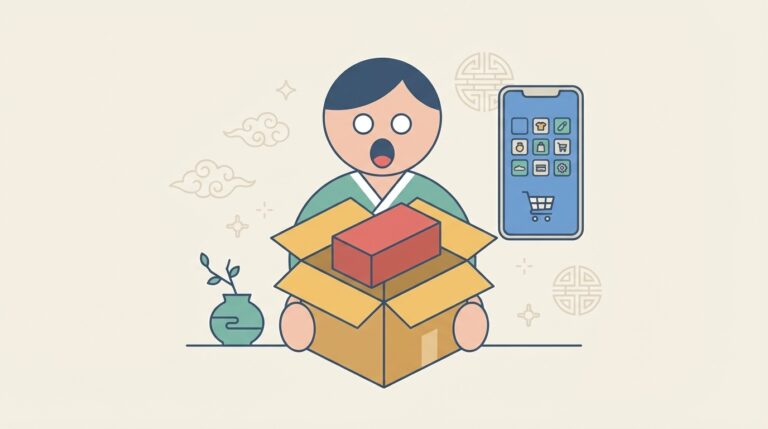
Hello! I’m your lead editor and tutor at Daily Hangul. Imagine this: You finally found it. The ultra-rare, out-of-print K-Pop photocard of your ultimate bias, or perhaps a gently used flagship smartphone you’ve been eyeing, listed at an absolute steal on a Korean second-hand app like Danggeun Market (당근마켓) or Joonggonara (중고나라). Your heart races. You send the money, wait agonizing days for the delivery, and finally, the parcel arrives. Cue the dramatic K-Drama OST… You rip open the tape, look inside, and find… a literal red brick. 🧱
Welcome to the infamous ‘벽돌 사기’ (Brick Scam).
Second-hand shopping in Korea is practically a national sport. From thrifting trendy Y2K fashion to scoring cheap electronics, it’s an amazing part of living in or visiting Korea. But just like any bustling marketplace, it has its dark corners. Today, I’m going to teach you the survival phrases you need to navigate Korean second-hand markets like a savvy local, so you never end up starring in your own tragic unboxing video. Let’s dive in!
Phase 2: Deep Dive into Core Expressions
1. 벽돌 사기 (Brick Scam)
- Pronunciation: [byeok-dol sa-gi]
- byeok sounds like you’re lightly choking out the word ‘buck’,
- dol rhymes with ‘mole’,
- sa-gi sounds like ‘saw-gee’.
- Meaning: Literal translation is “Brick Scam.” The real nuance is mail fraud where the seller ships a heavy piece of trash (traditionally a brick) instead of the valuable item.
- K-Culture Moment: You’ll see this in crime K-Dramas where the rookie detective gets scammed buying a gaming console online, sending the precinct into a frenzy.
- Editor’s Insight: This phrase is iconic. Even if the scammer sends a bottle of water or a rock, Koreans still call it a byeok-dol sa-gi.
- Situation Spectrum:
[🚫 절대 금지] ———— [⚠️ 주의] ———— [✅ 자유롭게]
- Casual (Friends): ✅ “나 벽돌 사기 당했어!” (I got brick-scammed!)
- Semi-formal (Police/Bank): ✅ “벽돌 사기를 당했습니다.”
- Formal (Work): ⚠️ (Unlikely to use unless it’s a work-related purchase)
- 🤔 Think About It: Why a brick? Scammers used bricks because the weight perfectly matched a boxed smartphone! How do scammers trick people in your country?
2. 직거래 할게요 (I will do a direct transaction)
- Pronunciation: [jik-geo-rae hal-ge-yo]
- jik like ‘Jeep’ but with a K,
- geo-rae sounds like ‘guh-ray’.
- Meaning: Face-to-face transaction (in-person trade).
- K-Culture Moment: A bustling subway station exit at 7 PM. You see two strangers awkwardly make eye contact, nod, exchange a shopping bag for a quick bank transfer on their phones, and part ways in 10 seconds. That’s jik-geo-rae.
- Editor’s Insight: This is your ultimate shield against the brick scam. If a seller refuses jik-geo-rae, run away.
- Situation Spectrum:
[🚫 절대 금지] ———— [⚠️ 주의] ———— [✅ 자유롭게]
- With the seller online: ✅
- 🤔 Think About It: Danggeun Market (당근마켓) became Korea’s #1 app simply by restricting trades to your GPS-verified neighborhood. What does this tell us about the Korean desire for local trust?
3. 선입금은 안 해요 (I don’t pay in advance)
- Pronunciation: [seon-ib-geum-eun an hae-yo]
- Meaning: Literal: “I do not do advanced deposits.” Real nuance: “I’m not sending you money before I see the item, nice try.”
- K-Culture Moment: Buying sold-out concert tickets on Twitter (X). The seller asks you to wire money first. You reply with this phrase to test if they are legitimate or a scammer.
- Editor’s Insight: Seon (선) means ‘first/advance’ and ip-geum (입금) means ‘deposit’. Combine them, and you get the red flag of all online trades.
Phase 3: Textbook vs Real Life
| Situation | 📖 Textbook Korean | 🗣️ Real Korean | 💡 Why the difference? |
|---|---|---|---|
| Suggesting a meetup | 직접 만나서 물건을 사고 싶어요. (I want to meet in person to buy the item.) | 직거래 가능하신가요? (Is direct trade possible?) | Koreans love efficiency. “직거래” (direct trade) is the standard 3-syllable jargon. |
| Asking for a discount | 가격을 조금 깎아 주실 수 있나요? (Could you cut the price a little?) | 네고 되나요? (Is ‘nego’ possible?) | ‘Nego’ is Konglish for negotiation. It’s the undisputed slang for haggling online! |
| When the seller vanishes | 판매자가 연락을 안 받아요. (The seller is not answering my contacts.) | 판매자가 잠수 탔어요. (The seller went diving/ghosted.) | “잠수 타다” (going underwater) is a highly visual slang for ghosting someone. |
Bottom Note: Stick to 직거래 and 네고 when using Korean trading apps. They instantly make you sound like an experienced buyer rather than a vulnerable tourist!
Phase 4: Cultural Deep Dive
4-1. Non-verbal Communication & Nunchi (눈치)
When doing a jik-geo-rae (in-person trade), Nunchi is everything. You meet at a subway station. You don’t need a long greeting. A simple “당근이세요?” (Are you Danggeun?) with a slight bow is enough. You inspect the item quickly but thoroughly. It is considered slightly rude to stare at the item for 10 minutes analyzing every scratch in front of the seller. Check the essentials, transfer the money via your phone right there, show them the transfer completion screen, say “감사합니다” (Thank you), and leave.
4-2. The “Certification Shot” (인증샷) in K-Pop Culture
If you absolutely cannot meet in person—say, you are buying a limited edition K-Pop photocard from someone in Busan while you live in Seoul—you must ask for an 인증샷 (in-jeung-syat). This means “verification shot.”
But a simple photo isn’t enough! Scammers steal photos from other blogs. You must ask the seller to take a photo of the photocard with today’s date, their username, and a specific hand gesture (like a peace sign or a finger heart) written on a post-it note next to the item. If they make an excuse? Cancel the trade immediately.
Phase 5: Immersive Roleplay Scenario
Scenario A: The Subway Station Meetup
Setting: Gangnam Station, Exit 11. It’s a brisk Friday evening. People are swarming past you. You are here to buy a used digital camera you found on an app.
Characters:
– YOU: An international student living in Seoul, trying to level up your photography game.
– Min-su (28): The seller. He looks like he just got off work.
Dialogue:
Min-su: 저기요… 혹시 카메라 직거래 하러 오셨나요?
(jeo-gi-yo… hok-si ka-me-ra jik-geo-rae ha-reo o-syot-na-yo?)
[Excuse me… did you come for the camera direct trade?]
(🎭 Min-su holds up a small paper bag awkwardly)
YOU: 아, 네! 안녕하세요. 물건 한번 확인해 봐도 될까요?
(a, ne! an-nyeong-ha-se-yo. mul-geon han-beon hwa-gin-hae bwa-do doelkka-yo?)
[Ah, yes! Hello. May I check the item for a moment?]
Min-su: 네, 여기요. 상태 엄청 좋아요.
(ne, yeo-gi-yo. sang-tae eom-cheong jo-a-yo.)
[Yes, here. The condition is really good.]
(🎭 You turn on the camera. It works perfectly, but there is a noticeable scratch not shown in the photos.)
🔀 Your Turn! How do you respond?
– A) “완벽하네요! 지금 바로 입금할게요.” (It’s perfect! I’ll transfer the money right now.)
– B) “사진에는 없었는데 기스가 있네요. 조금 네고 가능할까요?” (There’s a scratch that wasn’t in the photos. Is a little ‘nego’ possible?)
– C) “사기 치지 마세요! 경찰 부를게요!” (Don’t scam me! I’ll call the police!)✅ Best Choice: B — Reason: In Korea, if the item differs slightly from the description, it’s totally acceptable to ask for a small discount (네고) on the spot using polite language.
⚠️ Choice C Analysis: Whoa, slow down! A small scratch isn’t a “brick scam.” Accusing someone of a scam to their face over a scratch is a great way to start a street fight.
Min-su: 아… 그 기스요. 만 원 빼드릴게요.
(a… geu gi-seu-yo. man-won ppae-deu-ril-ge-yo.)
[Ah… that scratch. I’ll take 10,000 won off.]
YOU: 감사합니다. 지금 계좌로 이체할게요.
(gam-sa-ham-ni-da. ji-geum gye-jwa-ro i-che-hal-ge-yo.)
[Thank you. I will transfer it to your account now.]
Scenario B: The Online Red Flag
You are messaging a seller for a concert ticket.
Seller: 티켓 인기가 많아서요. 먼저 선입금 해주시면 우편으로 보낼게요.
[The ticket is very popular. If you do an advanced deposit first, I will mail it to you.]
YOU: 제가 사기를 당한 적이 있어서요. 직거래 아니면 거래 안 할게요. 죄송합니다.
[I’ve been scammed before. If it’s not a direct trade, I won’t do the transaction. Sorry.]
Seller: … (Seller leaves the chat)
Congratulations! You just dodged a bullet.
Phase 6: 10-Second Shadowing Drill
Practice this sentence to sound firm and confident when arranging a trade!
😤 저기요, / 선입금은 안 하고요, / 직거래만 / 할게요.
(jeo-gi-yo, / seon-ib-geum-eun an ha-go-yo, / jik-geo-rae-man / hal-ge-yo.)
[Excuse me, I don’t do advanced deposits, I will only do direct trades.]
Phase 7: K-Culture Glossary (Second-hand Edition)
| Korean | Romanization | English Meaning | Cultural Context |
|---|---|---|---|
| 당근마켓 | Danggeun Market | ‘Carrot Market’ | Korea’s #1 neighborhood-based trading app. “Are you a carrot?” is the universal greeting for users meeting up. |
| 매너온도 | maeneoon-do | Manner Temperature | A rating system on Danggeun. It starts at 36.5°C (human body temp). If they are 99°C, they are a trading angel. If they are 20°C, run. |
| 쿨거래 | kul-geo-rae | Cool trade | A fast, no-nonsense trade without tedious haggling. Koreans love this. |
| 네고 | ne-go | Negotiation (Discount) | Asking the seller to lower the price. |
| 계좌이체 | gye-jwa-i-che | Bank transfer | The default way to pay for second-hand goods in Korea. Cash is rarely used! |
Phase 8: Traveler’s Survival Kit
Even if you’re just visiting Korea for a few weeks, you might want to buy a used film camera at Dongmyo Flea Market or concert merch. Here are your lifesavers:
🆘 Survival Phrases for Buying Used Goods
– 🇰🇷 “이거 작동 잘 되나요?” (i-geo jak-dong jal doe-na-yo?)
– 🗣️ Meaning: Does this work well?
– 🇰🇷 “네고 조금만 해주세요~” (ne-go jo-geum-man hae-ju-se-yo~)
– 🗣️ Meaning: Please give me a little discount~
– 🇰🇷 “계좌번호 찍어주세요.” (gye-jwa-beon-ho jjig-eo-ju-se-yo.)
– 🗣️ Meaning: Please type in your account number (so I can transfer money).📌 Editor’s Travel Note
– Cash vs App: While locals use banking apps (like Toss or KakaoPay) to transfer money instantly, tourists without a Korean bank account will need to bring cash for direct trades.
– Safe Zones: Many Korean police stations now have designated “Safe Trade Zones” (안심거래존) with CCTV specifically for second-hand meetups!
Phase 9: Think Deeper — Language & Community
🧠 Think Deeper: The “Pali-Pali” Trust System
Why did a hyper-local app like Danggeun Market completely take over Korea? It reflects the intersection of Korea’s Pali-pali (hurry-hurry) culture and community trust. National shipping takes 1-2 days, which gives scammers time to mail a brick. Meeting someone who lives in your own neighborhood takes 10 minutes. The language reflects this: asking “당근이세요?” instantly establishes a shared community bond. It’s a high-tech solution to recreating the old-school village marketplace where everyone knew everyone’s face.💬 Your Turn: Have you ever bought anything second-hand in your country? Do people prefer shipping it, or meeting face-to-face? Share in the comments!
Phase 10: Troubleshooting & FAQ
Q: Is it okay to use “네고 (Nego)” with older people?
A: Yes, it has become a universal term! However, instead of saying “네고 해!” (Do nego!), make it polite: “네고 가능할까요?” (Is nego possible?).
Q: What if the seller asks me to click a “safe payment” link they send in a private text?
A: ABSOLUTE NO. This is Phishing 101. Only use the secure payment systems built directly inside the trading apps. Never click external links.
❌ Common Mistake #1: Paying first because the seller says “there are 5 other people waiting to buy this.”
✅ Do this instead: Let it go. It’s the oldest trick in the scammer’s handbook to create a false sense of urgency. Just say, “다른 분께 파세요” (Please sell it to the other person).
Phase 11: Wrap-up & Action Items
One-Liner Summary: To avoid the byeokdol sagi (brick scam), always insist on jikgeorae (direct trade) and never send money in advance!
🚀 Your Action Missions:
– 🥉 Bronze: Say “직거래 가능하신가요?” out loud 3 times right now.
– 🥈 Silver: Leave a comment below with what item you would love to buy second-hand in Korea!
– 🥇 Gold: Next time you watch a K-Drama and someone gets scammed, shout “벽돌 사기!” at the screen.
🥕 Special K-Culture Mission:
Go on X (Twitter) or Weverse and search for your favorite idol’s name + “양도” (transfer/sell) or “직거래”. Look at how Korean fans format their trading posts. You’ll definitely spot the word “인증샷” (certification shot)!
Phase 12: Interactive Quiz
1. You are chatting with a seller online. They say they live too far away and ask you to send the money first so they can mail the item today. What is your BEST response?
– A) 오, 감사합니다! 계좌번호 주세요. (Oh, thank you! Give me the account number.)
– B) 죄송하지만, 선입금은 안 해요. (Sorry, but I don’t do advanced deposits.)
– C) 네고 가능할까요? (Is nego possible?)
2. True or False: If a seller on Danggeun Market has a Manner Temperature (매너온도) of 15°C, they are a highly trusted and “cool” seller.
– A) True
– B) False
3. Fill in the blank: To avoid the “_______ 사기” (scam where you receive a heavy piece of trash instead of your item), you should always try to do a direct trade.
(Answers: 1: B, 2: False – 36.5 is average, lower means they have been reported or have terrible reviews! 3: 벽돌/byeokdol)
Frequently Asked Questions (FAQ)
Q: What does "벽돌 사기 (Brick Scam)" mean in Korean and how do you pronounce it?
A: In Korean, "벽돌 사기 (Brick Scam)" is pronounced [byeok-dol sa-gi] and means: a key conversational Korean expression covered in this lesson.
Q: What does "직거래 할게요 (I will do a direct transaction)" mean in Korean and how do you pronounce it?
A: In Korean, "직거래 할게요 (I will do a direct transaction)" is pronounced [jik-geo-rae hal-ge-yo] and means: a key conversational Korean expression covered in this lesson.
Q: What does "선입금은 안 해요 (I don't pay in advance)" mean in Korean and how do you pronounce it?
A: In Korean, "선입금은 안 해요 (I don't pay in advance)" is pronounced [seon-ib-geum-eun an hae-yo] and means: Literal: "I do not do advanced deposits." Real nuance: "I'm not sending you money before I see the item, nice try."







