

Hello! I’m your Daily Hangul Editor, your veteran tutor and local cultural navigator here in Seoul.
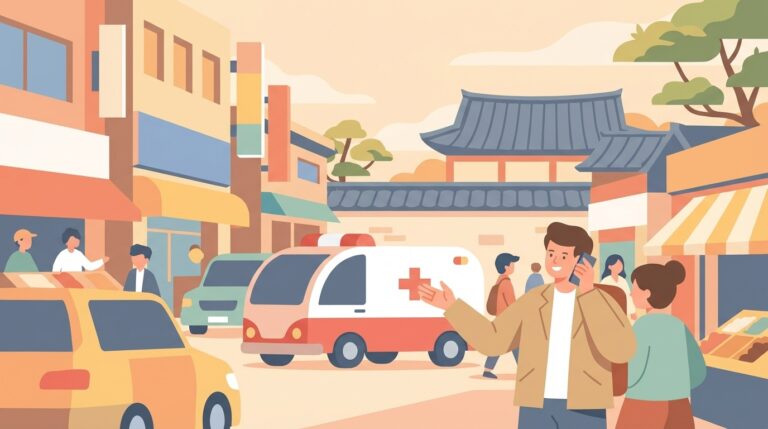
Imagine this: You are walking down the vibrant streets of Hongdae. Music is playing, people are laughing, and you are eating delicious Tteokbokki. Suddenly, with a loud thud, the person walking in front of you faints.
Panic sets in. You know how to say “Hello” (안녕하세요) and “Thank you” (감사합니다), but how do you save a life?
In K-Dramas, the handsome lead usually scoops the person up for a romantic piggyback ride to the hospital. But in real life? You need to call for help, fast. Today, we are learning the most crucial, life-saving Korean phrases for when someone collapses. This isn’t just a textbook lesson; this is your emergency survival kit. Let’s dive in!
Phase 2: Deep Dive into Core Expressions
1. 사람이 쓰러졌어요!
- Pronunciation: [sa-ram-i sseu-reo-jyeot-seo-yo!]
- Sound-alike guide: ‘쓰 (sseu)’ sounds a bit like a snake hissing “ss” with a tight smile. ‘사람’ means person.
- Meaning: Literal: A person fell down. / Real nuance: Someone collapsed/fainted!
- K-Culture Moment: You will hear this in medical K-Dramas like Hospital Playlist right before the doctors sprint down the hallway. In real life, shouting this in a subway station will instantly make people stop and look.
- Editor’s Insight: This is an urgent broadcast. You aren’t saying this to one specific person; you are shouting it to the crowd so someone takes action.
- Situation Spectrum:
[🚫 Never] ———— [⚠️ Be Careful] ———— [✅ Freely Use]
- Close Friends (Casual): ✅ (Drop the ‘yo’: 사람이 쓰러졌어!)
- Strangers/Emergency (Polite): ✅ (Keep the ‘yo’)
- 🤔 Think About It: Even in a high-stress emergency, Koreans still attach “~요 (yo)” at the end to keep it polite. Does your native language change formality levels during emergencies?
2. 119 불러 주세요!
- Pronunciation: [il-il-gu bul-leo ju-se-yo!]
- Sound-alike guide: “ill-ill-goo, bull-uh joo-say-yo!”
- Meaning: Please call 119!
- K-Culture Moment: In Korea, the emergency number for medical help and fire is 119 (not 911). You will see bright red 119 ambulances zipping through Seoul traffic.
- Editor’s Insight: “불러 주세요” literally means “please call out.” It is the standard way to ask someone to call a taxi or an ambulance.
- Situation Spectrum:
[🚫 Never] ———— [⚠️ Be Careful] ———— [✅ Freely Use]
- Any emergency situation: ✅
- 🤔 Think About It: Why do Koreans say “il-il-gu” (one-one-nine) instead of “baek-sip-gu” (one hundred nineteen)? In Korean, phone numbers are always read digit by digit for clarity!
3. 도와주세요!
- Pronunciation: [do-wa-ju-se-yo!]
- Sound-alike guide: “Dough-ah-joo-say-yo!”
- Meaning: Please help me!
- Editor’s Insight: The most basic survival phrase. If you forget everything else, just yell this.
Phase 3: Textbook vs. Real Life
| Situation | 📖 Textbook Korean | 🗣️ Real Korean | 💡 Why is it different? |
|---|---|---|---|
| Announcing the emergency | 응급 환자가 발생했습니다. (An emergency patient has occurred.) | 사람이 쓰러졌어요! (Someone collapsed!) | Textbooks use formal news anchor language. In reality, you need fast, punchy words. |
| Asking for an ambulance | 구급차를 호출해 주시겠습니까? (Would you please call an ambulance?) | 119 불러주세요! (Call 119!) | In emergencies, people use direct commands with basic politeness rather than long questions. |
Phase 4: Cultural Deep Dive
4-1. Non-verbal Communication: The “Pointing” Rule
In psychology, there is a “Bystander Effect” where everyone assumes someone else will help. In Korea, if you just yell “Call 119!”, people might freeze due to Nunchi (reading the room, waiting for others to act).
Pro Tip: Point directly at someone specific. “You, in the yellow shirt! 119 불러 주세요!” This instantly breaks the hesitation.
4-2. K-Drama Connection: The Piggyback Myth
We all love K-Dramas where the male lead carries the sick female lead on his back (어바주다 – piggybacking) and runs to the ER in the rain.
Critical View: Please do not do this in real life! Moving someone who has collapsed can cause severe spinal injuries. Real Koreans do not piggyback strangers; they call 119 and wait for the professionals. TV romance does not equal real-world safety!
Phase 5: Immersive Roleplay Scenario
Setting: Friday night, 8 PM. A crowded K-BBQ restaurant in Gangnam. Smoke fills the air, and soju bottles line the tables. You are eating with your Korean coworkers.
Characters:
– YOU: A foreign employee in Korea.
– Minsu (32): Your friendly Korean coworker.
Minsu: Wow, this pork belly is amazing! Eat up! 🥩
(Romanization) Wa, i samgyeopsal jinjja masitda! Mani meogeo!
(English) Wow, this pork belly is really delicious! Eat a lot!
(🎭 Stage Direction: Suddenly, a man at the table next to you grabs his chest and falls backward out of his chair.)
Minsu: (Freezes in shock) 어… 어떡해?
(Romanization) Uh… eotteokhae?
(English) Uh… what do we do?
🔀 YOUR TURN! How do you react?
– A) “민수 씨, 저 사람 좀 업어주세요!” (Minsu, please piggyback that person!)
– B) (Loudly to the restaurant) “여기 사람이 쓰러졌어요! 119 불러 주세요!” (Someone collapsed here! Please call 119!)
– C) “아이고, 배불러요.” (Oh my, I’m full.)✅ Best Choice: B — You alert the room and give a clear command.
⚠️ Choice A Analysis: Remember the K-Drama rule! Never move a collapsed person.
Phase 6: 10-Second Shadowing Drill
Let’s practice the rhythm. In an emergency, your voice should be loud and clear.
- 😱 여기 / 사/람/이 / 쓰러졌/어요!!
(yeogi / sa/ram/i / sseu-reo-jyeot/seo-yo!!) - 😤 저기요! / 일/일/구 / 불러/주세요!!
(jeo-gi-yo! / il/il/gu / bul-leo/ju-se-yo!!)
(Say it with urgency, pausing slightly at the slash marks for impact!)
Phase 7: K-Culture Glossary
| Korean | Romanization | English | Context |
|---|---|---|---|
| 119 | il-il-gu | 119 | Fire and Medical emergency number in Korea. |
| 112 | il-il-i | 112 | Police emergency number in Korea. |
| 응급실 | eung-geup-sil | Emergency Room (ER) | Where ambulances take patients. |
| 기절하다 | gi-jeol-ha-da | To faint | Used when someone loses consciousness. |
| 심폐소생술 | sim-pye-so-saeng-sul | CPR | Cardiopulmonary resuscitation. |
Phase 8: Traveler’s Survival Kit
Even if you never face a medical emergency, knowing how to navigate help is vital for any traveler.
🆘 Survival Phrases for Travel Emergencies
– 🇰🇷 “여기가 어디예요?” (yeogiga eodiyeyo?)
– 🗣️ Meaning: Where is this place? (Useful if you need to describe your location to 119).
– 🇰🇷 “영어 할 줄 아세요?” (yeongeo hal jul aseyo?)
– 🗣️ Meaning: Do you speak English?📌 Editor’s Travel Note
– The 119 Translation Service: If you call 119 and only speak English, don’t panic! The Korean 119 center has 24-hour interpretation services. Just say “English please.”
– Map Apps: Google Maps is not very accurate in Korea. Use KakaoMap or Naver Map. If you need to tell 119 your location, look for the nearest utility pole (전봇대) or storefront sign to read the address.
Phase 9: Think Deeper — Media vs. Reality
🧠 Think Deeper: The K-Drama Illusion
K-Dramas have beautifully crafted emergency scenes. The hero sweeps the heroine into his arms, runs through the streets, and demands the doctors save her. While incredibly romantic, this creates a false image of how Korean society handles crises. In reality, Korea has a highly efficient, fast, and modern emergency response system (119). Relying on the system is much safer than relying on a “hero.” It shows how media sometimes prioritizes dramatic tension over practical reality.💬 Your Turn: Have you ever seen a medical emergency in a TV show from your country that made you think, “That is NOT how we do it in real life”? Share in the comments!
Phase 10: Troubleshooting & Common Mistakes
Q: Do I have to use polite language (존댓말) to the 119 operator?
Yes! Always use “~요 (yo)” or “~습니다 (seumnida).” Even in a panic, Korean operators will understand you better if you use standard polite forms.
Q: What if I dial 911 in Korea?
Interestingly, if you dial 911 on a smartphone in Korea, many networks will automatically redirect your call to 119. However, it’s always safer to just dial 119 directly!
❌ Common Mistake #1: Reading 119 as a whole number.
Never say “백십구 (baek-sip-gu)” (One hundred nineteen).
✅ Do this instead: Read it digit by digit: “일-일-구 (il-il-gu).”
Phase 11: Wrap-up & Action Items
🎯 One-Liner Summary: When someone collapses, don’t act like a K-Drama hero; shout “사람이 쓰러졌어요! 119 불러주세요!”
Action Mission:
– 🥉 Bronze: Stand in your room and urgently shout “사람이 쓰러졌어요!” 3 times.
– 🥈 Silver: Download KakaoMap or Naver Map right now and learn how to find your current location.
– 🥇 Gold: Next time you watch a K-Drama, listen closely to see if they say “일일구 (119)” or “응급실 (ER)”!
Phase 12: Interactive Quiz
1. You are at a cafe and someone faints. What is the BEST thing to shout?
A) 구급차를 호출해 주시겠습니까?
B) 119 불러 주세요!
C) 112 불러 주세요!
2. True or False: In Korea, you should read 119 as “baek-sip-gu”.
3. Situational Judgment: You point at a man and say “119 불러 주세요!”. What does this prevent?
A) The Bystander Effect
B) The 119 translation service
C) The K-BBQ meat from burning
(Answers: 1: B (A is too formal, C is for police). 2: False (It’s il-il-gu). 3: A.)
Stay safe, and see you in the next Daily Hangul lesson! 😊
Frequently Asked Questions (FAQ)
Q: What does "사람이 쓰러졌어요!" mean in Korean and how do you pronounce it?
A: In Korean, "사람이 쓰러졌어요!" is pronounced [sa-ram-i sseu-reo-jyeot-seo-yo!] and means: a key conversational Korean expression covered in this lesson.
Q: What does "119 불러 주세요!" mean in Korean and how do you pronounce it?
A: In Korean, "119 불러 주세요!" is pronounced [il-il-gu bul-leo ju-se-yo!] and means: a key conversational Korean expression covered in this lesson.
Q: What does "도와주세요!" mean in Korean and how do you pronounce it?
A: In Korean, "도와주세요!" is pronounced [do-wa-ju-se-yo!] and means: a key conversational Korean expression covered in this lesson.







