

Phase 1: 공감 — 몰입형 오프닝 (Immersive Hook)
Hello! I’m the Lead Editor at Daily Hangul.
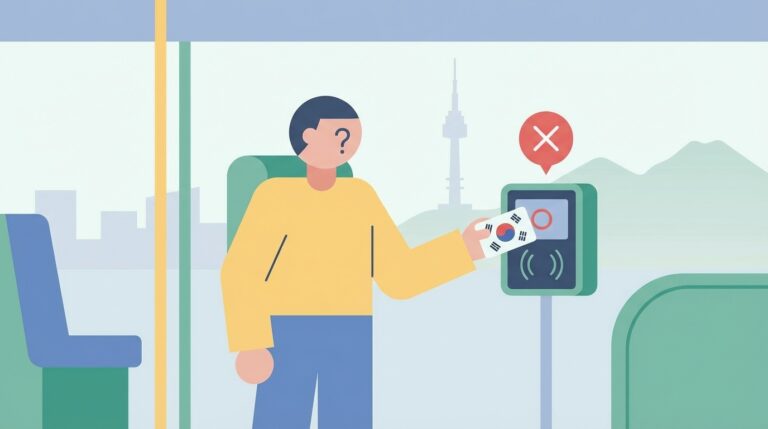
Imagine this: You’re in a K-Drama. It’s 8:30 AM in Seoul. The protagonist is running late for work, rushing onto a crowded green bus. They confidently tap their T-money card on the scanner, expecting that satisfying single “Beep!”
Instead, the machine aggressively blurts out: “잔액이 부족합니다!” (Janeegi bujokhamnida!)
The bus driver looks in the rearview mirror. The line of ten people behind you collectively sighs. In a drama, the handsome male lead might suddenly appear and tap his card for you, saying, “I’ll pay for two.” But in real life? You’re on your own, standing there with a red face, sweating profusely.
Welcome to the ultimate test of Korean Nunchi (눈치).
If you don’t know what to do or say in this exact moment, you might end up holding up the bus or getting yelled at by a fast-paced Ahjussi driver. But don’t worry! As your veteran tutor, I’ve seen countless students go through this exact transit trauma. Today, we are going to learn how to handle the dreaded “Insufficient Balance” situation like a true local.
Phase 2: 핵심 표현 심층 분석 (Deep Dive)
Let’s break down the essential phrases you need when your card betrays you.
1. 잔액이 부족합니다. (Janeegi bujokhamnida.)
- Pronunciation: [ja-nae-gi bu-jo-kam-ni-da]
(Tip: The ‘eo’ in bujok sounds like the ‘uh’ in ‘uh-oh!’)- Meaning: Literal: “The balance is insufficient.” / Real nuance: “You have no money on this card. Step aside!”
- K-Culture Moment: You won’t actually say this phrase; the card reader will scream it at you. In Korean variety shows (like Running Man), they often use this exact sound bite as a sound effect when someone fails at a mission or gets rejected!
- Editor’s Insight: This phrase uses the highly formal “-습니다” ending because it’s an automated machine announcement. Hearing this triggers an instant panic response in any Seoulite.
- Situation Spectrum:
[🚫 절대 금지] ———— [⚠️ 주의] ———— [✅ 자유롭게]
- You don’t say it, you just survive it!
- 🤔 Think About It: Notice how formal the machine is? Even when delivering bad news, Korean automated systems use the highest level of politeness. Does public transit in your country speak to you this politely?
2. 현금으로 낼게요. (Hyeongeumeuro naelgeyo.)
- Pronunciation: [hyeon-geu-meu-ro nael-gge-yo]
(Tip: ‘으’ sounds like the disgusted sound you make when stepping in gum. Try it: “Euu!”)- Meaning: Literal: “I will pay with cash.” / Real nuance: “Please wait, I have cash, let me pay physically!”
- K-Culture Moment: If you hear the dreaded insufficient balance sound, this is your instant lifeline—if you have cash in your pocket.
- Editor’s Insight: The “-(으)ㄹ게요” ending implies a promise or a forward-looking action to the listener. It has a much softer, more polite vibe than just saying “I am paying cash.”
- Situation Spectrum:
[🚫 절대 금지] ———— [⚠️ 주의] ———— [✅ 자유롭게]
- To Bus Driver (Formal): ✅
- To Taxi Driver (Formal): ✅
3. 만 원 충전해 주세요. (Man won chungjeonhae juseyo.)
- Pronunciation: [man won chung-jeon-hae ju-se-yo]
- Meaning: Literal: “Please recharge 10,000 won.” / Real nuance: “Load 10k won onto my card, please!”
- K-Culture Moment: You’ve walked into a GS25 or CU convenience store. You hand over your T-money card and a crisp 10,000 won bill to the part-timer who is probably listening to K-Pop on their AirPods.
- Editor’s Insight: The word “충전” (chungjeon) means “recharge” or “charge.” You can use this for your phone battery, your T-money card, or even metaphorically for your energy! (e.g., “당 충전” – sugar recharge).
- Situation Spectrum:
[🚫 절대 금지] ———— [⚠️ 주의] ———— [✅ 자유롭게]
- Convenience Store Clerk (Semi-formal): ✅
- Subway Station Attendant (Formal): ✅
Phase 3: 교과서 vs 진짜 한국어 (Textbook vs Real Life)
| 상황 | 📖 교과서 한국어 | 🗣️ 진짜 한국어 | 💡 왜 다를까? |
|---|---|---|---|
| At the convenience store | 교통카드에 만 원을 충전하고 싶습니다. (I would like to recharge 10,000 won to my transit card.) | 여기 만 원 충전이요. (Here, 10,000 won recharge, please.) | Koreans prioritize efficiency (빨리빨리). Dropping the verb and adding “이요” is polite yet super fast. |
| Realizing you have no cash on the bus | 잔액이 부족해서 다음 버스를 타겠습니다. (Because my balance is insufficient, I will take the next bus.) | 앗, 죄송합니다. 저 내릴게요! (Ah, sorry. I’ll get off!) | In a rushed situation, you just apologize quickly and state your immediate action to avoid blocking others. |
| Asking if you can pay by card | 신용카드로 결제할 수 있습니까? (Can I pay with a credit card?) | 카드로 결제돼요? (Can it be paid by card?) | “결제돼요?” is the ultimate magic phrase for asking “Do you accept…” in modern Korea. |
Phase 4: 문화적 맥락 — K-Culture 딥다이브 (Cultural Deep Dive)
4-1. 비언어적 요소: The Art of Transit Nunchi (눈치)
When your card fails, it’s not just about what you say; it’s about what you do. Korean public transit is incredibly fast-paced. If you hear “잔액이 부족합니다,” do not stand in front of the scanner searching your bag for 30 seconds.
Action: Immediately step to the side, let the people behind you tap their cards, and then communicate with the driver. Bow your head slightly while saying “죄송합니다” (Sorry) to acknowledge you disrupted the flow.
4-2. K-Travel Connection: The Language of the “Beeps”
Korean card readers actually speak to you through beeps!
– 1 Beep (“삑!”): Normal adult fare paid.
– 2 Beeps (“삑삑!”): Youth/Teenager fare paid (If you are an adult using a teen card, the driver will catch you because of this sound!).
– Multiple Beeps/Red Light (“삑삑삑삑!”): Error or Insufficient Balance.
Learning to recognize these sounds will make you a true local commuter. If you hear the rapid beeps, prepare your survival phrases!
Phase 5: 실전 롤플레이 시나리오 (Immersive Roleplay)
시나리오 A: 메인 롤플레이 (Main Scenario)
- Setting: Monday morning, 8:45 AM. A crowded blue bus (No. 400) in Gangnam. It’s raining slightly. You are holding your coffee and your T-money card.
- Characters:
- YOU: A B1-level Korean learner, heading to a language class.
- Bus Driver (Ahjussi): Wearing a neat uniform, wearing sunglasses, wants to keep the bus moving.
YOU: (Taps card enthusiastically)
Scanner: 삐빅! 잔액이 부족합니다! (Ppi-bik! Janeegi bujokhamnida!)
(🎭 Stage Direction: The three people behind you stop in their tracks. The driver looks at you.)
Driver: 학생, 카드 다시 찍어봐요.
(Haksaeng, kadeu dasi jjigeobwayo.)
[Student, try tapping the card again.]
YOU: (Taps again. 삐빅! 잔액이 부족합니다!)
Driver: 돈 없네. 현금 있어요?
(Don eomne. Hyeongeum isseoyo?)
[No money on it. Do you have cash?]
🔀 당신의 차례! 어떻게 대답할까요? (Your Turn! How will you respond?)
– A) “아니요, 저 돈 없습니다!” (No, I do not have money!)
– B) “잠시만요… 아! 현금으로 낼게요!” (Just a moment… Ah! I’ll pay in cash!)
– C) “저기요, 신용카드로 충전해 주세요!” (Excuse me, please recharge it with my credit card!)✅ Best Choice: B — Step aside, find your cash, and confidently use the “-ㄹ게요” ending.
⚠️ Choice A 분석: While grammatically correct, it sounds a bit too dramatic and robotic, almost like a soldier reporting a failure.
🚫 Choice C 분석: NEVER do this! You cannot recharge a T-money card on the bus, and you certainly can’t use a credit card to do it!
시나리오 B: K-Culture 보너스 롤플레이 (Convenience Store Rescue)
(You stepped off the bus and ran into a GS25)
Clerk: 어서 오세요~ (Welcome~)
YOU: 안녕하세요, 교통카드 충전해 주세요. (Hello, please recharge my transit card.)
Clerk: 네, 얼마 해드릴까요? (Yes, how much should I do for you?)
YOU: 만 원이요! (10,000 won, please!)
Phase 6: 10초 섀도잉 드릴 (Shadowing Drill)
Let’s practice the ultimate survival combo. Imagine you have no cash and need to escape the bus gracefully. Follow the rhythm and emotion!
😢 아저씨, / 죄송한데 / 저 내렸다가 / 다음 거 / 탈게요!
(Ajeossi, / joesonghande / jeo naeryeotdaga / daeum geo / talgeyo!)
Meaning: Sir, I’m sorry but I will get off and take the next one!
Tip: Pause slightly at the slashes /. Say “죄송한데” with a truly apologetic, slightly lowered voice.
Phase 7: K-Culture 미니 사전 (K-Culture Glossary)
| 한국어 | Romanization | 영어 | 맥락 설명 |
|---|---|---|---|
| 단말기 | danmalgi | Card reader/scanner | The machine you tap your card on. Literally means “terminal.” |
| 충전 | chungjeon | Recharge/Top-up | Used for cards, batteries, and even mental energy. |
| 환승 | hwanseung | Transfer | T-money allows free transfers within 30 minutes! Listen for “환승입니다” (Transfer applied). |
| 눈치 | nunchi | Nunchi / Situational awareness | Crucial when your card fails; stepping aside quickly is good nunchi. |
| 티머니 | Ti-meoni | T-money | The dominant transit card brand in Korea. |
Phase 8: 여행자 서바이벌 키트 (Traveler’s Survival Kit)
🆘 서바이벌 표현 TOP 3 (Transit Emergency Edition)
– 🇰🇷 “얼마예요?” (Eolmayeyo? – How much is it?)
– Use when paying cash on the bus to make sure you put the right amount in the plastic bin.
– 🇰🇷 “내려주세요!” (Naeryeojuseyo! – Please let me off!)
– Use when you miss your stop because you were too busy panicking about your card!
– 🇰🇷 “가까운 편의점이 어디예요?” (Gakkaun pyeonijeomi eodiyeyo? – Where is the nearest convenience store?)
– Use to find a place to recharge your card.📌 Editor’s Travel Note
– CASH IS KING FOR T-MONEY: This is the #1 mistake tourists make. You cannot recharge a T-money card with a foreign credit card or Apple Pay at subway machines or convenience stores. You MUST use Korean Won (KRW) cash! Always keep a 10,000 won bill in your pocket.
– Climate Card (기후동행카드): If you are staying in Seoul for a few days, look into the new unlimited transit card. It saves you from the “insufficient balance” anxiety entirely!
Phase 9: 비판적 사고 코너 — “한 발 더 깊이” (Think Deeper)
🧠 Think Deeper: The Irony of Korea’s Cashless Society
South Korea is famously one of the most cashless societies in the world. You can buy a 1,000 won pack of gum with a credit card without anyone batting an eye. Yet, ironically, the T-money card—the absolute backbone of Korean daily life—still requires physical paper cash to recharge at machines. This creates a unique cultural friction point where ultra-modern technology (sub-second NFC scanning) collides with traditional analogue systems (feeding cash into a kiosk).💬 Your Turn: Does your country have a fully digital transit system, or do you still need physical cards and cash? Share your local commuting culture in the comments!
Phase 10: FAQ & 오해 방지 (Troubleshooting)
Q: If I don’t have cash, can I just promise the driver I’ll pay next time?
No! While Korean drivers are kind, public transit is strictly regulated. You must step off the bus if you cannot pay. Don’t try to negotiate; it holds up the Ppalli-ppalli traffic flow.
Q: Can I say “만 원 충전해 주세요” to a much older clerk? Isn’t it rude to give commands?
Yes, you can! Adding “-주세요” (Please do…) makes it perfectly polite for service situations, regardless of the clerk’s age.
❌ 흔한 실수 (Common Mistake): Tapping your card too fast
Many foreigners tap their card and pull it away in a millisecond, causing an error.
✅ 이렇게 하세요: Hold the card firmly against the scanner for a full second until you hear the clear “Beep!”
Phase 11: 요약 및 액션 아이템 (Wrap-up)
One-Liner Summary: When the machine yells “잔액이 부족합니다,” don’t freeze—step aside and confidently say “현금으로 낼게요” or run to a convenience store for a “충전”!
Action Mission 3단계:
– 🥉 Bronze (혼자서): Practice the shadowing drill (Phase 6) in front of a mirror until you sound naturally apologetic.
– 🥈 Silver (온라인): Write down “저는 오늘 교통카드를 충전했어요” (I recharged my transit card today) in your Korean journal or on a learning app.
– 🥇 Gold (실전): Next time you are in Korea, boldly walk into a CU or GS25, hand over cash, and say “만 원 충전해 주세요!”
🎯 K-Culture Mission:
Watch a Korean vlog on YouTube (search “서울 버스 브이로그”). Listen closely to the background noise. Can you hear the difference between the 1-beep and 2-beep sounds when people board?
Phase 12: 퀴즈 — 인터랙티브 챌린지 (Interactive Quiz)
1. 상황 판단 문제 (Situational Judgment):
You tap your card on the subway turnstile, and it says “잔액이 부족합니다.” You have zero cash. What should you do?
– A) Jump over the turnstile. It’s a K-Drama!
– B) Ask the station attendant to recharge it with your Visa credit card.
– C) Find an ATM, withdraw cash, and go to the recharge machine.
(Answer: C! Remember the golden rule: T-money recharge requires cash! B is incorrect because attendants cannot process credit cards for T-money.)
2. 빈칸 채우기 (Fill in the Blank):
You are at 7-Eleven. You hand the clerk 5,000 won and your card.
“오천 원 _______해 주세요!”
(Answer: 충전 / chungjeon)
3. True or False — K-Culture 에디션:
“In Korea, if you pay for your bus fare with a 10,000 won bill, the driver will be very happy.”
(Answer: False! Drivers hate breaking large bills because it slows down the boarding process and drains their coin supply. Try to use 1,000 won bills or coins if you must pay cash!)
Frequently Asked Questions (FAQ)
Q: What does "잔액이 부족합니다. (Janeegi bujokhamnida.)" mean in Korean and how do you pronounce it?
A: In Korean, "잔액이 부족합니다. (Janeegi bujokhamnida.)" is pronounced [ja-nae-gi bu-jo-kam-ni-da] and means: Literal: "The balance is insufficient." / Real nuance: "You have no money on this card. Step aside!"
Q: What does "현금으로 낼게요. (Hyeongeumeuro naelgeyo.)" mean in Korean and how do you pronounce it?
A: In Korean, "현금으로 낼게요. (Hyeongeumeuro naelgeyo.)" is pronounced [hyeon-geu-meu-ro nael-gge-yo] and means: Literal: "I will pay with cash." / Real nuance: "Please wait, I have cash, let me pay physically!"
Q: What does "만 원 충전해 주세요. (Man won chungjeonhae juseyo.)" mean in Korean and how do you pronounce it?
A: In Korean, "만 원 충전해 주세요. (Man won chungjeonhae juseyo.)" is pronounced [man won chung-jeon-hae ju-se-yo] and means: Literal: "Please recharge 10,000 won." / Real nuance: "Load 10k won onto my card, please!"







