

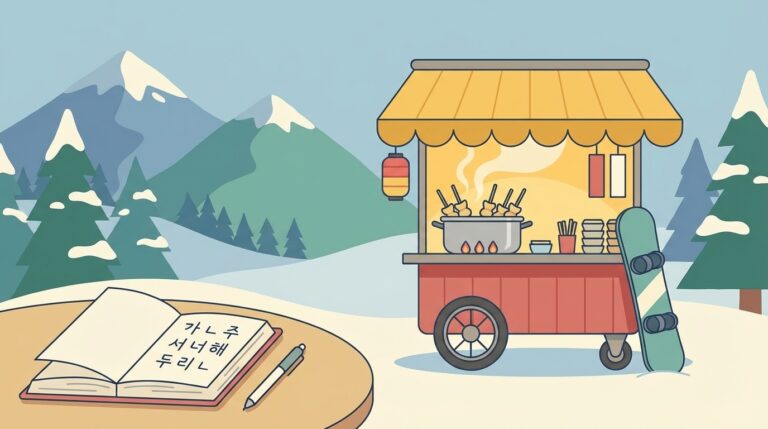
Phase 1: Immersive Hook — The Freezing Magic of Korean Ski Resorts
Hello! This is your Daily Hangul Editor.
Imagine this: You are at a ski resort in Pyeongchang or maybe Vivaldi Park. The temperature is -10°C (14°F). You’ve just finished a thrilling—or terrifying—run down the slopes. Your fingers are numb, your nose is red, and your breath comes out in white clouds. Then, through the snowy mist, you see it.
A glowing, steaming food cart.
You walk over and see K-Drama magic happening in real life: people huddled together, holding long wooden skewers of 어묵 (eomuk – fish cakes), blowing softly into paper cups filled with golden, steaming broth. You want to join in. You want that cup of liquid gold. But… how do you ask for it without sounding like a textbook robot? How do you ask for a refill of the broth (which, by the way, is completely free)?
If you don’t know the right words, you might just end up awkwardly paying for something you didn’t need to, or worse, missing out on the absolute best part of Korean winter sports culture.
This guide is based on real stories from my B2 students who knew how to say “It is cold” (춥습니다) but didn’t know how to say “This soup hits the spot!” Let’s turn you into a true Korean winter insider.
Phase 2: Deep Dive — Essential Expressions for the Slopes
Here are the 3 expressions you need to survive and thrive around the snack carts at a Korean ski resort.
1. 국물 좀 더 주실 수 있나요?
- Pronunciation: gungmul jom deo jusil su innayo?
(Tip: ‘국물’ is pronounced ‘goong-mool’, not ‘kook-mool’. Let the ‘ng’ flow softly!)- Meaning: Can I have some more broth, please?
- K-Culture Moment: The magic of Korean street food is “Service” (서비스 – freebies). The odeng broth is the ultimate winter service. It’s meant to be shared and refilled. You’ll see locals pouring it themselves from a kettle, or politely handing their paper cup back to the vendor for a refill.
- Editor’s Insight: By adding ‘좀’ (a little), you soften the request. It makes you sound humble and polite, exactly like a native speaker asking a busy vendor for a favor.
- Situation Spectrum:
[🚫 절대 금지] ———— [⚠️ 주의] ———— [✅ 자유롭게]
- Close Friends (Casual): 🚫 (Too formal! Use “국물 좀 더 줘”)
- Ski Resort Vendor (Formal/Polite): ✅
- 🤔 Think About It: Why is the broth always free and refillable in Korea? It traces back to the culture of 정 (Jeong)—a collective feeling of warmth, affection, and community. Can you think of a “free” comfort item in your country’s food culture?
2. 아~ 시원하다!
- Pronunciation: ah~ siwonhada!
- Meaning: (Literal) Ah, it’s cool/refreshing! vs (Real nuance) Ah, this hot soup hits the spot and warms my core!
- K-Culture Moment: You drink boiling hot fish cake soup, let out a deep sigh, and say “시원하다.” Wait, isn’t the soup hot? Yes! You’ll often see this in K-Dramas when middle-aged men sit in boiling saunas or eat spicy, hot stew.
- Editor’s Insight: For intermediate learners, mastering ‘시원하다’ for HOT things is a major milestone. It describes the feeling of tension leaving your body, like your frozen insides melting away.
- Situation Spectrum:
[🚫 절대 금지] ———— [⚠️ 주의] ———— [✅ 자유롭게]
- Close Friends (Casual): ✅ (Say it loudly after taking a sip!)
- Vendor/Strangers: ⚠️ (Say it as a soft exclamation to yourself, and the vendor will smile.)
- 🤔 Think About It: Does your language have words that completely contradict their literal meaning depending on the physical context?
3. 몸 좀 녹이고 타자.
- Pronunciation: mom jom nogigo taja.
- Meaning: Let’s warm up (melt our bodies) before we ride (ski/snowboard).
- K-Culture Moment: You’re sitting in the ski lodge cafeteria. Your friend wants to hit the advanced slope again, but you are freezing. You rub your hands together and suggest taking a break.
- Editor’s Insight: The verb ‘녹이다’ (to melt) is used beautifully here. Instead of just saying “Let’s rest because it’s cold,” you are vividly suggesting to “melt” the cold away. The grammar pattern
-고 타자shows the sequence: Melt first, ride later.- Situation Spectrum:
[🚫 절대 금지] ———— [⚠️ 주의] ———— [✅ 자유롭게]
- Close Friends (Casual): ✅
- Coworkers (Semi-formal): ⚠️ (Change to “몸 좀 녹이고 타시죠”)
Phase 3: Textbook vs Real Life
Let’s upgrade your B2 vocabulary from stiff textbook phrases to natural, trendy expressions.
| Situation | 📖 Textbook Korean | 🗣️ Real Korean | 💡 Why is it different? |
|---|---|---|---|
| Feeling extremely cold | 날씨가 너무 춥습니다. (The weather is very cold.) | 와, 손가락 떨어져 나갈 것 같아. (Wow, my fingers feel like they’re falling off.) | Koreans love dramatic, expressive exaggerations for physical sensations. |
| Suggesting a break | 휴게소에서 쉴까요? (Shall we rest at the lounge?) | 오뎅 국물 수혈 시급! (Urgent need for an odeng broth blood transfusion!) | “수혈” (blood transfusion) is a popular slang used when you desperately need coffee, sugar, or hot soup to survive. |
| Complimenting the food | 맛이 아주 좋습니다. (The taste is very good.) | 국물 끝내준다! / 폼 미쳤다! (The broth is killer! / The form is crazy good!) | Internet slang heavily influences daily speech; “폼 미쳤다” is a trendy way to say something is top-tier. |
Phase 4: Cultural Deep Dive — K-Culture on the Slopes
4-1. Non-verbal Communication & Nunchi (눈치)
When you’re at a busy Odeng cart, 눈치 (Nunchi – the ability to read the room) is everything.
– The Paper Cup Etiquette: You don’t ask the vendor for a cup. You usually grab a stack of paper cups resting near the pot yourself, take a ladle, and pour the broth.
– The Soy Sauce Rule: This is crucial! Never, ever double-dip your eaten skewer into the communal soy sauce bowl. Usually, there is a small brush. You use the brush to paint the soy sauce onto your fish cake before you bite it. Alternatively, use a spray bottle if they have one.
4-2. The K-Food & K-Drama Connection
Eating Odeng and Ramen in the freezing cold is a massive trope in K-Dramas and idol V-logs (like BTS’s winter packages). But why do Koreans insist on eating boiling hot food outdoors in winter?
It connects to the philosophy of 이열치열 (Fighting heat with heat), but applied to winter, it’s about warming the core. Sharing food at a ski resort isn’t just about calories; it’s a bonding ritual. When you stand shoulder-to-shoulder with strangers, shivering and eating from the same steaming pot, the cold environment forces a sense of instant community.
Phase 5: Immersive Roleplay — The Odeng Cart Challenge
Setting: Friday night, 9:00 PM. Yongpyong Ski Resort. The night skiing lights are glaring against the white snow. The wind is howling. You and your Korean friend, Min-su, just finished a brutal run. You spot an Odeng cart near the lift.
Characters:
– YOU: An expat working in Korea, exhausted and freezing.
– Min-su (32): Your snowboarding buddy. Loud, energetic, always hungry.
(Dialogue begins)
Min-su: 와, 오늘 영하 15도래. 손 꽁꽁 얼었다! 🥶
(wa, oneul yeongha sipsabodore. son kkongkkong eoreotda!)
[Wow, they said it’s -15 degrees today. My hands are completely frozen!]
YOU: 내 말이. 나 진짜 발가락에 감각이 없어.
(nae mari. na jinjja balgarage gamgagi eopseo.)
[Tell me about it. I seriously have no feeling in my toes.]
Min-su: 저기 포장마차 보인다! 야, 몸 좀 녹이고 타자.
(jeogi pojangmacha boinda! ya, mom jom nogigo taja.)
[I see a food cart over there! Hey, let’s warm up before we ride again.]
YOU: 콜! 오뎅 국물 수혈 시급해.
(kol! odeng gungmul suhyeol sigeuphae.)
[Deal! I urgently need an odeng broth transfusion.]
(🎭 Stage Direction: You both walk over to the cart. Steam is billowing into the night sky.)
Min-su: 이모님~ 여기 어묵 꼬치 4개 주세요!
(imonim~ yeogi eomuk kkochi ne gae juseyo!)
[Auntie~ 4 fish cake skewers here, please!]
YOU: (Grab a paper cup and pour the broth. You take a sip.)
🔀 Your Turn! How do you react to the hot broth like a true local?
– A) “와, 이 수프 너무 뜨겁습니다!”
– B) “크으~ 국물 시원하다! 끝내주네!”
– C) “아주 훌륭한 맛이네요.”✅ Best Choice: B — Why? “크으” is the ultimate Korean sound effect for satisfaction. Calling hot soup “시원하다” (refreshing) and “끝내준다” (killer) instantly elevates your Korean from textbook to native-level.
⚠️ Choice A & C Analysis: Both are grammatically perfect but sound like a news anchor. You are freezing at a ski resort with a friend—loosen up!
Min-su: (Laughs) 너 한국 사람 다 됐네! 국물 좀 더 마실래?
(neo hanguk saram da dwaenne! gungmul jom deo masillae?)
[You’ve become totally Korean! Want some more broth?]
YOU: 응, 이모님한테 국물 좀 더 주실 수 있나요 물어봐야겠다.
(eung, imonimhante gungmul jom deo jusil su innayo mureobwayagetda.)
[Yeah, I should ask Auntie if she can give us a little more broth.]
Phase 6: 10-Second Shadowing Drill
Practice this sentence until it flows naturally. Pay attention to the pauses (/) and the emotion!
😌 크으~ / 국물 진짜 / 끝/내/준/다! / 몸이 싹~ / 녹네 녹아.
(keueu~ / gungmul jinjja / kkeut/nae/jun/da! / momi ssak~ / nongne noga.)
[Ahhh~ / This broth is seriously / killer! / My body is completely~ / melting away.]
Voice Tip: For ‘크으~’, make a sound like you just drank the most refreshing glass of water in your life. For ‘녹네 녹아’, drop your pitch to sound fully relaxed.
Phase 7: K-Culture Glossary (Ski Resort Edition)
| 한국어 | Romanization | English | Context |
|---|---|---|---|
| 어묵 / 오뎅 | eomuk / odeng | Fish cake | Eomuk is the pure Korean word; Odeng is from Japanese. Both are widely used interchangeably on the streets. |
| 포장마차 | pojangmacha | Street food cart/tent | Literally “covered wagon.” They pop up around ski resorts selling snacks. |
| 수혈 | suhyeol | Blood transfusion | Gen Z/Millennial slang for desperately needing a specific food (coffee/soup) to function. |
| 눈치 | nunchi | Social awareness | The art of knowing not to stand directly in front of the cart’s pot when others want soup. |
| N빵 / 더치페이 | N-bbang / deochipei | Splitting the bill | “N-bbang” means dividing the cost by ‘N’ number of people. Very common among friends. |
Phase 8: Traveler’s Survival Kit
If you are traveling to a Korean ski resort, you MUST know these phrases for the food courts and snack carts.
🆘 Survival Expression #1
– 🇰🇷 “여기 계좌이체 되나요?” (yeogi gyejwaiche doenayo?)
– 🗣️ Meaning: Can I do a bank transfer here?
– 📍 Where to use: Independent street vendors outside the resort. (Inside the resort, cards are 100% accepted, but outdoor carts often prefer cash or bank transfers).🆘 Survival Expression #2
– 🇰🇷 “따로따로 계산해 주세요.” (ttarottaro gyesanhae juseyo.)
– 🗣️ Meaning: Please split the bill (calculate separately).
– 📍 Where to use: At the ski lodge cafeteria when paying for your own Ramen.📌 Editor’s Travel Note
– Card is King: South Korea is a cashless society. Even a $2 cup of Odeng can usually be paid with a card at the resort.
– No Tipping: Never leave a tip at the snack cart or lodge. It will cause confusion, and the vendor might chase you down the slope to give your money back!
Phase 9: Think Deeper — “Food & Identity”
🧠 Think Deeper: The Warmth of ‘Communal Eating’ in Winter
In many Western cultures, street food is a solitary experience—you buy a hot dog and keep walking. In Korea, an Odeng cart is a temporary gathering place. People stand together, sharing the same space, the same soy sauce brush, and the same pot of boiling broth. This reflects the Korean concept of 우리 (We/Us) over the individual. Even when it’s freezing, Koreans seek warmth not just from the hot soup, but from the physical and emotional closeness of eating together. The phrase “밥 한번 먹자” (Let’s grab a meal sometime) isn’t just a greeting; it’s a testament to how food builds relationships.💬 Your Turn: Do you have a specific winter food in your culture that brings strangers or friends together in a similar way? Share it in the comments!
Phase 10: FAQ & Troubleshooting
Q: Is it rude to drink the broth directly from the paper cup?
A: Not at all! In fact, no one uses spoons at the Odeng cart. Holding the cup with two hands to warm your fingers and drinking directly from it is the standard, culturally approved way.
Q: I saw a friend pay for everything without asking. Should I give them cash?
A: If a Korean friend says “내가 쏠게” (I’ll treat/buy), let them! It’s a way of showing affection. Just make sure to say “잘 먹겠습니다!” (I will eat well) and offer to buy the coffee or hot chocolate later at the lodge.
❌ Common Mistake #1: Saying “국물이 차가워요” (The broth is cold) when you meant to say “국물이 시원하다” (The broth is refreshing).
✅ Fix: Remember, ‘차갑다’ is strictly for physical temperature (like ice). ‘시원하다’ is the feeling of relief. If you say the soup is ‘차갑다’, the vendor will panic and turn up the stove!
Phase 11: Wrap-up & Action Items
One-Liner Summary: Surviving Korean winter sports isn’t just about snowboarding; it’s about mastering the art of warming your soul with Odeng broth and saying “시원하다” like a true local!
Take Action:
– 🥉 Bronze (Solo): Stand in front of a mirror with a mug of hot coffee or tea, take a sip, and dramatically say “크으~ 국물 끝내준다!” 3 times.
– 🥈 Silver (Online): Post a picture of your favorite winter soup on your social media or language app and caption it “추울 때는 OOO 수혈 시급!” (When it’s cold, urgent need for OOO transfusion!).
– 🥇 Gold (Real Life): Next time you visit a Korean market, K-Town, or ski resort, confidently ask the vendor: “국물 좀 더 주실 수 있나요?”
❄️ K-Culture Special Mission:
Search YouTube for “아이돌 스키장 브이로그” (Idol ski resort v-log). Watch how they react when they eat Ramen or Odeng at the top of the slopes. Try to catch the moment they say “시원하다” or “끝내준다!”
Phase 12: Interactive Quiz — Test Your Nunchi!
1. Situational Judgment: You are freezing at the ski resort and want to suggest to your coworker that you both go inside to warm up. Which is the best phrase?
– A) 몸 좀 녹이고 타시죠.
– B) 너무 춥습니다. 집에 갑시다.
– C) 오뎅 수혈 시급!
(Answer: A. It’s polite yet natural for a semi-formal relationship. C is too casual for a coworker unless you are very close.)
2. Fill in the Blank:
You take a sip of boiling hot fish cake soup. You let out a sigh and say: “아~ _______!”
– A) 맵다 (Spicy)
– B) 시원하다 (Refreshing/Hits the spot)
– C) 차갑다 (Cold)
(Answer: B! Remember, ‘차가워요’ means the soup is literally ice cold!)
3. True or False – K-Culture Edition:
“It is perfectly acceptable to double-dip your fish cake into the communal soy sauce bowl at a street cart.”
(Answer: FALSE! Always use the brush provided to glaze your eomuk before taking a bite!)
See you on the slopes! Stay warm, stay safe, and enjoy the broth! 🏂🍜
Frequently Asked Questions (FAQ)
Q: What does "국물 좀 더 주실 수 있나요?" mean in Korean and how do you pronounce it?
A: In Korean, "국물 좀 더 주실 수 있나요?" is pronounced [gungmul jom deo jusil su innayo?] and means: Can I have some more broth, please?
Q: What does "아~ 시원하다!" mean in Korean and how do you pronounce it?
A: In Korean, "아~ 시원하다!" is pronounced [ah~ siwonhada!] and means: (Literal) Ah, it's cool/refreshing! vs (Real nuance) Ah, this hot soup hits the spot and warms my core!
Q: What does "몸 좀 녹이고 타자." mean in Korean and how do you pronounce it?
A: In Korean, "몸 좀 녹이고 타자." is pronounced [mom jom nogigo taja.] and means: Let's warm up (melt our bodies) before we ride (ski/snowboard).







