

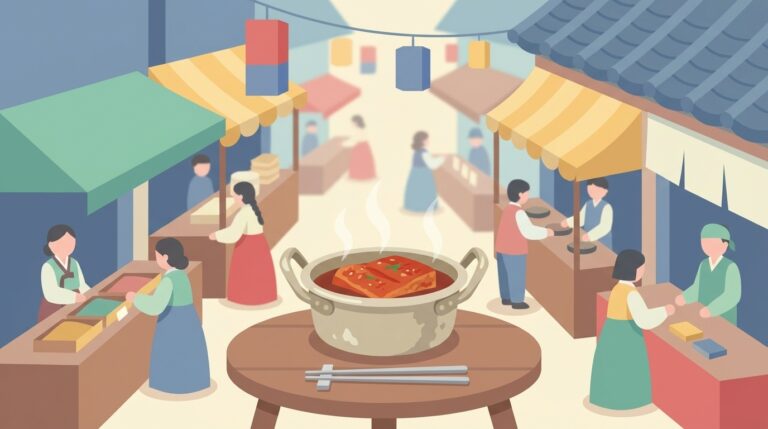
Phase 1: Immersive Hook — Welcome to the Alley\n\nHello! I’m the Lead Editor of Daily Hangul.\n\nPicture this: You are wandering through the labyrinth of Seoul’s Namdaemun Market (남대문 시장). Suddenly, you turn a corner and are hit by a thick cloud of spicy, savory steam. You’ve just entered the legendary Galchi Golmok (갈치 골목, Cutlassfish Alley). Ahjummas are shouting orders, battered nickel-silver pots are boiling over high flames, and the narrow alley is packed with office workers loosening their ties.\n\nIt feels exactly like a scene from a gritty K-Drama where the protagonist seeks comfort in a spicy meal and a bottle of Soju after a harsh day at work. But here’s the problem: if you walk in and try to use your textbook Korean—saying “저기요, 메뉴판 좀 주시겠어요?” (Excuse me, may I have a menu?)—you might get lost in the chaos.\n\nTo survive and truly enjoy this fiercely authentic K-Food experience, you need to speak the market’s language. Today, as an upper-intermediate (B2) learner, we are moving beyond basic ordering. Let’s learn the real, unfiltered Korean that will earn you a nod of respect from the local merchants!\n\n—\n\n### Phase 2: Deep Dive into Core Expressions\n\nLet’s upgrade your vocabulary from “spicy and delicious” to “local food critic” level.\n\n> ### 1. 이모님! 여기 갈치조림 2인분이요! (Auntie! Two portions of braised cutlassfish here!)\n>\n> – Pronunciation: [i-mo-nim! yeo-gi gal-chi-jo-rim i-in-bun-i-yo!] (The ‘이’ sounds like a sharp ‘E’ in eel.)\n> – Meaning: (Literal) Auntie! Two people’s portions of braised cutlassfish here! / (Real Nuance) Hello! We’ll have two portions of your signature fish, please!\n> – K-Culture Moment: In traditional markets, you don’t call the owner “사장님” (Boss) or “저기요” (Excuse me). You call them “이모님” (Aunt on the mother’s side). It instantly breaks the ice and creates a family-like bond, a core concept of Korean Jeong (정).\n> – Editor’s Insight: Saying this loudly with confidence as soon as you sit down shows you know the drill. It’s fast, efficient, and polite in a very localized way.\n> – Situation Spectrum:\n> [🚫 절대 금지] ———— [⚠️ 주의] ———— [✅ 자유롭게]\n> – Casual / Traditional Market: ✅\n> – Fine Dining / Fancy Restaurant: 🚫\n> – 🤔 Think About It: Why do Koreans use family terms like “Aunt” or “Uncle” for complete strangers who serve them food? Does your language have a similar way of breaking social barriers?\n\n> ### 2. 국물이 진짜 칼칼하네요! (The broth has a great spicy kick!)\n>\n> – Pronunciation: [guk-mul-i jin-jja kal-kal-ha-ne-yo!] (The ‘칼’ has a strong, aspirated K sound, almost like clearing your throat gently.)\n> – Meaning: (Literal) The broth is spicy. / (Real Nuance) The broth is wonderfully spicy, deeply flavorful, and soothingly hits the back of the throat.\n> – K-Culture Moment: K-Drama dads always say this while sipping a boiling red soup. Kalkalhada isn’t just “spicy” (맵다) like fire noodles. It implies a refreshing, deep heat that makes you exhale a satisfied “Ahhh~”\n> – Editor’s Insight: If you tell the restaurant owner “칼칼하고 맛있어요” instead of just “매워요”, she will be incredibly impressed. It proves you understand the soul of Korean soup culture.\n> – Situation Spectrum:\n> [🚫 절대 금지] ———— [⚠️ 주의] ———— [✅ 자유롭게]\n> – Any restaurant with soup: ✅\n> – Referring to sweet/salty food: 🚫\n> – 🤔 Think About It: Korean has dozens of words for “spicy” (매콤하다, 칼칼하다, 얼큰하다). What does this tell us about the importance of nuanced flavors in K-Food?\n\n> ### 3. 완전 밥도둑이에요. 공기밥 하나 추가요! (This is a total rice thief. One more bowl of rice!)\n>\n> – Pronunciation: [wan-jeon bap-do-duk-i-e-yo. gong-gi-bap ha-na chu-ga-yo!] \n> – Meaning: (Literal) It’s a complete rice thief. Add one bowl of rice! / (Real Nuance) This food is so salty, spicy, and delicious that I’ve eaten all my rice without realizing it. Give me more!\n> – K-Culture Moment: Galchi Jorim, Soy Sauce Crabs (게장), and Spam are famously known as “밥도둑” (Rice Thieves). Fans often use this term when discussing their favorite K-Pop idol’s mukbangs.\n> – Editor’s Insight: Galchi Jorim’s spicy radish and rich sauce are designed to be eaten with white rice. Ordering an extra bowl is the ultimate compliment to the chef.\n> – Situation Spectrum:\n> [🚫 절대 금지] ———— [⚠️ 주의] ———— [✅ 자유롭게]\n> – Eating with friends/colleagues: ✅\n> – Very formal business dinner: ⚠️ (Might sound a bit too casual)\n> – 🤔 Think About It: Notice how rice (밥) is the central standard of the meal, and the fish is just the “thief” stealing it. How central is rice in Korean culture?\n\n—\n\n### Phase 3: Textbook vs Real Life\n\nLet’s see how a B2 learner can upgrade their sentences to sound like a Seoul local.\n\n| 상황 (Situation) | 📖 교과서 한국어 (Textbook) | 🗣️ 진짜 한국어 (Real Korean) | 💡 왜 다를까? (Why the difference?) |\n|—|—|—|—|\n| Ordering Food | 메뉴판 좀 주시겠어요? (May I have a menu?) | 이모님, 여기 갈치조림 2인분이요! (Auntie, 2 portions here!) | Market spots usually have one main menu on the wall; ordering instantly shows you are a regular. |\n| Describing Taste | 맵고 아주 맛있습니다. (It is spicy and very delicious.) | 와, 진짜 칼칼하네요! 완전 밥도둑이에요. (Wow, it’s so kick-y! A total rice thief.) | Native speakers use specific sensory adjectives and cultural idioms to express deep satisfaction. |\n| Asking for More | 밥을 더 주실 수 있나요? (Could you give me more rice?) | 공기밥 하나 추가요! (One extra bowl of rice!) | In a busy market, brevity and efficiency (Pali-Pali culture) are key. |\n\n—\n\n### Phase 4: Cultural Deep Dive — K-Culture Connection\n\n#### 4-1. Non-verbal Communication: The Art of “Nunchi” (눈치)\nWhen eating in Namdaemun’s Galchi Alley, Nunchi is your best friend. The tables are tiny, and there is always a line of hungry office workers outside. \n- Do: Eat at a reasonable pace. When you’re done, wipe your mouth, pay, and leave quickly.\n- Don’t: Sit there chatting for 30 minutes over an empty pot. In traditional markets, high table turnover is how these ahjummas make a living!\n\n#### 4-2. The Nickel-Silver Pot (양은냄비) & K-Drama Tropes\nYou will notice the Galchi Jorim is served in a battered, dented, yellow metal pot called Yangeun Naembi. Why? This metal heats up incredibly fast—perfect for the Korean “Pali-Pali” (hurry hurry) culture. In K-Dramas, characters are often seen cooking ramen in these pots. The dents aren’t a sign of dirtiness; they represent years of history, hard work, and Jeong. The more dented the pot, the more delicious the food is presumed to be!\n\n—\n\n### Phase 5: Immersive Roleplay\n\nSetting: 12:15 PM, Galchi Alley, Namdaemun Market. The alley is narrow, steam is everywhere. You manage to grab the last empty table with your friend.\nCharacters:\n- YOU: A foreign traveler wanting an authentic experience.\n- 이모님 (Ahjumma): The fast-paced, loud, but warm-hearted restaurant owner.\n\nDialogue:\n\nYOU: 이모님! 여기 갈치조림 2인분이요!\n(Imonim! yeogi galchijorim i-inbun-iyo!)\n[Auntie! Two portions of braised cutlassfish here!]\n(🎭 Stage Direction: You hold up two fingers confidently)\n\n이모님: 네~ 학생들! 매운 거 잘 먹어? 우리 집 양념 좀 센데!\n(Ne~ haksaeng-deul! maeun geo jal meogeo? uri jip yangnyeom jom sende!)\n[Okay~ students! Can you handle spicy food? Our seasoning is a bit strong!]\n\nYOU: 네, 좋아해요! 아, 그리고 앞치마 두 개만 주시겠어요?\n(Ne, joahaeyo! Ah, geurigo apchima du gae-man jusigesseoyo?)\n[Yes, I like it! Ah, and could we get two aprons, please?]\n\n이모님: 거기 벽에 걸려있어! 가져다 입어~\n(Geogi byeoge geollyeoisseo! gajyeoda ibeo~)\n[They are hanging on the wall over there! Grab them and put them on~]\n\n(10 minutes later, the boiling pot arrives)\n\nYOU: 와… 냄새 장난 아니네요. 잘 먹겠습니다!\n(Wa… naemsae jangnan anineyo. jal meokgetseumnida!)\n[Wow… the smell is no joke. I will eat well!]\n\n이모님: 뼈 많으니까 조심해서 먹고! 입에 맞아?\n(Ppyeo maneunikka josimhaeseo meokgo! ibe maja?)\n[It has a lot of bones, so eat carefully! Does it suit your taste?]\n\n> 🔀 당신의 차례! 어떻게 대답할까요? (Your Turn! How should you reply?)\n> – A) 네, 맵고 맛있습니다. (Standard, polite)\n> – B) 아우, 너무 매워서 못 먹겠어요. (Oh, it’s too spicy to eat.)\n> – C) 국물이 진짜 칼칼하네요! 완전 밥도둑이에요.\n>\n> ✅ Best Choice: C — Using “칼칼하다” and “밥도둑” will instantly make the Ahjumma smile. You are speaking her language. She might even give you a free soda (서비스)!\n\n이모님: 아이고, 외국인이 밥도둑이라는 말도 알아? 예쁘네, 여기 사이다 하나 서비스!\n(Aigo, oegugini bapdodugiraneun maldo ara? yeppeune, yeogi saida hana seobiseu!)\n[Oh my, a foreigner knows the word ‘rice thief’? How lovely, here’s a Sprite on the house!]\n\n—\n\n### Phase 6: 10-Second Shadowing Drill\n\nTime to practice your market delivery. Speak with energy!\n\n😊 이모님! / 😤 국물이 / 진짜 칼칼하네요! / 🥺 공기밥 하나만 / 추가해 주세요!\n(imonim! / gungmuri / jinjja kalkalhaneyo! / gonggibap hanaman / chugahae juseyo!)\n\n—\n\n### Phase 7: K-Culture Glossary\n\n| 한국어 | Romanization | English | Context |\n|—|—|—|—|\n| 이모님 | imonim | Auntie | Used to respectfully but warmly address female restaurant staff/owners.\n| 앞치마 | apchima | Apron | Essential in Galchi Alley to protect clothes from the red, bubbling broth.\n| 양은냄비 | yangeun naembi | Nickel-silver pot | Fast-heating traditional pots used for stews and ramen; a symbol of nostalgic K-Food.\n| 밥도둑 | bapdoduk | Rice thief | A very flavorful, usually salty/spicy dish that makes you eat a lot of rice.\n| 칼칼하다 | kalkalhada | Spicy & soothing | Describes a specific heat that pleasantly clears the throat, unlike painful burning spice.\n\n—\n\n### Phase 8: Traveler’s Survival Kit\n\n> 🆘 Top 3 Survival Phrases for Namdaemun Market\n> – 🇰🇷 “앞치마 좀 주시겠어요?” (apchima jom jusigesseoyo?) — “Can I get an apron?” (A must for eating Galchi Jorim!)\n> – 🇰🇷 “덜 맵게 해 주실 수 있나요?” (deol maepge hae jusil su innayo?) — “Can you make it less spicy?”\n> – 🇰🇷 “계산은 어디서 해요?” (gyesaneun eodiseo haeyo?) — “Where do I pay?” (Usually at the front near the entrance).\n\n📌 Editor’s Travel Note:\n- Navigating the Alley: Namdaemun is a maze. Use KakaoMap or Naver Map and search for “남대문 갈치골목” (Namdaemun Galchi Alley). Google Maps won’t work well here!\n- Timing is Everything: Avoid going exactly between 12:00 PM and 1:00 PM on weekdays. You will be crushed by local office workers. Go at 11:30 AM or 1:30 PM for a better experience.\n- Payment: While Korea is a cashless society, having physical cash (Korean Won) in traditional markets is highly appreciated by the older merchants, though cards are legally accepted everywhere.\n\n—\n\n### Phase 9: Think Deeper — “한 발 더 깊이”\n\n🧠 Food & Identity: The Communal Pot\nIn Western dining cultures, everyone gets their own plate. But when you order Galchi Jorim in Korea, it comes in one large boiling pot placed right in the center of the table. Everyone dips their spoons in and shares the fish. This shared eating experience is the physical manifestation of Jeong (정)—the invisible thread of communal connection and affection in Korean society. By eating from the same pot, you are no longer just acquaintances; you become “식구” (Sikgu), a word for family that literally translates to “mouths that eat together.”\n\n💬 Your Turn: How is sharing food viewed in your culture? Is it a sign of intimacy, or considered unsanitary? Share in the comments!\n\n—\n\n### Phase 10: FAQ & Troubleshooting\n\nQ: Can I call male waiters “이모님” too?\nNo! 이모님 is strictly for older females. For older males in a market setting, you can use “삼촌” (Samchon – Uncle) or the universally safe “사장님” (Sajangnim – Boss/Owner).\n\nQ: I am traveling alone. Can I order Galchi Jorim for one person?\nUsually, Galchi Jorim is “2인분 이상 주문 가능” (Must order 2 or more portions). However, some places in Namdaemun offer a 1-person portion (1인분) if you go outside of peak lunch hours. Always ask: “1인분도 되나요?” (Is one portion possible?)\n\n> ❌ Common Mistake: Trying to eat the fish bones.\n> ✅ How to fix it: Galchi (Cutlassfish) has sharp bones along the edges and a thick spine in the middle. Use your chopsticks to gently slide the side bones out first, then lift the top layer of meat off the spine. Don’t just bite into it like a chicken wing!\n\n—\n\n### Phase 11: Wrap-up & Action Missions\n\nOne-Liner Summary: Mastering words like ‘이모님’, ‘칼칼하다’, and ‘밥도둑’ transforms you from a lost tourist into a respected foodie at Namdaemun Market.\n\nAction Mission 3 Steps:\n- 🥉 Bronze (Solo): Stand in front of a mirror and order: “이모님, 여기 갈치조림 2인분이요!” with confidence.\n- 🥈 Silver (Online): Drop a comment on a Korean Mukbang YouTube video saying: “와, 진짜 칼칼해 보여요. 완전 밥도둑이네요!”\n- 🥇 Gold (Real Life): Visit a Korean restaurant (or a market if you’re in Korea) and confidently ask for an apron (“앞치마 주세요”) and extra rice (“공기밥 추가요”).\n\n🎯 K-Culture Mission: \nGo to YouTube and search “남대문 갈치조림 골목” (Namdaemun Galchi Jorim Alley). Watch a walking tour video for 2 minutes to visualize the exact environment where you will use today’s expressions!\n\n—\n\n### Phase 12: Interactive Quiz\n\n1. Situational Judgment: You are eating Galchi Jorim, and you’ve run out of rice because the food is so good. What is the MOST natural way to ask for more in this busy market?\nA) 저기요, 밥을 더 주실 수 있나요?\nB) 이모님! 여기 공기밥 하나 추가요!\nC) 사장님, 밥이 부족합니다.\n\n2. Fill in the Blank: \nWow, this spicy fish is so delicious, it’s making me eat all my rice. This is a total ________ ! (Korean word for “Rice thief”)\n\n3. True or False (K-Culture Edition):\nWhen eating at a busy traditional market alley during peak hours, it is polite to sit and chat for 20 minutes after finishing your meal.\n\n(Answers: 1: B, 2: 밥도둑, 3: False – Pali-pali culture and Nunchi dictate that you should leave quickly to make room for others!)
Frequently Asked Questions (FAQ)
Q: What does "이모님" mean in Korean and how do you pronounce it?
A: In Korean, "이모님" is pronounced [Ahjumma] and means: The fast-paced, loud, but warm-hearted restaurant owner.\n\n
Q: What does "🔀 당신의 차례! 어떻게 대답할까요?" mean in Korean and how do you pronounce it?
A: In Korean, "🔀 당신의 차례! 어떻게 대답할까요?" is pronounced [Your Turn! How should you reply?] and means: \n> - A) 네, 맵고 맛있습니다. (Standard, polite)\n> - B) 아우, 너무 매워서 못 먹겠어요. (Oh, it's too spicy to eat.)\n> - C) 국물이 진짜 칼칼하네요! 완전 밥도둑이에요.\n>\n>







