

Phase 1: Immersive Hook — The K-Drama Reality Check
Hello there! I’m the Lead Editor at Daily Hangul.
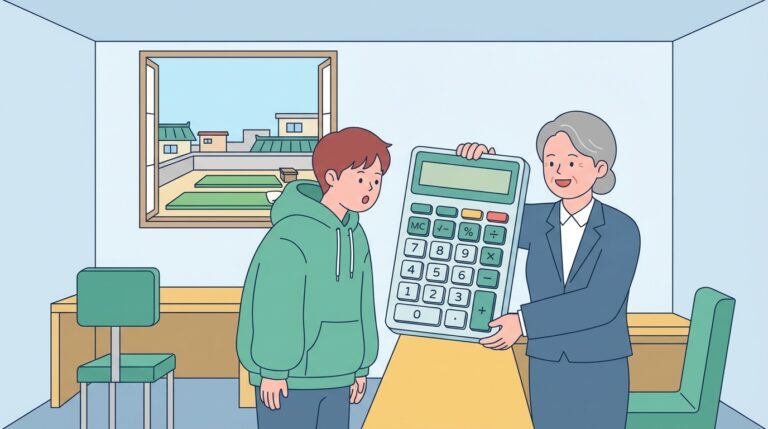
Picture this: You’re watching a K-Drama. The spunky protagonist, trying to make it in Seoul, visits a local real estate office (Budongsan). They look at a charming rooftop room (Oktapbang) where they will inevitably drink beer and look at the city lights. Or maybe it’s a semi-basement (Banjiha), like in the movie Parasite. The real estate agent punches some numbers into a giant calculator, slides it over, and the protagonist gasps.
Why did they gasp? It’s not just the monthly rent—it’s the deposit.
If you’re planning to stay in Korea for work, study, or an extended working holiday, you’ll eventually need to step into a Budongsan yourself. Knowing how to ask about rent isn’t just about finding a place to sleep; it’s about not getting caught off guard by Korea’s unique housing system. Let’s make sure you don’t gasp at the calculator like a drama protagonist!
Phase 2: Deep Dive into Core Expressions
Here are the top 3 phrases you absolutely must know before walking into a Korean real estate agency.
1. 월세 얼마예요? (How much is the monthly rent?)
- Pronunciation: wol-se eol-ma-ye-yo? [wol sounds like ‘wall’, se sounds like ‘say’]
- Meaning: Literal: Monthly rent how much is it? / Real nuance: What’s the monthly rent?
- K-Culture Moment: This is the basic question you ask when you see a listing on an app like Zigbang or pasted on the real estate agent’s window.
- Editor’s Insight: Wol (월) means ‘month’ and se (세) means ‘rent/tax’. It’s direct, polite, and gets straight to the point.
- Situation Spectrum:
[🚫 절대 금지] ———— [⚠️ 주의] ———— [✅ 자유롭게]
- Casual (To a friend): 월세 얼마야? ✅
- Semi-formal (To a real estate agent): 월세 얼마예요? ✅
- Formal (Highly formal setting): 월세가 어떻게 됩니까? ✅
- 🤔 Think About It: Why is it specifically called monthly rent? Because in Korea, there is another very common system called Jeonse (전세), where you pay a massive deposit upfront but NO monthly rent at all!
2. 보증금 얼마예요? (How much is the deposit?)
- Pronunciation: bo-jeung-geum eol-ma-ye-yo? [‘eu’ in jeung sounds like the disgusted sound you make when stepping in gum: “Ugh!”]
- Meaning: How much is the security deposit?
- K-Culture Moment: This is the moment the drama protagonist faints. In many Western countries, a deposit is 1-2 months’ rent. In Korea, a standard studio deposit starts at 5 million to 10 million won (approx. $4,000 – $8,000 USD)!
- Editor’s Insight: Always ask this right after asking about the rent. In Korea, rent and deposit go hand-in-hand. You often see listings written as “1000/50” (천에 오십) meaning 10 million won deposit / 500,000 won monthly rent.
- Situation Spectrum:
[🚫 절대 금지] ———— [⚠️ 주의] ———— [✅ 자유롭게]
- Casual: 보증금 얼마야? ✅
- Formal/Real Estate: 보증금은 얼마예요? ✅
- 🤔 Think About It: Does your home country require such large deposits? This high-deposit system is deeply tied to Korea’s rapid economic growth, where landlords used deposits to invest in banks or other properties.
3. 관리비 포함이에요? (Is the maintenance fee included?)
- Pronunciation: gwan-ri-bi po-ham-i-e-yo?
- Meaning: Are maintenance/administrative fees included?
- K-Culture Moment: You move in, thinking your rent is cheap, only to get a gwanribi bill for building cleaning, elevator use, internet, and sometimes water.
- Editor’s Insight: Gwanribi (관리비) is the building maintenance fee. Poham (포함) means ‘included’. If you don’t ask this, you might end up paying an extra $50-$100 a month!
- Situation Spectrum:
[🚫 절대 금지] ———— [⚠️ 주의] ———— [✅ 자유롭게]
- Casual: 관리비 포함이야? ✅
- Formal/Real Estate: 관리비 포함이에요? ✅
Phase 3: Textbook vs Real Life
| Situation | 📖 Textbook Korean | 🗣️ Real Korean | 💡 Why the difference? |
|---|---|---|---|
| Asking the rent | 이 방의 월세는 얼마입니까? | 여기 월세 얼마예요? | Native speakers drop “this room’s” (이 방의) because it’s obvious from the context, and ‘-요’ is softer than ‘-입니까?’. |
| Asking the deposit | 보증금은 얼마입니까? | 보증금 어떻게 돼요? | “어떻게 돼요?” (How does it work/turn out?) is a very polite, indirect way Koreans use to ask for numbers, prices, or policies. |
| Asking about utilities | 관리비가 포함되어 있습니까? | 관리비 포함이에요? | Koreans love efficiency! They shorten phrases down to the bare minimum noun + verb ending. |
Bottom Note: At an A2 level, saying “여기 월세 얼마예요?” (How much is the rent here?) is perfect. It’s polite, natural, and makes you sound like someone who knows their way around!
Phase 4: Cultural Deep Dive — Budongsan Survival
4-1. Non-verbal Communication: The Art of the “Nunchi” at the Budongsan
When you walk into a real estate office, don’t just ask for the price and leave. Korean real estate agents (공인중개사 – Gongin Junggaesa) are like neighborhood matchmakers. If you are polite, bow slightly upon entering, and say “안녕하세요” (Hello), they will use their network to find you ‘hidden’ listings that aren’t online. If they offer you mixed coffee (맥심 커피), accept it with two hands! It’s a sign they want to sit down and really help you out.
4-2. K-Culture Connection: The “One-Room” (원룸) Culture
If you listen to K-Pop or watch K-Dramas about college students (like Age of Youth or Record of Youth), you’ll constantly hear the word 원룸 (One-Room). This is Konglish for a studio apartment.
In Korea, young people rarely rent full apartments (아파트 – Apateu), which are massive, multi-bedroom complexes for families. Instead, singles live in a One-Room, Two-Room (투룸 – 1 bedroom + 1 living room), or an Officetel (오피스텔 – a modern studio in a commercial building). Knowing exactly what type of housing you want before asking the rent will make you look like a total local!
Phase 5: Immersive Roleplay
Scenario A: The Budongsan Visit
- Setting: A small, slightly cluttered real estate office near a university in Seoul. There’s a giant map of the neighborhood on the wall.
- Characters:
- YOU: An international student/worker looking for a studio. Your budget is tight!
- Mr. Kim (50s): The friendly neighborhood real estate agent.
Mr. Kim: 어서 오세요! 방 찾으세요? 🏠
(eoseo oseyo! bang chajeuseyo?)
[Welcome! Are you looking for a room?]
(🎭 Stage Direction: Mr. Kim pushes a cup of sweet mixed coffee toward you)
YOU: 네, 원룸 찾아요.
(ne, wollum chajayo.)
[Yes, I’m looking for a one-room (studio).]
Mr. Kim: 예산이 어떻게 돼요?
(yesani eotteoke dwaeyo?)
[What is your budget?]
YOU: 월세 50만 원 정도요.
(wolse osimman won jeongdoyo.)
[Around 500,000 won for monthly rent.]
Mr. Kim: 아, 마침 좋은 방이 하나 있어요. 보증금 1000에, 월세 50.
(a, machim joeun bangi hana isseoyo. bojeunggeum cheone, wolse osip.)
[Ah, I have a good room right now. Deposit 10 million, rent 50(0,000).]
YOU: 아, 보증금 1000만 원이요?
(a, bojeunggeum cheonman woniyo?)
[Ah, 10 million won deposit?]
Mr. Kim: 네, 역이랑 아주 가까워요.
(ne, yeogirang aju gakkawoyo.)
[Yes, it’s very close to the station.]
🔀 Your Turn! How should you respond next?
– A) “관리비 포함이에요?” (Is the maintenance fee included?)
– B) “너무 비싸요. 안녕히 계세요.” (Too expensive. Goodbye.)
– C) “월세 깎아주세요!” (Give me a discount on the rent!)✅ Best Choice: A. Before making a decision, you MUST ask about the Gwanribi. If it’s not included, that 500k rent might actually be 570k.
⚠️ Choice B & C Analysis: Walking out immediately (B) might cost you a good agent. Asking for a rent discount (C) is tough—in Korea, you can sometimes negotiate the deposit, but rarely the monthly rent.
YOU (choosing A): 관리비 포함이에요?
(gwanribi pohamieyo?)
[Is the maintenance fee included?]
Mr. Kim: 아니요, 관리비 5만 원 따로 있어요. 수도, 인터넷 포함이에요.
(aniyo, gwanribi oman won ttaro isseoyo. sudo, inteonet pohamieyo.)
[No, maintenance is 50,000 won extra. Water and internet are included.]
YOU: 아, 네. 방 한번 볼 수 있어요?
(a, ne. bang hambeon bol su isseoyo?)
[Ah, okay. Can I see the room?]
Mr. Kim: 그럼요! 갑시다.
(geureomyo! gapsida.)
[Of course! Let’s go.]
Phase 6: 10-Second Shadowing Drill
Let’s practice the rhythm of Korean. Follow the slashes (/) for natural pausing.
- 🧐 Curious: 저기요, / 이 방 / 월세 / 얼마예요?
(jeogiyo, / i bang / wolse / eolmayeyo?)
[Excuse me, how much is the monthly rent for this room?] -
😟 Slightly worried: 혹시… / 보증금은 / 얼마예요?
(hoksi… / bojeunggeumeun / eolmayeyo?)
[By any chance… how much is the deposit?] -
🤔 Smart renter: 월세에 / 관리비 / 포함이에요?
(wolsee / gwanribi / pohamieyo?)
[Is the maintenance fee included in the rent?]
Phase 7: K-Culture Glossary (Real Estate Edition)
| Korean | Romanization | English | Context |
|---|---|---|---|
| 부동산 | budongsan | Real estate agency | The physical office you visit to find housing. |
| 월세 | wolse | Monthly rent | Paying a monthly fee + a deposit. |
| 전세 | jeonse | Key money deposit | A unique Korean system: No monthly rent, but a massive deposit (often 50-80% of house value) returned when you move out. |
| 보증금 | bojeunggeum | Security deposit | The money you put down before moving in. |
| 관리비 | gwanribi | Maintenance fee | Monthly fee for building upkeep, elevator, etc. |
| 원룸 | won-rum | Studio apartment | A “one-room” apartment, very popular among young singles. |
| 옥탑방 | oktapbang | Rooftop room | Cheap, great views, heavily featured in K-Dramas, but very hot in summer and cold in winter! |
Phase 8: Traveler’s Survival Kit
Even if you aren’t renting an apartment, you’ll need to ask “How much?” when you travel!
🆘 Survival Phrase #1: The Ultimate Price Question
– 🇰🇷 “이거 얼마예요?” (igeo eolmayeyo?)
– 🗣️ Pronunciation: i-geo eol-ma-ye-yo?
– 📍 Where to use: Street markets (Myeongdong, Namdaemun), underground shopping malls, or food stalls.
– 💡 Pro Tip: If you can’t understand the Korean numbers they reply with, just hand them your phone with the calculator app open. They will gladly type the price for you. It’s universally understood!📌 Editor’s Travel Note: Short-term stays
If you need to stay in Korea for 1-3 months, looking for a traditional Wolse is hard because standard contracts are for 1-2 years. Look into 고시원 (Goshiwon) (tiny study rooms with no deposit) or short-term rentals on apps like Airbnb or local apps.
Phase 9: Think Deeper — “A Step Further”
🧠 Think Deeper: Media vs Reality (The Romanticized Rooftop)
In K-Dramas, the Oktapbang (rooftop room) is often portrayed as a romantic, cozy space where leads fall in love while grilling pork belly under the stars. However, in reality, these rooms are often the cheapest option for a reason. Because they are exposed on the roof, they suffer from extreme temperatures—freezing in Korea’s harsh winters and boiling in the humid summers. The media glamorizes the struggle of the youth, but the reality of living in these spaces speaks volumes about the tough housing market in Seoul.
💬 Your Turn: Does your country have a specific type of housing that is often romanticized in movies but is actually quite tough to live in? Share in the comments!
Phase 10: FAQ & Troubleshooting
Q: “Can I negotiate the monthly rent?”
Maybe, but usually no. In Korea, rent (wolse) is fairly fixed. However, you can sometimes negotiate the deposit! You can ask to increase the deposit to lower the monthly rent, or vice versa. (e.g., “Can I pay 10M deposit / 500k rent instead of 5M deposit / 550k rent?”)
Q: “Why did the agent just say ’50’? I know 50 is ‘오십’, but 50 won is nothing!”
In Korean real estate lingo, they drop the “만 원” (10,000 won) for rent. So “50” actually means “50만 원” (500,000 won). For deposits, “1000” (천) means “1000만 원” (10 million won).
❌ Common Mistake: Confusing Wolse (월세) and Jeonse (전세).
✅ Do this instead: If a place looks incredibly cheap with no monthly rent listed, it’s probably Jeonse. Always clarify by asking: “이거 월세예요?” (Is this monthly rent?)
Phase 11: Wrap-up & Action Items
One-Liner Summary: To survive the Korean housing market, always ask about the monthly rent (월세), the deposit (보증금), and the hidden maintenance fees (관리비)!
Action Mission:
– 🥉 Bronze (Solo): Stand in your current room and ask the walls out loud: “여기 월세 얼마예요?”
– 🥈 Silver (Online): Go to a Korean learning forum and write a short sentence: “제 방 월세는 ___ 예요.” (My room’s rent is ___.)
– 🥇 **Gold (Real Life):** If you are in Korea, point to a real estate window listing and ask your Korean friend to read the deposit and rent to you!
K-Culture Mission:
Download a Korean real estate app like 직방 (Zigbang) or 다방 (Dabang) (you can browse without logging in). Find a neighborhood you’d love to live in (like Hongdae or Gangnam) and check out the Wolse and Bojeunggeum prices. Prepare to be amazed (or shocked)!
Phase 12: Interactive Quiz
1. Situational Judgment: You found a great studio. The agent says the rent is 600,000 won. What is the most crucial question you should ask next before signing anything?
– A) 여기 비빔밥 배달 돼요? (Can I get bibimbap delivered here?)
– B) 보증금이랑 관리비는 얼마예요? (How much are the deposit and maintenance fee?)
– C) 역에서 멀어요? (Is it far from the station?)
2. Fill in the Blank:
A: 방 찾으세요?
B: 네, 저 _____ 50만 원 이하로 찾고 있어요.
(Hint: You are looking to pay a monthly fee under 500,000 won).
– A) 전세
– B) 보증금
– C) 월세
3. True or False – K-Culture Edition:
In Korea, it is common to rent a house by paying a massive deposit upfront and paying absolutely $0 in monthly rent. (T/F)
👉 Click to see the answers!
- Answer: B. Always check the deposit and maintenance fees. The rent might be 600k, but the deposit could be $10,000, and the maintenance fee could add another $100!
- Answer: C (월세). You are looking for a monthly rent (월세) under 500,000 won.
- Answer: True. This unique system is called 전세 (Jeonse)!
See you in the next lesson! 화이팅! (You can do it!)
Frequently Asked Questions (FAQ)
Q: What does "월세 얼마예요? (How much is the monthly rent?)" mean in Korean and how do you pronounce it?
A: In Korean, "월세 얼마예요? (How much is the monthly rent?)" is pronounced [wol-se eol-ma-ye-yo? [wol sounds like 'wall', se sounds like 'say'] and means: Literal: Monthly rent how much is it? / Real nuance: What's the monthly rent?
Q: What does "보증금 얼마예요? (How much is the deposit?)" mean in Korean and how do you pronounce it?
A: In Korean, "보증금 얼마예요? (How much is the deposit?)" is pronounced [bo-jeung-geum eol-ma-ye-yo? ['eu' in jeung sounds like the disgusted sound you make when stepping in gum: "Ugh!"] and means: How much is the security deposit?
Q: What does "관리비 포함이에요? (Is the maintenance fee included?)" mean in Korean and how do you pronounce it?
A: In Korean, "관리비 포함이에요? (Is the maintenance fee included?)" is pronounced [gwan-ri-bi po-ham-i-e-yo?] and means: Are maintenance/administrative fees included?







