

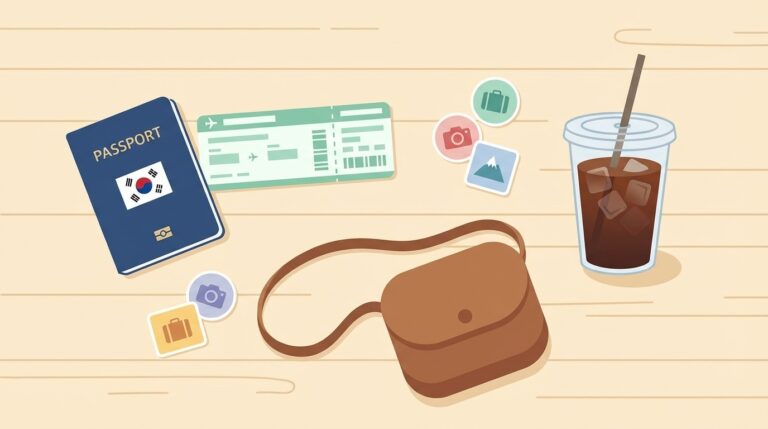
Phase 1: Immersive Hook
Hello! I’m your Daily Hangul editor, your personal guide to not just speaking Korean, but feeling it.
Picture this: You are the main character in a K-Drama. The upbeat OST is playing as you run out of your hotel in Myeongdong, dragging your carrier. You jump into a taxi heading to Incheon Airport. Your Korean friend looks at you with wide eyes and asks a crucial question. The subtitles say, “Did you bring it?”
If you don’t understand this exact phrase, you might find yourself at the airline counter digging through your bags in pure panic!
When planning your travel to Korea, packing your passport is step zero. But in Korea, your passport isn’t just for the airport—it’s your golden ticket for instant tax refunds at Olive Young, checking into cute Hanok guesthouses, and getting your K-Pop concert tickets at the box office.
Today, we are going to learn exactly how to talk about your passport like a true local, based on real panic-moments from our students!
Phase 2: Deep Dive into Core Expressions
Let’s break down the most essential phrases you need when checking for your passport.
1. 여권 챙겼어요?
- Pronunciation: [yeo-gwon chaeng-gyeot-seo-yo?] (The ‘yeo’ sounds like the ‘yo’ in ‘yonder’, and ‘gwon’ sounds like ‘Gwen’ with an ‘o’. ‘Chaeng’ rhymes with ‘hang’.)
- Meaning: Did you pack your passport? / Did you make sure you have your passport?
- K-Culture Moment: This is the classic phrase a caring Korean friend or a sweet K-Drama mom will yell out as you are rushing out the door. It’s the ultimate expression of care.
- Editor’s Insight: The verb 챙기다 (chaeng-gi-da) is magic. The dictionary says it means ‘to pack’ or ‘to take’, but the real nuance is ‘to take good care of’ or ‘to not forget’. We use it for things (packing bags) AND people (taking care of the youngest person in the group).
- Situation Spectrum:
[🚫 Never] ———— [⚠️ Be Careful] ———— [✅ Go Ahead]- Close Friends (여권 챙겼어? – dropped the ‘yo’): ✅
- Colleagues/Acquaintances: ✅
- Boss/Elders (여권 챙기셨어요? – adding ‘shi’): ⚠️
- 🤔 Think About It: Why does Korean use the same word (챙기다) for packing a physical object and taking care of a human being? What does this say about the Korean mindset regarding ‘looking after’ things and people?
2. 여권 어딨지?
- Pronunciation: [yeo-gwon eo-dit-ji?] (Sound alike: ‘eo’ like the ‘u’ in ‘up’, ‘dit’ like ‘deet’ but short, ‘ji’ like ‘jee’.)
- Meaning: Where is my passport?
- K-Culture Moment: Imagine a reality show where a K-Pop idol is at the airport counter, patting all their pockets in a panic. They will mumble this to themselves while the camera zooms in on their stressed face.
- Editor’s Insight: The ending ‘~지 (ji)’ when talking to yourself implies you are wondering or trying to remember something. It’s much more natural than formally asking “Where is my passport?”
- Situation Spectrum:
[🚫 Never] ———— [⚠️ Be Careful] ———— [✅ Go Ahead]- Mumbling to yourself: ✅
- Asking a close friend (여권 어딨지?): ✅
- Asking an airport staff (여권 어딨어요? – must add ‘yo’): ⚠️
3. 여기 있어요.
- Pronunciation: [yeo-gi it-seo-yo.] (Sound alike: yuh-gee eet-suh-yo)
- Meaning: Here it is. (Literal: It exists here.)
- K-Culture Moment: You will use this exact phrase when the immigration officer at Incheon Airport, the Olive Young cashier, or the hotel receptionist asks for your passport.
- Editor’s Insight: Handing something over in Korea is all about the vibe. When you say “여기 있어요”, make sure to hand your passport over with both hands (or one hand supporting your other arm). It instantly makes you look like a polite, cultured traveler!
- Situation Spectrum:
[🚫 Never] ———— [⚠️ Be Careful] ———— [✅ Go Ahead]- Friends (여기 있어): ✅
- Strangers/Clerks (여기 있어요): ✅
- Boss/Elders (여기 있습니다 – formal): ⚠️
Phase 3: Textbook vs Real Life
| Situation | 📖 Textbook Korean | 🗣️ Real Korean | 💡 Why is it different? |
|---|---|---|---|
| Asking “Did you pack it?” | 여권을 가방에 넣었습니까? (Did you put the passport in the bag?) | 여권 챙겼어요? (Did you pack the passport?) | ‘챙기다’ is the ultimate everyday verb for packing/not forgetting. |
| Asking “Where is it?” | 여권이 어디에 있습니까? (Where is the passport?) | 여권 어딨지? / 어딨어요? (Where is the passport?) | Koreans love efficiency! ‘어디에 있어’ shrinks to ‘어딨어’. |
| Giving the passport | 이것이 제 여권입니다. (This is my passport.) | 아, 여기 있어요. (Ah, here it is.) | It’s softer and more conversational than stating a hard fact. |
Bottom Note for Beginners (A2): You don’t need complex grammar here. Just knowing ‘여권’ and ‘여기 있어요’ will solve 90% of your airport problems!
Phase 4: Cultural Deep Dive
4-1. Non-verbal Communication: The “Two-Handed Rule”
When you finally find your passport and hand it to the airport staff or a cashier, how you hand it over is just as important as what you say. In Korea, handing items with one hand (especially your left hand) can be seen as slightly rude.
Pro tip: Hand your passport over with both hands. If you are holding a coffee in one hand, use your right hand to give the passport, and lightly touch your right elbow or wrist with your left hand. The staff will immediately think, “Wow, this person knows Korean culture!”
4-2. K-Travel Connection: The Olive Young Tax Refund
Let’s be real—your passport in Korea isn’t just for immigration. It’s for shopping! If you go to a major Olive Young store in Myeongdong or Hongdae to buy K-Beauty products, you can get an “Immediate Tax Refund” (즉시 환급). But you MUST have your physical passport.
When the cashier sees your basket full of sheet masks, they will ask: “여권 있으세요?” (Do you have your passport?). If you packed it, you smile and say, “네, 여기 있어요!” (Yes, here it is!).
Phase 5: Immersive Roleplay Scenario
Scenario A: The Hotel Lobby Panic
- Setting: 8:00 AM, the lobby of a hotel in Hongdae. Your flight is at 1:00 PM. The airport bus (Limousine bus) is arriving in 5 minutes.
- Characters:
- YOU: A traveler who bought way too many K-Pop albums and K-Snacks.
- Ji-woo (28): Your Korean friend who came to see you off. She’s highly organized and a bit of a “mom” friend.
Ji-woo: 짐 다 쌌어요? 빠진 거 없죠?
(jim da ssat-seo-yo? ppa-jin geo eop-jjo?)
[Did you pack everything? Nothing is missing, right?]
YOU: 네, 다 챙겼어요!
(ne, da chaeng-gyeot-seo-yo!)
[Yes, I packed everything!]
Ji-woo: 가장 중요한 거! 여권 챙겼어요?
(ga-jang jung-yo-han geo! yeo-gwon chaeng-gyeot-seo-yo?)
[The most important thing! Did you pack your passport?]
(🎭 Stage Direction: Ji-woo points at your bursting backpack suspiciously)
YOU: 헉… 잠깐만요.
(heok… jam-kkan-man-yo.)
[Gasp… wait a minute.]
Ji-woo: 에이, 설마요. 가방 잘 찾아봐요.
(e-i, seol-ma-yo. ga-bang jal cha-ja-bwa-yo.)
[No way. Look through your bag carefully.]
🔀 Your Turn! How will you respond after finding it in your jacket pocket?
– A) “이것이 제 여권입니다.” (Formal, textbook style)
– B) “아! 다행이다. 여기 있어요!” (Natural, relieved style)
– C) “대박 사건!” (Slang, dramatic style)✅ Best Choice: B — “Ah! Thank goodness (다행이다). Here it is!” It sounds incredibly natural and fits the emotional relief of the situation.
⚠️ Choice A Analysis: You sound like a robot reporting to the police!
Scenario B: Bonus – The K-Pop Concert Ticket Booth
- Setting: Outside the Olympic Gymnastics Arena (KSPO Dome). You are picking up your K-Pop concert ticket.
- Staff: 신분증이나 여권 보여주세요. (Please show your ID or passport.)
- YOU: (Handing it with both hands) 네, 여기 있어요. (Yes, here it is.)
- Staff: 본인 확인 되셨습니다. 티켓 여기 있습니다! (Identity verified. Here is your ticket!)
Phase 6: 10-Second Shadowing Drill
Let’s practice reading these naturally. Follow the slashes for pauses, and try to match the emotional tag!
- 🥺 (Slightly worried): 아… / 내 여권 / 어딨지?
(ah… / nae yeo-gwon / eo-dit-ji?) - 😤 (Confident & Proud): 네! / 여권 / 잘 챙겼어요!
(ne! / yeo-gwon / jal chaeng-gyeot-seo-yo!) - 😊 (Polite & Bright): 네, / 여기 / 있어요!
(ne, / yeo-gi / it-seo-yo!)
Phase 7: K-Culture Glossary
| Korean | Romanization | English | Context |
|---|---|---|---|
| 여권 | yeo-gwon | Passport | Your most important travel document. |
| 신분증 | sin-bun-jeung | ID card | In Korea, foreigners use their passport or ARC (Alien Registration Card) as ID. |
| 챙기다 | chaeng-gi-da | To pack / take care | Used for packing items or looking after someone. |
| 면세점 | myeon-se-jeom | Duty-free shop | Places like Lotte Duty Free or Olive Young where you need your passport! |
| 다행이다 | da-haeng-i-da | What a relief | The exact feeling when you finally find your lost passport. |
Phase 8: Traveler’s Survival Kit
🆘 Survival Phrases at the Tax-Free Counter
– 🇰🇷 “택스 리펀 되나요?” (taek-seu ri-peon doe-na-yo?)
– 🗣️ Meaning: Do you offer tax refunds?
– 📍 Where to use: Olive Young, clothing stores, department stores.
– 💡 Pro Tip: Look for the “Global Tax Free” or “Tax Refund” orange/blue logos on the store window!📌 Editor’s Travel Note: The “Safe Korea” Paradox
South Korea is famous for being so safe that people leave their laptops on cafe tables to go to the restroom. However, when it comes to official business—getting a SIM card, buying age-restricted items, or picking up concert tickets—they are extremely strict about ID. A photo of your passport on your phone rarely works. Always carry the physical booklet if you plan to shop or do official tasks!
Phase 9: Think Deeper — “One Step Further”
Global Era & Identity: The “K-Safe” Culture vs Strict Verification
Have you ever wondered why Korea is so safe from petty theft, yet so strict about verifying who you are? In Korea, community trust is high (no one steals your bag), but the administrative system is highly digitized and precise. In the global era, as more foreigners visit Korea, this creates a unique experience. You feel completely relaxed walking the streets at 2 AM, but you must strictly present your physical ‘여권’ (passport) at a K-Pop concert to prove you aren’t a ticket scalper.
💬 Your Turn: Does your country require physical IDs for buying concert tickets or getting tax refunds? How strict is it compared to Korea? Share your thoughts in the comments!
Phase 10: FAQ & Troubleshooting
Q: Can I just show a picture of my passport on my phone?
Editor’s Answer: Usually NO. For Olive Young tax refunds, hotel check-ins, or concert ticket pick-ups, they require the physical passport. A photo only works in very rare, casual situations.
Q: Is it safe to carry my passport everywhere in Korea?
Editor’s Answer: Yes! Pickpocketing is incredibly rare in Korea. Carry it safely in a small cross-bag, but don’t stress too much about it being stolen.
❌ Common Mistake #1: Mispronouncing 여권 (yeo-gwon) as “여관” (yeo-gwan).
✅ How to fix it: 여권 means passport. 여관 means an old, cheap motel! Be careful with the vowel. It’s “gwon” (rhymes with dawn), not “gwan”.
Phase 11: Wrap-up & Action Items
One-Liner Summary: When packing for your Korea trip, always ask yourself, “여권 챙겼어요?” and know how to say “여기 있어요” to the staff!
Your Action Missions:
– 🥉 Bronze (Solo): Say “여권 어딨지?” out loud the next time you are looking for your keys or wallet.
– 🥈 Silver (Online): Write “여권 챙겼어요!” in your travel planning journal or our learning community.
– 🥇 Gold (Real Life): Hand your passport over with both hands and say “여기 있어요” to the immigration officer when you land at Incheon Airport!
🎬 K-Culture Mission:
Go watch a Korea travel vlog on YouTube today. Notice how the vloggers film themselves at Incheon Airport. Do you hear them mention ‘여권’ or see them holding it up to the camera?
Did you enjoy today’s lesson? Let me know in the comments what you want to learn next for your Korea trip!
Phase 12: Interactive Quiz
1. Situational Judgment: You are at a K-Beauty store in Myeongdong. The cashier says, “여권 있으세요?” (Do you have your passport?). What is the best and most polite way to hand it over?
– A) Toss it on the counter and say “여권.”
– B) Hand it with both hands and say “네, 여기 있어요.”
– C) Hide it and say “여권 어딨지?”
2. True or False – K-Culture Edition:
In Korea, it’s perfectly fine to hand important documents like a passport to an elder or official using only your left hand. (T/F)
3. Fill in the Blank:
A: 짐 다 쌌어요? (Did you pack everything?)
B: 네, 가방 쌌어요. 아 맞다! 내 여권 _________? (Yes, I packed my bag. Oh right! Where is my passport?)
(Answers: 1. B – because ‘여기 있어요’ with two hands is the golden rule of Korean politeness! / 2. False – Always use both hands or your right hand supported by your left. / 3. 어딨지?)
Frequently Asked Questions (FAQ)
Q: What does "여권 챙겼어요?" mean in Korean and how do you pronounce it?
A: In Korean, "여권 챙겼어요?" is pronounced [yeo-gwon chaeng-gyeot-seo-yo?] and means: Did you pack your passport? / Did you make sure you have your passport?
Q: What does "여권 어딨지?" mean in Korean and how do you pronounce it?
A: In Korean, "여권 어딨지?" is pronounced [yeo-gwon eo-dit-ji?] and means: Where is my passport?
Q: What does "여기 있어요." mean in Korean and how do you pronounce it?
A: In Korean, "여기 있어요." is pronounced [yeo-gi it-seo-yo.] and means: Here it is. (Literal: It exists here.)







