

Phase 1: Immersive Hook
Hello there! I’m your editor from Daily Hangul, your local Korean bestie.
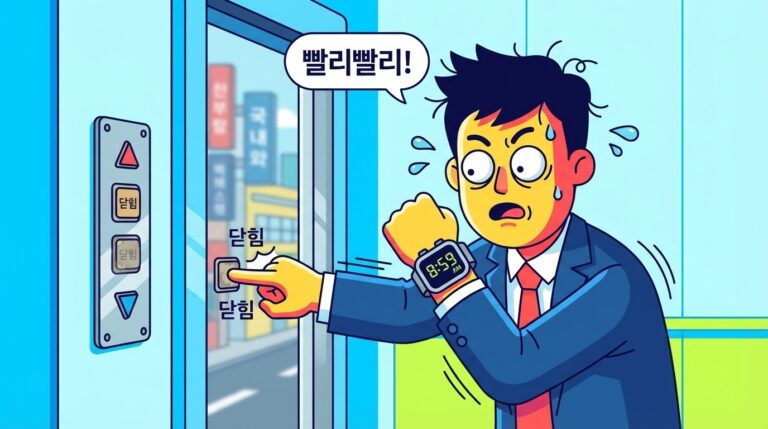
Let’s set the scene: You are watching a tense K-Drama. The main character is running away from the villain, or maybe they’re just trying to avoid their awkward ex-boyfriend at the office. They dash into the elevator, and what do they do? They don’t just stand there waiting for the doors to close. They start smashing the >< (close) button like their life depends on it! Tat-tat-tat-tat!
Welcome to Korea’s famous 빨리빨리 (Bbali-bbali – Hurry, hurry) culture.
If you’ve ever been to Korea, you might have noticed something funny in the elevators: the >< button is often completely faded or the paint has rubbed off entirely, while the <> (open) button looks brand new. In a society where everything from food delivery to internet speed is lightning-fast, waiting three seconds for an elevator door to close automatically feels like an eternity.
But what happens if you are the one running toward the elevator? Or what if you’re inside, and you need to tell someone to hurry up? If you only know textbook Korean, you might miss the elevator entirely! Today, I’m going to show you the real-life phrases Koreans use in these high-stakes, hyper-fast situations so you can navigate them like a true insider.
Phase 2: Deep Dive into Key Expressions
Let’s break down the most essential phrases you’ll hear—or need to use—around Korean elevators.
1. 잠시만요! 탈게요!
- Pronunciation: [jam-si-man-yo! tal-gge-yo!]
Sound-alike guide: ‘jam’ sounds like fruit jam, ‘si’ like ‘she’, ‘man’ like the man, ‘yo’ like yo-yo. ‘Tal’ sounds like ‘tall’, ‘gge’ sounds like the hard ‘g’ in ‘get’, ‘yo’ like yo-yo.- Meaning: (Literal) Just a moment! I will ride! / (Real nuance) Wait, hold the door! I’m getting on!
- K-Culture Moment: You’re sprinting across the lobby of your hotel in Myeongdong. The doors are closing. You yell this out, and suddenly, a hand shoots out from inside to block the doors like a superhero.
- Editor’s Insight: This is your absolute lifesaver. ‘잠시만요’ usually means ‘excuse me’ or ‘wait a moment,’ but adding ‘탈게요’ makes your intention clear. It’s urgent but polite enough to shout at strangers.
- Situation Spectrum:
[🚫 절대 금지] ———— [⚠️ 주의] ———— [✅ 자유롭게]
- Casual (Friends): ✅
- Semi-formal (Strangers/Coworkers): ✅
- Formal (Seniors/Boss): ✅ (It’s an emergency, they will understand!)
- 🤔 Think About It: In your culture, is it common to shout to hold the elevator, or do people silently accept their fate and wait for the next one? How does this reflect the value of time in your country?
2. 빨리 좀 닫아.
- Pronunciation: [bbal-li jom da-da]
Sound-alike guide: ‘bbal’ is a tense, sharp ‘b’ (think of the ‘b’ in ‘rabbit’ said aggressively). ‘da-da’ sounds like ‘dada’ in ‘dadaism’.- Meaning: (Literal) Close it a little fast. / (Real nuance) Hurry up and close the door.
- K-Culture Moment: You are hanging out with your Korean friend. They press the close button five times in one second and mutter this under their breath because they are craving 삼겹살 (pork belly) and can’t wait to get to the restaurant.
- Editor’s Insight: This is purely informal (반말 – casual speech). You would only say this to a close friend or mutter it to yourself. The word ‘좀’ (a little) is often used in Korean to soften a command, but here it actually adds a tone of mild frustration or urgency.
- Situation Spectrum:
[🚫 절대 금지] ———— [⚠️ 주의] ———— [✅ 자유롭게]
- Casual (Friends/Self): ✅
- Semi-formal (Strangers/Coworkers): 🚫 (Do not say this to strangers!)
- Formal (Seniors/Boss): 🚫
- 🤔 Think About It: Why do Koreans often talk to themselves out loud when frustrated? Is it a way to vent stress in a fast-paced environment?
3. 왜 이렇게 안 닫혀?
- Pronunciation: [wae i-reo-ke an da-chyeo?]
Sound-alike guide: ‘wae’ (why), ‘i-reo-ke’ (e-raw-keh). ‘chyeo’ sounds like ‘chuh’ with a ‘y’ inside, like ‘ch-yuh’.- Meaning: (Literal) Why doesn’t it close like this? / (Real nuance) Why is this taking so long to close?
- K-Culture Moment: The classic K-Drama scene where the hero is trying to escape a pursuer. They hit the button, but the door is moving in slow motion. They aggressively whisper this phrase in panic.
- Editor’s Insight: This is a rhetorical question. You aren’t asking for the mechanical reason the elevator is slow; you are just expressing your impatience. It perfectly captures the Bbali-bbali spirit.
- Situation Spectrum:
[🚫 절대 금지] ———— [⚠️ 주의] ———— [✅ 자유롭게]
- Casual (Friends/Self): ✅
- Semi-formal (Strangers/Coworkers): ⚠️ (Only whisper it to yourself)
- Formal (Seniors/Boss): 🚫
- 🤔 Think About It: Notice the passive voice here (‘안 닫혀’ – doesn’t get closed). How does using the passive voice shift the blame from the person pressing the button to the ‘slow’ machine itself?
Phase 3: Textbook vs Real Life
Let’s compare what you studied in your Korean class with what you will actually hear in the wild.
| Situation | 📖 Textbook Korean | 🗣️ Real Korean | 💡 Why the difference? |
|---|---|---|---|
| Asking to hold the door | 문을 열어 주시겠습니까? (Would you please open the door?) | 잠시만요! 탈게요! (Wait! I’ll ride!) | Urgency! In a split second, you need short, impactful words, not long polite grammar forms. |
| Telling a friend to hurry into the elevator | 빨리 들어오세요. (Please come in quickly.) | 빨리 타! (Get in fast!) | ‘타다’ (to ride) is much more natural for vehicles/elevators than ‘들어오다’ (to enter). |
| Muttering about the slow doors | 문이 참 늦게 닫히네요. (The door closes quite late.) | 아 왜 안 닫혀? (Ah, why won’t it close?) | Real emotion requires real frustration markers like ‘아’ (Ah) and ‘왜’ (Why). |
Editor’s Bottom Note: At a B1 level, you know how to be perfectly polite. But matching the speed of the situation is a higher-level cultural skill. Don’t be afraid to drop the long endings when you’re literally running out of time!
Phase 4: Cultural Deep Dive
4-1. Non-verbal Communication: The Hovering Finger
If you step into an elevator in Korea, observe the person standing next to the button panel. Notice their index finger. It is likely hovering exactly 1 millimeter away from the >< button, ready to strike the millisecond the last person crosses the threshold. This is part of Korean 눈치 (Nunchi)—the subtle art of reading the room. If you are standing by the panel, it is your unspoken duty to be the ‘elevator captain.’ You press the floor buttons for others, and you must press ‘close’ efficiently to save everyone’s precious time.
4-2. K-Travel Connection: The ‘Bbali-bbali’ Shock
For travelers, Korean public transport is a dream. The subway arrives exactly on time, and KTX trains bullet across the country. But this speed requires participation. In a bustling Seoul subway station elevator, there is no lingering. People walk with purpose. If you dawdle while getting in, you might hear a gentle but firm “먼저 내릴게요” (I’ll get off first). Understanding this flow isn’t about being rushed; it’s about mutual efficiency.
Phase 5: Immersive Roleplay
Scenario A: The 8:58 AM Gangnam Office Sprint
Setting: It’s 8:58 AM on a Tuesday in a sleek Gangnam office building. You need to clock in by 9:00 AM. You dash into the elevator. Inside is Minsoo (32, your friendly but slightly frantic Korean coworker).
You: 하아… 하아… 세이프!
(Haa… Haa… Seipeu!)
[Huff… Puff… Safe!]
(🎭 Stage Direction: You lean against the wall, catching your breath)
Minsoo: 아휴, 깜짝이야. 뛰느라 고생했어요.
(Ahyu, kkamjjagiya. Ttwineura gosaenghaesseoyo.)
[Oh, you startled me. Good job running.]
You: 네, 지각하는 줄 알았어요.
(Ne, jigakhaneun jul arasseoyo.)
[Yeah, I thought I was going to be late.]
(🎭 Stage Direction: Minsoo’s finger is aggressively tapping the close button)
Minsoo: 이 엘리베이터는 왜 이렇게 느리죠? 아, 안 되겠다.
(I ellibeiteoneun wae ireoke neurijo? Ah, an doegeda.)
[Why is this elevator so slow? Ah, this won’t do.]
You: 민수 씨, 버튼 부서지겠어요!
(Minsu ssi, beoteun buseojigesseoyo!)
[Minsoo, you’re going to break the button!]
Minsoo: 한국인은 이 속도 못 참아요! 어? 저기 부장님 오신다!
(Hangugineun i sokdo mot chamayo! Eo? Jeogi bujangnim osinda!)
[Koreans can’t stand this speed! Oh? The boss is coming over there!]
(🎭 Stage Direction: Through the closing doors, you see your strict boss running toward the elevator)
🔀 Your Turn! How do you react?
– A) (Quickly press the Open button) “부장님! 여기요!” (Boss! Over here!)
– B) (Look away and do nothing) “어어… 문이 닫히네요…” (Uh… the doors are closing…)
– C) (Help Minsoo press the Close button) “빨리 닫혀라!” (Close fast!)✅ Best Choice: A — Reason: In a Korean workplace, ignoring a boss who is running for the elevator is a big Nunchi failure! You must press open and greet them.
⚠️ Choice B & C Analysis: While highly tempting (and great for K-Drama comedy), doing this in real life will make your office life very awkward later!
Scenario B: The Subway Platform Dash (Bonus)
Setting: You are running down the stairs at Hongik University Station. You hear the transfer music playing—the doors are about to close!
You: (Running wildly) 잠시만요! 탈게요!
(Jamsimanyo! Talgeyo!)
[Wait! I’m getting on!]
Stranger inside: (Blocks the sensor with their arm so the door bounces back) 빨리 타세요!
(Bballi taseyo!)
[Get in quickly!]
You: 휴, 정말 감사합니다!
(Hyu, jeongmal gamsahamnida!)
[Phew, thank you so much!]
Phase 6: 10-Second Shadowing Drill
Time to practice! Let’s say you are desperately running for the elevator.
🥺 잠시만요! / 저 / 탈게요!! (jam-si-man-yo! / jeo / tal-gge-yo!!)
- Intonation Guide: Start high and loud on ‘잠’. Pause briefly after ‘저’ (I). Put a desperate, pleading emphasis on ‘탈’ (ride).
- Vibe: Think of a melodramatic movie scene where you are reaching out your hand.
Phase 7: K-Culture Glossary
Here are some essential terms to understand the Bbali-bbali mindset.
| 한국어 | Romanization | English | Context |
|---|---|---|---|
| 빨리빨리 | bbali-bbali | Hurry, hurry / Fast-paced | The core philosophy of modern Korean society—efficiency and speed above all. |
| 눈치 | nunchi | Social sense / Tact | The ability to read a situation. Knowing when to hold the door or press close requires high nunchi. |
| 출근길 | chulgeungil | Way to work / Commute | The most stressful, high-speed time of day. Do not block the flow of traffic during chulgeungil! |
| 지각 | jigak | Being late / Tardy | Something Koreans dread. Hence, the elevator button spamming. |
| 닫힘 | dachim | Close (Button) | The >< button. Often faded, scratched, or completely white from overuse. |
Phase 8: Traveler’s Survival Kit
Elevators and public transit are where you’ll feel the Bbali-bbali culture the most.
🆘 Survival Phrases for Transit & Elevators
– 🇰🇷 “올라가나요? / 내려가나요?” (ol-la-ga-na-yo? / nae-ryeo-ga-na-yo?)
– 🗣️ Meaning: Going up? / Going down?
– 📍 Where to use: When rushing into an elevator and you aren’t sure which way it’s headed.
- 🇰🇷 “내릴게요!” (nae-ril-gge-yo!)
- 🗣️ Meaning: I’m getting off!
- 📍 Where to use: When you are stuck in the back of a crowded elevator/subway and the doors open. Shout this to make people part like the Red Sea.
📌 Editor’s Travel Note
– Escalator Etiquette: In Korea, stand on the right, walk on the left. If you stand on the left, you will block the bbali-bbali flow and get some annoyed sighs!
– T-Money Tip: Have your transportation card ready in your hand before you reach the subway turnstile. Stopping in front of the gate to dig through your bag is a major Nunchi violation!
Phase 9: Think Deeper — Language in the Modern Era
🧠 Think Deeper: Modern Society & Efficiency
Korea’s Bbali-bbali culture isn’t just impatience; it’s a byproduct of the nation’s incredibly rapid economic growth, known as the “Miracle on the Han River.” In a few short decades, Korea transformed into a high-tech powerhouse. Time literally became gold. This hyper-efficiency seeped into the language and physical spaces. The faded elevator close button is a modern artifact of a society that believes moving fast is a virtue, directly linked to diligence and success. When a Korean presses that button, they aren’t just saving three seconds; they are actively participating in the collective rhythm of a nation that never stops moving.
💬 Your Turn: Does your country have a similar “hurry” culture, or is life taken at a much slower pace? How do people in your country react when an elevator is too slow? Share in the comments!
Phase 10: FAQ & Troubleshooting
Let’s clear up some common confusions about elevator etiquette.
Q: Is it rude to press the close button if someone is walking toward the elevator?
A: Yes! Bbali-bbali has limits. If you make eye contact with someone walking toward the elevator and you hit ‘close’ while staring them down, that is universally rude. (Though villains in K-Dramas do this perfectly).
Q: Who should press the buttons if the elevator is crowded?
A: Whoever is standing closest to the button panel automatically becomes the unofficial “Elevator Captain.” If that’s you, it’s polite to ask, “몇 층 가세요?” (What floor are you going to?) and press the numbers for people whose hands are full.
❌ Common Mistake: Yelling “기다려!” (Wait!) to a stranger.
✅ Do this instead: Say “잠시만요!” (Jam-si-man-yo!). “기다려” sounds like you are commanding a dog to stay. Always use polite forms with strangers, even in an emergency!
Phase 11: Wrap-up & Action Items
One-Liner Summary: To survive Korea’s Bbali-bbali elevator culture, keep your finger on the close button, but always shout “잠시만요!” when you’re the one running for it!
Action Mission:
– 🥉 Bronze: Stand in front of a mirror, pretend you are running, and dramatically shout “잠시만요! 탈게요!” 3 times.
– 🥈 Silver: Leave a comment on this post telling us if you are a “press the close button” person or a “let it close automatically” person, using today’s Korean words.
– 🥇 Gold: The next time you are in Korea (or at a Korean office), boldly volunteer to be the ‘Elevator Captain’ and handle the open/close duties with flawless Nunchi!
🎬 K-Culture Mission:
Watch one episode of a modern K-Drama today. I guarantee you will see at least one scene of someone anxiously spamming an elevator button. When you spot it, yell “빨리 좀 닫아!” at the screen!
Phase 12: Interactive Quiz
Test your Bbali-bbali survival skills!
1. You are standing in a crowded elevator in Seoul. Someone outside shouts “잠시만요!”. What is your immediate reaction?
A) Stare at them silently as the doors close.
B) Swiftly press the <> (Open) button to hold the door.
C) Yell “빨리 좀 닫아!” (Hurry up and close!).
2. Fill in the blank: You want to get off the crowded subway, but people are blocking the door. You politely but loudly say: “_____게요!”
A) 탈 (Tal)
B) 닫힐 (Dachil)
C) 내릴 (Naeril)
3. True or False – K-Culture Edition:
In Korea, standing on the left side of the escalator during rush hour is perfectly fine as long as you hold the handrail. (T/F)
(Answers below!)
…
…
Click here for Answers!
1. B – That is the true Nunchi move! (A is unhelpful, and C is incredibly mean!)
2. C – 내릴게요 (I’m getting off). 탈게요 means ‘I’m getting on’.
3. False – Never stand on the left! The left side is the “fast lane” for people walking up or down. Always stand on the right.
Frequently Asked Questions (FAQ)
Q: What does "잠시만요! 탈게요!" mean in Korean and how do you pronounce it?
A: In Korean, "잠시만요! 탈게요!" is pronounced [jam-si-man-yo! tal-gge-yo!] and means: (Literal) Just a moment! I will ride! / (Real nuance) Wait, hold the door! I'm getting on!
Q: What does "빨리 좀 닫아." mean in Korean and how do you pronounce it?
A: In Korean, "빨리 좀 닫아." is pronounced [bbal-li jom da-da] and means: (Literal) Close it a little fast. / (Real nuance) Hurry up and close the door.
Q: What does "왜 이렇게 안 닫혀?" mean in Korean and how do you pronounce it?
A: In Korean, "왜 이렇게 안 닫혀?" is pronounced [wae i-reo-ke an da-chyeo?] and means: (Literal) Why doesn't it close like this? / (Real nuance) Why is this taking so long to close?







