

Hello! I’m your lead editor at Daily Hangul. If you’ve ever spent a summer in Korea, you know the drill. You’re sitting in a perfectly air-conditioned cafe, sipping your iced Americano, when suddenly—BZZZT! BZZZT! Everyone’s phones erupt in a synchronized, apocalyptic siren.
In a K-Drama, this is usually the moment the protagonist dramatically runs out to save someone. In reality? It’s just another Tuesday in July, and the government is sending a 재난문자 (Emergency Alert Text) about the extreme heatwave.
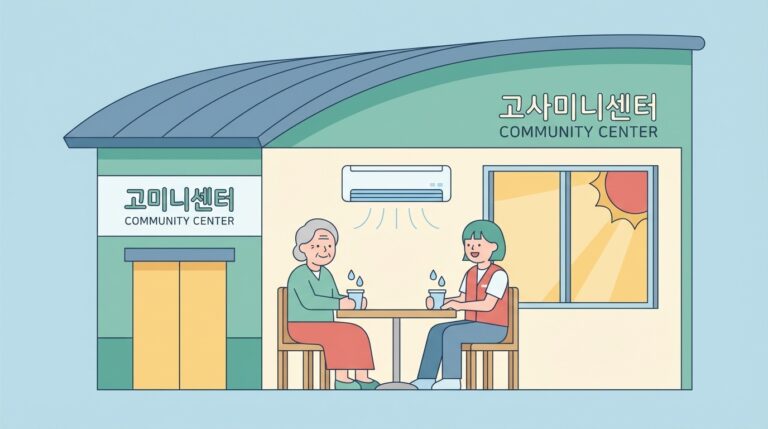
But if you look closely at these messages, you’ll notice they aren’t just telling you to stay indoors. They often include deeply community-focused instructions: “Please check on the elderly, and guide them to a cooling center.” At a C2 level, learning Korean is no longer just about surviving; it’s about understanding how Korean society cares for its most vulnerable members during a crisis. Let’s dive into the advanced vocabulary and cultural nuances of Korea’s 무더위쉼터 (Cooling Centers).
Phase 2: Core Expressions Deep Dive
To understand disaster safety in Korea, we need to decode the formal, bureaucratic language (often heavy with Sino-Korean words) used in public broadcasts and alerts.
1. 폭염 경보가 발효되었으니, 인근 무더위쉼터를 이용하시기 바랍니다.
- Pronunciation: [Pogyom gyeongboga balhyodoeeosseuni, ingeun mudeowi-swimteoreul iyong-hasigi baramnida.]
- Meaning: A heatwave warning has been issued; please use nearby cooling centers.
- K-Culture Moment: You’ll hear this echoing from the neighborhood loudspeakers (마을 방송) in rural areas or see it scrolling at the bottom of the screen during the evening news.
- Editor’s Insight: Look at the word 무더위쉼터. Instead of using a cold, bureaucratic Sino-Korean term like ‘냉방센터 (Cooling Center)’, the government intentionally uses native Korean words: 무더위 (sweltering heat) + 쉼터 (resting place). It sounds much more welcoming and comforting to the elderly.
- Situation Spectrum:
[🚫 Casual] ———— [⚠️ Semi-formal] ———— [✅ Public Announcement/News]- 🤔 Think About It: How does the choice of vocabulary affect public policy? If they called it a “Disaster Relief Center,” would the elderly be as willing to visit and chat with their neighbors?
2. 온열질환에 취약한 어르신들의 안부를 수시로 확인해 주세요.
- Pronunciation: [Onyeol-jirhwane chwiyakhan eoreusindeurui anbureul susiro hwaginhae juseyo.]
- Meaning: Please frequently check on the wellbeing of the elderly who are vulnerable to heat-related illnesses.
- K-Culture Moment: This is the essence of Korean Jeong (정). The government doesn’t just tell individuals to take care of themselves; it instructs the community to check on each other.
- Editor’s Insight: 안부를 확인하다 (checking on someone’s wellbeing) is a massive cultural pillar in Korea. It’s not just saying “Are you okay?” It involves making sure they have eaten, are staying cool, and aren’t lonely.
- Situation Spectrum:
[🚫 Casual] ———— [✅ Workplace/Community Guidelines] ———— [✅ Formal Text]- 🤔 Think About It: Does your home country’s government send text messages asking citizens to check on their neighbors during a heatwave? What does this say about collective responsibility in Korea?
3. 야외 활동을 전면 자제하시고 충분한 수분 섭취를 권장합니다.
- Pronunciation: [Yaoe hwaldong-eul jeonmyeon jajehasigo chungbunhan subun seopchwireul gwonjanghamnida.]
- Meaning: We strongly advise you to completely refrain from outdoor activities and ensure sufficient fluid intake.
- K-Culture Moment: The standard text you receive on your phone when the temperature hits 35°C (95°F).
- Editor’s Insight: Notice the high-level Sino-Korean verbs: 자제하다 (to refrain/control oneself) instead of 하지 마세요 (don’t do), and 섭취하다 (to ingest/intake) instead of 마시세요 (drink). Mastering these elevates your Korean from “everyday fluent” to “professional/native level.”
- Situation Spectrum:
[🚫 Friends] ———— [⚠️ Colleague Advice] ———— [✅ Official Alerts]
Phase 3: Textbook vs Real Life
When you read the emergency text, it sounds like a news anchor. But what do locals actually say to each other?
| Situation | 📖 Official / Textbook Korean | 🗣️ Real Conversational Korean | 💡 Why the difference? |
|---|---|---|---|
| Warning someone | 온열질환에 유의하세요. (Beware of heat illness.) | 더위 먹지 않게 조심해. (Don’t “eat” the heat.) | Koreans use the verb ‘먹다 (eat)’ for many things, including suffering from the heat (더위를 먹다). |
| Describing the heat | 폭염이 지속되고 있습니다. (The heatwave continues.) | 와, 오늘 찜통이다 찜통. / 완전 대프리카네. | ‘찜통’ means a steamer (like for dumplings). ‘대프리카’ is a famous portmanteau of Daegu (Korea’s hottest city) + Africa. |
| Suggesting a cooling center | 무더위쉼터로 이동하십시오. (Move to a cooling center.) | 더운데 은행이나 들어가자. (It’s hot, let’s just go into a bank.) | Banks in Korea are notoriously frigid in summer and serve as unofficial public cooling centers! |
Bottom Note: As a C2 learner, you should be able to read the official SMS (Textbook column) but instantly translate it into the conversational vibe (Real Korean column) when talking to your friends.
Phase 4: Cultural Deep Dive
4-1. Non-verbal Communication: The Art of ‘Nunchi’ in Heatwaves
When guiding an elderly person to a cooling center, you cannot just point and say, “Go there.” Korean Nunchi (눈치) dictates that you must assess their physical state and pride. Many elderly Koreans are stubborn and might say, “에이, 난 괜찮아 (Ah, I’m fine),” not wanting to be a burden. The culturally correct response isn’t to leave them alone, but to gently insist: “어르신, 제가 더워서 그러는데 같이 은행 가서 물 한잔만 마셔요” (Elderly sir/ma’am, I am feeling hot, could we go to the bank together and have a glass of water?). You make yourself the excuse so they don’t lose face.
4-2. K-Culture Connection: The ‘Oasis’ of the City
In Korea, surviving the heatwave isn’t just a government job; it’s a collective effort. Did you know about the Oasis Seoul (오아시스 서울) project? Many local cafes and restaurants stick an “Oasis” sticker on their doors, meaning anyone—especially delivery riders, street cleaners, or the elderly—can walk in and ask for a free cup of cold water, no purchase necessary. It’s a modern, urban manifestation of traditional Korean hospitality.
Also, during summer, K-Pop fan bases often donate bottled water or portable fans to these community cooling centers (often located in Senior Centers – 경로당) under their idol’s name. It’s a brilliant blend of fandom culture and disaster safety!
Phase 5: Immersive Roleplay
Scenario A: The Stubborn Grandfather
- Setting: A sweltering Tuesday afternoon (36°C) at a local Community Center (주민센터) in Seoul, which is acting as an official 무더위쉼터 (Cooling Center). You are volunteering here.
- Characters:
- YOU: A C2-level Korean speaker, volunteering to guide vulnerable groups.
- 할아버지 (Elderly Man, 80s): Wiping sweat with a towel, trying to leave the center to go tend to his rooftop chili pepper garden.
할아버지: 아유, 이제 땀 좀 식었네. 나 그만 가볼게. 옥상에 고추 널어놓은 거 뒤집어야 돼.
(Ayu, ije ttam jom sigeonne. Na geuman gabolge. Oksang-e gochu neoreonoeun geo dwijibeoya dwae.)
[Ah, my sweat has cooled down. I’ll be going now. I need to go flip the chili peppers drying on the roof.]
YOU: 어르신, 지금 바깥 온도가 36도예요. 휴대폰으로 재난문자도 왔어요.
(Eoreusin, jigeum bakkat ondoga 36-doyeyo. Hyudaeponeuro jaenanmunjado wasseoyo.)
[Sir, the outside temperature is 36 degrees right now. Emergency alerts were sent to phones too.]
할아버지: 에이, 이깟 더위가 대수라고. 나 젊었을 때는 땡볕에서도 농사 다 지었어! 비켜봐요.
(Ei, ikkat deowiga daesurago. Na jeolmeosseul ttaeneun ttaengbyeot-eseodo nongsa da jieosseo! Bikyeobwayo.)
[Bah, this heat is nothing. When I was young, I farmed in the blazing sun! Step aside.]
🔀 Your Turn! How do you politely but firmly stop him?
– A) “안 됩니다! 온열질환으로 쓰러지십니다. 자제하십시오!” (Strict and bureaucratic)
– B) “어르신, 뉴스에서 폭염 특보 발효됐대요. 고추보다 어르신 건강이 먼저잖아요. 시원한 식혜 한 잔 드릴 테니까 조금만 더 쉬다 가세요~”
– C) “할아버지, 가지 마세요. 더위 먹어요!”✅ Best Choice: B — Why? It uses advanced vocabulary (폭염 특보 발효) to establish authority, appeals to logic gently, and uses high-level cultural persuasion (offering Sikhye/sweet rice beverage to keep him seated).
⚠️ Choice A Analysis: Too aggressive. You sound like a police officer, which might offend him.
⚠️ Choice C Analysis: Too simple and casual for a C2 speaker talking to an 80-year-old.
Phase 6: 10-Second Shadowing Drill
Practice reading this official announcement like an empathetic news anchor. Pay attention to the pauses!
😤 폭염 특보가 / 발효되었습니다. (Pogyom teukboga / balhyodoeeotseumnida.)
🥺 주변에 / 홀로 계신 어르신들의 / 안부를 확인해 주시고, (Jubyeone / hollo gyesin eoreusindeurui / anbureul hwaginhae jusigo,)
😊 무더위쉼터 이용을 / 적극 권장해 주시기 바랍니다. (Mudeowi-swimteo iyongeul / jeokgeuk gwonjanghae jusigi baramnida.)
Phase 7: K-Culture Glossary
| Korean | Romanization | English | Context |
|---|---|---|---|
| 무더위쉼터 | mudeowi-swimteo | Cooling Center | Designated public spaces (banks, community centers, senior centers) for people to escape the heat. |
| 재난문자 | jaenan-munja | Emergency Alert Text | The blaring SMS alerts sent by the government for weather, missing persons, or emergencies. |
| 온열질환 | onyeol-jirhwan | Heat-related illness | Formal medical term for heat exhaustion/stroke. |
| 취약 계층 | chwiyak gyecheung | Vulnerable groups | Often refers to the elderly, low-income households, or those living in “Jjokbang” (tiny rooms without AC). |
| 더위 먹다 | deowi meokda | To suffer from the heat | Literally “to eat the heat.” Used when you feel dizzy, nauseous, or exhausted from the sun. |
Phase 8: Traveler’s Survival Kit (Extreme Heat Edition)
Even if you’re just visiting Korea, summer can be brutal. If you or someone around you is suffering from the heat, you need to know how to ask for help or find a cooling center.
🆘 Survival Phrase #1: Finding a Cooling Center
– 🇰🇷 “근처에 무더위쉼터나 쉴 만한 주민센터가 있나요?”
(geuncheoe mudeowi-swimteona swil manhan juminsenteoga innayo?)
– 🗣️ Meaning: Is there a cooling center or a community center where I can rest nearby?
– 📍 Where to use: Asking a police officer, convenience store worker, or local.🆘 Survival Phrase #2: Expressing Heat Exhaustion
– 🇰🇷 “제가 더위를 먹은 것 같아요. 혹시 시원한 물 한 잔 얻을 수 있을까요?”
(jega deowireul meogeun geot gatayo. Hoksi siwonhan mul han jan eodeul su isseulkkayo?)
– 🗣️ Meaning: I think I’ve got heat exhaustion. Could I possibly get a glass of cold water?
– 💡 Pro Tip: Look for cafes with the “오아시스 서울 (Oasis Seoul)” sticker on their windows. They will gladly give you free cold water.📌 Editor’s Travel Note
– Secret Cooling Centers: If you can’t find an official center, step into any Bank (은행) or Subway Station (지하철역). They are heavily air-conditioned and no one will kick you out for standing in the lobby for 10 minutes.
Phase 9: Think Deeper — “Language and Public Policy”
🧠 Language & Power: The Compassion in Bureaucracy
In many Western countries, emergency alerts are strictly informative: “Heatwave warning. Stay indoors. Hydrate.” It centers on individual responsibility. However, the Korean government’s use of phrases like “어르신들의 안부를 확인해 주세요” (Please check on the elderly) reflects a fundamentally different societal structure. Korea historically relied on village communities (마을 공동체) to survive natural disasters. Even in a hyper-modern metropolis like Seoul, the language of the state still echoes this collective mindset. The government delegates the duty of care to the citizens, reinforcing the cultural expectation of Jeong (정). As a C2 speaker, recognizing how traditional values are woven into modern bureaucratic language is key to truly mastering Korean.
💬 Your Turn: Does your home country rely on community networks during natural disasters like heatwaves, or is it purely individual/state responsibility? Share your thoughts below!
Phase 10: FAQ & Troubleshooting
Q: “Can I use ‘취약 계층’ (vulnerable groups) in everyday conversation?”
A: ⚠️ Caution. It is a very formal, socio-economic term. You should use it in essays, news debates, or professional meetings. If you are talking to a friend about your elderly neighbor, just say “할머니가 혼자 사셔서 걱정돼 (I’m worried because the grandmother lives alone).” Calling your neighbor a ‘취약 계층’ to their face would be highly unnatural and potentially offensive!
Q: “If I see an elderly person sitting in the heat, is it rude to approach a stranger?”
A: No, but approach with respect. Start with “어르신 (Elderly sir/ma’am)” and use honorifics. Offering an unopened bottle of water from a convenience store is a universally appreciated gesture.
❌ Common Mistake: Translating “Cooling Center” directly as “쿨링 센터” (Cooling Center).
✅ Do This Instead: While some younger people might understand the Konglish, the official and universally recognized term is 무더위쉼터. Always use this when asking for directions or reading maps.
Phase 11: Wrap-up & Action Items
One-Liner Summary: Surviving a Korean heatwave requires more than just AC; it requires understanding the advanced vocabulary of disaster safety and the cultural empathy of checking on your neighbors.
Action Mission:
– 🥉 Bronze: Say the phrase “폭염 특보가 발효되었습니다” out loud three times, perfectly mimicking a Korean news anchor’s authoritative tone.
– 🥈 Silver: Search “무더위쉼터” on Naver Maps or Kakao Map. Find the one closest to your current or future accommodation in Korea.
– 🥇 Gold (K-Culture Mission): Next time you watch a K-Drama set in summer, listen closely to the background noise. Can you hear the emergency broadcast or the buzzing of the cicadas (매미)? Notice how the characters hand each other cold drinks with two hands!
Phase 12: Interactive Challenge (Quiz)
1. Situational Judgment: You are a manager at a Korean company. An extreme heatwave warning (폭염 경보) has just been issued. Which announcement is the most professional and culturally appropriate to send to your outdoor field team?
– A) 너무 더우니까 일하지 마요! (Too hot, don’t work!)
– B) 폭염 경보가 발효되었으니, 야외 작업을 전면 자제하고 수분을 섭취하시기 바랍니다.
– C) 더위 먹지 않게 눈치껏 쉬세요.
2. True or False – K-Culture Edition:
“If you receive a 재난문자 (Emergency text) with a loud siren, you must immediately evacuate your building.”
(T/F?)
(Answers: 1 – B. It uses the correct C2 level formal vocabulary for a corporate/safety setting. A is too casual, C is too vague. 2 – False. While the siren is loud, during summer it is often just a heatwave warning telling you to drink water and check on the elderly! Always read the text before panicking.)
Frequently Asked Questions (FAQ)
Q: What does "폭염 경보가 발효되었으니, 인근 무더위쉼터를 이용하시기 바랍니다." mean in Korean and how do you pronounce it?
A: In Korean, "폭염 경보가 발효되었으니, 인근 무더위쉼터를 이용하시기 바랍니다." is pronounced [Pogyom gyeongboga balhyodoeeosseuni, ingeun mudeowi-swimteoreul iyong-hasigi baramnida.] and means: A heatwave warning has been issued; please use nearby cooling centers.
Q: What does "온열질환에 취약한 어르신들의 안부를 수시로 확인해 주세요." mean in Korean and how do you pronounce it?
A: In Korean, "온열질환에 취약한 어르신들의 안부를 수시로 확인해 주세요." is pronounced [Onyeol-jirhwane chwiyakhan eoreusindeurui anbureul susiro hwaginhae juseyo.] and means: Please frequently check on the wellbeing of the elderly who are vulnerable to heat-related illnesses.
Q: What does "야외 활동을 전면 자제하시고 충분한 수분 섭취를 권장합니다." mean in Korean and how do you pronounce it?
A: In Korean, "야외 활동을 전면 자제하시고 충분한 수분 섭취를 권장합니다." is pronounced [Yaoe hwaldong-eul jeonmyeon jajehasigo chungbunhan subun seopchwireul gwonjanghamnida.] and means: We strongly advise you to completely refrain from outdoor activities and ensure sufficient fluid intake.







