

Phase 1: Immersive Hook
Hello there! I’m the Head Editor of Daily Hangul. 👋
Picture this: It’s a Friday night in Sinchon or Gangnam. You’ve just finished a sizzling, hearty Korean BBQ dinner with your friends. Stomachs are full, but the night is still young. Someone wipes their mouth and shouts, “자, 2차 가자!” (Alright, let’s go to the second round!)
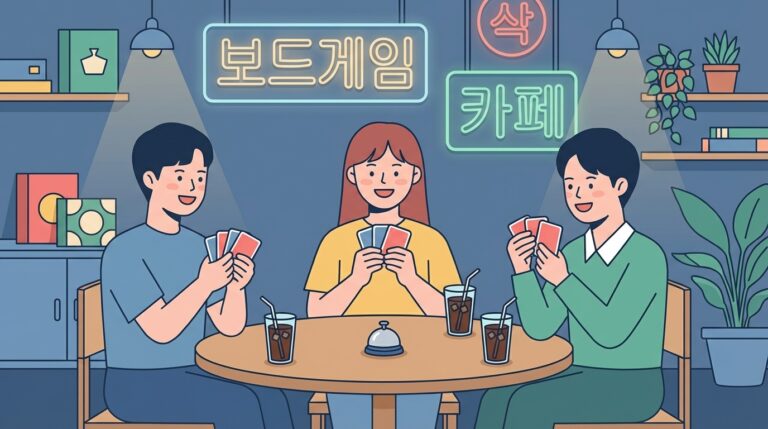
Instead of a noisy bar, you are dragged up to the 3rd floor of a brightly lit building. The door opens to a room filled with intense cheering, the clanking of plastic chips, collective groans, and someone frantically slamming a silver bell. Welcome to the Korean Board Game Cafe (보드게임 카페)—the ultimate cultural battleground for university students, awkward blind dates, and fiercely competitive coworkers.
If you’ve watched K-variety shows like Run BTS or Going Seventeen, you know that Koreans take casual games very seriously. In this post, we’ll learn exactly what to say to secure your table, understand the rules, and most importantly, how to make the inevitable bets like a true local. If you don’t know these phrases, you might end up paying for everyone’s iced Americanos!
(Note: Everything here is based on real moments my B2 students have experienced during their Korean language journeys!)
Phase 2: Deep Dive into Core Expressions
Let’s break down the essential phrases you need to survive and thrive in the game room.
1. “게임 룰 설명해 주실 수 있나요?”
- Pronunciation: [geim rul seolmyeonghae jusil su innayo?] / game rool sul-myung-hae joo-shil soo in-na-yo?
- Meaning: Can you explain the rules of the game?
- K-Culture Moment: Unlike regular cafes, board game cafes in Korea have dedicated “Game Masters” (staff members) whose sole job is to bring games to your table and explain them brilliantly. When you press the call button on your table, they’ll come over. This polite phrase using the B2 grammar
~어/아 주실 수 있나요?is perfect for asking for their expertise.- Editor’s Insight: You can also simply say, “이거 어떻게 하는 거예요?” (How do you play this?) if you want to sound a bit more casual.
- Situation Spectrum:
[🚫 절대 금지] ———— [⚠️ 주의] ———— [✅ 자유롭게]
- Close Friends (Casual): ⚠️ (Too formal for friends. Use: “야, 이거 룰 뭐냐?”)
- Cafe Staff (Formal/Polite): ✅
- 🤔 Think About It: Why do Koreans prefer getting explanations from staff rather than reading the manual? It’s all about ‘Pali-pali’ (빨리빨리 – hurry) culture! Reading takes too long; an energetic 2-minute summary gets the fun started immediately.
2. “진 사람이 커피 쏘기!”
- Pronunciation: [jin sarami keopi ssogi!] / jin sa-ram-ee cuh-pee sso-gee!
- Meaning: The loser buys coffee!
- K-Culture Moment: In Korea, playing a game without a small bet (내기) is like eating Samgyeopsal without Ssamjang. It’s almost mandatory. “쏘다” literally means “to shoot (a gun),” but in slang, it means “to treat/pay for someone.”
- Editor’s Insight: The noun form ending
~기is very commonly used among friends to establish a rule or a condition quickly.- Situation Spectrum:
[🚫 절대 금지] ———— [⚠️ 주의] ———— [✅ 자유롭게]
- Close Friends (Casual): ✅
- Coworkers (Semi-formal): ✅ (Very common during team-building!)
- Boss/Elders (Formal): 🚫 (Do not demand the boss pays if they lose, unless they suggest it first!)
- 🤔 Think About It: Does your culture have a specific word for “treating” a whole group? In Korea, Sseoda is a huge part of social bonding.
3. “아, 한 번만 봐주라~”
- Pronunciation: [a, han beonman bwajura~] / ah, han bun-man bwa-joo-ra~
- Meaning: Ah, let it slide just this once~ / Go easy on me!
- K-Culture Moment: You made a terrible move in Jenga, and the tower is wobbling. You look at your friends with puppy-dog eyes. This is where you use Aegyo (애교 – cute display of affection) to beg for mercy.
- Editor’s Insight: The verb “봐주다” literally means “to look for someone,” but idiomatically means “to go easy on” or “to let something slide.” The
~라ending makes it a friendly, whiny plea.- Situation Spectrum:
[🚫 절대 금지] ———— [⚠️ 주의] ———— [✅ 자유롭게]
- Close Friends (Casual): ✅
- Boss/Elders (Formal): 🚫 (Extremely inappropriate and sounds childish to an elder.)
Phase 3: Textbook vs Real Life
Let’s see how textbook Korean transforms when the adrenaline hits the board game table.
| Situation | 📖 Textbook Korean | 🗣️ Real Korean | 💡 Why the difference? |
|---|---|---|---|
| Telling someone it’s their turn | 당신 차례입니다. (It is your turn.) | 야, 니 차례야. / 누구 차례야? (Hey, your turn. / Whose turn is it?) | “당신” is rarely used in real life. Koreans drop pronouns and use names or “니” (you – casual). |
| Winning the game | 제가 이겼습니다. (I won.) | 아싸, 내가 이겼다! / 나이스! (Aww yeah, I won! / Nice!) | Emotional exclamations like “아싸!” show genuine excitement, which textbooks often miss. |
| Sensing someone is cheating | 속이지 마십시오. (Do not deceive.) | 야, 밑장빼기 금지! / 사기 치지 마! (Hey, no dealing from the bottom! / Don’t cheat!) | Movie references (like Tazza) strongly influence casual game slang. |
Bottom Note for B2 Learners: You don’t need to use aggressive slang, but knowing “아싸!” and dropping “당신” will immediately make you sound like you’ve lived in Seoul for years.
Phase 4: Cultural Deep Dive
4-1. Non-verbal Communication: The Art of Nunchi
In a Korean board game cafe, Nunchi (눈치 – the ability to read the room) is your greatest weapon. If you’re playing Halli Galli (a wildly popular card game in Korea where you smack a bell), don’t look at the cards—look at your opponents’ eyes. The intense staring, the hovering hand over the bell… games in Korea are 50% strategy and 50% psychological warfare.
4-2. K-Culture Connection: The “Room” Culture
Why go to a board game cafe when you can play at home? In Korea, young adults usually live with their parents until marriage, or in tiny one-room studios (원룸). Therefore, socializing happens outside.
Board game cafes offer private rooms (룸카페 style) where you can scream, laugh, and eat without disturbing neighbors. It’s the same logic behind PC Bangs (internet cafes) and Noraebangs (karaoke rooms).
Critical Viewpoint: While K-dramas often show characters elegantly sipping wine in large apartments, the reality for most Korean youths is finding affordable, private “third spaces” like these cafes to hang out and relieve stress.
Phase 5: Immersive Roleplay
Scenario A: The Betrayal at the Table
- Setting: A private room in a Sinchon board game cafe, 9 PM. Empty cups of iced tea are on the table. The game is Halli Galli.
- Characters:
- YOU: A competitive B2 Korean learner.
- Min-su (28): Your Korean friend who hates losing.
- Ji-yoon (28): The friend who always suggests making a bet.
Ji-yoon: 자, 이번 판 지는 사람이 오늘 게임비 다 내기! 콜? 😈
(ja, ibeon pan jineun sarami oneul geimbi da naegi! kol?)
[Alright, whoever loses this round pays for the game room fee today! Deal?]
Min-su: 당연히 콜이지. 내가 다 이겨줄게.
(dangyeonhi koriji. naega da igyeojulge.)
[Of course deal. I’m gonna beat you all.]
(🎭 Stage Direction: The cards are flipped rapidly. Five strawberries appear. You slap the bell first! But wait… it was only four strawberries. A penalty!)
Min-su: 앗싸! 너 틀렸지? 카드 다 내놔!
(asssa! neo teullyeotji? kadeu da naenwa!)
[Aww yeah! You got it wrong, right? Hand over all your cards!]
🔀 Your Turn! How do you respond?
– A) “정말 죄송합니다. 제 실수입니다.” (Extremely formal, bowing your head)
– B) “아, 한 번만 봐주라~ 나 진짜 잘못 봤어!” (Whiny, cute, pleading for mercy)
– C) “아니야! 다섯 개 맞잖아!” (Denial, flipping the cards over)✅ Best Choice: B. In this casual, high-energy setting, admitting your mistake while playfully begging (“봐주라”) keeps the mood fun and light!
⚠️ Choice A Analysis: Using business-level apologies during a board game will make your friends burst out laughing and think you are doing a weird comedy sketch.
Scenario B: Bonus – Ordering at the Counter
- Staff: 어서 오세요! 몇 분이세요? (Welcome! How many people?)
- YOU: 세 명이요. 혹시 지금 룸 자리 있나요? (Three. Do you happen to have a private room available right now?)
- Staff: 네, 있습니다. 저희 카페는 1인 1음료 필수입니다. (Yes, we do. Our cafe requires one drink order per person.)
- YOU: 아, 네! 그럼 아이스 아메리카노 세 잔 주세요. (Ah, okay! Then three iced Americanos, please.)
Phase 6: 10-Second Shadowing Drill
Let’s practice your game-face intonation! Read this out loud, pausing at the slashes.
😈 이번 판 / 지는 사람이 / 오늘 커피 / 쏘는 거다?
(ibeon pan / jineun sarami / oneul keopi / ssoneun geoda?)
“The person who loses / this round / buys coffee / today, got it?”
Tip: Raise your pitch slightly at the end (“거다?”) to make it sound like a teasing challenge!
Phase 7: K-Culture Glossary
| 한국어 (Korean) | Romanization | English | Cultural Context |
|---|---|---|---|
| 1인 1음료 | 1in 1-eumnyo | 1 drink per person | A strict rule in almost all Korean cafes/game cafes to justify the seating time. |
| 내기 | naegi | Bet / Wager | Usually involves paying for food or receiving a physical penalty (like a finger flick). |
| 딱밤 | ttakbam | Finger flick | The most common physical penalty in Korean casual games. Hit the loser’s forehead! |
| 콜 | kol | Call / Deal! | Konglish derived from poker. Used to enthusiastically agree to a plan or a bet. |
| 꼴찌 | kkoljji | Last place / Loser | The person who comes in last. (e.g., “내가 꼴찌야 ㅠㅠ”) |
Phase 8: Traveler’s Survival Kit
Board game cafes can have slightly confusing billing systems for travelers. Here is your cheat sheet!
🆘 Survival Phrases for the Cafe
– 🇰🇷 “1시간에 얼마예요?” (1-sigane eolmayeyo?)
– 🗣️ English: How much is it per hour?
– 📍 Context: Most cafes charge a base hourly rate (e.g., 3,000 KRW/hr) plus the mandatory drink cost.
- 🇰🇷 “음료는 선불인가요?” (eumnyoneun seonburingayo?)
- 🗣️ English: Are drinks prepaid?
- 📍 Context: Sometimes you pay for the drink first (선불), and pay the hourly game fee when you leave (후불).
📌 Editor’s Travel Note:
– Apps: Use Naver Map and search for “보드게임 카페” (Board game cafe). The franchise “Red Button” (레드버튼) is very foreigner-friendly as they have tablets in the rooms with video explanations (often with English subtitles!).
– Tipping: Do NOT leave a tip if you win a game or for the staff. Tipping does not exist in Korea.
Phase 9: Think Deeper
🧠 Language & Power: The Culture of ‘Sseoda’ (쏘다)
In Korean culture, paying for a group’s meal or drinks (“쏘다” – treating) is traditionally linked to age, corporate hierarchy, or celebrating good news. The oldest or highest-ranking person usually pays, solidifying their authority and showing care.
However, in the context of games and Naegi (bets), this power dynamic is temporarily suspended. Making the loser pay (진 사람이 쏘기) is a socially acceptable way for younger or lower-ranking friends to enjoy a free treat without disrupting the usual hierarchy. It turns the serious cultural obligation of paying into a thrilling, egalitarian game.
💬 Your Turn: In your country, how do you decide who pays when friends go out? Do you split the bill evenly, or do you play games for it? Let me know in the comments!
Phase 10: FAQ & Troubleshooting
Q1: Can I use “한 번만 봐주세요” (Please go easy on me) to my boss during a company workshop game?
Maybe, but be careful (⚠️). If the vibe is extremely casual and everyone is laughing, a polite “부장님, 한 번만 봐주세요~” with a smile might work. But if you aren’t sure, it’s safer to just take the loss gracefully!
Q2: Are high-stakes bets legal in these cafes?
No. Friendly wagers for coffee or the game fee are perfectly fine and culturally encouraged. However, gambling with actual cash is strictly illegal in Korea.
❌ Common Mistake #1: Not ordering a drink.
✅ Do this instead: Even if you just want to play games, you must order a drink. If you don’t want coffee, ask for “아이스티” (Iced peach tea), which is a staple in these cafes.
Phase 11: Wrap-up & Action Items
🎯 One-Liner Summary:
To survive a Korean board game cafe, master the art of the bet (“내기”) and know how to politely ask the staff for help!
🚀 Your Action Missions:
– 🥉 Bronze (Solo): Stand in front of a mirror, glare fiercely, and say, “진 사람이 커피 쏘기!” 3 times.
– 🥈 Silver (Online): Go to a Korean language forum or comment below: “저는 보드게임 하면 항상 꼴찌예요!” (I’m always last place when playing board games!)
– 🥇 Gold (Real Life): Next time you meet your Korean friends, suggest: “우리 밥 먹고 보드게임 카페 갈래?” (Wanna go to a board game cafe after eating?)
📺 K-Culture Mission:
Search for “Going Seventeen Board Game” on YouTube. Watch how they argue over the rules. Can you catch them saying “야!” or “콜!”?
Phase 12: Interactive Quiz
Test your B2 survival skills!
1. You are at the counter of a board game cafe. The staff says: “고객님, 저희는 1인 1음료 필수입니다.” What does this mean?
A) You can only stay for 1 hour.
B) You must order at least one drink per person.
C) The first drink is free.
2. Fill in the blank: Your friend challenges you to a game of Jenga. If they lose, they will buy dinner. They say, “오늘 지는 사람이 밥 ________!”
A) 먹기
B) 쏘기
C) 가기
3. True or False: If you don’t know the rules of a game, you should read the manual silently for 20 minutes to not bother the staff.
(Scroll down for answers!)
Answers: 1: B, 2: B (쏘기 – treating), 3: False! Press the bell and ask “룰 설명해 주실 수 있나요?” (Can you explain the rules?) The staff are trained game masters!
Frequently Asked Questions (FAQ)
Q: What does ""게임 룰 설명해 주실 수 있나요?"" mean in Korean and how do you pronounce it?
A: In Korean, ""게임 룰 설명해 주실 수 있나요?"" is pronounced [geim rul seolmyeonghae jusil su innayo?] and means: Can you explain the rules of the game?
Q: What does ""진 사람이 커피 쏘기!"" mean in Korean and how do you pronounce it?
A: In Korean, ""진 사람이 커피 쏘기!"" is pronounced [jin sarami keopi ssogi!] and means: The loser buys coffee!
Q: What does ""아, 한 번만 봐주라~"" mean in Korean and how do you pronounce it?
A: In Korean, ""아, 한 번만 봐주라~"" is pronounced [a, han beonman bwajura~] and means: Ah, let it slide just this once~ / Go easy on me!







