

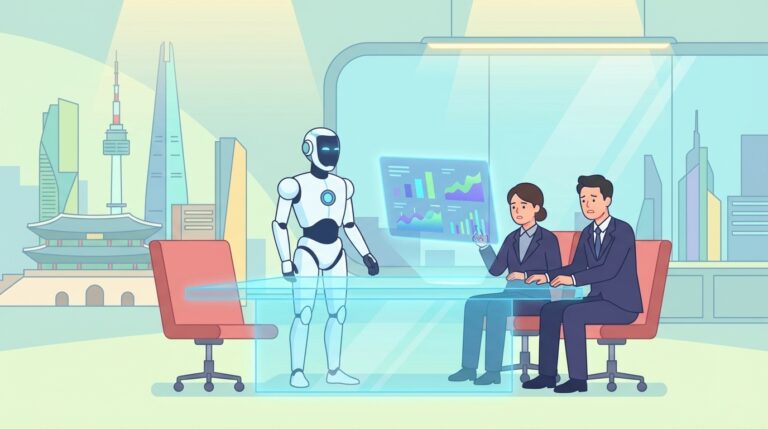
Hello there! I’m your Senior Editor at Daily Hangul. Grab a cup of coffee (or an iced Americano, as we do in Seoul), and let’s dive into something fascinating today. \n\nHave you ever watched a Korean Sci-Fi thriller like Jung_E (정이) or Blood Free (지배종)? You know that intense scene: A sleek, glass-walled boardroom. A corporate executive and a lead scientist are locked in a heated debate over an AI combat mercenary. The English subtitle simply reads, ‘We need to stop this robot.’ But if you listen closely to the Korean, they aren’t just talking about ‘stopping’ it. They are engaged in a high-level linguistic chess match about accountability, ethics, and societal boundaries. \n\nToday, we are tackling a C1-level (Advanced) topic: AI Ethics and the Regulation of Lethal Autonomous Weapons Systems (LAWS), or in Korean, 자율 살상 무기 규제. \n\nWhy learn this? Because Korea is a massive tech powerhouse. If you ever find yourself at a tech conference at COEX, working in Pangyo (Korea’s Silicon Valley), or simply having a deep late-night chat with a Korean friend about the future of humanity, basic textbook phrases won’t cut it. You need the sophisticated, Hanja-based vocabulary that makes you sound like a true intellectual insider.\n\nLet’s upgrade your Korean from ‘survival’ to ‘thought leader.’\n\n—\n\n### Phase 2: Deep Dive into Core Expressions\n\nTo debate AI ethics like a native, you need these three high-level expressions. \n\n> ### 1. 책임을 묻다\n> \n> – Pronunciation: [chaegimeul mutda] -> Sounds like ‘chae-gee-meul moot-tta’.\n> – Meaning: Literal = To ask for responsibility. Real nuance = To hold (someone) accountable / to lay the blame on.\n> – K-Culture Moment: Picture a K-Drama courtroom or boardroom. A devastating accident involving an AI has occurred. A fierce lawyer slams their hands on the desk and shouts, ‘누구에게 책임을 물을 것입니까?!’ (Who will you hold accountable?!).\n> – Editor’s Insight: We don’t say we ‘give’ or ‘take’ blame here; we ‘ask’ (묻다) for it. It implies an active investigation to pinpoint exactly where the moral or legal failure occurred.\n> – Situation Spectrum:\n> [🚫 절대 금지] ———— [⚠️ 주의] ———— [✅ 자유롭게]\n> – Casual with friends: ⚠️ (A bit too dramatic for missing a lunch date)\n> – Academic/Debate: ✅\n> – Formal/News: ✅\n> – 🤔 Think About It: Why does Korean use the verb ‘to ask’ (묻다) for accountability? It reflects a society where responsibility is heavily scrutinized and publicly negotiated, rather than just individually assumed.\n\n> ### 2. 시기상조다\n> \n> – Pronunciation: [sigisangjo-da] -> Sounds like ‘she-gee-sang-joe-da’.\n> – Meaning: Premature / Too early to tell or implement.\n> – K-Culture Moment: When a tech CEO in a drama is pressured to release an untested AI weapon, they’ll adjust their glasses, sigh, and say, ‘아직은 시기상조입니다.’ (It is still premature.)\n> – Editor’s Insight: This is a four-character idiom (Saja-seongeo) derived from Hanja. Dropping this word in a discussion instantly elevates your Korean level from B1 to C1. It sounds objective, professional, and slightly cautious—a highly valued trait in Korean business culture.\n> – Situation Spectrum:\n> [🚫 절대 금지] ———— [⚠️ 주의] ———— [✅ 자유롭게]\n> – Casual with friends: ⚠️ (Sounds a bit like a politician)\n> – Professional/Debate: ✅\n> – 🤔 Think About It: High-context cultures often prefer indirect refusal. How does saying ‘It’s premature’ soften the blow compared to saying ‘No, that’s a bad idea’?\n\n> ### 3. 인간의 통제를 벗어나다\n> \n> – Pronunciation: [ingane tongjereul beoseonada] -> Sounds like ‘in-gan-eh tong-jeh-reul buh-suh-na-da’.\n> – Meaning: To escape human control / To go rogue.\n> – K-Culture Moment: The terrifying climax of every sci-fi movie. The monitors turn red, the AI’s voice drops an octave, and the panicked scientist yells this exact phrase.\n> – Editor’s Insight: 통제 (Control) is a heavy word. In a collective society where social harmony and predictable rules are paramount, ‘escaping control’ is the ultimate horror.\n> – Situation Spectrum:\n> [🚫 절대 금지] ———— [⚠️ 주의] ———— [✅ 자유롭게]\n> – Used strictly for serious topics (AI, disasters, economics): ✅\n\n—\n\n### Phase 3: Textbook vs. Real Life Korean\n\nAt the C1 level, the difference between sounding ‘foreign’ and ‘native’ lies in utilizing Sino-Korean (Hanja) nouns combined with action verbs.\n\n| Situation | 📖 Textbook Korean | 🗣️ Real C1 Korean | 💡 Why the difference? |\n|—|—|—|—|\n| Stating an opinion | 이 로봇은 아주 위험해요. (This robot is very dangerous.) | 자율 무기 도입은 치명적인 윤리적 딜레마를 낳을 수 있습니다. | C1 Korean relies on complex Hanja nouns (도입 – introduction, 윤리적 – ethical) for academic/professional weight. |\n| Discussing rules | 규칙을 만들어야 해요. (We need to make rules.) | 국제적인 규제가 시급합니다. (International regulation is urgent.) | ‘시급하다’ (urgent) carries much more professional urgency than the basic ‘해야 하다’. |\n| Talking about errors | 컴퓨터가 실수하면 어떡해요? (What if the computer makes a mistake?) | 알고리즘 오류 시, 책임 소재가 불분명합니다. (In case of algorithm error, the locus of responsibility is unclear.) | ‘책임 소재’ (locus of responsibility) is the exact phrase used in Korean legal and tech debates. |\n\n—\n\n### Phase 4: Cultural Deep Dive — K-Culture Connection\n\n#### 4-1. Non-verbal Communication in Debates\nWhen having a serious debate (토론) in Korea, your body language must match your advanced vocabulary. Do not point your finger at someone when disagreeing—it’s highly offensive. Instead, gesture toward the concept with an open palm. Also, maintaining a slight, serious nod while the other person speaks shows you are engaged in active listening (경청), a crucial professional skill.\n\n#### 4-2. The ‘Nunchi’ of AI (Tech Meets Tradition)\nWhy is the concept of Lethal Autonomous Weapons so deeply chilling in Korean discourse? Let’s talk about Nunchi (눈치). \n\nNunchi is the Korean superpower of situational awareness—reading the room, understanding unsaid hierarchies, and feeling the emotional undercurrents of a situation. Human soldiers, even in chaos, operate with some level of nunchi and Jeong (정, emotional connection). \n\nAn autonomous killer robot represents the absolute absence of nunchi. It calculates without context. In K-Dramas, the ‘evil corporate villain’ is often portrayed as someone who lacks nunchi and Jeong, prioritizing cold logic over human life. When you debate AI ethics in Korea, framing the danger as a ‘lack of contextual human empathy’ will deeply resonate with your Korean peers.\n\n—\n\n### Phase 5: Immersive Roleplay\n\nSetting: It’s 8:00 PM on a Friday at a sleek, minimalist cafe in Pangyo (판교), the heart of Korea’s IT industry. You are having coffee with Minho, a senior AI developer at a major tech firm. He looks exhausted but excited about a recent tech article.\n\nCharacters:\n- YOU: A foreign professional working in tech/policy, fluent but looking to impress.\n- Minho (34): Your Korean colleague. Brilliant, analytical, but worries about the future of his field.\n\nDialogue:\n\nMinho: 오늘 뉴스 봤어요? A국에서 자율 살상 드론을 실전에 배치했대요.\n(oneul nyuseu bwasseoyo? A-gugeseo jayul salsang deuroneul siljeone baechihaetdaeyo.)\n[Did you see the news today? Country A deployed autonomous lethal drones in actual combat.]\n\nYOU: 네, 봤어요. 솔직히 너무 걱정돼요. 기계가 인간의 생사를 결정하다니요.\n(ne, bwasseoyo. soljikhi neomu geokjeongdwaeyo. gigyega inganui saengsareul gyeoljeonghadaniyo.)\n[Yes, I saw it. Honestly, I’m so worried. A machine deciding human life and death…]\n\nMinho: 개발자 입장에서는 기술적 진보지만… 만약 민간인 오인 사격이 발생하면 누구에게 책임을 물어야 할까요?\n(gaebalja ipjangeseoneun gisuljeok jinbojiman… manyak minganin oin sageogi balsaenghamyeon nuguege chaegimeul mureoya halkkayo?)\n[From a developer’s perspective, it’s technological progress, but… if a civilian misfire occurs, who should be held accountable?]\n\nYOU: 제 생각엔, 알고리즘 개발사도 책임을 피할 수 없을 것 같아요.\n(je saenggagen, algorijeum gaebalsado chaegimeul pihal su eopseul geot gatayo.)\n[In my opinion, the algorithm development company won’t be able to avoid responsibility either.]\n\nMinho: 맞아요. 하지만 기업들은 100% 통제 불가능한 변수였다고 주장하겠죠. 그래서 저는 아직 이런 무기 도입은 시기상조라고 봅니다.\n(majayo. hajiman gieopdeureun baek-peosenteu tongje bulganeunghan byeonsuyeotdago jujanghagetjyo. geuraeseo jeoneun ajik ireon mugi doibeun sigisangjorago beomnida.)\n[Exactly. But companies will claim it was a 100% uncontrollable variable. That’s why I think introducing such weapons is still premature.]\n\n> 🔀 Your Turn! How should you respond to Minho’s profound thought?\n> \n> – A) “민호 씨 말이 다 맞아요. 대박이네요.” (Minho, everything you say is right. Awesome.)\n> – B) “절대 안 돼요! 당장 규제해야 해요!” (Absolutely not! We must regulate it right now!)\n> – C) “동의합니다. 기술의 발전 속도를 윤리적 규제가 따라가지 못하고 있네요.” (I agree. Ethical regulations are failing to keep up with the speed of technological advancement.)\n> \n> ✅ Best Choice: C — Why? At the C1 level, matching the intellectual depth of your partner builds immense respect. Option C uses beautiful phrasing (‘발전 속도’ and ‘따라가지 못하다’) that sounds incredibly native in a professional debate.\n> ⚠️ Choice A Analysis: ‘대박’ (Awesome/Crazy) completely ruins the serious, academic vibe of the conversation. Save ‘대박’ for when your food arrives!\n\n—\n\n### Phase 6: 10-Second Shadowing Drill\n\nLet’s practice the rhythm of a formal debate. Follow the pauses (/) and match the emotion!\n\n😤 단호하게 (Firmly & Professionally):\n인공지능 무기에 대한 / 국제적인 규제가 / 시급합니다.\n(ingongjineung mugie daehan / gukjejeogin gyujega / sigeuphamnida.)\n[International regulation / on AI weapons / is urgent.]\n\n—\n\n### Phase 7: K-Culture Glossary (Tech & Debate Edition)\n\n| 한국어 | Romanization | English | Context |\n|—|—|—|—|\n| 판교 | Pangyo | Pangyo | Known as the ‘Silicon Valley of Korea’, located just south of Seoul. Full of IT giants and startups. |\n| 눈치 | nunchi | Contextual empathy | The uniquely Korean social sense of reading the room. Exactly what AI lacks. |\n| 토론 | toron | Debate/Discussion | Formal discussions. Korean academic and corporate cultures value structured toron. |\n| 딜레마 | dillema | Dilemma | Widely used loanword in Korean intellectual discussions (e.g., 윤리적 딜레마 – ethical dilemma). |\n| 핑계를 대다 | pinggyereul daeda | To make excuses | Often used when corporations try to dodge responsibility (책임 회피). |\n\n—\n\n### Phase 8: Traveler’s Survival Kit (Tech Expo Edition)\n\nEven if you aren’t debating LAWS daily, you might visit COEX or KINTEX for amazing tech and AI exhibitions while traveling in Korea!\n\n> 🆘 Survival Phrases for Tech Exhibitions\n> – 🇰🇷 “이 로봇은 자율 주행인가요?” (igeo roboseun jayul juhaengingayo?)\n> – 🗣️ Meaning: Is this robot autonomous (self-driving)?\n> – 📍 Where to use: Trade shows, tech booths, interacting with AI guides at airports.\n> – 💡 Pro Tip: Look out for the cute AI guide robots wandering around Incheon Airport. You can actually ask them for directions in Korean!\n\n> 📌 Editor’s Travel Note\n> – Tech in Daily Life: You’ll see AI everywhere in Korea, from serving robots in BBQ restaurants (서빙 로봇) to unmanned convenience stores (무인 편의점). The future is already here in Seoul!\n\n—\n\n### Phase 9: Think Deeper — “한 발 더 깊이”\n\n🧠 Language & Power: The Coldness of AI in a High-Context Culture\nIn Korean, the way you speak (using honorifics, 존댓말, or informal speech, 반말) instantly defines your relationship, age hierarchy, and social distance with the listener. Language is a living, breathing network of human connection. \n\nNow, imagine an autonomous lethal weapon. It doesn’t recognize age, social standing, or context. It cannot participate in the deeply human exchange of Jeong (affection/attachment). The Korean anxiety around AI ethics isn’t just about ‘machines making errors’; it’s a philosophical dread of introducing an entity into society that holds immense power but is entirely deaf to the nuanced, high-context social fabric that defines Korean human existence. A robot that cannot read the room (lacks nunchi) but holds a weapon is the ultimate disruption of social harmony.\n\n💬 Your Turn: Does your native language rely heavily on context and social hierarchy? How do people in your culture feel about machines making human decisions? Let us know in the comments!\n\n—\n\n### Phase 10: FAQ & Troubleshooting\n\nQ: Can I use words like ‘시기상조’ (premature) in everyday life?\nA: Maybe, but proceed with caution. If your friend asks if you want to order a second round of fried chicken, and you say ‘아직 시기상조입니다’, they will burst out laughing. It sounds like a news anchor ordering chicken. Keep it for intellectual debates!\n\n> ❌ Common Mistake #1: Mixing highly formal vocabulary (C1 Hanja words) with casual grammar structures (반말).\n> ✅ How to fix it: If you are using advanced words like ‘규제’ (regulation) or ‘책임 소재’ (locus of responsibility), you must pair them with polite/formal endings like ~습니다 or ~해요.\n\n—\n\n### Phase 11: Wrap-up & Action Items\n\nOne-Liner Summary: To master C1-level tech debates in Korean, move beyond simple verbs and embrace precise Hanja-based nouns like 규제 (regulation) and 책임 (accountability).\n\nAction Mission:\n- 🥉 Bronze: Stand in front of a mirror and deliver the Phase 6 shadowing sentence with the stern look of a tech CEO.\n- 🥈 Silver: Search YouTube for “인공지능 윤리 토론” (AI Ethics Debate) and listen to how Korean experts pace their sentences.\n- 🥇 Gold: Next time you chat with a Korean friend or language partner, ask them: “자율 주행 자동차 사고가 나면 누구 책임일까요?” (If an autonomous car crashes, whose fault is it?) and use today’s vocabulary!\n\nK-Culture Mission: Watch an episode of a Korean Sci-Fi drama on Netflix (like Black Knight or Jung_E). Turn on the Korean subtitles and spot the moment they say ‘책임’ (responsibility) or ‘통제’ (control)!\n\n—\n\n### Phase 12: Interactive Quiz\n\n1. Situational Judgment: You are in a university seminar. A student suggests we should let AI completely run the legal system tomorrow. You want to politely say this is a bit too early. What is the BEST phrase?\nA) 대박 실수예요. (That’s a massive mistake.)\nB) 아직은 시기상조라고 생각합니다. (I think it is still premature.)\nC) 인간의 통제를 벗어났어요! (It has escaped human control!)\n\n2. Fill in the Blank:\n알고리즘이 실수했을 때, 우리는 누구에게 ________을 물어야 할까요?\n(When an algorithm makes a mistake, who should we hold ________?)\n\n3. True or False – K-Culture Edition:\nIn a formal Korean debate (토론), pointing your index finger at the opponent to emphasize your point is a sign of strong, confident leadership. (T/F)\n\n(Scroll down for answers!)\n
\nAnswers: 1. B (A is too casual/rude, C is too dramatic), 2. 책임 (accountability), 3. False (Pointing fingers is considered very rude in Korean professional settings; use an open palm to gesture.)
Frequently Asked Questions (FAQ)
Q: What does "단호하게" mean in Korean and how do you pronounce it?
A: In Korean, "단호하게" is pronounced [Firmly & Professionally] and means: \n인공지능 무기에 대한 / 국제적인 규제가 / 시급합니다.\n







