

Phase 1: Immersive Hook
Hello! I am your Daily Hangul Editor.
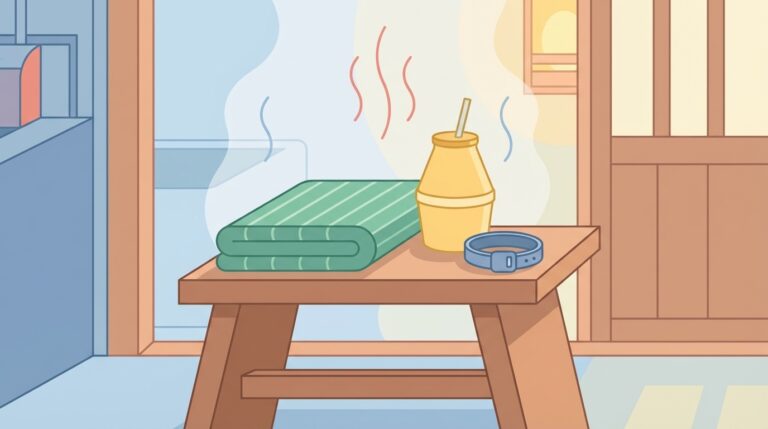
Imagine this: You are watching a K-Drama. The main character goes to a public bathhouse after a tough breakup or a long day at work. You see them lying on a waterproof table while a lady (or man) in black underwear vigorously scrubs them with a brightly colored towel. Then, they emerge glowing, drinking a little yellow bottle of milk.
Welcome to the world of Jjimjilbang (찜질방) and the legendary Korean body scrub, known as Seshin (세신)!
Many foreigners visit a Korean bathhouse but are too intimidated to try the body scrub. I get it! Lying completely naked while a stranger scrubs you like a dirty potato can be terrifying. But trust me, once you get past the initial shock, your skin will feel as soft as a baby’s.
Today, we are going to learn exactly what to say to survive—and enjoy—your first Korean body scrub. This guide is based on real panic moments from my foreign students!
Phase 2: Deep Dive into Core Expressions
Let’s learn the survival phrases you need when you are on that scrub table.
1. 때 밀어 주세요 (Please give me a body scrub)
- Pronunciation: ttae mi-reo ju-se-yo [Sounds like: ttay (strong ‘t’) + me-row ju-say-yo]
- Meaning: Literal: Please push the dirt. / Real nuance: I would like a body scrub, please.
- K-Culture Moment: You walk into the wet sauna area. You see the scrub master. You walk up to them and say this magic phrase to book your spot.
- Editor’s Insight: The word 때 (ttae) literally means dead skin cells or dirt on the body. We don’t say ‘wash’, we say ‘push’ (밀다) because they literally push the dead skin off your body!
- Situation Spectrum:
[🚫 Do Not Use] ———— [⚠️ Caution] ———— [✅ Feel Free]
- To the Scrub Master: ✅
- To a friend (asking them to scrub your back): ✅
- To a coworker: 🚫 (Please, no!)
- 🤔 Think About It: Why do Koreans use the word “주세요” (please give me) for a physical service? In Korean, offering a service is seen as giving a favor, so we ask them to “give” the action!
2. 살살 해 주세요 (Please do it gently)
- Pronunciation: sal-sal hae ju-se-yo [Sounds like whispering: sal-sal heh ju-say-yo]
- Meaning: Literal: Please do it softly. / Real nuance: Please don’t scrub my skin off!
- K-Culture Moment: The scrub master starts, and it feels like sandpaper. You need to say this immediately before you turn red!
- Editor’s Insight: 살살 (sal-sal) is a cute mimetic word that mimics a gentle, soft motion. If you don’t say this, the scrub master will use their default strength, which is usually very strong!
- Situation Spectrum:
[🚫 Do Not Use] ———— [⚠️ Caution] ———— [✅ Feel Free]
- To the Scrub Master: ✅
- Getting a massage: ✅
- 🤔 Think About It: Korean has many repetitive words that describe sound or motion (like sal-sal). Does your language have words that sound like the action they describe?
3. 아파요 (It hurts)
- Pronunciation: a-pa-yo [Sounds like: ah-pah-yo]
- Meaning: Literal & Real: It hurts / Ouch!
- K-Culture Moment: Not just for the bathhouse! Use this at the doctor, when eating something too spicy, or when you stub your toe.
- Editor’s Insight: It’s a polite but direct way to express pain. Don’t try to endure the pain at the bathhouse to look strong. Just say “아파요!”
- Situation Spectrum:
[🚫 Do Not Use] ———— [⚠️ Caution] ———— [✅ Feel Free]
- Anytime you feel pain: ✅
Phase 3: Textbook vs Real Life
| Situation | 📖 Textbook Korean | 🗣️ Real Korean | 💡 Why the difference? |
|---|---|---|---|
| Booking a scrub | 목욕탕에서 때를 밀고 싶습니다. (I want to scrub my body at the bathhouse.) | 이모님, 때 밀어주세요! (Auntie, please scrub me!) | Koreans use family titles like “이모님” (Auntie) to show friendliness and respect to service workers. |
| It’s too strong | 너무 강하게 밀지 마세요. (Please do not scrub too strongly.) | 아, 이모님! 살살요! (Ah, Auntie! Gently!) | In moments of pain, shorter is better! Adding ‘요’ to ‘살살’ makes it instantly polite. |
Phase 4: Cultural Deep Dive
4-1. Non-verbal Communication: The Art of the “Flip”
When you get a scrub, you don’t need to do much. In fact, doing less is better! Just lie completely still like a starfish.
Here is where Korean Nunchi (눈치) comes in: The scrub master will not say “Please turn over.” They will simply tap your shoulder or thigh twice. Tap, tap. That is your cue to roll over! Don’t try to lift your arms or help them. Just relax and let them move you like a dough.
4-2. K-Food Connection: The Holy Grail of Bathing
If you watch K-Dramas, you know what happens right after the body scrub. You walk out of the wet sauna, your skin is glowing, and you go straight to the convenience store inside the Jjimjilbang to buy 바나나맛 우유 (Banana-flavored milk).
Why? Because after sweating in the hot tub and losing dead skin, your body craves sugar and hydration. Drinking that ice-cold, sweet banana milk with a straw while sitting in front of a fan is the ultimate Korean healing experience. It’s an unwritten cultural rule!
Phase 5: Immersive Roleplay
Setting: Saturday morning. You are inside the humid, echoey wet sauna of a famous Jjimjilbang in Seoul. You booked a scrub, and the Seshinsa (Scrub Master, usually referred to as Imo-nim) waves at you to come over to her table.
Characters:
– YOU: A brave foreigner trying a body scrub for the first time.
– Imo-nim (Scrub Master): A tough but caring Korean lady in her 50s, wearing black undergarments and holding a green Italian towel.
Dialogue:
Imo-nim: 이리 와요! 누우세요. 🛏️
(Iri wayo! Nu-u-se-yo.)
(Come here! Lie down.)
(🎭 Stage Direction: She splashes warm water on the vinyl table.)
YOU: 네, 안녕하세요. 때 밀어 주세요.
(Ne, annyeonghaseyo. Ttae mi-reo ju-se-yo.)
(Yes, hello. Please give me a body scrub.)
Imo-nim: (Starts scrubbing your arm vigorously) 때가 많네~ 시원하죠?
(Ttaega manne~ Siwonhajyo?)
(You have a lot of dead skin~ Feels refreshing, right?)
YOU: (It feels like sandpaper!) 으악…
(Eu-ak…)
(Ack…)
🔀 Your Turn! How should you respond?
– A) “아니요, 안 시원해요.” (No, it’s not refreshing.)
– B) “이모님, 너무 아파요. 살살 해 주세요.” (Auntie, it hurts too much. Please do it gently.)
– C) “도와주세요!” (Help me!)✅ Best Choice: B — It communicates clearly that you are in pain but asks politely for an adjustment.
⚠️ Choice A & C Analysis: Choice A sounds a bit rude and kills the mood. Choice C sounds like you are being kidnapped!
Imo-nim: 아유, 미안해요. 외국인이라 피부가 약하네. 살살 할게요.
(Ayu, mianhaeyo. Oeguginira pibuga yakhane. Sal-sal halgeyo.)
(Oh my, I’m sorry. Your skin is sensitive because you’re a foreigner. I’ll do it gently.)
(🎭 Stage Direction: She softens her scrubbing, and suddenly it feels like a great massage.)
Imo-nim: (Tap, tap on your shoulder)
YOU: (You remember your Nunchi! You roll over onto your stomach.)
Phase 6: 10-Second Shadowing Drill
Practice this before you enter the sauna! Pay attention to the pauses(/) and the emotion.
🥺 이모님, / 살살 / 해 주세요!
(Imo-nim, / sal-sal / hae ju-se-yo!)
Emotion: Pleading slightly, with a friendly smile.
🥵 앗, / 조금 / 아파요.
(At, / jogeum / a-pa-yo.)
Emotion: Wincing a little bit, keeping it polite.
Phase 7: K-Culture Glossary
| Korean | Romanization | English | Context |
|---|---|---|---|
| 때 | ttae | Dead skin/dirt | The whole reason you are getting scrubbed. |
| 세신사 | seshinsa | Scrub Master | The official professional title of the person scrubbing you. |
| 이모님 | imo-nim | Auntie | A polite, affectionate term for middle-aged female service workers. |
| 바나나맛 우유 | bananamat uyu | Banana milk | The mandatory post-scrub drink. |
| 이태리 타월 | itaeri tawol | Italian Towel | The abrasive green or pink towel used for scrubbing. (Fun fact: It was invented in Korea, using fabric imported from Italy!) |
Phase 8: Traveler’s Survival Kit
🆘 Survival Expression #1: Locating the Sauna
– 🇰🇷 “사우나 어디예요?” (sauna eodiyeyo?)
– 🗣️ Sounds like: sah-oo-nah uh-dee-yay-yo?
– 📍 Where to use: At the front desk when you get your locker key.🆘 Survival Expression #2: Buying the Milk
– 🇰🇷 “바나나 우유 하나 주세요.” (banana uyu hana juseyo.)
– 🗣️ Sounds like: ba-na-na oo-yoo ha-na ju-say-yo.
– 📍 Where to use: At the snack bar (매점) inside the Jjimjilbang.
📌 Editor’s Travel Note:
– The Magic Key: When you enter a Jjimjilbang, you get a bracelet with a key. This key opens your locker, but it’s also your credit card inside! You tap the key to buy food, drinks, or pay for the body scrub. You settle the final bill at the front desk when you leave.
– Cash Tip? Tipping is NOT a culture in Korea. Do not try to tip the scrub master, it will cause confusion!
Phase 9: Think Deeper — “One Step Further”
🧠 Think Deeper: Body, Space, and Identity
Have you ever noticed a paradox in Korean culture? On the streets of Seoul, people dress very modestly. Showing shoulders or cleavage is often frowned upon. Yet, inside the Jjimjilbang, Koreans walk around completely naked with total strangers, chatting about politics or TV shows as if they were fully clothed in a cafe. The public bathhouse strips away social status. When everyone is naked, there are no CEOs or entry-level workers—just people enjoying the hot water. It represents a unique communal intimacy (Jeong, 정) in Korean society.
💬 Your Turn: How does your culture view public bathing or communal nakedness? Would a Jjimjilbang be popular in your home country? Share in the comments!
Phase 10: FAQ & Troubleshooting
Q: Can I wear a swimsuit in the wet sauna area?
NO. This is the number one mistake tourists make! The wet bathing area is strictly naked, separated by gender. Wearing a swimsuit is considered unhygienic because it brings outside dirt into the clean water.
Q: How do I book the scrub?
Usually, you walk into the wet sauna area and look for the scrub tables. Make eye contact with the worker and say, “때 밀어 주세요!” They will point to a clock and tell you a time (e.g., “Come back in 10 minutes”).
❌ Common Mistake #1: Scrubbing yourself too hard with the green towel before the professional does it. You will ruin your skin!
✅ Do This Instead: Just soak in the hot tub (탕) for 15-20 minutes to soften your skin, then go to the scrub master.
Phase 11: Wrap-up & Action Items
One-Liner Summary: To survive a Korean body scrub, politely ask them to “push your dead skin” (때 밀어 주세요) and beg them to do it “gently” (살살 해 주세요)!
Action Mission 3 Steps:
– 🥉 Bronze (Solo): Say “아파요! 살살 해 주세요” to yourself next time you take a hot shower.
– 🥈 Silver (Online): Find a YouTube vlog of a foreigner trying a Jjimjilbang and leave a comment identifying the green towel (이태리 타월).
– 🥇 Gold (Real Life): Visit a Jjimjilbang in Korea (or your local Koreatown), book a scrub, and use these exact phrases!
K-Culture Mission:
Go to a Korean grocery store and buy a bottle of 바나나맛 우유 (Banana milk). Drink it while imagining you just survived the most refreshing body scrub of your life!
Phase 12: Interactive Quiz
1. You are on the scrub table. The lady taps your shoulder twice. What should you do?
A) Say “Hello!”
B) Roll over like a pancake.
C) Grab the towel and help her scrub.
2. Fill in the blank: The water is too hot, and the scrub is too rough! “이모님, 너무 아파요. ____ 해 주세요!”
A) 빨리 (Fast)
B) 많이 (A lot)
C) 살살 (Gently)
3. True or False: You should bring cash into the wet sauna to pay the scrub master.
(Answers below!)
Click here for answers
1. B – The “tap tap” is the non-verbal cue to flip over.
2. C – 살살 (sal-sal) means gently.
3. False – You tap your locker key bracelet to pay, and settle the bill at the front desk when leaving!
Frequently Asked Questions (FAQ)
Q: What does "때 밀어 주세요 (Please give me a body scrub)" mean in Korean and how do you pronounce it?
A: In Korean, "때 밀어 주세요 (Please give me a body scrub)" is pronounced [ttae mi-reo ju-se-yo [Sounds like: ttay (strong 't'] and means: Literal: Please push the dirt. / Real nuance: I would like a body scrub, please.
Q: What does "살살 해 주세요 (Please do it gently)" mean in Korean and how do you pronounce it?
A: In Korean, "살살 해 주세요 (Please do it gently)" is pronounced [sal-sal hae ju-se-yo [Sounds like whispering: sal-sal heh ju-say-yo] and means: Literal: Please do it softly. / Real nuance: Please don't scrub my skin off!
Q: What does "아파요 (It hurts)" mean in Korean and how do you pronounce it?
A: In Korean, "아파요 (It hurts)" is pronounced [a-pa-yo [Sounds like: ah-pah-yo] and means: Literal & Real: It hurts / Ouch!







