

Don’t Be ‘That Guy’ at a Korean Musical: The Ultimate C1 Guide to Seoul’s Broadway Culture 🎭
Hello, language enthusiasts! This is your Lead Editor at Daily Hangul.
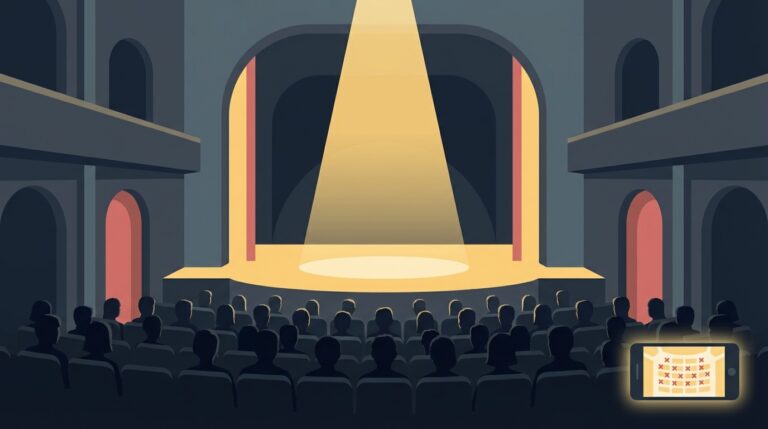
Imagine this: The lights dim at the magnificent Charlotte Theater in Seoul. You’ve managed to snag a ticket to the Korean production of Chicago or The Phantom of the Opera. As the overture begins, you shift in your seat to get comfortable. Suddenly, you feel a piercing glare from the person next to you. You haven’t said a word, but you’ve already committed a cardinal sin in the Korean theatre world.
While Seoul is a global hub for licensed Broadway and West End musicals, the theatre culture here is vastly different from New York or London. It’s intense, highly organized, and comes with a whole dictionary of advanced slang. If you want to survive ‘Korean Broadway’ (often centered around Daehakro and major mega-theaters) and impress your Korean friends, textbooks won’t help you here. Today, we are diving deep into the C1-level vocabulary of the Yeon-myu-deok (연뮤덕 – Theatre and Musical nerds).
Let’s pull back the curtain on the real Korean musical vocabulary!
Phase 2: Core Expressions Deep Dive 🕵️♀️
If you want to sound like a true Seoul local discussing the latest West End import, these are the three expressions you must master.
1. 피켓팅 (Piketting)
- Pronunciation: [pi-ket-ting] Sounds like ‘pea-ket-ting’. Emphasize the strong ‘P’ and tight ‘T’.
- Meaning: Blood Ticketing (Fierce competition to buy tickets)
- K-Culture Moment: When a famous K-Pop idol or a legendary musical actor (like Cho Seung-woo) is cast as the lead in Jekyll & Hyde, the server crashes within 0.1 seconds. Fans go to PC Bangs (internet cafes) just to get a faster ping rate.
- Editor’s Insight: This is a portmanteau of ‘피’ (pi – blood) and ‘티켓팅’ (ticket-ing). It captures the sheer desperation and battlefield-like atmosphere of trying to secure a seat.
- Situation Spectrum:
[🚫 Taboo] ———— [⚠️ Caution] ———— [✅ Go Wild]
- Close Friends (Casual): ✅ “오늘 피켓팅 무조건 성공해야 돼!”
- Colleagues (Semi-formal): ✅ “이번 뮤지컬은 피켓팅이라 구하기 힘드네요.”
- Boss/Elders (Formal): ⚠️ (Too slangy for highly formal settings, but acceptable in casual office small talk)
- 🤔 Think About It: Korea boasts some of the fastest internet speeds in the world, which naturally birthed a ‘first-come, first-served’ digital culture. Does your country have a similar concept for hyper-competitive ticket sales?
2. 이선좌 (I-seon-jwa)
- Pronunciation: [i-seon-jwa] Smooth and connected, sounds like ‘E-sun-jwa’.
- Meaning: Literal: “This seat is already selected.” / Real Nuance: “You failed, try another seat before it’s too late!”
- K-Culture Moment: You are staring at the ticketing screen. You see a VIP seat (a purple pixel). You click it with lightning speed. A pop-up appears: “이미 선택된 좌석입니다” (This seat is already selected). By the time you close the pop-up, the entire map is grey (sold out).
- Editor’s Insight: It’s an abbreviation of 이미 선택된 좌석입니다. It is the most traumatic acronym for any K-Culture fan, whether for Broadway musicals in Seoul or BTS concerts.
- Situation Spectrum:
[🚫 Taboo] ———— [⚠️ Caution] ———— [✅ Go Wild]
- Close Friends (Casual): ✅ “아, 또 이선좌 맞았어!”
- Colleagues (Semi-formal): ⚠️ (Only if they are also fans)
- Boss/Elders (Formal): 🚫 (They won’t understand the abbreviation)
- 🤔 Think About It: Koreans love shortening phrases (줄임말) for efficiency. How does this reflect the Pali-pali (hurry up) culture?
3. 관크 (Gwan-keu)
- Pronunciation: [gwan-keu] The ‘eu’ sounds like the disgusted sound you make when stepping in gum.
- Meaning: Literal: Audience Critical. / Real Nuance: An annoying audience member who ruins the show.
- K-Culture Moment: You are watching a heartbreaking scene in Les Misérables. The person next to you opens a crinkly candy wrapper, or their Apple Watch lights up. After the show, Korean fans will vent on Twitter: “오늘 내 옆자리 관크 대박이었음” (The ‘gwan-keu’ next to me was unbelievable today).
- Editor’s Insight: A mix of 관객 (Audience) + 크리티컬 (Critical, from gaming terminology for a ‘critical hit’). It means someone critically damaged your viewing experience.
- Situation Spectrum:
[🚫 Taboo] ———— [⚠️ Caution] ———— [✅ Go Wild]
- Close Friends (Casual): ✅
- Colleagues (Semi-formal): ✅
- Boss/Elders (Formal): 🚫
- 🤔 Think About It: In Broadway, audiences might cheer mid-song. In Korea, absolute silence is demanded. Why is communal harmony and not inconveniencing others taken to such an extreme here?
Phase 3: Textbook vs Real Life 📖🗣️
| Situation | 📖 Textbook Korean | 🗣️ Real C1 Korean | 💡 Why the difference? |
|---|---|---|---|
| Buying a ticket is hard | 표를 사기 정말 어렵습니다. | 완전 피켓팅이야. | Slang accurately captures the emotional distress of the process. |
| Watching a show multiple times | 이 공연을 여러 번 봤습니다. | 이 극 회전문 도는 중이에요. | ‘회전문’ (revolving door) perfectly visualizes a fan going in and out of the theater daily. |
| The person next to me was annoying | 옆 사람의 매너가 안 좋았습니다. | 오늘 옆자리 관크 오졌어. | Internet gaming slang easily bleeds into fandom culture for dramatic effect. |
(Bottom Note: As C1 learners, using phrases like ‘회전문 돌다’ will immediately signal to Koreans that you possess deep, native-level cultural fluency!)
Phase 4: Cultural Deep Dive — The ‘Corpse Viewing’ Phenomenon 🧟♂️🎭
4-1. Non-verbal Communication: The Art of Absolute Stillness
If you take away one thing from this lesson, let it be this: 시체관극 (Si-che-gwan-geuk).
Literally translating to “Corpse Viewing,” this is the unwritten law of Korean musical theatre. While West End audiences might sip wine or lean over to whisper to a friend during Wicked, doing so in Seoul will result in intense Nunchi (social pressure).
You are expected to sit completely still—like a corpse—so you don’t block anyone’s view or distract them. Do not lean forward (known as 수그리 – su-geu-ri, which blocks the view of the person behind you).
4-2. K-Culture Connection: K-Pop meets West End
Why is the Korean musical market booming? Because of Idol Casting.
When a popular K-Pop idol is cast as the lead in a Broadway adaptation, their entire fandom mobilizes. This merges K-Pop’s fierce loyalty with traditional theatre. Fans will buy tickets for all 30 of their idol’s performances (회전문 도는 중). They will wait outside the stage door for the 퇴근길 (Toe-geun-gil – the path home) to wave to the actor.
However, this also creates friction. Traditional theatre buffs sometimes criticize idol fans for bringing concert etiquette into the silent, sacred space of the musical theater. It’s a fascinating cultural collision!
Phase 5: Immersive Roleplay Scenario 🎬
Scenario A: The Intermission Crisis
Setting: Friday night, 9:00 PM. Intermission at the Blue Square Theater. You and your Korean colleague, Minsu, just finished watching the first act of Chicago.
Characters:
– YOU: A foreign expat working in Seoul, excited for your first Korean musical.
– Minsu (32): Your Korean coworker and a massive Yeon-myu-deok.
Minsu: 아, 진짜 짜증나. 내 뒤에 앉은 사람 완전 관크야.
(A, jinjja jjajeungna. Nae dwie anjeun saram wanjeon gwankeunya.)
Ugh, so annoying. The person sitting behind me is a total gwan-keu.
(🎭 Stage Direction: Minsu aggressively drinks his bottled water, looking stressed.)
YOU: 왜요? 계속 발로 찼어요?
(Waeyo? Gyesok ballo chaseoyo?)
Why? Did they keep kicking your seat?
Minsu: 네, 패딩 부스럭거리는 소리에, 발로 차고… 집중이 하나도 안 됐어요.
(Ne, paeding buseureokgeorineun sorie, ballo chago… jipjungi hanado an dwaesseoyo.)
Yeah, the rustling sound of their puffer jacket, the kicking… I couldn’t focus at all.
🔀 Your Turn! How should you respond?
– A) “제가 가서 화내고 올게요!” (I’ll go yell at them!)
– B) “어셔(하우스 어텐던트)한테 말해볼까요?” (Should we talk to the usher?)
– C) “그냥 참으세요. 원래 그런 사람 많아요.” (Just endure it. There are lots of people like that.)✅ Best Choice: B — Reason: In Korea, direct confrontation is highly frowned upon (disrupts social harmony/Nunchi). The socially acceptable and most effective method is to ask the official staff (어셔 – ushers) to intervene.
⚠️ Choice A Analysis: Too aggressive for Korean conflict resolution norms. You might cause a bigger scene, making Minsu more uncomfortable.
Bonus Scenario B: The Blood Ticketing Trauma
(You and a friend are at a PC Bang, trying to buy tickets for The Phantom of the Opera.)
Friend: 헐! 나 앞자리 포도알(VIP석) 눌렀어!
(Heol! Na apjari podo-al nulleosseo!)
Omg! I clicked the grape (VIP seat/purple dot) in the front row!
YOU: 대박! 결제 넘어갔어?
(Daebak! Gyeolje neomeogasseo?)
Awesome! Did it go to the payment page?
Friend: 아니… 이선좌 떴어. 나 그냥 회전문 포기할래.
(Ani… I-seon-jwa tteosseo. Na geunyang hoejeonmun pogihallae.)
No… I got ‘i-seon-jwa’. I’m just going to give up on watching this multiple times.
Phase 6: 10-Second Shadowing Drill 🗣️⏱️
Let’s practice the frustration of failing to get a ticket! Follow the emotion tags.
😤 아, / 또 이선좌야! / 내 자리 / 하나쯤은 / 있어야 되는 거 아니야?
(Ah, / tto i-seon-jwa-ya! / nae jari / hana-jjeum-eun / isseo-ya doeneun geo a-ni-ya?)
(Ugh, / it’s ‘i-seon-jwa’ again! / Shouldn’t there be / at least one seat / for me?)
Pro-Tip: Emphasize the “또” (again) with pure annoyance, and raise your pitch at the end of “아니야?”
Phase 7: K-Culture Glossary (Musical Edition) 📚
| Korean | Romanization | English | Context |
|---|---|---|---|
| 연뮤덕 | yeon-myu-deok | Theatre/Musical Nerd | A devoted fan of plays (연극) and musicals (뮤지컬). |
| 포도알 | podo-al | Grape (VIP Seat) | VIP seats on Interpark Ticket are colored purple, resembling grapes. |
| 페어 | pe-eo | Cast Pair | Shows run for months, so multiple actors play the same role. Fans choose specific combinations (pairs). |
| 시체관극 | siche-gwanggeuk | Corpse Viewing | The strict etiquette of sitting completely motionless and silent during a show. |
| 막공 | mak-gong | Final Performance | The absolute last show of the season. Tickets for this are the hardest to get. |
Phase 8: Traveler’s Survival Kit 🎒
Heading to a musical in Seoul? Save these phrases!
🆘 Survival Phrases for the Box Office
– 🇰🇷 “예매 내역 보여드릴게요.” (Yemae naeyeok boyeodeurilgeyo.)
– 🗣️ English: I will show you my reservation details.
– 🇰🇷 “오페라 글라스 대여 되나요?” (O-pe-ra geul-la-seu daeyeo doenayo?)
– 🗣️ English: Can I rent opera glasses? (Highly recommended for large venues!)
– 🇰🇷 “오늘 커튼콜 촬영 가능한가요?” (Oneul keoteunkol chwaryeong ganeunghangayo?)
– 🗣️ English: Is curtain call photography allowed today?📌 Editor’s Travel Note
– Lateness is Fatal: Korean theaters have incredibly strict “지연 관객 입장” (latecomer entry) rules. If you are 1 minute late, you might have to wait 30 minutes in the lobby until a specific scene transition.
– No Photos: Unlike Broadway, taking photos inside the auditorium—even before the show starts or during curtain call—is strictly prohibited, unless it is a designated “Curtain Call Day” (커튼콜 데이).
Phase 9: Think Deeper — Media vs Reality 🧠
The “Idolization” of Global Theatre
When a famous West End musical lands in Seoul, the marketing often shifts entirely towards the star power of the cast, particularly if they are K-Pop idols or A-list TV actors. This guarantees sold-out arenas and introduces younger generations to classic arts. However, purists argue that this commercialization compromises the depth of the performance, as audiences sometimes treat the musical like an idol fan meeting. It’s a vivid example of how K-Pop’s gravitational pull reshapes everything it touches—even centuries-old global art forms.
💬 Your Turn: Does your country rely on celebrity casting to sell theater tickets, or is the focus purely on the art itself? Share your thoughts in the comments!
Phase 10: FAQ & Troubleshooting 🛠️
Q: Can I use “관크” (Gwan-keu) to the person directly?
No! It is a descriptive slang used about a situation or person to a third party. Saying “당신 지금 관크예요” (You are a gwan-keu right now) to a stranger is extremely aggressive. Just politely ask them to be quiet or tell an usher.
❌ Common Mistake #1: Cheering wildly after a solo.
✅ Do This Instead: In Broadway, you might cheer immediately. In Korea, wait until the final note completely fades into silence before clapping. Premature clapping is considered a form of Gwan-keu!❌ Common Mistake #2: Taking a selfie with the stage background before the show.
✅ Do This Instead: The stage design is copyrighted. The ushers will run over with laser pointers to stop you. Take your photos at the designated “Photo Zones” in the lobby!
Phase 11: Wrap-up & Action Items 🎯
One-Liner Summary: Surviving Seoul’s Broadway requires fast clicking (Piketting), intense focus (Corpse Viewing), and knowing the lingo!
Your Action Missions:
– 🥉 Bronze: Stand in front of a mirror and dramatically say “아, 또 이선좌야!” 3 times.
– 🥈 Silver: Go to a Korean language forum and write: “한국에서 피켓팅을 경험해 본 적 있나요?” (Have you ever experienced Piketting in Korea?)
– 🥇 Gold (K-Culture Mission): Go to ‘Interpark Global Ticket’, search for a musical playing at Blue Square or Charlotte Theater, and see how many purple dots (포도알) are left. Experience the heat of the battle yourself!
Phase 12: Interactive Quiz 📝
1. You are at a theater in Seoul. The person next to you is humming along to the music. You want to complain to your friend later. What word should you use?
A) 회전문 (Hoejeonmun)
B) 이선좌 (I-seon-jwa)
C) 관크 (Gwan-keu)
2. True or False: It is completely fine to take a quick photo of the stage before the actors come out.
A) True
B) False
(Answers: 1. C – Humming along is a huge NO in Korean theatre! 2. False – Stage designs are copyrighted and strictly protected in Korea. Use the lobby photo zones!)
Did you survive today’s deep dive? Leave a comment below with your favorite theater memory, and let me know if you’ve ever suffered from I-seon-jwa! 👇
Frequently Asked Questions (FAQ)
Q: What does "피켓팅 (Piketting)" mean in Korean and how do you pronounce it?
A: In Korean, "피켓팅 (Piketting)" is pronounced [pi-ket-ting] and means: Blood Ticketing (Fierce competition to buy tickets)
Q: What does "이선좌 (I-seon-jwa)" mean in Korean and how do you pronounce it?
A: In Korean, "이선좌 (I-seon-jwa)" is pronounced [i-seon-jwa] and means: Literal: "This seat is already selected." / Real Nuance: "You failed, try another seat before it's too late!"
Q: What does "관크 (Gwan-keu)" mean in Korean and how do you pronounce it?
A: In Korean, "관크 (Gwan-keu)" is pronounced [gwan-keu] and means: Literal: Audience Critical. / Real Nuance: An annoying audience member who ruins the show.







