

Hello! It’s your lead editor from Daily Hangul.
Picture this: You’re watching your favorite K-Drama. The main character is sitting inside a green-tented pojangmacha (street food stall), sighing deeply over a shot of soju. Did they just get dumped? No. They just got a text from their landlord saying, “I’m raising the rent.”
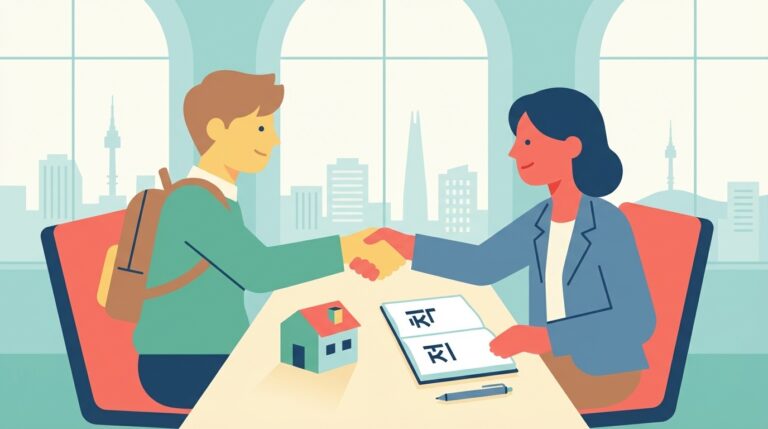
If you live in Korea, dealing with real estate—whether it’s Jeonse (huge lump-sum deposit) or Wolse (monthly rent)—is a rite of passage. But what if I told you that you don’t have to just pack your bags when your 2-year contract ends? Under Korean law, you have a magic shield: The Right to Request a Contract Renewal (계약갱신청구권).
Today, we’re going to learn how to use this “magic shield” to protect your home and your wallet, all while sounding perfectly natural and polite. Let’s dive into the world of Korean real estate survival!
Phase 2: Deep Dive into Key Expressions
Let’s look at the absolute must-know phrases to lock in your lease for another two years.
1. 계약을 연장하고 싶습니다.
- Pronunciation: [gyeyageul yeonjanghago sipseumnida]
Sound-alike: ‘gye’ sounds like ‘gyeh’, ‘yeonjang’ sounds like ‘yawn-jang’.- Meaning: I would like to extend the contract.
- K-Culture Moment: This is the standard, polite text message you send to your landlord about 2 to 6 months before your contract expires. It’s business-like, neat, and respectful.
- Editor’s Insight: This is a safe, soft opener. You aren’t bringing out the legal terms yet; you’re just stating your intention. It tests the waters to see how the landlord will react.
- Situation Spectrum:
[🚫] ———— [⚠️] ———— [✅]
- Casual (Friends): 🚫 (Too formal)
- Real Estate Agent / Landlord via Text: ✅ (Perfect)
- 🤔 Think About It: Why use the formal “-습니다” (seumnida) ending here instead of the polite “-아/어요” (a/eoyo)? In Korea, contracts and money matters demand the highest level of formal respect to maintain a clear boundary.
2. 계약갱신청구권을 행사하겠습니다.
- Pronunciation: [gyeyak-gaengsin-cheonggugwoneul haengsahagetseumnida]
Sound-alike: ‘gaeng-sin’ sounds like ‘gang-shin’, ‘cheong-gu-gwon’ sounds like ‘chong-goo-gwon’.- Meaning: I will exercise my right to request a contract renewal.
- K-Culture Moment: The “Mic Drop” moment in a real estate office. If the landlord says, “I want to raise the rent by 20%,” saying this legally limits them to a maximum 5% increase.
- Editor’s Insight: Yes, it’s a mouthful. It’s a legal term. But as a B2 learner, using this exact term shows you know your rights. You don’t say this angrily; you type or say it very calmly.
- Situation Spectrum:
[🚫] ———— [⚠️] ———— [✅]
- Everyday conversation: 🚫 (Sounds like a lawyer)
- When negotiating rent limits: ✅ (Absolute necessity)
- 🤔 Think About It: Notice the word “권” (gwon – right/authority). Many legal rights in Korea end in this character. Does your language have a specific suffix for legal rights?
3. 기존 조건과 동일하게 진행할까요?
- Pronunciation: [gijon jogeongwa dong-ilhage jinhaenghalkkayo?]
- Meaning: Shall we proceed with the same conditions as before?
- K-Culture Moment: You are sitting on the sofa at the Budongsan (Real Estate Agency), sipping instant Maxim coffee. You politely ask the agent if the landlord is okay with keeping the deposit and rent exactly the same.
- Editor’s Insight: “동일하게” (same as) and “진행하다” (to proceed) are B2-level business words. It sounds much more sophisticated than saying “똑같이 해요” (let’s do it the same).
- Situation Spectrum:
[🚫] ———— [⚠️] ———— [✅]
- Formal business / Real Estate: ✅
Phase 3: Textbook vs Real Life
How do actual Koreans communicate with their landlords?
| Situation | 📖 Textbook Korean | 🗣️ Real Korean | 💡 Why the difference? |
|---|---|---|---|
| Texting Landlord | 임대차 계약을 갱신하고자 연락드렸습니다. | 사장님, 이번에 만기인데 2년 더 연장하고 싶어서요. | “사장님” (Boss) is a polite, flattering way to address a landlord. Real life uses softer endings (-서요). |
| Asking about rent | 월세를 인상하실 계획이십니까? | 혹시 보증금이나 월세 변동 있을까요? | “변동” (change/fluctuation) sounds softer than directly asking “Are you raising it?” |
| Confirming | 알겠습니다. 그렇게 합시다. | 네, 그럼 원래대로 진행하는 걸로 할게요! | Koreans love using “~하는 걸로 할게요” (Let’s go with doing…) to softly confirm an agreement. |
Bottom Note: You don’t need to sound like a law dictionary. Combine formal legal terms (when necessary) with soft, polite conversational endings to master the Korean Nunchi (눈치) game!
Phase 4: Cultural Deep Dive
4-1. Non-verbal Communication: The Power of Texting
In many Western cultures, having a phone call or an in-person meeting to discuss lease renewals is preferred. In Korea? Text messaging (KakaoTalk or SMS) is actually better. Why? Because it leaves a written record! If a dispute arises, having a text where you stated “I want to exercise my renewal right” is legally binding and easy to prove. Don’t feel like texting is “rude” in this situation—it’s smart.
4-2. K-Drama Connection: The “Budongsan” Scene
Have you noticed in K-Dramas like Because This Is My First Life, the real estate agency (부동산) always has a huge map on the wall and the agent is usually a friendly neighborhood auntie or uncle? The real estate agent (공인중개사) in Korea isn’t just a salesperson; they act as a mediator between you and the landlord. If you feel uncomfortable directly telling your landlord you want to cap the rent increase at 5%, you can ask the agent to do it for you!
Phase 5: Immersive Roleplay
Scenario A: The Negotiation at the Budongsan
- Setting: A Saturday afternoon at a “Budongsan” in Seoul. You are sitting across from the agent. The wall is covered in neon-colored papers listing house prices.
- Characters:
- YOU: An expat who loves their current apartment and wants to stay.
- Mr. Kim (50s): The local real estate agent. Friendly, but clearly trying to mediate a tricky situation.
Mr. Kim: 어서 오세요! 커피 한 잔 드릴까요? ☕
(eoseo oseyo! keopi han jan deurilkkayo?)
[Welcome! Shall I get you a cup of coffee?]
(🎭 Stage Direction: Mr. Kim reaches for a yellow Maxim instant coffee stick)
YOU: 네, 감사합니다. 사장님, 저 다음 달이 만기라서요.
(ne, gamsahamnida. sajangnim, jeo daeum dari mangiraseoyo.)
[Yes, thank you. Sir, my contract expires next month.]
Mr. Kim: 아, 맞다. 집주인하고 통화해 봤어요?
(a, matda. jipjuinhago tonghwahae bwasseoyo?)
[Ah, right. Did you talk to the landlord?]
YOU: 아직요. 저는 2년 더 살고 싶은데요.
(ajigyo. jeoneun inyeon deo salgo sipeundeyo.)
[Not yet. I’d like to live here for 2 more years.]
Mr. Kim: 음… 어쩌죠. 집주인이 월세를 10만 원 올리고 싶어 하던데.
(eum… eojjeojyo. jipjuini wolseleul simman won olligo sipeo hadeonde.)
[Hmm… What should we do. The landlord wants to raise the rent by 100,000 won.]
YOU: 10만 원이요? 그건 좀 부담스러운데요…
(simman woniyo? geugeon jom budamseureoundeyo…)
[100,000 won? That’s a bit burdensome…]
Mr. Kim: 물가가 많이 올라서 어쩔 수 없대요.
(mulgaga mani ollaseo eojjeol su eopdaeyo.)
[They say they can’t help it because inflation is high.]
🔀 Your Turn! How will you respond?
– A) “아, 네… 그럼 10만 원 더 낼게요.” (Give up and pay)
– B) “저, 계약갱신청구권 쓸게요. 5%만 올릴 수 있는 거 아니에요?” (Use your legal shield)
– C) “그럼 저 이사 갈게요. 보증금 빼주세요.” (Threaten to leave immediately)✅ Best Choice: B — You respectfully but firmly invoke your right. By law, if you use this right, the landlord cannot raise the rent by more than 5%.
⚠️ Choice C Analysis: Moving in Korea involves high fees (agent fees, moving trucks). Don’t bluff unless you actually mean it!
YOU (Choosing B): 저, 계약갱신청구권 쓸게요. 법적으로 5%까지만 올릴 수 있는 거 아닌가요?
(jeo, gyeyakgaengsincheonggugwon sseulgeyo. beopjeogeuro o-peurokkajiman ollil su inneun geo aningayo?)
[I’ll use my contract renewal right. Legally, isn’t it only up to 5%?]
Mr. Kim: 아… 네, 맞아요. 그럼 제가 집주인한테 잘 말해볼게요.
(a… ne, majayo. geureom jaega jipjuinhante jal malhaebolgeyo.)
[Ah… Yes, that’s right. Then I’ll try speaking nicely to the landlord.]
YOU: 네, 잘 부탁드립니다!
(ne, jal butakdeurimnida!)
[Yes, please take care of it for me!]
Phase 6: 10-Second Shadowing Drill
Let’s practice the magic sentence. Pay attention to the pauses!
😤 단호하게 (Firmly but politely):
저는 / 이번 만기 때 / 계약 갱신 청구권을 / 행사하겠습니다.
(jeo-neun / ibeon mangi ttae / gyeyak gaengsin cheonggugwoneul / haengsahagetseumnida.)
Phase 7: K-Culture Glossary
| Korean | Romanization | English | Context |
|---|---|---|---|
| 전세 | jeonse | Key-money Deposit | A unique Korean system where you give a massive deposit instead of paying monthly rent. |
| 월세 | wolse | Monthly Rent | Standard monthly rent, usually accompanied by a smaller security deposit. |
| 만기 | mangi | Expiration | The end date of your lease contract. |
| 보증금 | bojeunggeum | Security Deposit | The money held by the landlord during your stay. |
| 집주인 (임대인) | jipjuin (imdaein) | Landlord | ‘Jipjuin’ is conversational; ‘Imdaein’ is the legal term on the contract. |
| 세입자 (임차인) | seipja (imchain) | Tenant | You! ‘Imchain’ is the legal term. |
Phase 8: Traveler’s Survival Kit
Even if you aren’t signing a 2-year lease, you might need to find mid-to-short term housing as a long-term traveler or digital nomad in Korea.
🆘 Survival Phrases for Digital Nomads
– 🇰🇷 “단기 임대 가능한 방 있나요?” (dangi imdae ganeunghan bang innayo?)
– 🗣️ Meaning: Do you have any rooms available for short-term lease?
– 📍 Where to use: Real estate agencies, Goshiwon (고시원), Co-living spaces.
– 💡 Pro Tip: Look for “단기” (Short-term) or “무보증” (No deposit) signs on the windows of real estate offices.📌 Editor’s Housing Note
– Useful Apps: Zigbang (직방) and Dabang (다방) are the go-to apps for looking at apartment prices, but beware of ‘fake listings’ (허위매물) designed to lure you to the agency.
– Agent Fees (복비): In Korea, you must pay the real estate agent a legally capped commission fee when you sign a lease. It is NOT free!
Phase 9: Think Deeper — “Language & Power”
🧠 Think Deeper: Why do we call the landlord “Boss”?
In Korean real estate culture, tenants often address their landlords as 사장님 (Sajangnim – Boss/CEO) or 사모님 (Samonim – Madam), even though they aren’t your employer. This reflects a deep-rooted linguistic dynamic of power. In Korea, property ownership holds immense social status. By elevating the landlord with a respectful title, tenants aim to build Jeong (정 – emotional connection) and make negotiations (like rent prices or fixing a broken boiler) smoother. Language here isn’t just about meaning; it’s a social lubricant.
💬 Your Turn: In your home country, what is the power dynamic like between a landlord and a tenant? Do you use specific polite titles, or is it strictly first-name basis? Share in the comments!
Phase 10: FAQ & Troubleshooting
Q: “Can I just tell them I want to use my renewal right over the phone?”
Yes, but record the call! (In Korea, it is legal to record a phone call if you are an active participant in the conversation). Otherwise, send a text message so you have a timestamped written record.
Q: “Are there any exceptions where the landlord can refuse my renewal right?”
Yes! The biggest loophole is if the landlord (or their direct family member) plans to move into the apartment themselves. If they state this, they can legally deny your renewal request.
❌ Common Mistake #1: Waiting until the last minute.
✅ Do this instead: By law, you MUST notify the landlord of your intent to renew between 6 months and 2 months before the contract ends. If you text them 1 week before, you lose your right!
Phase 11: Wrap-up & Action Items
One-Liner Summary: Protect your home and wallet by confidently saying “계약갱신청구권을 행사하겠습니다” via text 2-6 months before your lease ends.
Action Mission:
– 🥉 Bronze: Say “계약 갱신 청구권” out loud 5 times right now. It’s a tongue twister!
– 🥈 Silver: Check your current housing contract. Do you know exactly what date your mangi (만기 – expiration) is?
– 🥇 Gold: Next time you pass by a Budongsan, look at the window listings and try to read the Wolse and Jeonse prices!
🎬 K-Culture Mission:
Watch an episode of Because This Is My First Life (이번 생은 처음이라) and pay attention to how stressful the main character’s housing situation is. You’ll understand Korean real estate culture instantly!
Phase 12: Interactive Quiz
1. Fill in the blank:
You want to text your landlord softly to see if you can keep the same rent conditions.
“사장님, 혹시 기존 조건과 _______ 진행할까요?”
A) 무례하게 (rudely)
B) 동일하게 (identically/same)
C) 비싸게 (expensively)
2. True or False – K-Culture Edition:
If you use the Contract Renewal Right (계약갱신청구권), the landlord cannot raise your rent AT ALL. (T/F)
3. Situational Judgment:
Your contract expires on December 31st. When is the LATEST you should text your landlord to use your renewal right?
A) December 30th
B) October 31st (2 months before)
C) Whenever you feel like it.
(Answers: 1: B, 2: False – they can raise it up to 5%, 3: B)
Got a real estate headache in Korea right now? Let us know in the comments below, and we’ll help you find the right Korean words to solve it!
Frequently Asked Questions (FAQ)
Q: What does "계약을 연장하고 싶습니다." mean in Korean and how do you pronounce it?
A: In Korean, "계약을 연장하고 싶습니다." is pronounced [gyeyageul yeonjanghago sipseumnida] and means: I would like to extend the contract.
Q: What does "계약갱신청구권을 행사하겠습니다." mean in Korean and how do you pronounce it?
A: In Korean, "계약갱신청구권을 행사하겠습니다." is pronounced [gyeyak-gaengsin-cheonggugwoneul haengsahagetseumnida] and means: I will exercise my right to request a contract renewal.
Q: What does "기존 조건과 동일하게 진행할까요?" mean in Korean and how do you pronounce it?
A: In Korean, "기존 조건과 동일하게 진행할까요?" is pronounced [gijon jogeongwa dong-ilhage jinhaenghalkkayo?] and means: Shall we proceed with the same conditions as before?







