

Phase 1: Immersive Hook
Hello! I’m your Daily Hangul Editor.
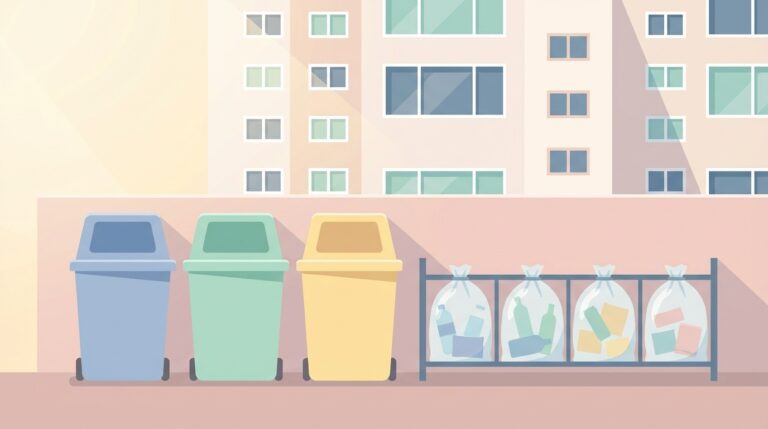
Have you ever watched a K-Drama and noticed how often the main characters awkwardly bump into each other late at night, wearing cozy sweatpants, messy hair, and carrying a transparent bag full of empty soju bottles or crushed boxes? That magical, slightly embarrassing place is the Korean apartment recycling area (분리수거장).
In Korea, taking out the trash isn’t just a chore; it’s a highly organized, community-driven event. If you live in a Korean apartment or stay at a local Airbnb, you will quickly realize that missing the designated ‘Recycling Day’ is a big deal. Do it wrong, and you might get a gentle (or not-so-gentle) scolding from the almighty apartment security guard, the 경비 아저씨 (Gyeongbi ajeossi).
But don’t worry! As someone who once hoarded a week’s worth of plastic bottles because I was too afraid to ask how to sort them, I’ve got your back. Today, we’re going to learn the essential phrases you need to survive Korean recycling culture and earn your badge as an ‘honorary local.’
Phase 2: Deep Dive into Core Expressions
Let’s break down the most crucial phrases you need before heading down to the recycling bins.
1. 오늘 분리수거 하는 날이에요?
- Pronunciation: o-neul bun-ri-su-geo ha-neun na-ri-e-yo?
(Tip: ‘bun’ sounds like the ‘bun’ in bunny. ‘su-geo’ sounds like ‘sue go’)- Meaning: Is today recycling day?
- K-Culture Moment: You step out of the elevator and see your neighbors rushing out with piles of cardboard. You ask the security guard this question to confirm if you should run back inside and grab your recyclables too.
- Editor’s Insight: In many Korean apartment complexes, you can’t just recycle any day. You usually have a specific day (e.g., Tuesdays) from 6 PM to 11 PM. This phrase is a lifesaver to double-check the schedule!
- Situation Spectrum:
[🚫 Never] ———— [⚠️ Careful] ———— [✅ Go ahead]
- Friends/Roommates (Casual): ⚠️ (Drop the ‘요’ and say “오늘 분리수거 하는 날이야?”)
- Neighbors/Security Guard (Formal): ✅
- 🤔 Think About It: Notice the word 분리 (Bunri – separation) and 수거 (Sugeo – collection). Why do you think Korean uses such a systematic term instead of just saying “trash day”?
2. 이거 일반 쓰레기예요?
- Pronunciation: i-geo il-ban sseu-re-gi-ye-yo?
(Tip: ‘sseu’ sounds like the disgusted sound you make when stepping in gum—just clench your teeth and say ‘eww’)- Meaning: Is this general waste?
- K-Culture Moment: You are holding a dirty napkin or a greasy pizza box, standing confused between the plastic bin and the general trash bin. You ask a friendly neighbor this question to avoid a sorting disaster.
- Editor’s Insight: In Korea, if something is stained with food, it cannot be recycled. It becomes 일반 쓰레기 (general waste). Asking this shows you are trying to be a responsible resident!
- Situation Spectrum:
[🚫 Never] ———— [⚠️ Careful] ———— [✅ Go ahead]
- Friends (Casual): ⚠️ (Say “이거 일반 쓰레기야?”)
- Security Guard/Elders (Formal): ✅
- 🤔 Think About It: How is trash sorted in your home country? The strict categorization in Korea reflects a high-density population trying to manage resources efficiently.
3. 종량제 봉투 어디서 팔아요?
- Pronunciation: jong-ryang-je bong-tu eo-di-seo pa-ra-yo?
- Meaning: Where do you sell the standardized garbage bags?
- K-Culture Moment: You just moved into your new officetel in Seoul. You realize you can’t just use any plastic bag for your trash. You run to the convenience store and ask the cashier this question.
- Editor’s Insight: 종량제 봉투 (Jongnyangje bongtu) is a volume-based waste fee bag. You MUST buy these specific bags from local supermarkets or convenience stores to throw away general trash.
- Situation Spectrum:
[🚫 Never] ———— [⚠️ Careful] ———— [✅ Go ahead]
- Cashier/Store Owner (Formal): ✅
Phase 3: Textbook vs Real Life
| Situation | 📖 Textbook Korean | 🗣️ Real Korean | 💡 Why the difference? |
|---|---|---|---|
| Asking where to put plastic | 플라스틱은 어디에 버려야 합니까? | 플라스틱 여기 버려요? | Dropping the subject particle (은/는) and the location particle (에) makes speech much faster and natural in busy situations. |
| Apologizing for a mistake | 제가 잘못 버렸습니다. 죄송합니다. | 아, 몰랐어요. 죄송해요! | “Ah, I didn’t know” (몰랐어요) sounds much more relatable and less robotic than a formal confession of guilt. |
| Asking if someone can take out the trash | 분리수거를 해 주시겠습니까? | 오늘 분리수거 좀 부탁해~ | Between roommates/couples, adding “좀” (a little/please) softens the request perfectly. |
Phase 4: Cultural Deep Dive
4-1. Non-verbal Communication: The Power of ‘Nunchi’
When you’re at the recycling center, it’s all about 눈치 (Nunchi – situational awareness). Watch what your neighbors are doing. If they are aggressively ripping tape off cardboard boxes, you should do the same! If you need to ask the security guard for help, don’t just yell from afar. Walk up to him, bow slightly, look a bit apologetic (since you are interrupting his work), and hold out your trash with two hands.
4-2. K-Culture Connection: The K-Drama Meet-Cute
Why do so many K-Dramas feature scenes at the recycling area? Because in a bustling city like Seoul, where everyone lives in high-rise apartments, the recycling area is the ultimate communal space. It’s where CEOs, students, and artists all do the exact same mundane task. It’s the perfect setting to show a character’s “real” side—no makeup, stretched-out t-shirt, just doing their best to separate clear PET bottles from colored ones. Next time you watch a romance drama, spot the inevitable trash-sorting scene!
Phase 5: Immersive Roleplay
Main Scenario
Setting: Tuesday night, 9 PM. The basement parking lot of your Seoul apartment complex. It’s “Recycling Day.” Neighbors are everywhere, sorting paper, plastic, and cans. You are holding a large, slightly greasy pizza box and looking completely lost.
Characters:
– YOU: An expat trying to do the right thing.
– 경비 아저씨 (Security Guard – age 60s): Wears a neat uniform. He is strict about rules but secretly has a warm heart.
Dialogue:
YOU: (Approaching cautiously) 아저씨, 안녕하세요…
(a-jeo-ssi, an-nyeong-ha-se-yo…)
[Hello, sir…]
(🎭 Stage Direction: You bow slightly and point to your pizza box)
Guard: 예, 안녕하세요. 그 박스 버리려고요?
(ye, an-nyeong-ha-se-yo. geu bak-seu beo-ri-ryeo-go-yo?)
[Yes, hello. Are you trying to throw away that box?]
YOU: 네, 종이류에 버리면 되나요?
(ne, jong-i-ryu-e beo-ri-myeon doe-na-yo?)
[Yes, can I throw it in the paper section?]
Guard: (Frowning slightly) 에이, 기름 묻었잖아요. 일반 쓰레기예요.
(e-i, gi-reum mu-deot-ja-na-yo. il-ban sseu-re-gi-ye-yo.)
[Hey, it has oil on it. It’s general waste.]
YOU: 아, 이거 일반 쓰레기예요?
(a, i-geo il-ban sseu-re-gi-ye-yo?)
[Oh, is this general waste?]
Guard: 네, 종량제 봉투에 넣어야 해요. 테이프는 뗐어요?
(ne, jong-nyang-je bong-tu-e neo-eo-ya hae-yo. te-i-peu-neun tte-sseo-yo?)
[Yes, you have to put it in the standard garbage bag. Did you take the tape off?]
🔀 Your Turn! How should you respond?
– A) “아니요, 아저씨가 해주세요.” (No, you do it for me.)
– B) “아! 몰랐어요. 지금 뗄게요!” (Ah! I didn’t know. I’ll take it off right now!)
– C) “대박! 진짜 귀찮네요.” (Daebak! This is really annoying.)✅ Best Choice: B — Acknowledging your mistake and showing immediate willingness to fix it is the best way to win the guard’s favor.
⚠️ Choice C Analysis: Complaining out loud with slang like “대박” to an elder is considered very rude!
YOU: 아! 몰랐어요. 지금 뗄게요!
(a! mol-la-sseo-yo. ji-geum ttel-ge-yo!)
[Ah! I didn’t know. I’ll take it off right now!]
Guard: (Smiling) 네, 다음부터는 조심해요. 외국인이라서 헷갈릴 수 있죠.
(ne, da-eum-bu-teo-neun jo-sim-hae-yo. oe-gu-gin-i-ra-seo het-gal-ril su it-jjo.)
[Yes, just be careful next time. You’re a foreigner, so it can be confusing.]
YOU: 감사합니다! 안녕히 계세요!
(gam-sa-ham-ni-da! an-nyeong-hi gye-se-yo!)
[Thank you! Goodbye!]
Phase 6: 10-Second Shadowing Drill
Practice this until it flows naturally! Read aloud, following the pauses and intonation marks.
🥺 아저씨 / 제가 잘 몰라서 그러는데 / 플라스틱은 / 여기 버려요?
(a-jeo-ssi / je-ga jal mol-la-seo geu-reo-neun-de / peul-la-seu-ti-geun / yeo-gi beo-ryeo-yo?)
(Excuse me sir, I’m asking because I don’t really know, but do I throw plastics here?)
Phase 7: K-Culture Glossary
| Korean | Romanization | English | Contextual Meaning |
|---|---|---|---|
| 분리수거 | bunrisugeo | Recycling / Waste sorting | The literal translation is “separation and collection.” It’s an essential part of Korean civic duty. |
| 종량제 봉투 | jongnyangje bongtu | Standardized garbage bag | You must buy these to throw away non-recyclable trash. Each district in Korea has its own specific bag. |
| 음식물 쓰레기 | eumsingmul sseuregi | Food waste | Food waste must be strictly separated from general waste because it is recycled into animal feed or fertilizer. |
| 경비 아저씨 | gyeongbi ajeossi | Security guard | The older gentlemen who manage apartment complexes. They are the gatekeepers of the recycling rules! |
Phase 8: Traveler’s Survival Kit
Even if you’re just staying at an Airbnb for a few days, you need to know how to buy trash bags!
🆘 Survival Phrases at the Convenience Store
– 🇰🇷 “종량제 봉투 10리터짜리 하나 주세요.” (jong-nyang-je bong-tu sim-ni-teo-jja-ri ha-na ju-se-yo.)
– 🗣️ English: Please give me one 10-liter standard garbage bag.
– 📍 Where to use: Any convenience store (CU, GS25, 7-Eleven).
– 💡 Pro Tip: Cashiers usually keep them behind the counter, so you MUST ask for them. “리터 (liter)” is how they measure the bag size. 10L or 20L is standard for a week’s trash.
📌 Editor’s Travel Note:
Never put food waste in the regular trash bag! Convenience stores also sell separate, usually yellow or small green bags specifically for 음식물 쓰레기 (food waste).
Phase 9: Think Deeper — “One Step Further”
🧠 Think Deeper: Language, Space, and Collectivism
Korea is a mountainous peninsula with very limited land space. Because of this, massive apartment complexes are the most common form of housing. The incredibly strict recycling system reflects a deep cultural mindset of Collectivism (공동체 의식). It’s not just about saving the earth; it’s about not causing inconvenience to your neighbors. When the security guard scolds someone for not flattening a cardboard box, he isn’t just enforcing a rule—he’s protecting the harmony of the shared community space.
💬 Your Turn: How is trash and recycling handled in your country? Is it viewed as an individual responsibility or a strict community duty? Let us know in the comments!
Phase 10: FAQ & Troubleshooting
Q: Can I use slang or drop honorifics when talking to the security guard?
A: Absolutely NOT. Most security guards are in their 60s or 70s. In Korean culture, you must use polite formal language (존댓말) with elders, regardless of their profession.
Q: I washed my delivery food container, but it’s still stained red from Tteokbokki. Can I recycle it?
A: No. If plastic is stained and cannot be cleaned completely, it must go into the general waste bag (종량제 봉투).
❌ Common Mistake #1: Putting a half-empty coffee cup in the plastic recycling bin.
✅ Do this instead: You MUST empty the liquid, rinse the cup, and throw away the straw separately. Koreans are very strict about emptying contents first!
Phase 11: Wrap-up & Action Items
One-Liner Summary: Mastering the Korean recycling system and knowing how to ask the security guard for help will make your life in Korea 100x easier and earn you major respect from locals.
Action Missions:
– 🥉 Bronze (Solo): Look around your room right now and say “이거 일반 쓰레기예요?” out loud to three different objects.
– 🥈 Silver (Online): Share a photo of your local recycling bins on a Korean learning forum and caption it with “오늘 분리수거 하는 날이에요?”
– 🥇 Gold (Real Life): Next time you visit a Korean convenience store, buy something and successfully ask for a “종량제 봉투”!
– 🇰🇷 K-Culture Mission: Watch any slice-of-life K-Drama (like Reply 1988 or Hospital Playlist) and try to spot a scene where characters are sorting trash or interacting with their neighbors outside!
Did you ever make a funny mistake while throwing away trash in a foreign country? Tell me your stories below! 👇
Phase 12: Interactive Challenge (Quiz)
1. You are holding an unwashed, greasy fried chicken box. Where does it go?
A) Paper recycling (종이류)
B) Food waste (음식물 쓰레기)
C) General waste bag (종량제 봉투)
(Answer: C. Because it is greasy, it cannot be recycled!)
2. Fill in the blank:
To buy a standard garbage bag at the store, you say: “__________ 봉투 하나 주세요.”
(Answer: 종량제 / jongnyangje)
3. True or False – K-Culture Edition:
“In Korea, it is perfectly fine to throw away your trash in regular black plastic bags from the grocery store.”
(Answer: False! You will get fined. You must use the official district garbage bags.)
Frequently Asked Questions (FAQ)
Q: What does "오늘 분리수거 하는 날이에요?" mean in Korean and how do you pronounce it?
A: In Korean, "오늘 분리수거 하는 날이에요?" is pronounced [o-neul bun-ri-su-geo ha-neun na-ri-e-yo?] and means: Is today recycling day?
Q: What does "이거 일반 쓰레기예요?" mean in Korean and how do you pronounce it?
A: In Korean, "이거 일반 쓰레기예요?" is pronounced [i-geo il-ban sseu-re-gi-ye-yo?] and means: Is this general waste?
Q: What does "종량제 봉투 어디서 팔아요?" mean in Korean and how do you pronounce it?
A: In Korean, "종량제 봉투 어디서 팔아요?" is pronounced [jong-ryang-je bong-tu eo-di-seo pa-ra-yo?] and means: Where do you sell the standardized garbage bags?







