

How to Save a Life in Korea: The C2 Guide to CPR & AED
안녕하세요! I’m your Daily Hangul Editor.
Imagine this: You’re at a crowded K-Pop concert, or perhaps navigating the chaotic transfer tunnels of Sindorim Station during rush hour. Suddenly, the person next to you collapses. The crowd gasps. A circle forms, but everyone freezes. We’ve all seen this in K-Dramas like Hospital Playlist or Dr. Romantic—the brilliant doctor pushes through the crowd, barks a few authoritative commands, and saves the day right within the ‘Golden Time’.
But in reality, there’s no script, and there might not be a doctor. You might be the only one with CPR certification.
At a C2 proficiency level, your Korean needs to go beyond ordering coffee or discussing news. You need the linguistic authority to take control of a high-stakes, life-or-death situation. In an emergency, cultural norms like nunchi (눈치, reading the room) can tragically paralyze a crowd due to the bystander effect.
Today, we aren’t just learning words; we are learning how to cut through the noise, bypass cultural hesitation, and command a scene to save a life in South Korea. Let’s dive in.
Phase 2: Core Expressions Deep Dive
1. “거기 파란 셔츠 입으신 분, 119에 신고해 주세요!”
- Pronunciation: geogi paran syeocheu ibeusin bun, il-il-gu-e singohaeyo! (Note: 119 is read as il-il-gu, not baek-sip-gu).
- Meaning: (Literal) That person wearing the blue shirt, please report to 119! / (Real nuance) YOU in the blue shirt, call emergency services NOW!
- K-Culture Moment: In Korean CPR training, the first rule is to overcome the bystander effect. If you just yell “Somebody help!”, nobody moves because everyone thinks someone else will do it. You must single someone out by their clothing or physical characteristics.
- Editor’s Insight: This requires an authoritative yet polite tone. Adding “~신 분” (honorific for ‘person’) maintains the minimum required social respect while delivering a direct command. It’s sharp, clear, and unignorable.
- Situation Spectrum:
[🚫 절대 금지] ———— [⚠️ 주의] ———— [✅ 자유롭게]
- Casual (Friends): ✅
- Semi-formal (Strangers): ✅ (In emergencies, urgency overrides standard etiquette)
- Formal (Bosses/Elders): ✅
- 🤔 Think About It: Why do we specifically point out clothing instead of just making eye contact? In a highly collective society, pointing out a distinguishing feature instantly shifts the responsibility from the ‘group’ to the ‘individual.’
2. “가까운 곳에서 자동 심장 충격기(AED) 좀 가져다주세요!”
- Pronunciation: gakkaun goseseo jadong simjang chunggyeokgi (AED) jom gajyeodajuseyo!
- Meaning: Please bring an Automated External Defibrillator (AED) from nearby!
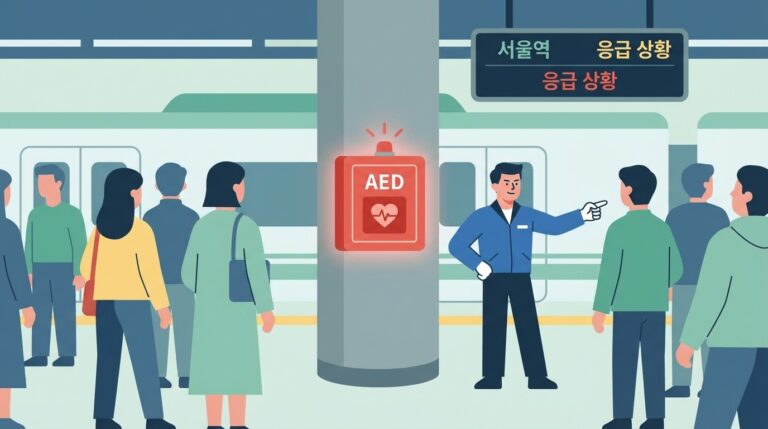
- K-Culture Moment: You’ll see AEDs in every Korean subway station, usually in glowing red/orange boxes near the turnstiles. Koreans often refer to it interchangeably as ‘제세동기’ (je-se-dong-gi) or just the English letters ‘AED’ (에이이디).
- Editor’s Insight: The word ‘좀’ (a little/please) here doesn’t mean you want a small AED. It softens the command slightly, a deeply ingrained habit in Korean speech, even during emergencies, to make requests sound less aggressive and more like an urgent plea for cooperation.
- Situation Spectrum:
[🚫 절대 금지] ———— [⚠️ 주의] ———— [✅ 자유롭게]
- Casual: ✅
- Semi-formal: ✅
- Formal: ✅
- 🤔 Think About It: Even in a life-or-death situation, Koreans naturally insert ‘좀’ (please/just) into their commands. Does your native language have a ‘softener’ that remains even in extreme emergencies?
3. “환자분 의식이 없습니다. 제가 흉부 압박 시작하겠습니다.”
- Pronunciation: hwanjabun uisigi eopseumnida. jega hyungbu apbak sijakagetseumnida.
- Meaning: The patient is unconscious. I will begin chest compressions.
- K-Culture Moment: This sounds like a line straight out of a medical K-Drama. Declaring your actions loudly serves two purposes: it informs the 119 dispatcher (if someone is on the phone) and it reassures the panicked crowd that someone competent is taking charge.
- Editor’s Insight: Notice the use of formal language (습니다). In a chaotic public space, using formal language projects authority, calm, and professionalism, making strangers more likely to trust and assist you.
- Situation Spectrum:
[🚫 절대 금지] ———— [⚠️ 주의] ———— [✅ 자유롭게]
- Public Emergency: ✅ (Highly recommended to establish control)
Phase 3: Textbook vs Real Life
| 상황 | 📖 교과서 한국어 | 🗣️ 진짜 한국어 (Street Survival) | 💡 왜 다를까? |
|---|---|---|---|
| Calling for help | 누군가 구급차를 불러주세요. | 119(일일구) 전화 좀 해주세요! | “Ambulance” (구급차) is too vague. Naming the number “119” triggers immediate action. |
| Describing the state | 심장 마비입니다. | 심정지 온 것 같아요! | “심장 마비” (heart attack) is the cause; “심정지” (cardiac arrest) is the immediate clinical state requiring CPR. Medical dramas popularized the latter. |
| Asking for the device | 제세동기를 찾아주세요. | 거기 역무원한테 AED 어딨냐고 물어보세요! | Directing a bystander to an authority figure (station staff) is the fastest way to locate the device. |
Bottom Note: At the C2 level, precision is key. Distinguishing between 심장 마비 (Myocardial Infarction) and 심정지 (Cardiac Arrest) shows native-like command of adult vocabulary.
Phase 4: Cultural Deep Dive
4-1. Non-verbal Communication: The Exception to the Rule
Usually, pointing directly at someone with your index finger in Korea is considered quite rude. You are taught to gesture with an open palm. However, CPR training in Korea explicitly teaches you to break this rule. You must point directly and aggressively at a specific person when assigning tasks (e.g., calling 119). This abrupt break in etiquette acts as a psychological shock, snapping the person out of the collective nunchi (bystander effect) and forcing them into action.
4-2. K-Culture Connection: The Good Samaritan Law & Medical Dramas
If you watch hit dramas like Dr. Romantic (낭만닥터 김사부), you’ll frequently hear the term “골든타임” (Golden Time). This Konglish term refers to the critical window of time to save a patient (usually 4 minutes for cardiac arrest).
Historically, some Koreans hesitated to perform CPR on strangers due to the fear of being sued for breaking ribs or causing injury. To combat this, Korea strengthened the 응급의료에 관한 법률 (Emergency Medical Service Act), often referred to as the ‘착한 사마리아인 법’ (Good Samaritan Law). It protects individuals who provide emergency first aid from civil and criminal liability if things go wrong. Knowing this cultural context explains why you must assert yourself boldly—you are protected by law to be a hero.
Phase 5: Immersive Roleplay Scenario
Setting: A chilly Friday night in Hongdae. You are watching a popular indie band busking. The crowd is packed shoulder-to-shoulder. Suddenly, a middle-aged man in front of you collapses. The music stops. People gasp and step back, paralyzed.
Characters:
– YOU: A foreigner who recently renewed their CPR certification.
– 지훈 (Ji-hoon): A panicked Korean college student standing next to you.
– 행인 (Bystander): A woman in a yellow padding jacket.
Dialogue:
YOU: (Tapping the man’s shoulders firmly) 여보세요! 괜찮으세요? 제 말 들리세요?
(yeoboseyo! gwaenchaneuseyo? je mal deulliseyo?)
[Sir! Are you okay? Can you hear me?]
(🎭 Stage Direction: The man is unresponsive. No breathing.)
지훈: 헐, 어떡해… 이 아저씨 쓰러졌어요! 피… 피는 안 나는데?
(heol, eotteokae… i ajeossi sseureojyeosseoyo! pi… pineun an naneunde?)
[OMG, what do we do… this man collapsed! He’s… he’s not bleeding though?]
YOU: 환자분 의식이 없습니다. 호흡도 없어요. 심정지 상태입니다.
(hwanjabun uisigi eopseumnida. hoheupto eopseoyo. simjeongji sangtaeimnida.)
[The patient is unconscious. No breathing. He’s in cardiac arrest.]
🔀 당신의 차례! How do you instruct the crowd?
– A) “제발 아무나 119에 전화 좀 걸어주세요!” (Please, anyone, call 119!)
– B) “거기 노란 패딩 입으신 분! 지금 바로 119에 신고해 주시고 스피커폰 켜주세요!” (You in the yellow padding! Call 119 right now and put it on speakerphone!)
– C) “지훈 씨, 빨리 구급차 불러요!” (Ji-hoon, quickly call an ambulance!)✅ Best Choice: B — Reason: Option A falls victim to the bystander effect. Option C is okay, but Ji-hoon is already panicking. Option B singles out a calm bystander, gives a specific number, and asking for speakerphone is crucial so you can communicate with the dispatcher while doing compressions.
(Assuming you chose B)
행인 (Bystander): 네? 아, 네! 지금 걸게요!
(ne? a, ne! jigeum geolgeyo!)
[Me? Ah, yes! I’ll call right now!]
YOU: (To Ji-hoon) 지훈 씨, 저기 앞 편의점이나 지하철역 가서 자동 심장 충격기 좀 빨리 가져다주세요! 뛰세요!
(jihun ssi, jeogi ap pyeonijeomina jihacheollyeok gaseo jadong simjang chunggyeokgi jom ppalli gajyeodajuseyo! ttwiseyo!)
[Ji-hoon, go to the convenience store or subway station over there and bring an AED quickly! Run!]
지훈: 네, 알겠습니다! 에이이디 맞죠? 갔다 올게요!
(ne, algetseumnida! ei-i-di matjyo? gatda olgeyo!)
[Yes, understood! AED, right? I’ll be back!]
YOU: (Clasping hands) 제가 흉부 압박 시작하겠습니다. 하나, 둘, 셋, 넷…
(jega hyungbu apbak sijakagetseumnida. hana, dul, set, net…)
[I will start chest compressions. One, two, three, four…]
행인 (Bystander): 119 연결됐어요! 홍대 걷고싶은거리 버스킹 앞이라고 했어요!
(il-il-gu yeongyeoldaesseoyo! hongdae geotgosipeungeori beuseuking apirago haesseoyo!)
[119 is connected! I told them we’re in front of the busking area on Hongdae Pedestrian Street!]
YOU: 구급대원한테 환자 심정지 상태고, 지금 CPR 중이라고 전해주세요!
(gugeupdaewonhante hwanja simjeongji sangtaego, jigeum si-pi-al jungirago jeonhaejuseyo!)
[Tell the dispatcher the patient is in cardiac arrest and we are doing CPR right now!]
보너스 롤플레이 (Bonus Scenario: The 119 Dispatcher)
(The bystander puts the phone on speaker next to you)
119 대원 (Dispatcher): 환자분 나이대가 어떻게 되십니까? 의식과 호흡이 전혀 없습니까?
(hwanjabun naidaega eotteoke doesimnikka? uisilgwa hoheubi jeonhyeo eopseumnikka?)
[What is the patient’s approximate age? Is there absolutely no consciousness or breathing?]
YOU: 50대 남성입니다! / 호흡 없습니다! / 지금 제가 가슴 압박 30회째 하고 있습니다!
(osipdae namseongimnida! / hoheup eopseumnida! / jigeum jega gaseum apbak samsiphoejjae hago itseumnida!)
[Male in his 50s! / No breathing! / I am currently on my 30th chest compression!]
Phase 6: 10-second Shadowing Drill
Practicing the intonation is critical. In an emergency, your voice must project from your diaphragm.
😤 거기 / 노란 패딩 / 입으신 분! / 일일구에 / 신고해 주세요!
(geogi / noran paeding / ibeusin bun! / il-il-gu-e / singohaeyo!)
😤 자동 / 심장 / 충격기 / 좀 / 가져다주세요!
(jadong / simjang / chunggyeokgi / jom / gajyeodajuseyo!)
Phase 7: K-Culture 미니 사전 (Glossary for C2 Level)
| 한국어 | Romanization | English | Contextual Nuance |
|---|---|---|---|
| 심정지 | simjeongji | Cardiac Arrest | The clinical term used by medical professionals and informed citizens. Differents from 심장 마비 (Heart attack). |
| 흉부 압박 | hyungbu apbak | Chest Compressions | The formal term for CPR chest pumps. |
| 제세동기 | jesedonggi | Defibrillator / AED | Found in public places. Also called 자동 심장 충격기 (jadong simjang chunggyeokgi) to be more accessible to the public. |
| 골든타임 | goldeuntaim | Golden Time | The crucial first few minutes to save a life. A favorite buzzword in Korean medical dramas. |
| 착한 사마리아인 법 | chakan samariain beop | Good Samaritan Law | The legal framework protecting you when you step up to help. |
| 눈치 | nunchi | Nunchi (Reading the room) | The social radar that usually maintains harmony, but can cause hesitation in emergencies. |
Phase 8: Traveler’s Survival Kit
If you are traveling in Korea, emergencies don’t wait for your vocabulary to catch up. Here are the survival essentials.
🆘 Survival Expresssions TOP 3
– 🇰🇷 “여기 사람 쓰러졌어요!” (yeogi saram sseureojyeosseoyo!)
– Meaning: A person collapsed here!
– 🇰🇷 “일일구(119) 불러주세요!” (il-il-gu bulleojuseyo!)
– Meaning: Call 119!
– 🇰🇷 “제세동기 어디 있어요?” (jesedonggi eodi isseoyo?)
– Meaning: Where is the AED?📌 Editor’s Travel Note: Pinpointing Your Location
– 119 vs 112: In Korea, 119 is for Fire and Medical emergencies. 112 is for the Police.
– Location Hacks: If you don’t know the address, look at the nearest telegraph pole (전봇대). They have unique ID numbers that 119 can track instantly. Alternatively, naming the nearest Subway Station + Exit Number (e.g., Gangnam Station Exit 10) is the fastest way to guide an ambulance.
Phase 9: 비판적 사고 코너 — “한 발 더 깊이” (Think Deeper)
🧠 Think Deeper: 언어와 권력 (Language, Society & Emergency)
In Korean society, the concept of Nunchi (눈치) maintains social harmony by encouraging individuals to blend in and not disrupt the collective atmosphere. However, in a medical emergency, this cultural strength becomes a fatal flaw—the bystander effect. Notice how the language we just learned forcefully dismantles this. By saying “거기 파란 셔츠 입으신 분” (You in the blue shirt), you are temporarily stripping away their anonymity in the crowd and assigning them a direct, unavoidable duty. You are utilizing the Korean language’s explicit honorifics (입으신 분) to maintain respect while wielding the absolute authority of a first responder. It’s a fascinating linguistic paradox: demanding extreme individual action while upholding collective politeness.
💬 Your Turn: Have you ever witnessed an emergency in your home country? Did people jump in to help, or did everyone wait for someone else to act? How would you direct a crowd in your native language? Share in the comments!
Phase 10: FAQ & Troubleshooting
Q: In an emergency, do I really have to worry about honorifics (존댓말)?
A: Yes and No. You don’t need perfectly structured formal sentences. Shouting “119 불러!” (Drop honorifics) out of sheer panic is understandable. However, using “~주세요” (Please) or “~신 분” (Honorific for a person) actually helps you control the situation better. It makes you sound like a trained professional rather than just a panicked bystander, prompting faster cooperation from Koreans.
Q: Can I get in legal trouble for breaking a rib during CPR in Korea?
A: No. As discussed, Korea’s Good Samaritan Law (응급의료에 관한 법률) protects you from liability for unintentional harm caused while providing vital life-saving first aid to an unconscious person.
❌ Common Mistake #1: Yelling “누군가 도와주세요!” (Somebody help!).
✅ Do this instead: Point directly at a specific person. “거기 모자 쓰신 분! 119 전화해 주세요!” (You in the hat! Call 119!).
Phase 11: Wrap-up & Action Items
One-Liner Summary: In a Korean emergency, bypassing the bystander effect by assigning specific tasks with authoritative yet polite Korean is your ultimate life-saving tool.
Action Mission 3단계:
– 🥉 Bronze: Stand in front of a mirror and firmly practice pointing and saying: “거기 파란 셔츠 입으신 분, 119에 신고해 주세요!”
– 🥈 Silver: Next time you are in a Korean subway station or building, actively locate the glowing AED box (자동 심장 충격기). Make a mental note of where they are usually kept.
– 🥇 Gold: Memorize the nearest subway exit number or landmark of where you live/work in Korea right now, so you can state it instantly if you ever need to call 119.
🩺 K-Culture Mission: Watch an episode of a Korean medical drama (like Hospital Playlist or Dr. Romantic). Listen carefully for the words “심정지” (Cardiac Arrest) and “골든타임” (Golden Time). Notice how the doctors give commands to the nurses!
Phase 12: Interactive Quiz
1. Situational Judgment: A person faints at a cafe and has no pulse. What is the MOST effective thing to shout?
– A) 누군가 구급차 좀 불러주세요!
– B) 거기 안경 쓰신 분, 119에 신고해 주세요!
– C) 경찰 불러주세요!
2. Fill in the Blank:
“환자분 의식이 없습니다. 제가 ____ ____(을/를) 시작하겠습니다.”
(Hint: formal term for chest compressions)
3. True or False — K-Culture Edition:
In Korea, it is strictly illegal to touch a stranger, so you should wait for paramedics even if they are in cardiac arrest. (T/F)
Answers (Click to reveal)
- B – Option A triggers the bystander effect. Option C (Police – 112) is wrong; you need Medical (119).
- 흉부 압박 (hyungbu apbak)
- False – The Good Samaritan Law protects you. Waiting will miss the ‘Golden Time’. Act immediately!
Frequently Asked Questions (FAQ)
Q: What does ""거기 파란 셔츠 입으신 분, 119에 신고해 주세요!"" mean in Korean and how do you pronounce it?
A: In Korean, ""거기 파란 셔츠 입으신 분, 119에 신고해 주세요!"" is pronounced [geogi paran syeocheu ibeusin bun, il-il-gu-e singohaeyo! (Note: 119 is read as il-il-gu, not baek-sip-gu] and means: (Literal) That person wearing the blue shirt, please report to 119! / (Real nuance) YOU in the blue shirt, call emergency services NOW!
Q: What does ""가까운 곳에서 자동 심장 충격기(AED) 좀 가져다주세요!"" mean in Korean and how do you pronounce it?
A: In Korean, ""가까운 곳에서 자동 심장 충격기(AED) 좀 가져다주세요!"" is pronounced [gakkaun goseseo jadong simjang chunggyeokgi (AED] and means: Please bring an Automated External Defibrillator (AED) from nearby!
Q: What does ""환자분 의식이 없습니다. 제가 흉부 압박 시작하겠습니다."" mean in Korean and how do you pronounce it?
A: In Korean, ""환자분 의식이 없습니다. 제가 흉부 압박 시작하겠습니다."" is pronounced [hwanjabun uisigi eopseumnida. jega hyungbu apbak sijakagetseumnida.] and means: The patient is unconscious. I will begin chest compressions.







