

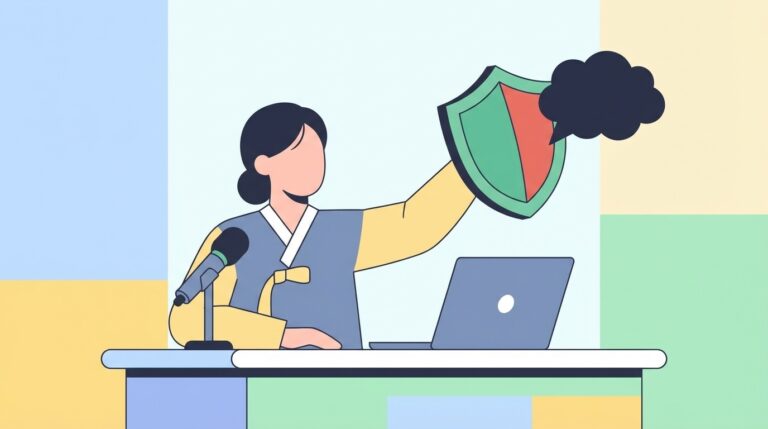
Hello! I’m your Daily Hangul Editor, your veteran Korean tutor and local culture navigator.
Imagine this: You’ve finally launched your YouTube channel or blog in Korea. Your latest vlog goes viral! You’re sipping an iced Americano, excitedly scrolling through the comments. But suddenly, right between the “You’re so cool!” and “Love this!” comments, you spot it—an incredibly rude, completely uncalled-for comment attacking you.
In the K-Drama world, this is the exact moment the protagonist drops their phone in shock, dramatic music plays, and their agency CEO angrily dials a lawyer. In real life? Managing an online community in Korea requires a delicate balance of nunchi (reading the room), setting strict boundaries, and knowing the exact vocabulary to show you’re not an easy target.
Today, we are diving deep into the art of handling 악플 (Akpeul – malicious comments) and managing your online presence like a seasoned Korean creator. If you want to survive the fierce Korean internet landscape without losing your cool, grab your notebook. Let’s get started!
Phase 2: Core Expressions Deep Dive
When dealing with trolls in Korea, sounding too emotional makes you look weak, and sounding too textbook-like makes you look like a foreigner who doesn’t know the rules. Here are the top C1-level expressions to establish your authority.
1. 선처 없이 강경 대응하겠습니다.
- Pronunciation: Seoncheo eopsi ganggyeong daeunghagetseumnida. [Sun-chuh op-shi gang-gyung dae-ung-ha-get-sum-ni-da]
- Meaning: (Literal) We will take strong countermeasures without leniency. / (Real Nuance) “We are suing you, and no amount of begging will make us drop the charges.”
- K-Culture Moment: If you follow K-Pop, you’ve definitely seen this. An agency suddenly posts a solid black image with white text on social media. It always contains this exact phrase to announce they are suing haters. It’s the ultimate mic-drop moment.
- Editor’s Insight: This is highly formal and carries immense legal weight. You don’t use this for a simple “I don’t like your video” comment. You use this when someone crosses the line into defamation or spreading false rumors.
- Situation Spectrum:
[🚫 절대 금지] ———— [⚠️ 주의] ———— [✅ 자유롭게]
- Casual vlog comment reply: 🚫 (Too dramatic)
- Official community tab statement: ✅
- Responding to a severe rumor: ✅
- 🤔 Think About It: Why do Koreans specifically emphasize “선처 없이” (without leniency)? Because historically, many celebrities would forgive haters who wrote apology letters. Emphasizing no leniency shows a shift in Korean cyber culture toward zero tolerance.
2. 비판은 수용하되 비난은 사절합니다.
- Pronunciation: Bipaneun suyonghadwe binaneun sajeolhamnida. [Bee-pan-eun soo-yong-ha-dwe bee-nan-eun sa-jeol-ham-ni-da]
- Meaning: (Literal) I accept criticism but decline condemnation. / (Real Nuance) “Constructive feedback is welcome, but blind hate will be deleted/ignored.”
- K-Culture Moment: Bloggers and mid-tier YouTubers often pin a comment like this at the top of a controversial video. It shows maturity and open-mindedness while firmly shutting the door on trolls.
- Editor’s Insight: The rhyming play between 비판 (bi-pan: criticism, logical) and 비난 (bi-nan: condemnation, emotional) makes you sound highly educated and eloquent. It’s polite but icy.
- Situation Spectrum:
[🚫 절대 금지] ———— [⚠️ 주의] ———— [✅ 자유롭게]
- YouTube Pinned Comment: ✅
- Blog Notice: ✅
- Telling off a friend: 🚫 (Too formal)
- 🤔 Think About It: Does your language have a similar rhyming distinction between constructive feedback and useless hate?
3. 선을 넘으셨네요.
- Pronunciation: Seoneul neomeusyeonneyo. [Sun-eul num-uh-syun-ne-yo]
- Meaning: (Literal) You crossed the line. / (Real Nuance) “You’ve gone too far. Watch your mouth.”
- K-Culture Moment: A Twitch streamer or YouTube Live host is reading the chat. Someone makes an inappropriate joke about the host’s family. The host’s smile drops, they stare dead into the camera, and say this. The chat immediately spams “ㄷㄷ” (shivering/scared).
- Editor’s Insight: This is your best everyday shield. It’s not legally threatening, but socially, it immediately calls out bad behavior. It uses the honorific “~시” (으셨네요) toward the hater, which is a classic Korean passive-aggressive way of maintaining the high ground.
- Situation Spectrum:
[🚫 절대 금지] ———— [⚠️ 주의] ———— [✅ 자유롭게]
- Live streaming chat management: ✅
- Replying to an overly personal question: ✅
- To your boss: 🚫 (You will be fired)
- 🤔 Think About It: Why do Koreans maintain honorifics even when angry at a stranger online? How does this relate to maintaining one’s own “face” (체면)?
Phase 3: Textbook vs Real Life
Let’s look at how the textbook teaches internet safety versus how Korean netizens actually talk.
| Situation | 📖 Textbook Korean | 🗣️ Real Korean (Internet Slang) | 💡 Why the difference? |
|---|---|---|---|
| Telling someone to stop trolling | 나쁜 말을 쓰지 마세요. (Please don’t use bad words.) | 어그로 끌지 마세요. (Don’t pull aggro.) | Derived from gaming (drawing monster aggression); used for people seeking negative attention. |
| Threatening legal action | 경찰에 신고하겠습니다. (I will report you to the police.) | 금융치료 들어가겠습니다. (I will begin financial therapy.) | Sarcastic slang: Suing someone makes them pay fines, “curing” their bad behavior through financial loss. |
| Exposing a fabricated story | 이것은 거짓말입니다. (This is a lie.) | 이거 주작이네. (This is fabricated/Jujak.) | “주작” (manipulation) is the internet standard for calling out fake news or staged videos. |
Bottom Note for C1 Learners: Using “금융치료” in a live stream shows you are highly integrated into Korean internet culture, but reserve it for lighthearted warnings. For actual legal notices, stick to Phase 2’s formal expressions.
Phase 4: Cultural Deep Dive — The Law of the Keyboard
4-1. Non-verbal Communication: The “Pinned Comment” Nunchi
In Korean online communities, outright screaming matches in the comment section look unprofessional for the creator. Instead, Koreans use Nunchi (눈치) via platform features. Pinning a highly polite but utterly devastating reply to a hater’s comment so that everyone can see it is a common tactic. It invites your loyal subscribers (your fandom) to defend you, without you having to dirty your own hands.
4-2. K-Culture Connection: The Idol Protection Protocol
If you run a blog or channel about K-Culture or K-Pop, you must understand the concept of 악플러 고소 (Suing malicious commenters). Unlike many Western countries where freedom of speech heavily protects online insults, Korea has strict Cyber Defamation Laws (사이버 명예훼손죄).
Even if you state a true fact (사실적시), if it is done publicly to ruin someone’s reputation, it is a criminal offense in Korea. This is why K-Pop fans aggressively collect PDFs of malicious comments and mass-email them to agencies. As a creator in Korea, knowing how to say “PDF 땄습니다” (I saved it as a PDF / I took a screenshot for evidence) is a cultural survival skill.
Phase 5: Immersive Roleplay Scenario
Setting: Friday night. You are hosting a “Q&A Live Stream” on YouTube to celebrate hitting 50,000 subscribers. The chat is scrolling fast with congratulations. Suddenly, a user named Guest_999 starts spamming: “Your Korean is so awkward. This channel is totally fake. Do you even live in Korea?”
Characters:
– YOU: The creator, trying to keep the vibe positive but needing to set boundaries.
– Subscribers: Spamming “Don’t listen to them!” in the chat.
Dialogue:
Guest_999: 아 진짜 노잼. 발음도 구리고 영상 다 주작 아님? 👎
(A jinjja nojaem. Bareumdo gurigo yeongsang da jujak anim?)
[Ugh, so boring. Your pronunciation sucks and aren’t all your videos fake?]
Subscriber1: 어그로 끌지 마세요! 매니저님 이 사람 차단해주세요.
(Eogeuro kkeulji maseyo! Maenijeonim i saram chadanhaejuseyo.)
[Don’t troll! Manager, please block this person.]
YOU: (🎭 Stage Direction: You pause your story, look directly at the camera, and smile calmly.)
🔀 Your Turn! How do you handle this troll in front of 5,000 live viewers?
- A) “야! 너 뭐야? 당장 나가!” (Hey! What are you? Get out right now!)
- B) “비판은 수용하겠지만, 이런 무분별한 비난은 선을 넘으셨네요. 차단하겠습니다.”
- C) “여러분, 저 슬퍼요… 왜 저한테 악플을 다실까요? ㅠㅠ”
✅ Best Choice: B — Why? It uses C1-level vocabulary (무분별한 비난, 선을 넘다), shows zero emotion, and officially announces the block. It makes you look incredibly professional and cool.
⚠️ Choice A Analysis: Getting angry and using “야” (Hey) makes you lose the high ground. Trolls feed on this reaction.
⚠️ Choice C Analysis: Playing the victim might get sympathy, but in the long run, it invites more trolls who know you are emotionally vulnerable.
Phase 6: 10-Second Shadowing Drill
Channel your inner CEO. Keep your voice steady, pause at the slashes, and speak with absolute authority.
😤 단호하게 (Firmly):
비판은 / 수용하겠지만, / 선을 넘는 발언은 / 차단하겠습니다.
(Bipaneun / suyonghagetjiman, / seoneul neomneun bareoneun / chadanhaetgeumnida.)
😎 여유롭게 (With relaxed confidence):
계속 이러시면 / 금융치료 / 들어가겠습니다~
(Gyesok ireosimyeon / geumyungchiryo / deureogagetseumnida~)
Phase 7: K-Culture Glossary (Community Manager Edition)
| 한국어 | Romanization | English | Context/Meaning |
|---|---|---|---|
| 악플 | akpeul | Malicious comment | Portmanteau of 악 (evil) + 리플 (reply). |
| 선플 | seonpeul | Positive comment | Portmanteau of 선 (good) + 리플. Campaigns often encourage “선플 달기” (leaving good comments). |
| 어그로 | eogeuro | Trolling / Attention-seeking | Doing something provocative purely to get a reaction. |
| 주작 | jujak | Fabrication / Staged | Used when a video, story, or post is suspected to be entirely made up. |
| 팩트폭력 (팩폭) | paekteupongnyeok | Fact violence | Hitting someone with a truth so hard it hurts. Often used when criticizing someone logically. |
Phase 8: Traveler’s Survival Kit (Review Reader Edition)
Even if you aren’t a YouTuber, as a traveler or expat, you will use apps like Naver Map or Kakao Map. When checking restaurant reviews, you need to differentiate between an actual bad place and an “악플러” (troll) doing “별점 테러” (star-rating terrorism).
🆘 Essential Phrases for Reading Korean Reviews
– 🇰🇷 “여기 알바 푼 것 같아요.” (yeogi alba pun geot gatayo.)
– 🗣️ Meaning: “Looks like they hired part-timers (to write fake good reviews).”
– 📍 Context: When a 1-star review warns you the 5-star reviews are fake.
- 🇰🇷 “내돈내산 찐 후기입니다.” (naedonnaesan jjin hugi-imnida.)
- 🗣️ Meaning: “This is a genuine review bought with my own money.”
- 📍 Context: Bloggers use this to prove it’s not a sponsored post.
📌 Editor’s Travel Note
When operating a business or writing reviews in Korea, be careful not to write overly emotional or insulting bad reviews. Because of Korea’s strict defamation laws, a business owner can request portal sites (like Naver) to temporarily blind your review if it harms their business reputation.
Phase 9: Think Deeper — “한 발 더 깊이”
🧠 Language & Power: Anonymity vs. Accountability in Korea
Korean internet culture is a fascinating paradox. In real life, the language is deeply bound by age, status, and honorifics (존댓말). But the moment Koreans log online under an anonymous username, those social hierarchies vanish. This sudden release of social pressure is partly why Korean online communities can be so brutally direct and why “악플” (malicious comments) became such a massive social issue.
To counter this, the Korean legal system treats cyber insults with actual criminal penalties. When a creator says “고소하겠습니다” (I will sue you), it is not an empty threat; it is a mobilization of state power to enforce the social respect that anonymity erased.
💬 Your Turn: Does your country have laws against online insults? How do creators in your culture handle intense haters? Let us know in the comments!
Phase 10: Troubleshooting (FAQ & Common Mistakes)
Q: If a hater uses 반말 (informal language) to me in the comments, should I use 반말 back to show dominance?
A: No! As a creator, maintaining 존댓말 (formal language) while destroying their logic is the ultimate power move. If you use 반말 back, netizens will say “둘 다 똑같다” (they are both the same), and you lose your professional image.
Q: I want to pin a warning comment. Is “금융치료” too informal?
A: Yes. “금융치료” is great for witty banter during a live stream. But for a written, pinned notice, always use standard, formal language like “무분별한 악플은 법적 조치를 취하겠습니다” (We will take legal action against reckless malicious comments).
❌ Common Mistake #1: Translating “I don’t care” literally to trolls.
If you say “저는 신경 안 써요” (I don’t care), Korean trolls see it as a challenge.
✅ Do this instead: Either completely ignore them (먹금 – “feeding forbidden”), or use Phase 2’s “선을 넘으셨네요” to set a strict boundary.
Phase 11: Wrap-up & Action Items
One-Liner Summary: To handle Korean internet trolls, keep your emotions hidden, use strictly formal boundaries, and remember that “financial therapy” (lawsuits) is your ultimate shield.
🚀 Action Mission:
– 🥉 Bronze (Solo): Stand in front of a mirror, look completely unimpressed, and say “선을 넘으셨네요” three times.
– 🥈 Silver (Online): Find a Korean YouTube video about a controversy or a K-Pop agency’s notice, and spot the word “선처” (leniency) or “강경 대응” (strong action).
– 🥇 Gold (Practical): Write your own “Community Guidelines” for your blog/channel in Korean using the phrase “비판은 수용하되 비난은 사절합니다.”
Phase 12: Interactive Quiz
1. You are doing a live stream and someone is spamming the same annoying question just to get your attention. What is the most natural Korean internet slang to describe their behavior?
A) 주작하고 있네요. (You are fabricating.)
B) 어그로 끌고 있네요. (You are pulling aggro/trolling.)
C) 선처 없습니다. (There is no leniency.)
2. True or False – K-Culture Edition:
In Korea, if you write a 100% true fact about someone online, but it damages their reputation, you cannot be sued for defamation because it’s the truth.
3. Fill in the Blank:
“저희 소속 아티스트를 향한 무분별한 악플에 대해 ( ______ ) 없이 강경 대응하겠습니다.”
(We will take strong action against reckless malicious comments toward our artists without _______.)
(Answers: 1. B, 2. False – Defamation by true facts exists in Korea!, 3. 선처 (leniency))
How do you feel? Ready to manage your Korean audience like a pro? Stay strong, keep creating, and I’ll see you in the next Daily Hangul post! 화이팅! 🚀
Frequently Asked Questions (FAQ)
Q: What does "선처 없이 강경 대응하겠습니다." mean in Korean and how do you pronounce it?
A: In Korean, "선처 없이 강경 대응하겠습니다." is pronounced [Seoncheo eopsi ganggyeong daeunghagetseumnida. [Sun-chuh op-shi gang-gyung dae-ung-ha-get-sum-ni-da] and means: (Literal) We will take strong countermeasures without leniency. / (Real Nuance) "We are suing you, and no amount of begging will make us drop the charges."
Q: What does "비판은 수용하되 비난은 사절합니다." mean in Korean and how do you pronounce it?
A: In Korean, "비판은 수용하되 비난은 사절합니다." is pronounced [Bipaneun suyonghadwe binaneun sajeolhamnida. [Bee-pan-eun soo-yong-ha-dwe bee-nan-eun sa-jeol-ham-ni-da] and means: (Literal) I accept criticism but decline condemnation. / (Real Nuance) "Constructive feedback is welcome, but blind hate will be deleted/ignored."
Q: What does "선을 넘으셨네요." mean in Korean and how do you pronounce it?
A: In Korean, "선을 넘으셨네요." is pronounced [Seoneul neomeusyeonneyo. [Sun-eul num-uh-syun-ne-yo] and means: (Literal) You crossed the line. / (Real Nuance) "You've gone too far. Watch your mouth."







