

Phase 1: Immersive Hook
Hello there! It’s your Daily Hangul Editor. Imagine this: You’re sitting in a bustling, neon-lit Korean BBQ restaurant. You’ve just watched your favorite K-Drama where the main characters bond over sizzling pork belly and spicy Tteokbokki. You take a bite of what looks like a harmless green pepper, and suddenly… FIRE!
Your mouth is burning. You desperately need water. You look at the busy waiter and yell out, “Water, please!” But instead of rushing over with a glass, they just smile apologetically and point to a sign on the wall.
The sign says: “물은 셀프입니다”
Wait, water is… what? If you don’t know this one simple phrase, you might end up waiting forever for a drink while your tongue is on fire! Today, we are going to decode one of the most common, yet confusing, aspects of dining in Korea. Let’s turn you into a local dining insider!
Phase 2: Deep Dive
Let’s break down the most important expressions you need when your mouth is on fire.
1. 물은 셀프입니다 (Water is self-serve)
- Pronunciation: [Mureun selpeu-imnida]
- Sound-alike guide: “Moo-roon cell-poo-im-knee-da”. The ‘selpeu’ part sounds exactly like the English word “self” but spoken with a cute ‘eu’ at the end.
- Meaning: Literal = Water is self. / Real nuance = Please get your own water.
- K-Culture Moment: You’ll see this printed on signs in 80% of casual Korean restaurants, from the neighborhood noodle shop to the loud BBQ joints you see in K-Dramas.
- Editor’s Insight: This isn’t the restaurant being rude! It’s actually a sign of Korea’s famous Ppali-ppali (hurry up) culture. It’s faster for you to grab it yourself than to wait for someone to bring it.
- Situation Spectrum:
[🚫 절대 금지] ———— [⚠️ 주의] ———— [✅ 자유롭게]
- Casual Mom-and-Pop Shop: ✅
- High-end Fine Dining: 🚫 (They will pour it for you!)
- 🤔 Think About It: Why do you think Koreans use the English word “self” instead of a traditional Korean phrase? How does your culture handle water in restaurants?
2. 정수기 어디 있어요? (Where is the water purifier?)
- Pronunciation: [Jeong-su-gi eodi isseoyo?]
- Sound-alike guide: “Jung-soo-gee uh-dee ee-so-yo?”. ‘Jung’ rhymes with ‘hung’, and ‘soo-gee’ sounds like the name ‘Suzie’ with a hard G.
- Meaning: Literal = Water purifier where is it? / Real nuance = Where can I get some water?
- K-Culture Moment: If you can’t find the water station, you just ask the busy auntie (Imo-nim) this question. She’ll point you to a big white machine in the corner.
- Editor’s Insight: Most casual restaurants don’t use tap water or pitchers. They have a central water purifier (Jeong-su-gi) where everyone fills their own stainless steel cups.
- Situation Spectrum:
- With friends (Casual): ✅
- To a busy restaurant staff (Polite): ✅
- 🤔 Think About It: Notice how we don’t say “Excuse me, could you please tell me where…”? Korean is often more direct. Being direct here isn’t rude; it’s efficient!
Phase 3: Textbook vs Real Life
Here is why the Korean you learned in a textbook might get you weird looks at a local street food stall.
| Situation | 📖 Textbook Korean | 🗣️ Real Korean | 💡 Why the difference? |
|---|---|---|---|
| You want water | “물 좀 주시겠어요?” (Could you please give me some water?) | “물은 셀프죠?” (Water is self-serve, right?) | Waiters are too busy. Acknowledging it’s self-serve makes you look like a pro. |
| Finding a cup | “컵이 어디에 있습니까?” (Where are the cups located?) | “컵 어딨어요?” (Where’s the cup?) | Spoken Korean drops markers and combines words for speed! |
| Asking for more side dishes | “반찬 좀 더 주시겠어요?” (Could you give me more side dishes?) | “이모님~ 여기 김치 좀 더 주세요!” or looking for “추가 반찬은 셀프” | Using titles like Imo-nim (Auntie) builds a friendly connection. |
Phase 4: Cultural Deep Dive
4-1. Non-verbal Communication: The Glowing Blue Box
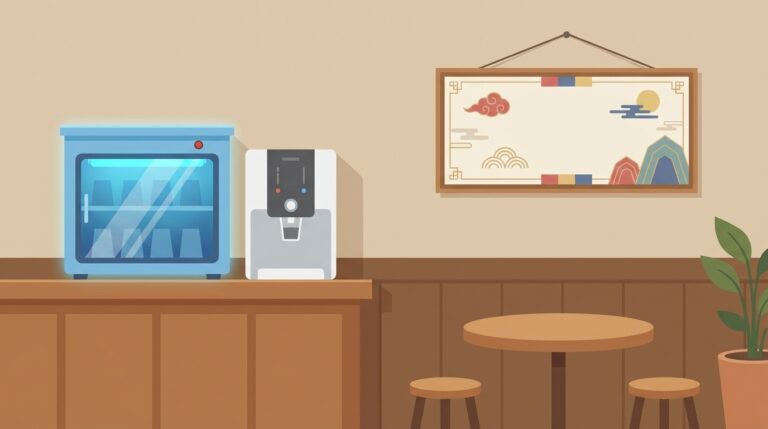
When you see the “물은 셀프” sign, your next mission is to find the cups. Look around the restaurant for a machine that looks like a mini-fridge emitting a futuristic blue or purple light.
This is the 컵 소독기 (Cup Sterilizer)! You don’t need to ask for permission. Just open the door, grab a warm, freshly sanitized stainless steel cup, and head to the water purifier. Opening this box yourself is the ultimate test of your local Nunchi (reading the room).
4-2. K-Food Connection: The “Self” Expansion
If you’ve watched K-Dramas, you know Koreans take their food seriously, and they eat fast. Because of this, “Self” culture has expanded beyond just water.
At many restaurants, you will also see signs like:
– 추가 반찬은 셀프 (Extra side dishes are self-serve)
– 앞치마는 셀프 (Aprons are self-serve)
Instead of waiting 10 minutes for a waiter to bring you more Kimchi, you can just march up to the side-dish bar and load up your plate as much as you want. It’s a win-win: the restaurant saves time, and you get unlimited Kimchi!
Phase 5: Immersive Roleplay
Scenario A: The BBQ Rescue
Setting: Friday night, 7 PM. A smoky, loud BBQ restaurant near Gangnam Station. The smell of roasted garlic is in the air. You are out with your friendly Korean coworker, Minsu.
Minsu: 야, 고기 진짜 맛있다! 많이 먹어!
(Ya, gogi jinjja masitda! Mani meogeo!)
(English: Wow, the meat is so good! Eat a lot!)
(🎭 Stage Direction: Minsu puts a large piece of pork belly with spicy paste on your plate)
YOU: 고마워요 민수 씨! (Takes a bite) 헉… 너무 매워요!
(Gomawoyo Minsu ssi! Heok… neomu maewoyo!)
(English: Thanks Minsu! gasp… It’s so spicy!)
(🎭 Stage Direction: You fan your mouth desperately)
Minsu: 앗, 매워요? 물 마실래요?
(At, maewoyo? Mul masillaeyo?)
(English: Oh, is it spicy? Do you want to drink water?)
YOU: 네, 물 좀… 어? 직원이 안 오네요.
(Ne, mul jom… eo? Jigeoni an oneyo.)
(English: Yes, some water… huh? The staff isn’t coming.)
Minsu: 아, 여기 벽에 써 있잖아요.
(Ah, yeogi byeoge sseo itjanayo.)
(English: Ah, it’s written on the wall here.)
(🎭 Stage Direction: Minsu points to a big sign that says “물은 셀프입니다”)
🔀 Your Turn! How do you respond to show off your local skills?
– A) “사장님!!! 물 주세요!!!” (Boss!!! Give me water!!!)
– B) “아, 셀프군요! 제가 가져올게요. 정수기 어딨어요?”
– C) “민수 씨가 가져다주세요.” (Please bring it for me, Minsu.)✅ Best Choice: B — “Ah, it’s self-serve! I’ll go get it. Where is the water purifier?” You understood the sign, showed initiative, and used the natural word Jeong-su-gi.
⚠️ Choice A Analysis: Yelling for water when there’s a “Self” sign will make the busy staff gently scold you.
⚠️ Choice C Analysis: Minsu might do it because you’re a foreigner, but getting your own water shows you’re adapting to Korean culture beautifully!
Phase 6: 10-Second Shadowing Drill
Time to practice! Follow the slashes (/) for pauses and match the emotion tag.
🥵 급하게 / 저기요, / 정수기 / 어디 있어요?
(geup-ha-ge / jeo-gi-yo, / jeong-su-gi / eo-di isseo-yo?)
[Emotion: 🥵 Urgently/Desperately — Your mouth is on fire!]
Phase 7: K-Culture Glossary
| 한국어 | Romanization | English | Context |
|---|---|---|---|
| 눈치 | nunchi | Social sense | The superpower of reading the room. Noticing the “Self” sign before asking is good nunchi. |
| 셀프 | sel-peu | Self-serve | Konglish for “Do it yourself.” Used for water, side dishes, and aprons. |
| 정수기 | jeong-su-gi | Water purifier | The machine you must find to get your water. |
| 컵 소독기 | keop so-dok-gi | Cup sterilizer | The glowing blue cabinet holding clean stainless steel cups. |
| 맵찔이 | maep-jjil-i | Spicy-food beginner | Slang for someone who can’t handle spicy food. If you are one, always find the water first! |
Phase 8: Traveler’s Survival Kit
Navigating Korean restaurants like a pro requires a few quick phrases. Here are your absolute survival tools.
🆘 Survival Expression #1: Finding the water
– 🇰🇷 “물 어디 있어요?” (Mul eodi isseoyo?)
– 🗣️ Sound-alike: Mool uh-dee ee-so-yo?
– 💡 Meaning: Where is the water?🆘 Survival Expression #2: Checking the rules
– 🇰🇷 “이거 셀프예요?” (Igeo selpeu-yeyo?)
– 🗣️ Sound-alike: Ee-guh cell-poo-yeah-yo?
– 💡 Meaning: Is this self-serve? (Use this while pointing at Kimchi or aprons!)🆘 Survival Expression #3: The classic traveler question
– 🇰🇷 “이거 얼마예요?” (Igeo eolmayeyo?)
– 🗣️ Sound-alike: Ee-guh ull-mah-yeah-yo?
– 💡 Meaning: How much is this? (Great for when you grab a bottled water at a convenience store instead of a restaurant!)📌 Editor’s Travel Note
– Water Bottles: Sometimes, instead of a purifier, there is a large fridge full of cold water pitchers. If the sign says “물은 셀프”, just open the fridge and take a pitcher to your table!
– Tipping: Remember, Korea is a NO-TIP culture! Getting your own water is part of why you don’t need to leave a 20% tip.
Phase 9: Think Deeper — “Food & Identity”
🧠 Think Deeper: The Efficiency of ‘Self’
In many Western countries, dining out is an experience where service is paramount; the waiter pouring your water is part of the hospitality. In Korea, however, the dining identity is heavily tied to community and efficiency (Ppali-ppali). The “Self” culture isn’t a lack of service; it’s a practical system designed to get you eating faster and keeping prices reasonable. When you fetch your own water and extra Kimchi, you become a cooperative part of the restaurant’s bustling ecosystem.💬 Your Turn: Does your culture value “slow and pampered” service, or “fast and efficient” service? Let me know in the comments!
Phase 10: FAQ & Troubleshooting
- Q: What if I really can’t find the water purifier? Can I just ask them to bring it?
- A: Maybe. If the restaurant is empty, a kind auntie might bring it to you. But if it’s busy, they will just point at the machine. It’s best to go get it yourself!
- Q: Are side dishes always self-serve?
- A: Not always. When you first sit down, they will bring the first round of side dishes. If you want more, look for a “추가 반찬은 셀프” (Extra side dishes are self-serve) sign.
❌ Common Mistake #1: Sitting at your table for 15 minutes fuming because the waiter “forgot” your water.
✅ Do this instead: Look around the walls. If you see the letters 셀프, stand up and go on a water hunt!
Phase 11: Wrap-up & Action Items
💡 One-Liner Summary: In Korean restaurants, if you see the word 셀프 (Self), grab a cup from the glowing blue box and get your own water!
Action Mission:
– 🥉 Bronze (Solo): Look in the mirror and practice saying “정수기 어디 있어요?” with a confused, slightly panicked face.
– 🥈 Silver (Online): Go to your favorite K-Drama clip on YouTube featuring a restaurant scene and try to spot the “물은 셀프” sign in the background.
– 🥇 Gold (Real Life): Next time you go to a Korean restaurant in your city, look for the water station. Walk up confidently and serve yourself!
K-Culture Mission:
The next time you watch a K-Drama or a K-Pop idol’s V-Log where they are eating in a local restaurant, pay close attention to the background walls. I guarantee you will spot the “셀프” sign in at least one episode!
Phase 12: Interactive Quiz
1. You walk into a busy Korean noodle shop. You want water. You see a sign that says “물은 셀프입니다”. What should you do?
– A) Press the call button on the table and yell “Water please!”
– B) Wait patiently. They will serve foreigners eventually.
– C) Find the glowing cup sterilizer, grab a cup, and go to the water purifier.
2. Fill in the blank:
“Excuse me, where is the water purifier?”
💬 “저기요, [ ] 어디 있어요?”
– A) 김치 (Kimchi)
– B) 셀프 (Sel-peu)
– C) 정수기 (Jeong-su-gi)
3. True or False – K-Culture Edition:
“In Korean restaurants, you must pay extra if you want a second plate of side dishes (Kimchi, garlic, etc.).”
🚨 Click here for the answers!
- C (Never wait! Be proactive and get it yourself.)
- C (Jeong-su-gi = Water purifier)
- False (Side dishes are almost always free and unlimited in Korea! If there is a ‘셀프’ sign, you can serve yourself as much as you want without paying extra.)
Frequently Asked Questions (FAQ)
Q: What does "물은 셀프입니다 (Water is self-serve)" mean in Korean and how do you pronounce it?
A: In Korean, "물은 셀프입니다 (Water is self-serve)" is pronounced [Mureun selpeu-imnida] and means: a key conversational Korean expression covered in this lesson.
Q: What does "정수기 어디 있어요? (Where is the water purifier?)" mean in Korean and how do you pronounce it?
A: In Korean, "정수기 어디 있어요? (Where is the water purifier?)" is pronounced [Jeong-su-gi eodi isseoyo?] and means: a key conversational Korean expression covered in this lesson.







