

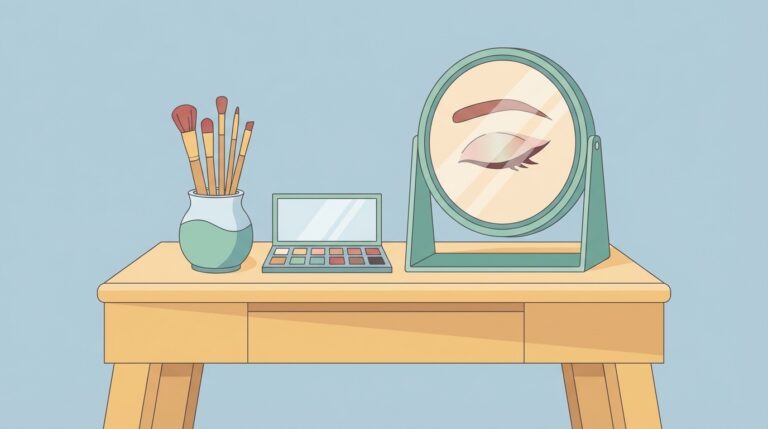
Hello! I’m the Senior Editor at Daily Hangul. Have you ever watched a K-Pop idol’s “Get Ready With Me” (GRWM) vlog, or perhaps dreamed of getting your makeup done at a famous salon in Cheongdam-dong? You might have noticed the makeup artist pulling out a dizzying array of tiny, specialized brushes just for the eyes.
In Korean makeup culture, applying eyeshadow isn’t just “putting on color”; it’s an art form of layering, shading, and blending. If you go to Olive Young and simply say “I want an eye brush,” you’ll be met with an entire wall of highly specific tools. Today, as a C1-level learner, you’re going to move beyond the textbook “눈 화장을 해요” (I do eye makeup) and learn the exact, nuanced vocabulary that Korean makeup artists, beauty YouTubers, and locals use to perfect that flawless K-Beauty look. Let’s dive in!
Phase 2: Deep Dive into Key Expressions
To speak like a true K-Beauty insider, you need to understand the highly specific verbs and nouns used for eye makeup brushes.
1. 총알 브러쉬로 음영을 넣다
- Pronunciation: [Chong-al beureoshwi-ro eum-yeong-eul neota] + Sounds like: “Chong-al blur-ushy-ro oom-young-eul nuh-ta”
- Meaning: (Literal) To put in shading with a bullet brush. / (Real Nuance) To contour/add depth to the crease or outer corner using a pencil brush.
- K-Culture Moment: You’re watching a Korean beauty YouTuber explaining how to get that deep, melancholic K-Drama actress look (사연 있는 눈매). They pick up a small, tapered brush and say this.
- Editor’s Insight: “총알” means bullet. Because the brush head is shaped like a bullet, it’s universally called a 총알 브러쉬 in Korea. “음영” (shading/contouring) is the holy grail of Korean eye makeup—it’s what makes the eyes look naturally deep without harsh eyeliner.
- Situation Spectrum:
[🚫 절대 금지] ———— [⚠️ 주의] ———— [✅ 자유롭게]- Friends/Casual: ✅
- Shopping at Olive Young: ✅
- Professional/Formal: ✅ (It’s standard industry terminology)
- 🤔 Think About It: Korean beauty heavily relies on visual metaphors like “bullet” for a pencil brush. Can you think of any makeup tools in your native language that are named after everyday objects?
2. 경계를 자연스럽게 풀어주다
- Pronunciation: [Gyeong-gye-reul jayeon-seureop-ge pureojuda] + Sounds like: “Gyung-gyeh-reul jah-yun-srup-geh poo-ruh-joo-dah”
- Meaning: (Literal) To naturally loosen the boundaries. / (Real Nuance) To blend out the harsh lines smoothly.
- K-Culture Moment: You’re at a Cheongdam makeup salon. The artist applies a dark shadow as a liner, then takes a clean blending brush to soften the edges, explaining that harsh lines make you look older.
- Editor’s Insight: Notice the verb “풀어주다” (to loosen/untangle). In K-Beauty, blending isn’t just mixing (섞다); it’s “untangling” the strict borders between colors to achieve the famous 꾸안꾸 (effortless) watercolor effect.
- Situation Spectrum:
[🚫 절대 금지] ———— [⚠️ 주의] ———— [✅ 자유롭게]- Friends/Casual: ✅
- Makeup Artist to Client: ✅
- Formal: ✅
- 🤔 Think About It: Why does Korean culture value “풀어주다” (softening boundaries) so much in makeup? How might this reflect the broader cultural preference for harmony over sharp, aggressive contrast?
3. 애교살에 펄을 톡톡 얹어주다
- Pronunciation: [Aegyo-sare peoreul toktok eonjeojuda] + Sounds like: “Egg-yo-sal-eh pur-eul tok-tok un-juh-joo-dah”
- Meaning: (Literal) To tap-tap and place pearl on the aegyo-sal. / (Real Nuance) To lightly dab glitter onto the under-eye fat.
- K-Culture Moment: Think of Wonyoung from IVE or any K-Pop idol on stage. Their under-eyes are sparkling! The artist uses a tiny, flat brush to gently press the glitter on.
- Editor’s Insight: The genius of this phrase is the verb 얹다 (to place/rest) instead of 바르다 (to rub/apply). If you “바르다” glitter, it ruins the base makeup. You must gently “얹다” it. “톡톡” is an adorable onomatopoeia for a light tapping motion.
- Situation Spectrum:
[🚫 절대 금지] ———— [⚠️ 주의] ———— [✅ 자유롭게]- Friends/Casual: ✅
- Beauty Shops: ✅
- Formal: ✅
- 🤔 Think About It: Aegyo-sal (애교살) literally translates to “charming fat.” Why is highlighting under-eye bags considered beautiful in Korea, whereas Western makeup often tries to conceal them?
Phase 3: Textbook vs Real Life
When you hit C1, it’s time to drop the robotic textbook translations and use the tactile, sensory verbs that Koreans actually use.
| Situation | 📖 Textbook Korean | 🗣️ Real Korean | 💡 Why is it different? |
|---|---|---|---|
| Applying glitter | 눈 밑에 반짝이를 바르세요. (Apply glitter under the eyes.) | 애교살에 펄을 살짝 얹어주세요/올려주세요. | K-Beauty distinguishes between smearing base makeup (바르다) and gently placing point colors (얹다/올리다) to protect the layers. |
| Blending colors | 두 색을 잘 섞으세요. (Mix the two colors well.) | 브러쉬로 스머징해서 경계를 풀어주세요. | English loanwords like “스머징” (smudging) and “블렌딩” (blending) are actively used alongside native verbs. |
| Checking brush quality | 이 브러쉬 털이 좋아요. (This brush’s hair is good.) | 이 브러쉬는 모질이 부드럽고 눈가에 안 따가워요. | “털” sounds like animal or body hair. In cosmetics, the elegant Hanja word “모질” (bristle quality/hair texture) is used. |
Bottom Note: For C1 learners, mastering Konglish beauty terms (펄 – pearl/glitter, 스머징 – smudging, 발색 – color payoff/pigmentation) is just as crucial as knowing native Korean verbs!
Phase 4: Cultural Deep Dive — The K-Beauty Universe
4-1. Non-verbal Communication: The “Tap-Tap” (톡톡) Etiquette
If you ever watch a Korean makeup artist use an eyeshadow brush, you’ll notice they never apply it directly to the eye after dipping it in the palette. They always tap the handle against their hand or blow on it slightly (브러쉬를 털어내다). This non-verbal habit prevents “뭉침” (clumping) and “가루날림” (fallout). Also, when someone else is doing your eye makeup, the Korean nunchi rule is to look slightly downward rather than closing your eyes completely tight, which wrinkles the eyelids.
4-2. K-Culture Connection: The Idol Makeup Obsession
The 10-step skincare routine might be famous globally, but in Korea, the 10-brush eye makeup routine is the real secret behind K-Pop idol visuals. Idols often have intense stage lights on them, so their makeup artists use microscopic brushes (like the bullet brush or a flat liner brush) to create fake eyelashes, draw shadows under the aegyo-sal, and place individual specks of glitter. This meticulous attention to detail has driven the Korean cosmetic market to produce some of the highest-quality, most affordable makeup brushes in the world (e.g., Piccasso, Fillimilli).
Phase 5: Immersive Roleplay Scenario
Scenario A: The Olive Young Quest
- Setting: Friday night, 8 PM. The massive Olive Young flagship store in Myeongdong. The store is packed, K-Pop is blasting, and you are standing in front of the “Beauty Tools” section, overwhelmed by 50 different brushes.
- Characters:
- YOU: A makeup enthusiast looking for the perfect brush to blend your eyeshadow without irritating your sensitive eyelids.
- Ji-eun (20s): A friendly, fast-talking Olive Young employee.
Ji-eun: 고객님, 찾으시는 상품 있으세요? 😊
(Gogaengnim, chajeusineun sangpum isseuseyo?)
[Customer, is there a product you are looking for?]
(🎭 Stage Direction: Ji-eun approaches with a small basket in hand)
YOU: 아, 네. 아이섀도우 브러쉬 하나 보려고요. 너무 크지 않은 걸로요.
(Ah, ne. aishyaedou beureoshwi hana boryeogoyo. neomu keuji aneun geolloyo.)
[Ah, yes. I’m looking for an eyeshadow brush. One that isn’t too big.]
Ji-eun: 아! 베이스용 찾으세요, 아니면 포인트용 찾으세요?
(Ah! beiseuyong chajeuseyo, animyeon pointeuyong chajeuseyo?)
[Ah! Are you looking for a base brush or a point brush?]
YOU: 음영 넣고 경계 풀어줄 때 쓸 거라서요.
(Eum-yeong neoko gyeong-gye pureojul ttae sseul georaseoyo.)
[I’m going to use it for shading and softening the boundaries.]
Ji-eun: 그럼 이 총알 브러쉬 어떠세요? 요즘 저희 매장 베스트셀러예요.
(Geureom i chong-al beureoshwi eotteoseyo? yojeum jeohui maejang best-seller-yeyo.)
[Then how about this bullet brush? It’s our store’s best-seller these days.]
🔀 당신의 차례! How do you answer?
– A) “얼마예요? 살게요.” (How much? I’ll buy it. – A bit too abrupt!)
– B) “제가 눈가가 예민한데, 모질이 부드러운 편인가요?”
– C) “털이 좀 따가워 보이네요. 대박 별로예요.” (The hair looks prickly. It totally sucks. – Too rude!)✅ Best Choice: B — “I have a sensitive eye area; is the bristle quality on the softer side?” This shows C1-level fluency by using “모질” instead of “털” and accurately describing your skin concern.
Ji-eun: 네! 인조모인데도 천연모만큼 모질이 부드러워서 눈가에 자극이 전혀 없어요. 여기 테스터로 손등에 한번 발색해 보세요!
(Ne! injomo-indedo cheonyeonmo-mankeum mojiri budeureowoseo nungae jageugi jeonhyeo eopseoyo. yeogi teseuteoro sondeunge hanbeon balsaekhae boseyo!)
[Yes! Even though it’s synthetic hair, the bristles are as soft as natural hair, so there’s no irritation at all. Try testing the pigmentation on the back of your hand with this tester!]
Scenario B: Bonus — The Salon Request
You booked a makeup session before your trip to Gyeongbokgung to take Hanbok photos.
YOU: 선생님, 저는 눈 화장이 잘 번지는 편이에요.
(Seonsaengnim, jeoneun nun hwajangi jal beonjineun pyeon-ieyo.)
[Teacher (MUA), my eye makeup tends to smudge easily.]
MUA: 아, 그러시구나. 그럼 섀도우 얹기 전에 파우더 처리 먼저 꼼꼼하게 해드릴게요!
(Ah, geureosiguna. geureom shyaedou eon-gi jeone paudeo cheori meonjeo kkomkkomhage haedeurilgeyo!)
[Ah, I see. Then I’ll meticulously apply powder first before placing the eyeshadow!]
Phase 6: 10-Second Shadowing Drill
Practice this sentence to sound exactly like a Cheongdam makeup artist. Follow the intonation guides!
😊 베이스를 / 얇게 깔아준 다음에, / 총알 브러쉬로 / 경계를 / 살~짝 풀어주세요.
(beiseu-reul / yalkke kkarajun da-eume, / chong-al beureoshwi-ro / gyeong-gye-reul / sal~jjak pureojuseyo.)
[After laying down the base thinly, use a bullet brush to liiightly soften the boundaries.]
Pro-tip: Stretch out the “살~짝” (lightly) to emphasize how gentle the blending should be!
Phase 7: K-Culture Mini Glossary
| 한국어 | Romanization | English | Context |
|---|---|---|---|
| 모질 | mojil | Bristle quality | Used when evaluating how soft/scratchy a makeup brush is. |
| 발색 | balsaek | Color payoff / Pigmentation | How vividly an eyeshadow shows up on the skin. |
| 애교살 | aegyo-sal | Under-eye fat | The pocket of fat under the eye, highlighted to look youthful. |
| 가루날림 | garunallim | Fallout | When powdery eyeshadow drops onto your cheeks during application. |
| 뭉치다 | mungchida | To clump/cake | When makeup doesn’t blend well and sticks together in patches. |
| 꾸안꾸 | kku-an-kku | Effortless chic | Short for 꾸민 듯 안 꾸민 듯 (Like you dressed up, but didn’t). |
Phase 8: Traveler’s Survival Kit (Olive Young Edition)
Shopping for beauty tools in Korea is a must-do. Here are your C1 survival phrases!
🆘 서바이벌 표현 TOP 3
– 🇰🇷 1. “이 섀도우 팔레트, 발색 테스트 해봐도 되나요?”
(Can I test the pigmentation of this eyeshadow palette?)
– 🇰🇷 2. “이 브러쉬 가루날림은 심하지 않은가요?”
(Does this brush cause a lot of fallout?)
– 🇰🇷 3. “이거 세일 상품인가요, 아니면 정상가인가요?”
(Is this a sale item or regular price?)
📌 Editor’s Travel Note
– Olive Young Sales: Keep an eye out for the legendary “올영세일” (Olyoung Sale), which happens at the beginning of March, June, September, and December. Brushes like the Fillimilli line go on massive discounts!
– Hygiene: Always use the disposable applicators provided near the tester stations, and never apply lip or eye products directly from the tester to your face.
Phase 9: Think Deeper — K-Beauty and Identity
Media vs Reality: The Perfection of K-Beauty
In Korean media, celebrities possess impossibly perfect, “poreless” skin and intricate eye makeup that requires 10 different brushes. This trend—often called “아이돌 메이크업” (Idol makeup)—reflects a society that deeply values presentation, detail, and self-care. However, does every Korean do this at 7 AM before work? Absolutely not! The reality is that most office workers rely on a quick cushion foundation and a single finger swipe of eyeshadow. K-Beauty media showcases an idealized artistry, representing the peak of aesthetic craftsmanship rather than the daily grind.
💬 Your Turn: In your culture, is a highly detailed, multi-tool makeup routine seen as an art form, a burden, or just for special occasions? Share your thoughts in the comments!
Phase 10: FAQ & Troubleshooting
Q: Can I use “붓” instead of “브러쉬”?
A: Yes, “붓” is the native Korean word for brush. However, in the modern cosmetics industry, “브러쉬” (brush) is used 90% of the time. “붓” sounds a bit more like a paintbrush for art class (미술 붓), though you will hear “붓펜 아이라이너” (Brush pen eyeliner).
Q: I heard “글리터” (Glitter) and “펄” (Pearl). Are they the same?
A: In K-Beauty, they have slightly different nuances. “펄” refers to very fine, subtle shimmer (great for highlighters or base shadow). “글리터” refers to chunky, highly reflective sparkles (used for K-Pop idol stage makeup).
❌ Common Mistake #1: Saying “눈 지방” (Eye fat) instead of “애교살”.
✅ How to fix it: If you say “지방” (medical/literal fat), it sounds like you have a medical condition! Always use “애교살” when talking about the charming under-eye highlight.
Phase 11: Wrap-up & Action Items
One-Liner Summary: Mastering K-Beauty eye makeup vocabulary is all about using delicate verbs like “풀어주다” (blend/soften) and “얹다” (place gently), paired with specific nouns like “모질” (bristle quality).
Action Mission 3 Steps:
– 🥉 Bronze (Solo): Look at your own makeup bag. Pick up a small brush and say, “이건 총알 브러쉬예요” (This is a bullet brush).
– 🥈 Silver (Online): Find a Korean makeup tutorial on YouTube, turn off the subtitles, and see if you can catch the words “음영” or “경계”!
– 🥇 Gold (Real Life): Visit a Korean cosmetic store (or Olive Young if you’re in Korea) and ask, “모질이 부드러운 총알 브러쉬 있나요?”
K-Culture Mission: Watch any K-Pop idol’s music video today and look closely at their under-eyes. Can you spot how they used a brush to “애교살에 펄을 얹었는지” (place glitter on their aegyo-sal)?
Phase 12: Interactive Quiz
1. Situational Judgment: You are getting your makeup done, and the artist asks if you want your eyeshadow to look deep and cinematic. What keyword should you use to say “Yes, please add some depth/contouring”?
– A) 펄 (Pearl)
– B) 발색 (Pigmentation)
– C) 음영 (Shading/Depth)
2. Fill in the Blank:
“이 브러쉬로 섀도우를 바른 뒤에 경계를 자연스럽게 _________.”
(After applying eyeshadow with this brush, naturally _______ the boundaries.)
– A) 얹어주세요
– B) 풀어주세요
– C) 뭉치세요
3. True or False – K-Culture Edition:
“In Korean cosmetic stores, ‘모질’ refers to the color of the eyeshadow palette.” (T/F)
(Answers: 1: C, 2: B, 3: False – ‘모질’ refers to the bristle quality of a brush!)
Frequently Asked Questions (FAQ)
Q: What does "총알 브러쉬로 음영을 넣다" mean in Korean and how do you pronounce it?
A: In Korean, "총알 브러쉬로 음영을 넣다" is pronounced [Chong-al beureoshwi-ro eum-yeong-eul neota] and means: (Literal) To put in shading with a bullet brush. / (Real Nuance) To contour/add depth to the crease or outer corner using a pencil brush.
Q: What does "경계를 자연스럽게 풀어주다" mean in Korean and how do you pronounce it?
A: In Korean, "경계를 자연스럽게 풀어주다" is pronounced [Gyeong-gye-reul jayeon-seureop-ge pureojuda] and means: (Literal) To naturally loosen the boundaries. / (Real Nuance) To blend out the harsh lines smoothly.
Q: What does "애교살에 펄을 톡톡 얹어주다" mean in Korean and how do you pronounce it?
A: In Korean, "애교살에 펄을 톡톡 얹어주다" is pronounced [Aegyo-sare peoreul toktok eonjeojuda] and means: (Literal) To tap-tap and place pearl on the aegyo-sal. / (Real Nuance) To lightly dab glitter onto the under-eye fat.







