

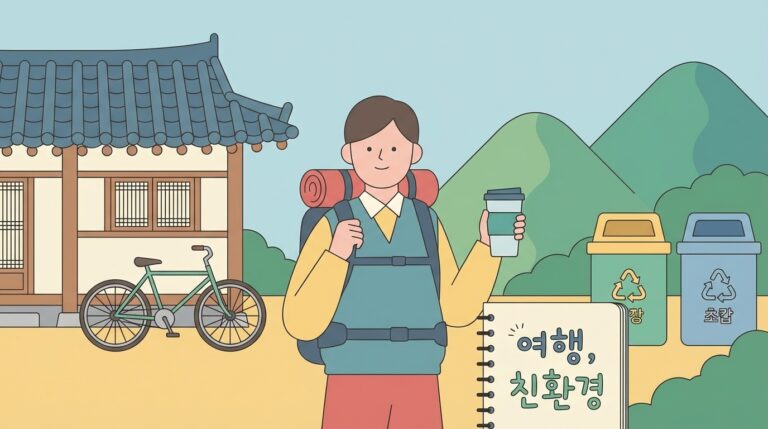
Phase 1: Immersive Hook — Welcome to the Green Side of Korea
Hello there! It’s your Daily Hangul Editor.
Picture this: You’re strolling through the trendy, industrial-chic alleys of Seongsu-dong, or perhaps you’re breathing in the salty ocean air on Jeju Island. You walk into a beautifully designed minimalist café. The aesthetic is perfect, but there’s a catch—it’s a ‘Zero-Waste’ café.
In K-Dramas, we often see romantic scenes where neighbors bump into each other while taking out the recycling (분리수거 – bunlisugeo). It’s a staple of Korean daily life! But when you’re actually standing in front of five different colored bins holding a plastic cup with a paper sleeve and leftover ice, the romance quickly fades into sheer panic. Or maybe you’ve ordered food delivery to your hotel, and you suddenly realize you don’t want them to send you a mountain of plastic spoons and wooden chopsticks.
South Korea is rapidly embracing eco-tourism and sustainable living. Knowing how to navigate this doesn’t just make you an environmentally responsible traveler; it earns you massive respect from the locals. You go from being a ‘tourist’ to an ‘insider’ who truly respects the community.
This guide is crafted from the real, slightly panicked questions my advanced students have asked me. Let’s dive into the authentic, C1-level Korean you need for sustainable travel!
Phase 2: Deep Dive into Core Expressions
1. 일회용품은 빼주세요.
- Pronunciation: [il-hoe-yong-pum-eun ppae-ju-se-yo] + [il-hweh-yong-poom-eun peh-joo-seh-yo]
- Meaning: (Literal) Please take out the single-use items. / (Real nuance) I don’t need disposable utensils/items.
- K-Culture Moment: You’ll see this phrase literally built into Korean food delivery apps like Baemin (배달의민족) as a checkbox. When ordering takeout at a local bunsik (snack) shop, saying this as they start bagging your food makes you look incredibly culturally fluent.
- Editor’s Insight: The verb 빼다 (to remove/leave out) is incredibly versatile. You use it for “No onions, please” (양파 빼주세요) and for refusing plastics. It’s polite, direct, and completely natural.
- Situation Spectrum:
[🚫 절대 금지] ———— [⚠️ 주의] ———— [✅ 자유롭게]- Friends/Casual: ✅ (일회용품 빼고 줘)
- Store Clerks/Service workers: ✅ (일회용품은 빼주세요)
- Formal Business: ✅ (일회용품은 제외해 주십시오)
- 🤔 Think About It: South Korea has a massive delivery culture (배달 문화), which traditionally generated huge amounts of waste. Why do you think the government made ‘opting out’ of plastics the default on delivery apps? How does convenience culture clash with sustainability in your home country?
2. 텀블러에 담아주시겠어요?
- Pronunciation: [teom-beul-leo-e dam-a-ju-si-gess-eo-yo?] + [tum-bleh-raw-eh dahm-ah-joo-she-gess-uh-yo?]
- Meaning: (Literal) Would you put it in the tumbler? / (Real nuance) Can I get this in my own cup, please?
- K-Culture Moment: During the “Yong-gi-nae” (용기내) Challenge—a viral social media movement in Korea where people brought their own containers to restaurants—this was the go-to phrase. (Fun fact: 용기 means both ‘courage’ and ‘container’!).
- Editor’s Insight: Instead of demanding “Put it here,” using 담아주시겠어요? (Would you be willing to put it in…?) softens the request beautifully. It shows high-level linguistic tact (눈치).
- Situation Spectrum:
[🚫 절대 금지] ———— [⚠️ 주의] ———— [✅ 자유롭게]- Friends/Casual: ⚠️ (Too formal for friends. Just say “여기 담아줘”)
- Baristas/Clerks: ✅
- Elders/Bosses: 🚫 (You wouldn’t usually ask them to serve you)
- 🤔 Think About It: Many Korean cafes offer a ‘텀블러 할인’ (tumbler discount). Does the language we use to ask for favors change when we know we are doing something socially approved, like saving the environment?
3. 영수증은 버려주세요. / 괜찮습니다.
- Pronunciation: [yeong-su-jeung-eun beo-ryeo-ju-se-yo / gwaen-chan-seum-ni-da] + [young-soo-jung-eun buh-ryuh-joo-seh-yo / gwen-chan-soom-nee-dah]
- Meaning: (Literal) Please throw away the receipt / It’s okay. / (Real nuance) I don’t need a receipt, save the paper.
- K-Culture Moment: At convenience stores (CU, GS25), the clerk will almost always ask, “영수증 필요하세요?” (Do you need a receipt?). Replying with a quick wave of the hand and “괜찮습니다” (It’s okay/I don’t need it) is the ultimate local move.
- Editor’s Insight: Korea is moving heavily towards paperless systems. You can even set your KakaoPay or NaverPay to only issue mobile receipts (전자 영수증).
- Situation Spectrum:
[🚫 절대 금지] ———— [⚠️ 주의] ———— [✅ 자유롭게]- Anyone offering a receipt: ✅
Phase 3: Textbook vs Real Life
| Situation | 📖 Textbook Korean | 🗣️ Real Korean | 💡 Why the difference? |
|---|---|---|---|
| Dining In | 매장에서 먹고 가겠습니다. 일회용 컵은 안 쓰겠습니다. (I will eat at the store. I will not use a disposable cup.) | 먹고 갈게요. 머그잔에 주세요. (I’ll eat and go. Mug, please.) | Real Korean is highly contextual; “eating and going” implies you need a store mug due to Korean laws banning plastics for dine-in. |
| Asking about a discount | 다회용기를 가져오면 할인을 받을 수 있습니까? (Can I receive a discount if I bring a multi-use container?) | 텀블러 할인 되나요? (Does the tumbler discount apply?) | Brevity! Koreans love shortening phrases. ‘텀블러 할인’ functions as a compound noun. |
| Refusing a bag | 환경 보호를 위해 비닐봉지는 필요 없습니다. (I do not need a plastic bag to protect the environment.) | 봉투 괜찮아요. 가방에 넣을게요. (Bag is okay [meaning no]. I’ll put it in my bag.) | ‘괜찮아요’ (It’s okay) is the ultimate polite refusal. No need to explain the environmental reasoning. |
Phase 4: Cultural Deep Dive — The K-Culture Connection
4-1. Non-verbal Communication: The ‘Tumbler Handover’
When handing your tumbler to a barista, make sure the lid is already taken off. Handing over a closed tumbler makes extra work for the busy staff, and in the fast-paced Palli-palli (빨리빨리) culture of Korean cafes, showing consideration (눈치 – Nunchi) by prepping your cup is highly appreciated. Pass it with two hands, or one hand supporting the other arm, to show politeness.
4-2. K-Culture Connection: The Idol Vegan & Eco-Warrior Trend
In the K-Pop world, sustainability is becoming a massive trend. Fandoms are increasingly protesting against the over-production of physical albums (which creates plastic waste from photocards). Many K-Pop idols now openly share their ‘Vegan’ (비건) or ‘Plogging’ (플로깅 – jogging while picking up trash) lifestyles on V-Live or Instagram.
If you go to a vegan restaurant in Itaewon or a zero-waste pop-up store in Seongsu, you might just be following a “tour course” mapped out by a K-Pop fandom celebrating their idol’s birthday with eco-friendly events instead of traditional subway ads!
Phase 5: Immersive Roleplay Scenario
Scenario A: The Zero-Waste Cafe in Yeonnam-dong
Setting: Saturday afternoon, 2 PM. A minimalist, plant-filled café in Yeonnam-dong. The line is long. You’ve brought your own tumbler to get a discount on an iced Americano.
Characters:
– YOU: An eco-conscious traveler exploring Seoul.
– Barista Ji-hoon (25): Fast, efficient, wearing a stylish canvas apron.
Ji-hoon: 안녕하세요, 주문 도와드릴까요? 😊
(an-nyeong-ha-se-yo, ju-mun do-wa-deu-ril-kka-yo?)
(Hello, can I help you with your order?)
YOU: 네, 아이스 아메리카노 한 잔 부탁드려요. 여기 텀블러에 담아주시겠어요?
(ne, a-i-seu a-me-ri-ka-no han jan bu-tak-deu-ryeo-yo. yeo-gi teom-beul-leo-e dam-a-ju-si-gess-eo-yo?)
(Yes, one iced Americano please. Could you put it in this tumbler?)
(🎭 Stage Direction: You hand over the tumbler with the lid already off.)
Ji-hoon: 네, 알겠습니다. 텀블러 할인 300원 적용해 드릴게요. 드시고 가시나요?
(ne, al-gess-seum-ni-da. teom-beul-leo hal-in sam-baek-won jeok-yong-hae deu-ril-ge-yo. deu-si-go ga-si-na-yo?)
(Yes, understood. I’ll apply the 300 won tumbler discount. Are you having it here?)
YOU: 아뇨, 가지고 갈게요.
(a-nyo, ga-ji-go gal-ge-yo.)
(No, I’ll take it to go.)
Ji-hoon: 결제 도와드리겠습니다. 영수증 필요하세요?
(gyeol-je do-wa-deu-ri-gess-seum-ni-da. yeong-su-jeung pil-yo-ha-se-yo?)
(I’ll help you with the payment. Do you need a receipt?)
YOU: 아, 영수증은 괜찮습니다.
(a, yeong-su-jeung-eun gwaen-chan-seum-ni-da.)
(Ah, the receipt is fine/I don’t need it.)
Ji-hoon: 네, 음료 나오면 불러드릴게요. 빨대 꽂아 드릴까요?
(ne, eum-nyo na-o-myeon bul-leo-deu-ril-ge-yo. ppal-dae kkoj-a deu-ril-kka-yo?)
(Yes, I’ll call you when the drink is ready. Shall I put a straw in it?)
🔀 Your Turn! How should you respond?
– A) “아니요, 저는 환경을 지키는 사람입니다!” (No, I am a person who protects the environment!)
– B) “네, 감사합니다.” (Yes, thank you.)
– C) “아, 빨대는 괜찮아요. 그냥 마실게요.” (Ah, the straw is okay [I don’t need it]. I’ll just drink it as is.)✅ Best Choice: C — Reason: It’s natural, polite, and uses the magic word ‘괜찮아요’ for refusal.
⚠️ Choice A Analysis: While technically correct grammatically, it sounds like a line from a superhero cartoon. You will definitely make the barista laugh, but it’s not natural everyday Korean!
Scenario B: Bonus Roleplay — The Convenience Store Confusion
Setting: You bought a sandwich and a drink. The clerk asks if you want to buy a plastic bag (봉투 – bongtu), which costs 20 to 50 won by law in Korea.
Clerk: 봉투 필요하세요? (bong-tu pil-yo-ha-se-yo? / Need a bag?)
YOU: 아, 장바구니 챙겨왔어요. 그냥 담아갈게요. (a, jang-ba-gu-ni chaeng-gyeo-wass-eo-yo. geu-nyang dam-a-gal-ge-yo. / Ah, I brought my eco-bag. I’ll just pack it myself.)
Clerk: 네, 결제 되셨습니다. 안녕히 가세요! (Payment is done. Have a good day!)
Phase 6: 10-Second Shadowing Drill
Speak these out loud! Pay attention to the pauses (/) and emotions.
😊 저기요, / 일회용품은 / 빼주세요! (jeo-gi-yo, / il-hoe-yong-pum-eun / ppae-ju-se-yo!)
🥺 아, / 영수증은 / 버려주셔도 돼요. (a, / yeong-su-jeung-eun / beo-ryeo-ju-syeo-do dwae-yo.)
😤 비닐봉투 / 안 주셔도 괜찮아요. / 가방에 / 넣을게요. (bi-nil-bong-tu / an ju-syeo-do gwaen-chan-a-yo. / ga-bang-e / neoh-eul-ge-yo.)
Phase 7: K-Culture Glossary (Eco-Travel Edition)
| Korean | Romanization | English | Context |
|---|---|---|---|
| 분리수거 | bunlisugeo | Waste sorting/Recycling | Korea has one of the strictest recycling systems in the world. You must separate paper, plastics, vinyl, and food waste! |
| 다회용기 | dahoeyonggi | Reusable container | Often seen in campaigns or zero-waste shops. |
| 장바구니 | jangbaguni | Reusable shopping bag | Literally “market basket.” Used instead of plastic bags. |
| 플로깅 | peulloging | Plogging | Picking up trash while jogging. A very popular eco-tour activity on Jeju Island beaches. |
| 용기내 | yongginae | Bring your own container | A pun combining “courage” and “container.” A movement to reduce takeout waste. |
Phase 8: Traveler’s Survival Kit
🆘 Survival Phrases for Eco-Conscious Travelers
– 🇰🇷 “이거 재활용 되나요?” (i-geo jae-hwal-yong doe-na-yo?)
– 🗣️ English: Can this be recycled?
– 📍 Where to use: Asking your Airbnb host or a café worker when looking at a complex piece of trash.
- 🇰🇷 “비건 메뉴 있나요?” (bi-geon me-nyu it-na-yo?)
- 🗣️ English: Do you have a vegan menu?
- 📍 Where to use: Restaurants. (Note: Veganism is growing, but still not universally understood in rural areas. You might need to specify “고기 빼주세요” – no meat).
🇰🇷 “매장용 컵으로 주세요.” (mae-jang-yong keob-eu-ro ju-se-yo.)
- 🗣️ English: Please give it to me in a store mug.
- 📍 Where to use: Cafes, to ensure you don’t get a disposable cup if you’re dining in.
📌 Editor’s Travel Note
– Useful Apps: Use Naver Maps and search “제로웨이스트” (Zero Waste) or “비건” (Vegan) to find highly rated eco-friendly spots.
– The Food Waste Shock: In Korea, food waste (음식물 쓰레기) is strictly separated from general trash. If you’re staying in an Airbnb, ask your host specifically where the food waste bin is! Never put bones or shells in food waste; they go in the general trash.
Phase 9: Think Deeper — “Korean in the Global Era”
🧠 Think Deeper: Konglish vs. Native Korean in the Green Movement
As sustainability becomes a global trend, the Korean language has absorbed many English terms: Zero Waste (제로웨이스트), Vegan (비건), Plogging (플로깅), and Upcycling (업사이클링). However, there is a fascinating pushback from pure Korean language enthusiasts. For example, instead of “Plogging,” the beautiful native Korean phrase “쓰담달리기” (Sseudam-dalligi) was coined. It combines “running” with “쓰담” (a pun on stroking/comforting the earth, and picking up trash). This shows how the Korean language isn’t just passively borrowing foreign words, but actively molding global concepts to fit the emotional resonance of Korean culture.💬 Your Turn: Does your home country use English loanwords for environmental concepts, or do you have your own native terms? Share in the comments!
Phase 10: Troubleshooting (FAQ & Common Mistakes)
Q: Can I ask for a tumbler discount (텀블러 할인) anywhere?
Yes, at most major franchises (Starbucks, Mega Coffee, Ediya). However, small independent cafes might not have a discount system in place. It’s always safe to ask politely: “혹시 텀블러 할인 되나요?” (By any chance, is there a tumbler discount?)
Q: What if I don’t know how to recycle something?
Don’t stress too much! If you’re at a cafe, look at what others are doing. Usually, liquids go in one bin, plastic cups in another, and general trash (like napkins) in a third. When in doubt, ask: “이거 어디에 버려요?” (Where should I throw this away?)
❌ Common Mistake #1: Saying “종이컵 안 돼” (Paper cup no) to a barista.
✅ Do this instead: It sounds too aggressive and uses informal speech (반말). Always use the polite form: “일회용 컵 말고 머그잔에 주세요” (Instead of a disposable cup, please give me a mug.)
Phase 11: Wrap-up & Action Items
🎯 One-Liner Summary: Mastering eco-friendly phrases like “일회용품 빼주세요” not only saves the planet but instantly upgrades your Korean from ‘tourist’ to ‘respectful local.’
Action Mission:
– 🥉 Bronze (Solo): Stand in front of a mirror and practice handing over an invisible tumbler while saying, “여기 담아주시겠어요?”
– 🥈 Silver (Online): Open Naver Maps or KakaoMap, search for a “제로웨이스트샵” (Zero Waste Shop) in Seoul, and read one of the Korean reviews.
– 🥇 Gold (Real Life): The next time you order coffee in Korea (or at a Korean-run cafe abroad), successfully refuse a receipt or plastic straw in Korean!
🌿 K-Culture Eco-Mission:
Go to YouTube and search for “플로깅 브이로그” (Plogging Vlog) or “제로웨이스트 한국” (Zero Waste Korea). Watch how locals actually use these terms in their daily lives!
Phase 12: Interactive Quiz
1. Situational Judgment: You are ordering food delivery to your hotel room on a Korean app. You already have travel utensils. What should you write in the request box?
– A) 젓가락 많이 주세요. (Please give me lots of chopsticks.)
– B) 일회용 수저 포크 빼주세요. (Please leave out disposable spoons and forks.)
– C) 영수증 버려주세요. (Please throw away the receipt.)
2. Fill in the Blank:
Barista: 영수증 필요하세요?
You: 아, _____________. (Ah, it’s okay / I don’t need it.)
3. True or False – K-Culture Edition:
In Korea, chicken bones and clam shells must be strictly separated and thrown into the “Food Waste” (음식물 쓰레기) bin. (T/F)
(Answers: 1. B, 2. 괜찮습니다 / 괜찮아요, 3. False! Bones and shells are considered general waste [일반 쓰레기] because they cannot be processed into animal feed or fertilizer.)
Frequently Asked Questions (FAQ)
Q: What does "일회용품은 빼주세요." mean in Korean and how do you pronounce it?
A: In Korean, "일회용품은 빼주세요." is pronounced [il-hoe-yong-pum-eun ppae-ju-se-yo] and means: (Literal) Please take out the single-use items. / (Real nuance) I don't need disposable utensils/items.
Q: What does "텀블러에 담아주시겠어요?" mean in Korean and how do you pronounce it?
A: In Korean, "텀블러에 담아주시겠어요?" is pronounced [teom-beul-leo-e dam-a-ju-si-gess-eo-yo?] and means: (Literal) Would you put it in the tumbler? / (Real nuance) Can I get this in my own cup, please?
Q: What does "영수증은 버려주세요. / 괜찮습니다." mean in Korean and how do you pronounce it?
A: In Korean, "영수증은 버려주세요. / 괜찮습니다." is pronounced [yeong-su-jeung-eun beo-ryeo-ju-se-yo / gwaen-chan-seum-ni-da] and means: (Literal) Please throw away the receipt / It's okay. / (Real nuance) I don't need a receipt, save the paper.







