

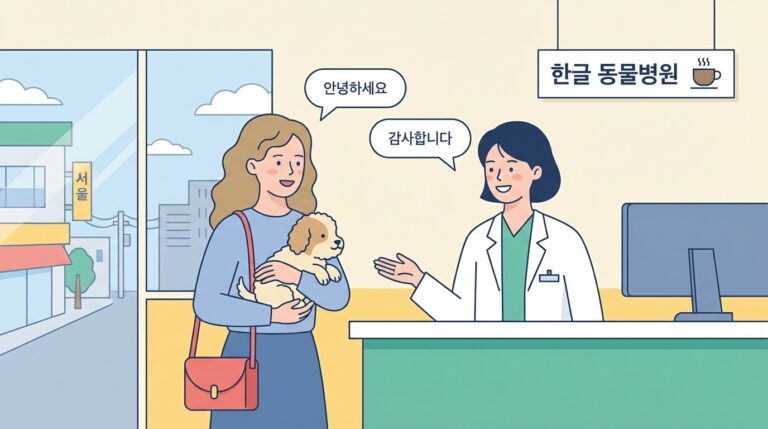
Phase 1: Empathy — Immersive Opening
Hello! I’m the lead editor of Daily Hangul. Have you ever watched a K-Drama where a stylish protagonist pushes a luxury stroller into a pristine, bright clinic that looks like a high-end café, only to reveal… a tiny, fluffy Pomeranian? Welcome to the modern Korean pet culture!
If you’ve adopted a furry friend in Korea or brought yours from home, you’ll eventually need to visit a 동물병원 (Dongmul Byeongwon), which literally translates to ‘Animal Hospital’ (yep, even for a simple check-up, it’s called a hospital!).
Walking into a medical facility in a foreign country is stressful enough. Throw in the anxiety of making sure your pet gets the right 예방접종 (vaccination), and your mind might go completely blank. What if the vet asks about side effects? What if you don’t understand their instructions for aftercare?
Don’t worry! I’ve guided countless expats through this exact scenario. This guide is built on real-life experiences to help you navigate a Korean vet clinic not just accurately, but like a true local who totally gets the 펫팸족 (Pet-Fam) vibe.
Phase 2: Deep Dive into Core Expressions
Let’s break down the 3 absolute must-know phrases for your vet visit.
1. 예방접종 하러 왔어요.
- Pronunciation: [yebang-jeopjong ha-reo wasseoyo]
(Tip: ‘ye’ sounds like ‘yeah’, and ‘wasseoyo’ sounds like ‘wassup’ but ending with ‘oh’) - Meaning:
- Literal: I came in order to do preventative inoculation.
- Real Nuance: I’m here for my pet’s vaccinations.
- K-Culture Moment: When you walk into a neighborhood vet clinic, the friendly nurse at the front desk will look at you expectantly. You just smile, point at your pet carrier, and drop this phrase. It immediately tells them exactly what you need without a long, complicated medical explanation.
- Editor’s Insight: The grammar
-러 왔어요(came to do [action]) is your best friend in Korea. We use it everywhere—from the bank to the vet. It sounds so much more natural than saying “I want a vaccine” (백신을 원해요), which sounds like you’re buying a product off a shelf. - Situation Spectrum:
[🚫 절대 금지] ———— [⚠️ 주의] ———— [✅ 자유롭게]- To friends (Casual): 🚫 (Use ‘예방접종 하러 왔어’)
- To clinic staff (Semi-formal/Formal): ✅
- 🤔 Think About It: Why does Korean rely so heavily on the verb ‘오다’ (to come) or ‘가다’ (to go) to explain one’s purpose? Does your language focus more on the desire (“I want”) or the action of arriving (“I came to”)?
2. 주사 맞을 때 안 울었어요?
- Pronunciation: [jusa majeul ttae an ureosseoyo?]
(Tip: ‘jusa’ sounds like ‘juice-ah’, and ‘ureosseoyo’ has a soft, rolling ‘r’ like the Spanish single r) - Meaning:
- Literal: Did they not cry when getting the injection?
- Real Nuance: Were they a good boy/girl during the shot?
- K-Culture Moment: The vet brings your dog back from the treatment room. You want to know if they threw a tantrum. In Korea, we treat pets like literal babies, so we ask if they “cried” (울다) instead of “barked” or “yelped”.
- Editor’s Insight: This phrase shows deep affection. If you ask the vet this, they will instantly recognize you as a deeply caring ‘pet parent’.
- Situation Spectrum:
[🚫 절대 금지] ———— [⚠️ 주의] ———— [✅ 자유롭게]- To the Vet/Nurse: ✅
- To other pet owners at the park: ✅
- 🤔 Think About It: Humanizing pets through language is a huge trend in Korea. Have you noticed how Koreans use human honorifics or baby talk for pets?
3. 부작용이 있을 수 있으니 잘 지켜봐 주세요.
- Pronunciation: [bujagyongi isseul su isseuni jal jikyeobwa juseyo]
- Meaning:
- Literal: There might be side effects, so please watch them well.
- Real Nuance: Keep a close eye on them in case they have a bad reaction to the vaccine.
- K-Culture Moment: You’ll hear this at the very end of your visit. The vet will hand you your pet, look you straight in the eye with a serious but warm expression, and say this. It’s the ultimate sign of Korean medical care—always emphasizing aftercare and observation.
- Editor’s Insight: You don’t need to say this, but you absolutely must understand it. ‘잘 지켜봐 주세요’ (Please watch them carefully) is a phrase you will hear in hospitals, daycares, and schools alike.
- Situation Spectrum:
[🚫 절대 금지] ———— [⚠️ 주의] ———— [✅ 자유롭게]- You will mostly hear this from professionals: ✅
Phase 3: Textbook vs Real Life
| Situation | 📖 Textbook Korean | 🗣️ Real Korean | 💡 Why is it different? |
|---|---|---|---|
| Announcing your arrival | 강아지에게 백신을 주사해 주세요. (Please inject the vaccine into the dog.) | 우리 애기 예방접종 하러 왔어요. (Our baby is here for vaccinations.) | Pet owners use “우리 애기” (our baby) instead of “강아지” to show family bonding. |
| Asking the vet to be gentle | 아프지 않게 해 주세요. (Please do it so it doesn’t hurt.) | 선생님, 살살 부탁드려요~ (Doctor, please do it gently~) | “살살” (gently/softly) is a highly colloquial, friendly way to ask for a light touch. |
| Asking about food after | 식사는 언제 할 수 있습니까? (When can they have a meal?) | 밥은 언제 줘도 돼요? (When can I give them food?) | “식사” (meal) is too formal for a pet. We just say “밥” (rice/food). |
Bottom Note: At the B1 level, avoid overly stiff robotic sentences. Throwing in a “우리 애기” or “살살 부탁드려요” will immediately make you sound fluent and socially aware!
Phase 4: Cultural Deep Dive
4-1. Non-verbal Communication (The Pet-Parent Nunchi)
When you hand over your pet carrier to the vet or nurse, use both hands. Even though you are handing over an animal, the two-handed gesture shows respect to the medical professional. Also, it’s common to refer to yourself not as “me” but as “보호자” (Guardian/Protector). The vet will call you “망고 보호자님” (Mango’s Guardian), not by your actual name!
4-2. K-Culture Connection: The Rise of ‘Gae-mocha’
If you walk around upscale neighborhoods like Gangnam or trendy spots like Yeonnam-dong, you might notice something surprising: there are often more strollers for dogs than for babies!
These are affectionately called 개모차 (Gae-mocha), a portmanteau of 개 (Dog) and 유모차 (Baby stroller). Because Korea has a booming Petconomy (Pet + Economy) alongside a declining birth rate, pets are treated with the highest level of human care. Taking your dog to the vet in a Gae-mocha isn’t seen as “too much”—it’s just a normal Tuesday in Seoul!
Phase 5: Immersive Roleplay Scenario
Setting: It’s Saturday morning at a clean, brightly lit animal hospital in Hongdae. Soft K-Pop instrumentals are playing. You are holding your cat, Mango, in a carrier. You walk up to the reception desk where Nurse Kim is smiling at you.
Characters:
– YOU: A foreigner living in Seoul, a bit nervous but ready to use your B1 Korean.
– Nurse Kim (28): Friendly, professional, and absolutely loves animals.
Nurse Kim: 안녕하세요! 어떻게 오셨어요? 😊
(annyeonghaseyo! eotteoge osyeosseoyo?)
[Hello! What brings you here today?]
YOU: 안녕하세요, 우리 망고 예방접종 하러 왔어요.
(annyeonghaseyo, uri manggo yebang-jeopjong ha-reo wasseoyo.)
[Hello, we’re here for Mango’s vaccination.]
Nurse Kim: 아, 망고 보호자님이시군요! 망고, 오늘 컨디션은 좀 어때요?
(a, manggo bohojanimisigunyo! manggo, oneul keondisyeoneun jom eottaeyo?)
[Ah, you must be Mango’s guardian! How is Mango’s condition today?]
YOU: 밥도 잘 먹고 아주 건강해요.
(bapdo jal meokgo aju geonganghaeyo.)
[He ate well and is very healthy.]
(🎭 Stage Direction: Nurse Kim types on her computer and guides you to the exam room where Dr. Park is waiting)
Dr. Park: 망고 들어오세요~ 작년에 주사 맞고 혹시 이상 반응은 없었나요?
(manggo deureooseyo~ jangnyeone jusa matgo hoksi isang baneungeun eopseonnayo?)
[Mango, come in~ Did he have any abnormal reactions after getting his shots last year?]
🔀 Your Turn! How should you reply?
– A) “완전 대박이었어요!” (It was totally awesome!)
– B) “네, 아무 문제 없었어요.” (Yes, there were no problems at all.)
– C) “저기요, 백신 주세요.” (Hey you, give the vaccine.)✅ Best Choice: B — It’s polite, accurate, and perfectly fits a medical setting.
⚠️ Choice A & C Analysis: ‘대박’ (A) is slang and completely inappropriate when a doctor asks a medical question. ‘저기요’ (C) is rude and demanding, completely ignoring the doctor’s question!
Dr. Park: 다행이네요. 자, 망고야 따끔해~
(dahaengineyo. ja, manggoya ttakkeumhae~)
[That’s a relief. Alright Mango, a little pinch~]
YOU: 망고 주사 맞을 때 안 울었어요?
(manggo jusa majeul ttae an ureosseoyo?)
[Did Mango cry when getting the shot?]
Dr. Park: 네, 아주 얌전했어요. 주사 잘 맞았으니까 간식 하나 줄게요.
(ne, aju yamjeonhaesseoyo. jusa jal majasseunikka gansik hana julgeyo.)
[Yes, he was very well-behaved. Since he took the shot so well, I’ll give him a treat.]
Nurse Kim: 보호자님, 오늘 목욕은 시키지 마시고, 부작용이 있을 수 있으니 잘 지켜봐 주세요.
(bohojanim, oneul mogyeogeun sikiji masigo, bujagyongi isseul su isseuni jal jikyeobwa juseyo.)
[Guardian, please don’t bathe him today, and watch him carefully as there might be side effects.]
YOU: 네, 감사합니다. 수고하셨습니다!
(ne, gamsahamnida. sugohasyeotseumnida!)
[Yes, thank you. Thank you for your hard work!]
Phase 6: 10-Second Shadowing Drill
Practice this aloud to get the natural rhythm and intonation. Follow the pauses (/) and the emotion tags!
😊 우리 애기 / 예방접종 / 하러 왔어요.
(uri aegi / yebang-jeopjong / ha-reo wasseoyo.)🥺 주사 맞을 때 / 많이 / 아파했나요?
(jusa majeul ttae / mani / apahaennayo?)😤 오늘 밤에 / 잘 / 지켜보겠습니다!
(oneul bame / jal / jikyebogetseumnida!)
Phase 7: K-Culture Glossary (Mini Dictionary)
| Korean | Romanization | English | Cultural Context |
|---|---|---|---|
| 보호자 | bohoja | Guardian / Pet Owner | Vets will call you by your pet’s name + 보호자님 (e.g., 초코 보호자님) instead of your name. |
| 댕댕이 | daengdaengi | Doggo / Puppy | Cute internet slang for a dog. Very commonly used in daily life. |
| 냥냥이 | nyangnyangi | Kitty | The cat equivalent of daengdaengi. |
| 츄르 | chureu | Churu (Cat treat) | The most famous tube treat for cats. Vets often use it to distract cats during shots. |
| 개모차 | gaemocha | Pet stroller | A symbol of Korea’s modern premium pet culture. |
Phase 8: Traveler’s Survival Kit
Even if you’re just traveling in Korea, you might stumble upon a stray animal that needs help, or you might want to visit one of Korea’s famous pet cafes! Here are 3 survival phrases:
🆘 Survival Phrase #1: Emergency Vet
– 🇰🇷 “근처에 24시간 동물병원 있나요?” (geuncheoe isipsasigan dongmul-byeongwon innayo?)
– 🗣️ Meaning: Is there a 24-hour animal hospital nearby?
– 📍 Where to use: Asking a hotel concierge or a taxi driver if you find an injured animal.🆘 Survival Phrase #2: Approaching Pets
– 🇰🇷 “강아지 만져봐도 돼요?” (gangaji manjeobwado dwaeyo?)
– 🗣️ Meaning: Can I pet your dog?
– 📍 Where to use: Parks (like Hangang Park) or pet cafes. Never touch a dog without asking first in Korea!🆘 Survival Phrase #3: Buying Treats
– 🇰🇷 “고양이 간식 어디 있어요?” (goyangi gansik eodi isseoyo?)
– 🗣️ Meaning: Where are the cat treats?
– 📍 Where to use: Convenience stores (CU, GS25) or Daiso, which have surprisingly great pet sections.📌 Editor’s Travel Note
– Useful App: If you need a vet, open KakaoMap or Naver Map and type “동물병원”. It will show you ratings and business hours.
– Weekend Vets: Unlike many Western countries, many Korean vets are fully open on Saturdays, and some even on Sundays!
Phase 9: Think Deeper — “One Step Further”
🧠 Think Deeper: Language & Power (The Shift to Family)
Have you noticed how the vocabulary around pets in Korea has shifted entirely to human terms? We don’t say “owner” (주인); we say “guardian” (보호자). We don’t say “it died”; we say “it crossed the rainbow bridge” (무지개 다리를 건넸다) using polite forms. This linguistic evolution perfectly mirrors the rapid societal shift in Korea. In a hyper-competitive society with shrinking human family sizes, pets provide unconditional love without the pressure of Korean societal expectations. As pets filled the emotional roles of children, the Korean language naturally adapted to elevate their status to human-equivalent family members.
💬 Your Turn: Does your native language use human-like terms for pets, or do you still use strictly animal-related vocabulary? Share in the comments!
Phase 10: FAQ & Troubleshooting
Q: Can I call the vet “수의사 선생님” (Veterinarian)?
Yes! But in the clinic, just saying “선생님” (Teacher/Doctor) or “원장님” (Director – if they own the clinic) is the most natural. Never just call them “의사” (Doctor)—always add “선생님”.
Q: What if I don’t know the exact name of the vaccine in Korean?
Don’t panic! Most vets in Korea know the English medical terms (like ‘Rabies’, ‘Kennel Cough’, etc.) because they study using English medical textbooks.
❌ Common Mistake #1: Saying “제 개” (My dog) to the vet.
✅ Do this instead: Say “우리 강아지” (Our puppy/dog). Because of Korea’s strong “We/Our” (우리) culture, saying “제 개” sounds very cold and detached, almost like you’re talking about a piece of property.
Phase 11: Wrap-up & Action Items
One-Liner Summary: To smoothly navigate a Korean vet clinic, politely state your purpose using “-러 왔어요” and remember to embrace the culture of treating your pet like “우리 애기” (our baby)!
Action Mission:
– 🥉 Bronze (Solo): Stand in front of a mirror holding your pet (or a stuffed animal) and confidently say, “예방접종 하러 왔어요” 3 times.
– 🥈 Silver (Online): Go to an expat forum or Korean learning community and write a short post introducing your pet’s name using Korean (e.g., “우리 댕댕이 이름은 찰리입니다”).
– 🥇 Gold (Real-world): Next time you pass by a local 동물병원 in Korea, look at the signs outside and see if you can spot the word “예방접종”!
🐾 K-Culture Mission:
Open Naver Maps, search for “동물병원” near your favorite spot in Seoul (like Hongdae or Gangnam), look at the photo reviews, and see how incredibly clean and cafe-like Korean vet clinics are!
Phase 12: Interactive Quiz 🎯
Let’s test what you’ve learned!
1. You walk into the clinic. What is the most natural thing to say?
A) 저기요, 개 백신 주세요.
B) 우리 강아지 예방접종 하러 왔어요.
C) 나는 병원에 갑니다.
2. True or False: In a Korean vet clinic, the staff will usually call you by your first name.
3. Fill in the blank: “부작용이 있을 수 있으니 잘 ______ 주세요.” (Please keep a close eye on them).
A) 지켜봐
B) 울어
C) 먹어
4. Why is it better to say “우리 강아지” instead of “제 개”?
A) Because “제 개” is grammatically incorrect.
B) Because “우리” reflects Korean communal culture and sounds more affectionate.
C) Because vets only treat puppies, not adult dogs.
(Answers: 1: B, 2: False – they call you [Pet Name] 보호자님, 3: A, 4: B)
Frequently Asked Questions (FAQ)
Q: What does "예방접종 하러 왔어요." mean in Korean and how do you pronounce it?
A: In Korean, "예방접종 하러 왔어요." is pronounced [yebang-jeopjong ha-reo wasseoyo] and means: Literal: I came in order to do preventative inoculation.
Q: What does "주사 맞을 때 안 울었어요?" mean in Korean and how do you pronounce it?
A: In Korean, "주사 맞을 때 안 울었어요?" is pronounced [jusa majeul ttae an ureosseoyo?] and means: Literal: Did they not cry when getting the injection?
Q: What does "부작용이 있을 수 있으니 잘 지켜봐 주세요." mean in Korean and how do you pronounce it?
A: In Korean, "부작용이 있을 수 있으니 잘 지켜봐 주세요." is pronounced [bujagyongi isseul su isseuni jal jikyeobwa juseyo] and means: Literal: There might be side effects, so please watch them well.







