

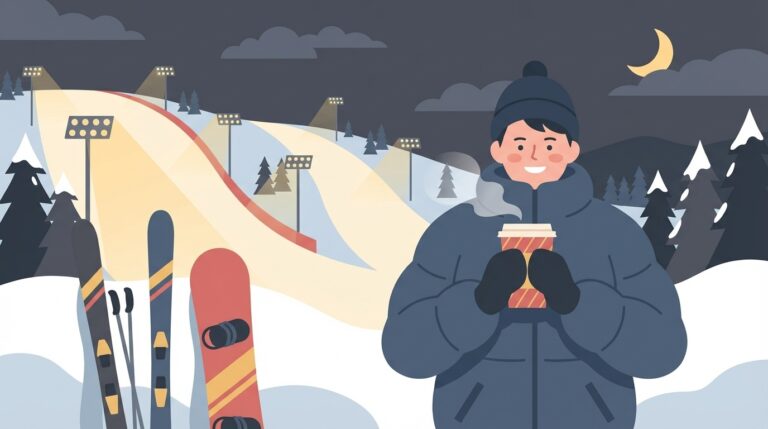
Night Skiing in Korea: How to Survive the Cold and Speak Like a Local
Hello! I’m your Daily Hangul Editor. 👋
Picture this: You are watching a classic K-Drama. The main characters are standing on a perfectly white, beautifully lit ski slope at midnight. Snowflakes are gently falling, they look deeply into each other’s eyes, and everything looks incredibly romantic.
But let me tell you a secret as someone who has lived in Seoul for over a decade and survived countless Korean winters. If you actually go night skiing (심야 스키) in Korea, you won’t be thinking about romance. The wind chill will be slapping your face, and your only thought will be: “I need boiling hot soup right now!”
Night skiing in Korea is a massive cultural phenomenon. Because of the intense working hours, many office workers hit the slopes from 9 PM until 2 AM! It’s the ultimate “work hard, play hard” experience. Today, as an upper-intermediate (B2) learner, we are going to move beyond textbook phrases like “날씨가 춥습니다” (The weather is cold). I’m going to teach you the real, survival-mode Korean you need to talk about the snow, complain about the freezing cold, and naturally suggest grabbing late-night snacks like a true local.
Are you ready? Zip up your padded jacket (롱패딩), and let’s dive in! ⛷️❄️
Phase 2: Core Expressions Deep Dive
1. 손발이 꽁꽁 얼 것 같아요. (My hands and feet feel like they are freezing solid.)
- Pronunciation: [sonbari kkongkkong eol geot gatayo]
💡 ‘꽁꽁’ sounds like a sharp, tense ‘kk’—imagine the sound your teeth make when they are chattering from the cold! - Meaning: Literal: It seems my hands and feet will freeze solid. / Real nuance: I’m freezing to death!
- K-Culture Moment: You’ve just come down from the highest slope. You take off your gloves, and your fingers are numb. You say this to your friend as you run toward the indoor cafeteria.
- Editor’s Insight: The magic word here is 꽁꽁 (kkong-kkong). It is a mimetic word (의태어) that describes something freezing completely solid. Koreans love using these vivid descriptive words. It sounds so much more expressive and native than just saying “너무 추워요” (It’s too cold).
- Situation Spectrum:
[🚫 절대 금지] ———— [⚠️ 주의] ———— [✅ 자유롭게]- Close Friends (Casual): ✅ (손발이 꽁꽁 얼 것 같아!)
- Coworkers (Semi-formal): ✅ (손발이 꽁꽁 얼 것 같네요.)
- Boss/Elders (Formal): ⚠️ (Use with polite endings, but it might sound a bit informal for a strict business setting.)
- 🤔 Think About It: Korean has hundreds of words that mimic sounds or physical states (like 꽁꽁). Does your native language have specific sound words to describe the feeling of being cold, or do you rely more on adjectives?
2. 오늘 설질 장난 아니에요. (The snow quality today is insane.)
- Pronunciation: [oneul seoljil jangnan anieyo]
💡 ‘장난’ sounds like ‘jang-nan’. Emphasize the ‘an’ in ‘anieyo’ for dramatic effect! - Meaning: Literal: Today’s snow quality is not a joke. / Real nuance: The snow conditions today are absolutely amazing (or incredibly terrible, depending on the context, but usually used for emphasis)!
- K-Culture Moment: You are riding the ski lift with a local Korean rider. They look down at the fresh, powdery snow and say this to express their excitement.
- Editor’s Insight: 설질 (seoljil) is a compound word meaning ‘snow’ (설) + ‘quality’ (질). 장난 아니다 (It’s no joke) is one of the most useful B2-level slang phrases you can master. It’s the Korean equivalent of saying something is “insane” or “unreal.”
- Situation Spectrum:
[🚫 절대 금지] ———— [⚠️ 주의] ———— [✅ 자유롭게]- Close Friends (Casual): ✅ (오늘 설질 장난 아니야!)
- Coworkers (Semi-formal): ✅ (설질 장난 아니네요.)
- Boss/Elders (Formal): 🚫 (Too slangy. Use “눈 상태가 아주 좋습니다” instead.)
- 🤔 Think About It: Why do Koreans use “It’s not a joke” to mean something is amazing? It shows how Korean expressions often use negation to emphasize a strong positive emotion!
3. 따뜻한 국물 당기네요. (I’m craving some warm broth.)
- Pronunciation: [ttatteuthan gungmul danggineyo]
💡 ‘당기네요’ sounds like ‘dang-gi-ne-yo’. Think of the word ‘dangle’ without the ‘le’! - Meaning: Literal: Warm broth is pulling me. / Real nuance: I’m really craving some hot soup right now.
- K-Culture Moment: After freezing outside, you smell the spicy Ramyeon and Eomuk (fish cake) skewers from the resort’s snack bar (매점). This phrase will make you sound 100% like a local.
- Editor’s Insight: In Korean, we don’t just “want” (원하다) food; the food “pulls” us (당기다). It’s a passive feeling of temptation! Also, noticing the ending ~네요, it shows you are expressing a spontaneous thought or realization.
- Situation Spectrum:
[🚫 절대 금지] ———— [⚠️ 주의] ———— [✅ 자유롭게]- Close Friends (Casual): ✅ (따뜻한 국물 당긴다.)
- Coworkers (Semi-formal): ✅ (국물 당기네요.)
- Boss/Elders (Formal): ⚠️ (A bit too casual, though acceptable in a friendly team dinner context.)
Phase 3: Textbook vs Real Life
| Situation | 📖 Textbook Korean | 🗣️ Real Korean | 💡 Why is it different? |
|---|---|---|---|
| Complaining about extreme cold | 날씨가 매우 춥습니다. (The weather is very cold.) | 손발이 꽁꽁 얼 것 같아요. (My hands and feet are freezing solid.) | Koreans prefer descriptive, sensory language (mimetic words) to express extreme discomfort. |
| Praising the snow | 눈이 아주 좋습니다. (The snow is very good.) | 오늘 설질 장난 아니에요. (The snow quality is no joke today.) | ‘장난 아니다’ is a versatile colloquialism used daily to express intensity, far more natural than ‘아주 좋다’. |
| Suggesting food | 무엇을 먹고 싶습니까? (What do you want to eat?) | 뭐 당기는 거 있어요? (Are you craving anything?) | We use ‘당기다’ (to pull/crave) for food, reflecting that appetite is an irresistible force! |
Phase 4: Cultural Deep Dive — K-Culture Connection
4-1. Non-verbal Communication: The “Hot-ppang” Breath
When Koreans say “손발이 꽁꽁 얼 것 같아요,” they don’t just stand still. You must physically demonstrate the cold! Bring your hands together, cup them near your mouth, and blow hot air into them—making a “Haaaa” sound. We do this so much it reminds us of blowing on a steaming Hoppang (steamed bun) in winter.
4-2. K-Culture Connection: The Night Hustle & K-Food
Night skiing (심야 스키) perfectly captures the Korean “Ppali-ppali” (hurry up) and hyper-efficient lifestyle. Office workers in Seoul might finish work at 7 PM, grab a quick dinner, drive 1.5 hours to a ski resort in Gyeonggi-do or Gangwon-do, ski from 10 PM to 2 AM, and drive back to work the next morning!
Because they are burning immense calories in the freezing midnight air, the K-Food connection is inevitable. You will see hundreds of people in bulky ski gear crowded around convenience store tables inside the resort. What are they eating? Cup Ramyeon (컵라면) and Fish Cake Skewers (어묵 꼬치). In Korea, fighting the winter cold isn’t about sitting by a fireplace; it’s about internally heating your body with spicy, boiling, sodium-rich broth! If you ski in Korea, eating this at midnight is a mandatory cultural ritual.
Phase 5: Immersive Roleplay Scenario
Scenario A: The Midnight Snack Run
- Setting: 11:30 PM, the cafeteria at Vivaldi Park Ski Resort. The windows are fogged up from the heat inside. You’ve been skiing for 2 hours, and you can barely feel your toes.
- Characters:
- YOU: An expat who loves Korean winter sports.
- Minji (29): Your energetic Korean friend who dragged you here after work.
Minji: 와, 오늘 영하 10도래! 안 추워요?
(Wa, oneul yeongha sip-dorae! An chuwoyo?)
[Wow, they say it’s minus 10 degrees today! Aren’t you cold?]
YOU: 장난 아니에요. 손발이 꽁꽁 얼 것 같아요.
(Jangnan anieyo. Sonbari kkongkkong eol geot gatayo.)
[It’s no joke. My hands and feet feel like they’re freezing solid.]
(🎭 Stage Direction: You dramatically rub your hands together and blow on them.)
Minji: 그치? 그래도 오늘 사람이 없어서 설질은 장난 아니죠?
(Geuchi? Geuraedo oneul sarami eopseoseo seoljireun jangnan anijo?)
[Right? But still, since there are no people today, the snow quality is insane, right?]
YOU: 네, 진짜 최고예요! 근데 좀 쉬었다 타면 안 될까요?
(Ne, jinjja choegoyeyo! Geunde jom swieotda tamyeon an doelkkayo?)
[Yes, it’s really the best! But could we take a break before riding again?]
Minji: 좋아요! 저기 매점 보이네. 뭐 먹고 싶은 거 있어요?
(Joayo! Jeogi maejeom boine. Mwo meokgo sipeun geo isseoyo?)
[Sounds good! I see the snack bar over there. Do you have anything you want to eat?]
🔀 Your Turn! How should you respond to Minji to sound like a true Korean?
* A) “음식 메뉴판을 보여주세요.” (Please show me the food menu.)
* B) “날씨가 추우니까 따뜻한 국물 당기네요. 어묵 어때요?” (Since it’s cold, I’m craving warm broth. How about Eomuk?)
* C) “아무거나 다 좋습니다.” (Anything is fine.)✅ Best Choice: B — Reason: By using “국물 당기네요” (craving broth), you show you understand both the language and the specific Korean cultural habit of seeking hot soup in winter. Option A is totally robotic, and C is polite but misses the chance to bond over food!
Scenario B: K-Culture Bonus Roleplay
- Setting: You are at the convenience store inside the resort buying hot packs, but you can’t find them.
- YOU: 사장님, 혹시 핫팩 다 팔렸나요?
(Sajangnim, hoksi hatpaek da pallyeonnayo?) [Boss, are the hot packs all sold out by any chance?] - Clerk: 아, 핫팩 방금 다 나갔어요. 대신 따뜻한 캔커피라도 드릴까요?
(A, hatpaek banggeum da nagasseoyo. Daesin ttatteuthan kankaepirado deurilkkayo?) [Ah, the hot packs just sold out. Would you like a warm canned coffee instead?] - YOU: 아쉽네요… 그럼 이거라도 주세요!
(Aswipneyo… Geureom igeorado juseyo!) [That’s a shame… Then I’ll take this at least!]
Phase 6: 10-Second Shadowing Drill
Read this out loud to practice your intonation and rhythm!
- 🥶 으으… / 너무 추워서 / 손발이 꽁꽁 / 얼 것 같아요!
(Eueu… / neomu chuwoseo / sonbari kkongkkong / eol geot gatayo!) - 😊 이럴 때는 / 무조건! / 따뜻한 국물이 / 당기죠.
(Ireol ttaeneun / mujogeon! / ttatteuthan gungmuri / danggijo.)
Phase 7: K-Culture Glossary (Mini Dictionary)
| Korean | Romanization | English | Contextual Meaning |
|---|---|---|---|
| 심야 스키 | simya seuki | Night Skiing | Ski sessions running from late night (10 PM) to early morning (2-4 AM). |
| 핫팩 | hatpaek | Hot Pack | Essential pocket hand warmers used by everyone in Korea during winter. |
| 설질 | seoljil | Snow Quality | A crucial term for skiers/snowboarders to describe the condition of the snow. |
| 매점 | maejeom | Snack Bar / Kiosk | Small convenience stalls found in resorts, schools, or subway stations. |
| 어묵 국물 | eomuk gungmul | Fish Cake Broth | The legendary, free (usually) hot broth served with fish cake skewers. The ultimate winter lifesaver. |
Phase 8: Traveler’s Survival Kit 🧳
If you are planning to hit the slopes in Korea, keep these expressions in your back pocket!
🆘 Survival Expressions
* 🇰🇷 “리프트권 야간으로 두 장 주세요.” (Lipeuteugwon yaganeuro du jang juseyo.)
* 🗣️ Meaning: Two night-pass lift tickets, please.
* 🇰🇷 “초보자 슬로프가 어디예요?” (Choboja seullopeuga eodiyeyo?)
* 🗣️ Meaning: Where is the beginner slope?
* 🇰🇷 “어묵 국물 좀 더 마셔도 되나요?” (Eomuk gungmul jom deo masyeodo doenayo?)
* 🗣️ Meaning: Can I drink a little more fish cake broth?📌 Editor’s Travel Note
* Transportation: Many major ski resorts (like Vivaldi Park or Yongpyong) offer free shuttle buses from Seoul for foreigners! You must book them in advance online.
* Free Broth Culture: When you buy fish cake skewers (어묵 꼬치) at a street tent or resort, drinking the broth from paper cups is usually free and self-service. Don’t be shy, grab a cup and pour it yourself!
Phase 9: Think Deeper — “Media vs Reality”
🧠 The K-Drama Illusion vs. The “Hustle” Reality
If you watch Korean dramas, ski resorts are portrayed as private, serene winter wonderlands where chaebols confess their love. However, the reality of Korean “Simya Ski” (Night Skiing) reveals a fascinating aspect of modern Korean society: the hyper-efficient leisure culture. Because Koreans work some of the longest hours in the OECD, their hobbies are often squeezed into the late hours of the night. Seeing thousands of people aggressively carving down the slopes at 1 AM under massive stadium lights isn’t just about sports; it’s a testament to the Korean willpower to “play as hard as we work,” no matter how tired or freezing we are.
💬 Your Turn: In your culture, do people participate in extreme sports or hobbies late at night after a full day of work? Or are nights strictly reserved for resting? Share your thoughts in the comments!
Phase 10: FAQ & Troubleshooting
Q: Can I use “장난 아니다” (It’s no joke) in a business meeting?
* A: No! 🚫 While it’s great for casual or semi-formal situations (like a team dinner or with close colleagues), it is fundamentally slang. If you are reporting to your CEO, use “매우 훌륭합니다” (It is very excellent) instead.
Q: What is the difference between “춥다” and “차갑다”?
* A: This is a classic B2 hurdle!
* 춥다 (Chupda): Used for the environment or how your body feels overall. (e.g., 날씨가 추워요 = The weather is cold.)
* 차갑다 (Chagapda): Used for objects you touch. (e.g., 커피가 차가워요 = The coffee is cold. / 네 손이 차갑다 = Your hands are cold to the touch.)
❌ Common Mistake #1: Saying “눈이 추워요” (The snow is cold).
✅ Do this instead: Say “눈이 차가워요” (The snow is cold to the touch) because you are referring to the physical object of the snow, not the weather!
Phase 11: Wrap-up & Action Missions
One-Liner Summary: To survive a freezing Korean night at the ski resort, tell your friends “손발이 꽁꽁 얼 것 같아요” (My hands and feet are freezing!) and go grab a hot broth because “국물이 당기네요” (You’re craving soup)!
Action Missions:
* 🥉 Bronze (Solo): Stand in front of your mirror, rub your hands, shiver, and loudly say, “손발이 꽁꽁 얼 것 같아요!” three times.
* 🥈 Silver (Online): Find a Korean YouTube vlog about “심야 스키” (Night skiing) and leave a comment: “영상만 봐도 손발이 꽁꽁 얼 것 같아요! 🥶” (Just watching the video makes my hands and feet feel frozen!)
* 🥇 Gold (Real Life): The next time you are freezing outside with a Korean friend, ask them: “따뜻한 국물 안 당겨요?” (Aren’t you craving some warm broth?)
* 🎿 K-Culture Mission: Search for “Korean Convenience Store Ramyeon Machine” online. Imagine operating one of those machines in minus 10-degree weather—that’s the true Korean winter experience!
Phase 12: Interactive Quiz
Let’s test your B2 instincts!
1. Fill in the Blank:
You just rode down an incredibly smooth slope. You turn to your friend and say:
“와, 오늘 설질 [ _____ ] 아니에요!”
(A) 진짜
(B) 장난
(C) 농담
2. True or False – K-Culture Edition:
“If you buy one fish cake skewer at a Korean street stall, you have to pay extra to drink the warm broth.”
(True / False)
3. Situational Judgment:
Your hands are freezing because you forgot your gloves. Which phrase is the most natural Korean expression to use?
(A) 손이 날씨가 추워요. (My hands are cold weather.)
(B) 제 손이 차갑게 되었습니다. (My hands have become cold.)
(C) 손발이 꽁꽁 얼 것 같아요. (My hands and feet feel like they’re freezing solid.)
Click to see the answers!
- (B) 장난. (장난 아니다 = It’s no joke / It’s amazing). ‘농담’ also means joke, but it is NOT used in this idiom!
- False. The eomuk broth (어묵 국물) is almost always free and self-service. Drink up and stay warm!
- (C). It uses the natural mimetic word (꽁꽁) and the correct verb (얼다 – to freeze), showing advanced emotional expression.
Did you enjoy today’s Daily Hangul lesson? What winter sports do you enjoy in your country? Let us know in the comments below! 👇
Frequently Asked Questions (FAQ)
Q: What does "손발이 꽁꽁 얼 것 같아요. (My hands and feet feel like they are freezing solid.)" mean in Korean and how do you pronounce it?
A: In Korean, "손발이 꽁꽁 얼 것 같아요. (My hands and feet feel like they are freezing solid.)" is pronounced [sonbari kkongkkong eol geot gatayo] and means: Literal: It seems my hands and feet will freeze solid. / Real nuance: I'm freezing to death!
Q: What does "오늘 설질 장난 아니에요. (The snow quality today is insane.)" mean in Korean and how do you pronounce it?
A: In Korean, "오늘 설질 장난 아니에요. (The snow quality today is insane.)" is pronounced [oneul seoljil jangnan anieyo] and means: Literal: Today's snow quality is not a joke. / Real nuance: The snow conditions today are absolutely amazing (or incredibly terrible, depending on the context, but usually used for emphasis)!
Q: What does "따뜻한 국물 당기네요. (I'm craving some warm broth.)" mean in Korean and how do you pronounce it?
A: In Korean, "따뜻한 국물 당기네요. (I'm craving some warm broth.)" is pronounced [ttatteuthan gungmul danggineyo] and means: Literal: Warm broth is pulling me. / Real nuance: I'm really craving some hot soup right now.







