

Phase 1: Immersive Hook
Hello, language learners! It’s your Daily Hangul lead editor.
Picture this: You’re watching your favorite K-Drama. The charming male lead awkwardly hands a beautifully wrapped, ridiculously expensive jewelry box to the female lead. The subtitles simply say, “It’s for you.” But if you listen closely, he mutters something else while looking away. Or maybe you’ve visited Korea, and your Airbnb host handed you a massive basket of fruit, bowing and saying, “It’s nothing, really.”
Spoiler alert: It wasn’t “nothing.”
In Western cultures, when we give a gift, we tend to hype it up: “I saw this and immediately thought of you! You’re gonna love it!” But in Korea? Hype is out. Modesty is in.
Today, we’re diving into the beautiful, slightly ironic, and deeply caring world of giving gifts in Korea. Specifically, how to say, “It’s just a little something.” Mastering this won’t just improve your Korean; it will instantly make you look like someone who truly gets Korean culture. Let’s jump in!
Phase 2: Deep Dive into Core Expressions
Here are the top three ways Koreans downplay their gifts to show respect.
1. 작은 성의예요.
- Pronunciation: [jageun seongui-yeyo] -> jah-geun sung-ee-yay-yo
- Meaning: Literal: “It’s a small sincerity.” / Real nuance: “It’s a small token of my appreciation.”
- K-Culture Moment: Imagine it’s your last day at your Korean office, and you brought small souvenirs from your home country for your team. You hand it to your boss with two hands and say this. Immediate respect earned!
- Editor’s Insight: The word 성의 (seong-ui) means sincerity or heartfelt effort. By calling it “small,” you are being humble, elevating the receiver.
- Situation Spectrum:
[🚫 Do Not Use] ———— [⚠️ Caution] ———— [✅ Feel Free]
- Close Friends (Casual): 🚫 (Too formal and stiff!)
- Coworkers (Semi-formal): ✅
- Boss/Elders (Formal): ✅✅
- 🤔 Think About It: Why does Korean culture value lowering oneself (saying your effort is “small”) when giving a gift? How does this compare to gift-giving in your culture?
2. 별거 아니에요.
- Pronunciation: [byeolgeo anieyo] -> byull-guh ah-nee-yay-yo
- Meaning: Literal: “It’s not a special thing.” / Real nuance: “It’s nothing special / Don’t make a fuss.”
- K-Culture Moment: You meet your Korean friend for coffee on their birthday. You slide a cute lipstick or a Starbucks gift card across the table. They gasp, and you wave your hand casually saying, “별거 아니에요.”
- Editor’s Insight: This is the most versatile phrase. It’s polite but not overly stiff. It tells the other person, “Please accept this without feeling burdened.”
- Situation Spectrum:
[🚫 Do Not Use] ———— [⚠️ Caution] ———— [✅ Feel Free]
- Close Friends (Casual): ✅ (Drop the ‘요’ -> 별거 아니야)
- Coworkers (Semi-formal): ✅
- Boss/Elders (Formal): ⚠️ (Better to use 작은 성의예요)
3. 오다 주웠어요.
- Pronunciation: [oda juwosseoyo] -> oh-dah joo-wuht-suh-yo
- Meaning: Literal: “I picked it up on the way here.” / Real nuance: “I didn’t go out of my way to buy this (even though I totally did).”
- K-Culture Moment: Ah, the ultimate K-Drama Tsundere (cold on the outside, warm on the inside) line! The tough guy tosses a bouquet of flowers to the girl, looks at the ground, and mumbles this line.
- Editor’s Insight: Do not use this seriously! It is used as a joke among close friends or couples to playfully mimic the K-drama trope.
- Situation Spectrum:
[🚫 Do Not Use] ———— [⚠️ Caution] ———— [✅ Feel Free]
- Close Friends (Casual): ✅ (As a joke!)
- Coworkers (Semi-formal): 🚫
- Boss/Elders (Formal): 🚫🚫 (They will think you literally gave them trash from the street!)
Phase 3: Textbook vs Real Life
Let’s see how textbooks teach gift-giving versus what actual Koreans say on the streets of Seoul.
| Situation | 📖 Textbook Korean | 🗣️ Real Korean | 💡 Why the difference? |
|---|---|---|---|
| Formal (To Boss) | 제 선물입니다. (This is my gift.) | 작은 성의예요. (It’s a small token.) | “선물” sounds a bit too direct and arrogant. Koreans prefer humility. |
| Polite (To Coworker) | 당신을 위해 샀어요. (I bought this for you.) | 부담 갖지 말고 받으세요. (Please accept it without feeling burdened.) | “부담” (burden) is a huge concept in Korea. We want to ensure the receiver doesn’t feel obligated to return the favor immediately. |
| Casual (To Friend) | 이거 받아. (Take this.) | 자, 뇌물! (Here, a bribe!) | Friends often joke that a gift is a “bribe” (뇌물) to keep the mood light and funny! |
Phase 4: Cultural Deep Dive
4-1. Non-verbal Communication: The “Two-Hand” Rule
In Korea, how you give the gift is just as important as what you say.
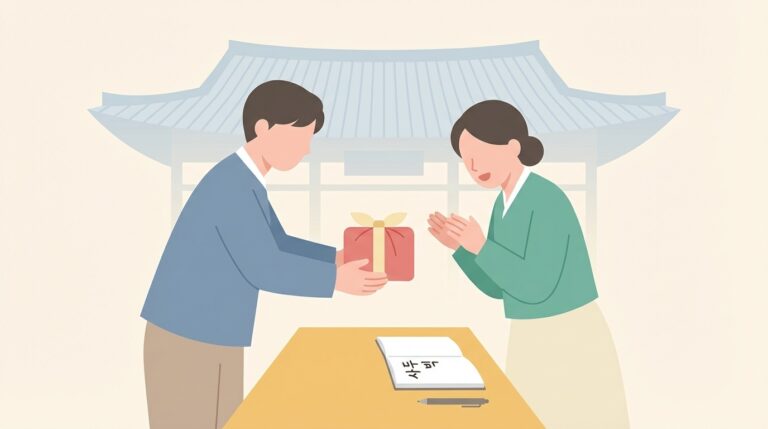
* Always, always, always use two hands when giving a gift to someone older or in a higher position.
* If the gift is small, hold it with your right hand, and support your right elbow or forearm lightly with your left hand.
* Add a slight bow (about 30 degrees) to complete the ultimate respectful combo.
4-2. K-Culture Connection: The “Tsundere” and “Nunchi”
In K-Dramas, you’ll often see characters giving gifts indirectly. They might sneak a hangover drink onto a coworker’s desk before they arrive, or pay the dinner bill while pretending to go to the restroom.
Why? Because of 부담 (Burden).
If you make a big show of giving a gift, the receiver’s 눈치 (Nunchi – social radar) goes into overdrive. They might feel bad that they didn’t prepare anything for you. By saying “It’s a small token” or secretly leaving it, you are showing ultimate consideration for their feelings. You are saying, “My gift is a pure expression of my feelings, so don’t stress about giving me something back.”
Phase 5: Immersive Roleplay
Scenario A: The Office Souvenir
- Setting: Tuesday morning, 8:50 AM. You are in the breakroom of your Korean company. You just got back from a vacation to your home country and brought some famous local snacks.
- Characters:
- YOU: An eager language learner who wants to impress the team.
- Minsu (32): Your friendly Korean coworker who sits next to you.
Minsu: 오! 여행 잘 다녀왔어요? (Oh! Did you have a good trip?)
YOU: 네! 이거 민수 씨 주려고 가져왔어요. (Yes! I brought this to give to you, Minsu.)
Minsu: 헉, 진짜요? 안 이러셔도 되는데… (Gasp, really? You didn’t have to do this…)
🔀 Your Turn! How should you respond?
– A) “비싼 거예요!” (It’s expensive!)
– B) “별거 아니에요. 드셔 보세요.” (It’s nothing special. Try some.)
– C) “오다 주웠어요.” (I picked it up on the way.)✅ Best Choice: B — It perfectly balances politeness and modesty. Minsu will feel touched but not overly burdened.
⚠️ Why A is bad: Bragging about the price is considered rude in Korea.
⚠️ Why C is risky: Unless Minsu loves K-Dramas and you two are incredibly close, he might get confused!
Minsu: 와, 감동이에요. 잘 먹을게요! (Wow, I’m touched. I’ll enjoy it!)
(🎭 Stage Direction: Minsu carefully takes the snack with two hands and bows his head slightly.)
Scenario B: Bonus K-Pop Fan Meeting
- Setting: A loud, fast-paced fan signing event. You finally step up to the table to meet your ultimate bias.
- Idol: 안녕하세요! 와주셔서 감사해요~ (Hello! Thank you for coming~)
- YOU: (Handing them a small gift bag) 오빠/언니, 이거 작은 성의예요. (Oppa/Unnie, this is a small token of my appreciation.)
- Idol: 에이~ 안 주셔도 되는데! 너무 고마워요! (Aw~ You didn’t have to! Thank you so much!)
Phase 6: 10-Second Shadowing Drill
Let’s practice the rhythm! Pay attention to the pauses (/) and the mood tags.
- 😊 Polite & Modest:
저기… / 이거 / 작은 성의예요.
(jeogi… / igeo / jageun seong-ui-yeyo.)
“Excuse me… this is a small token.” -
🥺 Casual & Friendly:
진짜 / 별거 아니에요. / 부담 갖지 마세요.
(jinjja / byeolgeo anieyo. / budam gatji maseyo.)
“It’s really nothing special. Don’t feel burdened.” -
😎 Playful Tsundere (To a close friend):
야! / 오다 주웠다. / 가져라.
(ya! / oda juwotda. / gajyeora.)
“Hey! I picked this up on the way. Keep it.”
Phase 7: K-Culture Glossary
| Korean | Romanization | English Meaning | Cultural Context |
|---|---|---|---|
| 부담 | budam | Burden / Pressure | The feeling of obligation. Koreans constantly try to reduce budam for each other. |
| 정 | jeong | Deep affection / Connection | The invisible emotional bond between people. Giving small food/gifts is a physical expression of jeong. |
| 눈치 | nunchi | Social radar / Tact | Sensing someone’s mood. Good nunchi means knowing when to give a gift quietly. |
| 뇌물 | noemul | Bribe | Often used jokingly between friends when giving a gift to ask for a favor later! |
| 츤데레 | cheundere | Tsundere | A Japanese loanword widely used in Korea for someone who acts cold but is actually sweet. |
Phase 8: Traveler’s Survival Kit
Are you in Korea right now shopping for those “small tokens of appreciation” to take back home? Here are the survival phrases you need at the souvenir shops!
🆘 Survival Phrases for Gift Shopping
– 🇰🇷 “선물용이에요. 포장해 주세요.” (seonmulyong-ieyo. pojanghae juseyo.)
– 🗣️ Meaning: “It’s for a gift. Please wrap it.”
– 📍 Where to use: Olive Young, Kakao Friends Store, Department stores.
- 🇰🇷 “이거 제일 잘 나가는 거예요?” (igeo jeil jal naganeun geoyeyo?)
- 🗣️ Meaning: “Is this the best-seller?”
- 📍 Where to use: Traditional markets, skincare shops.
📌 Editor’s Travel Note
– Free Samples (덤 – Deom): If you buy a lot at a Korean cosmetics store or market, the owner will often throw in free extra items. This is called “덤 (Deom)”. Don’t refuse it; it’s their way of showing Jeong!
– Wrapping: Many stores offer free or very cheap beautiful gift wrapping if you just mention the magic word: 선물 (Seonmul – Gift).
Phase 9: Think Deeper — “One Step Further”
Language & Culture: The Beauty of Modesty
In English, we say, “I got you the best present!” We express our love through confidence in the gift. But in Korean culture, expressing love is often about lowering the self and elevating the other person. By saying “It’s not much” or “It’s a small sincerity,” the giver takes the spotlight off their own effort and focuses on making the receiver feel comfortable and unburdened. The physical gift might be a $300 ginseng set, but the verbal packaging is wrapped in profound humility.
💬 Your Turn: In your home culture, do people usually hype up the gifts they give, or do they play them down like in Korea? Let me know in the comments!
Phase 10: FAQ & Troubleshooting
Q: What if the Korean person refuses the gift? Did I do something wrong?
A: No! In fact, refusing a gift 1 or 2 times is considered good manners in Korea. It shows they are not greedy. If they say, “아유, 안 주셔도 되는데” (Oh, you didn’t have to), just smile, push it gently toward them again, and say, “별거 아니에요. 받으세요” (It’s nothing, please accept it). They will happily accept it the second or third time!
Q: Can I use “작은 성의예요” to my close friend?
A: You can, but it sounds like you are wearing a tuxedo to a pajama party. It’s too formal. Stick to “별거 아니야” (It’s nothing) for friends.
❌ Common Mistake Alert!
Giving a gift to an elder with one hand while looking away.
✅ Do this instead: Look them warmly in the eyes, use two hands, bow slightly, and say smoothly: “작은 성의예요.”
Phase 11: Wrap-up & Action Items
One-Liner Summary: When giving a gift in Korea, wrap it in humility by saying “It’s a small token” (작은 성의예요) to show ultimate respect!
Your Action Missions:
– 🥉 Bronze (Solo): Stand in front of a mirror, hold a random object with two hands, bow slightly, and practice saying “작은 성의예요” 3 times out loud.
– 🥈 Silver (Online): Leave a comment on this blog post: Tell us what “small token” you would love to give to your favorite Korean celebrity!
– 🥇 Gold (Real Life): The next time you meet your language exchange partner or Korean friend, bring a small snack (like a candy) and hand it to them saying, “별거 아니에요!”
🎬 K-Culture Mission:
Turn on any K-Drama this week. Look out for a scene where a character gives a gift. Watch their body language—do they use two hands? Do they look shy or boastful?
Phase 12: Interactive Challenge (Quiz Time!)
1. Situational Judgment: You bought a nice box of chocolates for your Korean boss to say thank you. How should you present it?
– A) Slide it across the desk with one hand and say, “비싼 거예요!” (It’s expensive!)
– B) Hold it with two hands, bow slightly, and say, “작은 성의예요.”
– C) Throw it to them and say, “오다 주웠어요.”
2. True or False – K-Culture Edition:
“If a Korean person says ‘No, I can’t accept this’ the first time you offer a gift, you should immediately put the gift away and apologize.”
– True / False?
3. Fill in the Blank:
You want to tell your casual friend that the coffee you bought them is nothing special.
“진짜 ________ 아니야.”
(Scroll down for answers!)
…
…
…
Answers:
1. B (A is arrogant, C will get you fired!)
2. False (It is polite to politely decline at first. Offer it again gently!)
3. 별거 (byeolgeo)
Great job today! Keep practicing, and soon you’ll be giving gifts like a true Seoulite. See you in the next lesson! 👋
Frequently Asked Questions (FAQ)
Q: What does "작은 성의예요." mean in Korean and how do you pronounce it?
A: In Korean, "작은 성의예요." is pronounced [jageun seongui-yeyo] and means: Literal: "It's a small sincerity." / Real nuance: "It's a small token of my appreciation."
Q: What does "별거 아니에요." mean in Korean and how do you pronounce it?
A: In Korean, "별거 아니에요." is pronounced [byeolgeo anieyo] and means: Literal: "It's not a special thing." / Real nuance: "It's nothing special / Don't make a fuss."
Q: What does "오다 주웠어요." mean in Korean and how do you pronounce it?
A: In Korean, "오다 주웠어요." is pronounced [oda juwosseoyo] and means: Literal: "I picked it up on the way here." / Real nuance: "I didn't go out of my way to buy this (even though I totally did)."







