

Phase 1: Immersive Hook
Hello there! This is your Senior Editor at Daily Hangul.
Picture this: You are watching an intense, critically acclaimed K-Drama like My Mister or Mr. Sunshine. The protagonists aren’t saying “I love you,” nor are they overtly expressing hatred. Instead, they share a silent bowl of warm soup, or exchange a lingering, complex gaze. The subtitles read, “I’ve grown attached to you,” or “I have unresolved feelings.” But as an advanced (C2) Korean learner, you know the subtitles are failing miserably.
They aren’t just “attached.” They are experiencing 정 (Jeong). And that deep, heart-wrenching sorrow that drives the protagonist to ultimate sacrifice? That’s not just sadness; that’s 한 (Han).
Welcome to the absolute pinnacle of Korean cultural fluency. If you truly want to understand why K-Pop ballads pierce your soul, why Korean history is written in blood and resilience, and why the restaurant owner gave you an extra dumpling without saying a word—you need to master these two concepts. Today, we aren’t just learning vocabulary; we are decoding the Korean soul.
Phase 2: Deep Dive into Core Expressions
These expressions go far beyond textbook definitions. They are the emotional currency of Korea.
1. 정(이) 들다
- Pronunciation: [jeong-i deulda] / [jung-ee deul-dah]
- Meaning: (Literal) Jeong enters. / (Real nuance) To grow deeply attached to someone or something over time, often subconsciously.
- K-Culture Moment: You are moving out of an old, slightly run-down apartment in Seoul. The grumpy landlord who always nagged you about recycling suddenly hands you a box of warm rice cakes on your last day. You realize, “Ah… Jeong has seeped in.”
- Editor’s Insight: Notice the verb 들다 (to enter/seep in). Jeong isn’t something you actively do to someone. It’s like a stain. You spend time together, and the emotional connection naturally seeps into your heart without you noticing. It applies to people, pets, and even objects.
- Situation Spectrum:
[🚫 Absolute Ban] ———— [⚠️ Caution] ———— [✅ Freely Use]
- Close Friends/Lovers (Casual): ✅
- Colleagues (Semi-formal): ✅ (Usually when reflecting on time spent together)
- Professional/Strictly Formal Settings: ⚠️ (Too emotional for cold business)
- 🤔 Think About It: Why does Korean use a passive-like verb (들다) for attachment, whereas English uses active verbs like “to make friends” or “to build a relationship”? What does this say about the Korean view of human connection?
2. 미운 정 고운 정 다 들다
- Pronunciation: [miun jeong goun jeong da deulda] / [mee-oon jung go-oon jung dah deul-dah]
- Meaning: (Literal) Both hateful Jeong and beautiful Jeong have entered. / (Real nuance) To have gone through thick and thin with someone, developing a complex bond of both love and frustration.
- K-Culture Moment: In a K-Drama, two rivals who have been bickering for 16 episodes finally have to part ways. They look at each other, teary-eyed, realizing their rivalry was actually a profound connection.
- Editor’s Insight: This is the ultimate C2 expression. 미운 정 (Hateful Jeong) is uniquely Korean. It means you might dislike someone’s personality, but because you’ve shared so much history, you still care about them.
- Situation Spectrum:
[🚫 Absolute Ban] ———— [⚠️ Caution] ———— [✅ Freely Use]
- Long-time Friends/Spouses: ✅
- Coworkers of many years: ✅
- Superiors you just met: 🚫
- 🤔 Think About It: Have you ever experienced 미운 정 (attachment despite dislike) with a person or a place? Does your native language have a phrase that captures this specific “hate-affection”?
3. 한(이) 맺히다
- Pronunciation: [han-i maechida] / [hahn-ee meh-chee-dah]
- Meaning: (Literal) Han congeals/forms a knot. / (Real nuance) To harbor deep-seated, unresolved grief, resentment, or a profound unfulfilled desire.
- K-Culture Moment: Think of Pansori (Korean traditional storytelling) or the historical background of modern Korea. The collective suffering of the nation, or a ghost in a folktale who cannot move on to the afterlife because of an unresolved injustice.
- Editor’s Insight: The verb 맺히다 is used for things that form into droplets (like tears or dew) or knots. Han isn’t just an angry thought; it’s a physical, emotional knot in your chest. At a C2 level, you can also use this playfully in modern contexts: “I failed the driving test 5 times; I have a Han about getting this license!”
- Situation Spectrum:
[🚫 Absolute Ban] ———— [⚠️ Caution] ———— [✅ Freely Use]
- Deep, personal conversations: ✅
- Describing historical contexts/literature: ✅
- Light, everyday small talk: ⚠️ (Can sound overly dramatic unless used as an exaggeration)
- 🤔 Think About It: Han is often seen as negative, but it is also the driving force behind Korea’s rapid economic growth (the desire to overcome poverty and oppression). How can unresolved sorrow become fuel for success?
Phase 3: Textbook vs Real Life
Let’s see how C2-level emotional intelligence changes the way you speak.
| Situation | 📖 Textbook Korean | 🗣️ Real Korean (C2) | 💡 Why the difference? |
|---|---|---|---|
| Saying goodbye to a long-time colleague | 그동안 즐거웠습니다. (It was a pleasure.) | 미운 정 고운 정 다 들었는데 아쉽네요. (We’ve been through so much, I’m sad to see you go.) | The real expression acknowledges the complex, messy, and real history you share, showing ultimate sincerity. |
| Describing an old, worn-out neighborhood | 이 동네는 오래되었습니다. (This neighborhood is old.) | 이 동네는 참 정겨워요. (This neighborhood is so full of Jeong/warmth.) | Koreans highly value the warmth of old, human-touched things over sterile perfection. |
| Wanting to achieve a lifelong dream | 꼭 이루고 싶어요. (I really want to achieve it.) | 이거 못 하면 진짜 한이 맺힐 것 같아요. (If I don’t do this, it will leave a permanent knot of regret in my heart.) | Hyperbole using Han emphasizes the visceral, desperate nature of the desire. |
Phase 4: Cultural Deep Dive – K-Culture Connection
4-1. Non-verbal Communication of Jeong
Jeong is rarely spoken; it is acted. It’s the silent 눈치 (Nunchi) at a dinner table. It’s your Korean mother-in-law tearing a piece of Kimchi with her own chopsticks and placing it on your rice. It’s the restaurant owner pouring an overflowing glass of Soju. When talking about Jeong, your actions (sharing food, insisting on paying, walking someone to the bus stop) matter far more than words.
4-2. K-Food Connection: The Architecture of Jeong
Have you ever wondered why Korean stews (Jjigae) are served boiling hot in the middle of the table, and everyone dips their spoons into the same pot? From a Western hygienic perspective, it might seem shocking. But culturally, this is the ultimate manifestation of Jeong. Sharing saliva, sharing the same breathing space, and collectively dismantling a whole grilled fish is how Jeong “seeps in” (정이 들다).
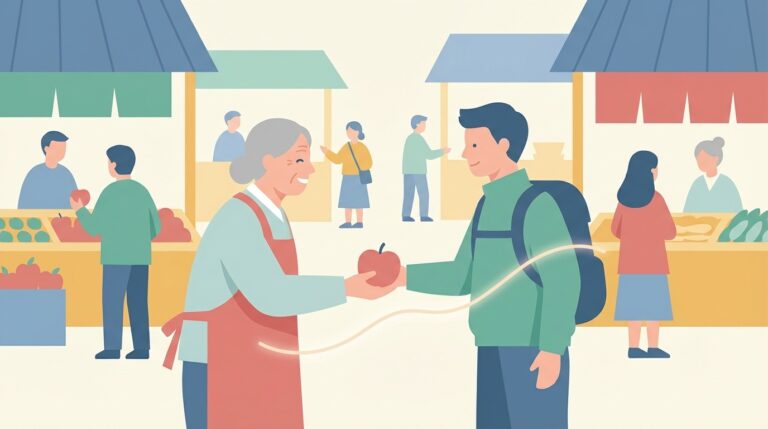
Furthermore, the concept of 서비스 (Service/freebies) and 덤 (Deom/extra portion) at traditional markets or local restaurants is the pure economy of Jeong. The owner gives you an extra piece of meat, not to make a profit, but because you are a 단골 (Dangol – regular customer) and Jeong has formed between you.
Phase 5: Immersive Roleplay – The Farewell Dinner
Setting: It’s 11:30 PM on a rainy Thursday in Euljiro. You are at an old, slightly greasy Gopchang (beef tripe) restaurant. You are moving back to your home country next week after working in Seoul for 5 years. You are having drinks with Team Leader Park, who used to scold you fiercely but always bought you dinner afterward.
Characters:
– YOU: A foreign expat, fluent in Korean (C2), feeling nostalgic and bittersweet.
– Team Leader Park (45, Male): Tough on the outside, incredibly warm on the inside. A typical Tsundere Korean boss.
Dialogue:
Park 팀장: 너 진짜 갈 거냐? 아유, 이 밤중에 비도 오는데 마음이 싱숭생숭하네.
(neo jinjja gal geonya? ayu, i bamjung-e bido o-neunde ma-eum-i singsungsaengsunghane.)
[Translation: Are you really leaving? Man, raining in the middle of the night… makes my heart feel restless.]
(🎭 Stage Direction: Park pours you a glass of Soju, avoiding eye contact, clearing his throat)
YOU: 팀장님… 그동안 정말 감사했습니다. 처음에 저 엄청 혼내셨잖아요. 기억나세요?
(timjangnim… geudong-an jeongmal gamsahaesseumnida. cheo-eum-e jeo eomcheong honnaesyeotjanayo. gieoknaseyo?)
[Translation: Team Leader… thank you so much for everything. You used to scold me so much at first. Do you remember?]
Park 팀장: 야, 내가 언제! 다 피가 되고 살이 되라고 한 소리지. 안 그래?
(ya, naega eonje! da piga doego sari doerago han soriji. an geurae?)
[Translation: Hey, when did I! It was all for your own good (to become flesh and blood). Right?]
YOU: 알죠. 팀장님 덕분에 한국 생활 잘 버텼습니다.
(aljyo. timjangnim deokbun-e hanguk saenghwal jal beotyeotseumnida.)
[Translation: I know. Thanks to you, I endured life in Korea well.]
Park 팀장: …가서 밥 잘 챙겨 먹고. 연락 자주 해라. 에휴, 정이 무섭다 진짜.
(…gaseo bap jal chaenggyeo meokgo. yeollak jaju haera. ehyu, jeong-i museopda jinjja.)
[Translation: …Make sure you eat well over there. Keep in touch often. Sigh, Jeong is truly a scary thing.]
🔀 Your Turn! How should you respond as a C2 Master?
– A) “네, 감사합니다. 안녕히 계세요.” (Yes, thank you. Goodbye.)
– B) “팀장님, 그동안 미운 정 고운 정 다 들었네요. 잊지 못할 거예요.”
– C) “아싸! 이제 잔소리 안 들어도 되네요!”✅ Best Choice: B — By acknowledging the “미운 정 고운 정” (hateful and beautiful Jeong), you validate all the tough love Team Leader Park gave you. You show you understood his heart. Prepare for him to cry into his Soju.
⚠️ Choice A Analysis: Grammatically flawless, but culturally cold. It lacks Jeong.
Bonus K-Culture Scenario: The Market Ajumma
(You are at Gwangjang Market, buying Banchan from a vendor you visit every week.)
이모님 (Vendor): 아이고, 우리 단골 왔네! 오늘은 깻잎무침이 맛있어. 내가 좀 더 얹었어.
(aigo, uri dangol wanne! oneul-eun kkaenninmuchim-i masisseo. naega jom deo eonjeosseo.)
[Oh, our regular is here! The marinated perilla leaves are good today. I put in a little extra.]
YOU: 이모님 진짜 최고! 이러니까 제가 이 집에 정이 듬뿍 들어서 다른 데를 못 가잖아요~
(imonim jinjja choego! ireonikka jega i jib-e jeong-i deumppuk deureoseo dareun de-reul mot gajanayo~)
[Auntie, you’re the best! This is why I’ve grown so deeply attached to this shop, I can’t go anywhere else!]
Phase 6: 10-Second Shadowing Drill
Time to get the intonation right. This expression requires a nostalgic, slightly sighing tone.
🥺 진짜 / 5년 동안 / 미운 정 고운 정 / 다~ 들었네요.
(jinjja / onyeon dong-an / miun jeong goun jeong / da~ deureonneyo.)
Tip: Stretch out the “다~” (all) to emphasize the sheer volume of history and emotions you share.
Phase 7: K-Culture Glossary (C2 Edition)
| Korean | Romanization | English | Contextual Meaning |
|---|---|---|---|
| 눈치 | nunchi | Social tact / Emotional intelligence | The ability to read the room and unspoken Jeong. |
| 단골 | dangol | Regular customer | A customer bound to a shop not by contracts, but by Jeong. |
| 덤 | deom | Extra / Free addition | Extra goods given out of Jeong by a vendor. |
| 츤데레 | cheundere | Tsundere | A slang term (borrowed from Japanese, but deeply embedded in Korea) for someone who shows Jeong through gruff, tough actions rather than sweet words. |
| 한 | han | Deep resentment / sorrow | The collective grief and resilience of the Korean people. |
Phase 8: Traveler’s Survival Kit
Even as a traveler, you can experience the profound concepts of Han and Jeong, especially at traditional markets (Sijang).
🆘 Survival Expression #1: Unlocking Market Jeong
– 🇰🇷 “이모님, 너무 맛있어 보여요! 조금만 더 주시면 안 돼요?”
– 🗣️ (imonim, neomu masisseo boyeoyo! jogeumman deo jusimyeon an dwaeyo?)
– 📍 Where to use: Traditional markets (Namdaemun, Gwangjang).
– 💡 Pro Tip: Asking for Deom (extra) with a bright smile isn’t seen as cheap; it’s seen as engaging in the playful transaction of Jeong.📌 Editor’s Travel Note
– The No-Tip Culture: Giving a monetary tip in Korea can actually break the atmosphere of Jeong. It turns a warm, human interaction into a cold financial transaction. If you want to show appreciation, become a regular (단골) or say “잘 먹었습니다!” (I ate well!) loudly on your way out.
Phase 9: Think Deeper — “A Step Further”
🧠 Think Deeper: Emotion & Identity (음식과 정체성)
The concepts of Jeong and Han are deeply interwoven with Korea’s collective identity, often summarized by the word 우리 (We/Our). In Korean, you don’t say “my mother” or “my country”; you say “our mother” (우리 엄마) and “our country” (우리나라). Jeong is the invisible glue that makes the “We” possible, demanding that individuals share space, food, and emotional burdens. Meanwhile, Han is the shared historical trauma that solidified this bond against outside forces. At a C2 level, understanding Korean means realizing that the language resists extreme individualism. Your joy is our joy; your Han is our Han.
💬 Your Turn: Does your native culture have a concept similar to “Jeong” that binds the community together, or is your culture more focused on individual emotional boundaries? Share your thoughts in the comments!
Phase 10: FAQ & Troubleshooting
Q: Is it okay to tell my Korean boss “정이 들었어요”?
A: Usually, YES, but timing is everything. It is highly appropriate during a farewell party or an end-of-year dinner. However, saying it during a serious Monday morning meeting about Q3 profits would be very awkward.
Q: Can I use “한이 맺히다” for small annoyances?
A: You can, but it acts as a comedic exaggeration. E.g., “내가 어제 못 먹은 치킨이 한이 맺힌다” (The chicken I couldn’t eat yesterday is leaving a knot of Han in my soul). Use it playfully with friends!
❌ Common Mistake #1: Confusing Jeong (정) with romantic love (사랑).
✅ Do this instead: Understand that Jeong can exist without love. You can feel Jeong for a pesky neighborhood cat, a strict boss, or an old, ugly sweater. Love is fiery; Jeong is sticky.
Phase 11: Wrap-up & Action Items
📌 One-Liner Summary: Jeong is the invisible, sticky bond formed over time, and Han is the profound knot of unresolved emotion; together, they are the heartbeat of the Korean language.
Action Mission:
– 🥉 Bronze (Solo): Look at an old item you own and say out loud, “이 물건에 정이 들었어요.”
– 🥈 Silver (Online): Leave a comment on your favorite K-Pop idol’s video saying, “이제 완전히 정들었어요!”
– 🥇 Gold (Real Life): Next time you leave Korea or say goodbye to a Korean friend, use the phrase “미운 정 고운 정 다 들었네요.”
🎬 K-Culture Mission:
Watch an episode of the drama Reply 1988 (응답하라 1988). Try to spot exactly how the neighbors share food without asking. That silent exchange? That is the physical form of Jeong.
Phase 12: Interactive Quiz — C2 Challenge
1. Situational Judgment: You have been going to the same dry cleaner for 3 years. The owner always sews your loose buttons for free. You are moving away. What is the most culturally profound way to express your feelings?
– A) 아주머니, 서비스 감사합니다. (Ma’am, thanks for the service.)
– B) 그동안 감사했습니다. 정이 많이 들었는데 아쉽네요. (Thank you for everything. I’ve grown very attached to you/this place, it’s a shame to leave.)
– C) 아주머니를 사랑합니다. (I love you, ma’am.)
2. True or False – K-Culture Edition:
Giving a 20% tip at a local Mom-and-Pop Korean restaurant is the best way to show Jeong.
– (True / False)
3. Fill in the Blank:
아이고, 우리 10년 동안 맨날 싸우더니 그새 ( ) 다 들었네.
(Oh man, we fought every day for 10 years, and in that time, we’ve developed ______.)
(Answers: 1: B, 2: False – it can make them uncomfortable; become a regular instead, 3: 미운 정 고운 정)
Frequently Asked Questions (FAQ)
Q: What does "정(이) 들다" mean in Korean and how do you pronounce it?
A: In Korean, "정(이) 들다" is pronounced [jeong-i deulda] and means: (Literal) Jeong enters. / (Real nuance) To grow deeply attached to someone or something over time, often subconsciously.
Q: What does "미운 정 고운 정 다 들다" mean in Korean and how do you pronounce it?
A: In Korean, "미운 정 고운 정 다 들다" is pronounced [miun jeong goun jeong da deulda] and means: (Literal) Both hateful Jeong and beautiful Jeong have entered. / (Real nuance) To have gone through thick and thin with someone, developing a complex bond of both love and frustration.
Q: What does "한(이) 맺히다" mean in Korean and how do you pronounce it?
A: In Korean, "한(이) 맺히다" is pronounced [han-i maechida] and means: (Literal) Han congeals/forms a knot. / (Real nuance) To harbor deep-seated, unresolved grief, resentment, or a profound unfulfilled desire.







