

Phase 1: Empathy — Immersive Hook
Hello there! This is your Daily Hangul Editor.
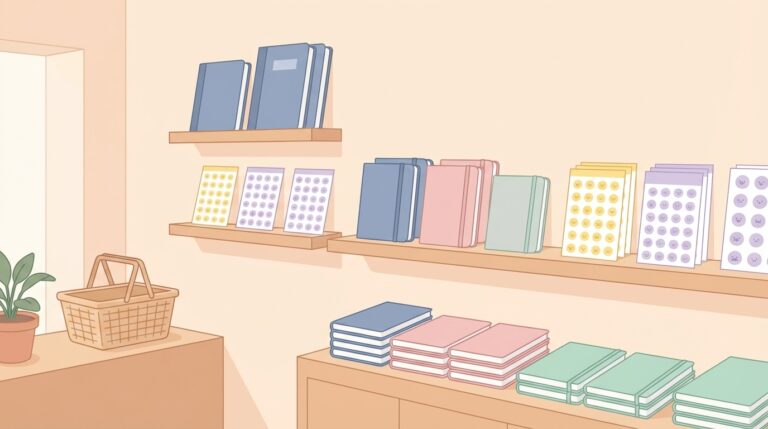
Picture this: You are watching a high school K-Drama. The main characters accidentally bump hands while reaching for the exact same cute notebook in a brightly lit, colorful store. Fast forward to reality—you are in Seoul, exploring Hongdae, and you walk into a massive stationery store like Artbox or Kyobo Hottracks. You are immediately overwhelmed by walls of pastel planners, adorable K-Pop photocard stickers, and gel pens in 50 shades of pink.
You want to buy a simple notebook to practice your Hangul writing. But the signs are all in Korean, the staff is busy organizing shelves, and your translation app is suddenly acting up. You just need to ask, “Do you have notebooks?” and “How much is this?”
If you don’t know the right words, you might end up wandering the aisles for 30 minutes in awkward silence. But don’t worry! By the end of this 5-minute guide, you’ll be able to grab a basket, confidently ask a staff member for exactly what you need, and check out like a true Seoulite. (This guide is completely based on the real panicked messages my A1 students send me when they try to buy souvenirs!)
Phase 2: Core Expression Deep Dive
Let’s look at the absolute must-know survival phrases for your stationery shopping spree.
1. 공책 있어요?
- Pronunciation: [gong-chaek i-sseo-yo?] + [gong-check ee-suh-yo?]
- Meaning: Do you have notebooks? (Literal: Notebook exists?)
- K-Culture Moment: You’ll hear this “Noun + 있어요?” pattern everywhere in Korea! From a fan asking a pop-up store clerk if their bias’s merch is still in stock (“포카 있어요?”), to a diner asking if a restaurant has spicy food.
- Editor’s Insight: English speakers usually ask, “Do you sell notebooks?” or “Do you carry notebooks?” But in Korean, we simply ask if the item exists in the store. It’s much simpler! Keep your intonation going up at the end to make it a question.
- Situation Spectrum:
[🚫 Never] ———— [⚠️ Caution] ———— [✅ Freely]
- To friends (Casual): ⚠️ (Drop the ‘yo’ and say “있어?”)
- To store staff (Semi-formal): ✅
- To the store manager (Formal): ✅
- 🤔 Think About It: Why do Koreans focus on the “existence” (있어요) of an object rather than the “action” of selling it? How does this reflect a culture that values quick, direct information exchanges?
2. 이거 얼마예요?
- Pronunciation: [i-geo eol-ma-ye-yo?] + [ee-guh ull-mah-yeh-yo?]
- Meaning: How much is this?
- K-Culture Moment: The ultimate street market and underground shopping mall phrase. Even if you don’t know Korean numbers yet, asking this prompts the clerk to either type the price on a calculator or point to the price tag for you.
- Editor’s Insight: “이거” (ee-guh) means “this thing.” It’s your magical pointing word. Point at a sparkly pen, a cute eraser, or a BTS poster and say “이거 얼마예요?”
- Situation Spectrum:
- To store staff (Semi-formal): ✅
- 🤔 Think About It: In many Western stores, everything is strictly price-tagged. In traditional Korean markets, bargaining is a culture. While you shouldn’t bargain at a modern franchise stationery store, this phrase is your key to starting any transaction in Korea!
3. 이거 주세요.
- Pronunciation: [i-geo ju-se-yo.] + [ee-guh joo-seh-yo.]
- Meaning: Please give me this. (I’ll take this.)
- K-Culture Moment: You bring your chosen notebook to the checkout counter, slide it to the cashier, and say this magic phrase with a polite nod.
- Editor’s Insight: “주세요” (joo-seh-yo) literally means “please give.” You can attach it to anything! Coffee? “아메리카노 주세요.” A notebook? “공책 주세요.”
- Situation Spectrum:
- To store staff (Semi-formal): ✅
Phase 3: Textbook vs Real Life Korean
| Situation | 📖 Textbook Korean | 🗣️ Real Korean | 💡 Why is it different? |
|---|---|---|---|
| Trying to get the clerk’s attention | 실례합니다. (Excuse me – formal) | 저기요! (Over here!) | “실례합니다” sounds like you stepped on someone’s foot. “저기요” is used to call a worker over. |
| Saying you want to buy it | 이것을 사고 싶습니다. (I want to buy this.) | 이거 계산해 주세요. (Please calculate/ring up this.) | Koreans prefer efficient, action-oriented verbs at the checkout counter. |
| Leaving the store | 안녕히 계십시오. (Goodbye – highly formal) | 감사합니다~ 또는 수고하세요~ (Thank you / Keep up the good work) | A light bow and “Thank you” is much more natural for quick retail interactions. |
Phase 4: Cultural Deep Dive
4-1. Non-verbal Communication: The Two-Handed Rule
When you finally buy that perfect vocabulary notebook, how do you hand your credit card to the cashier? In Korea, you should never hand over money or a card with just one hand (especially not while looking away). Always use two hands, or hold the card with your right hand while your left hand lightly supports your right forearm or elbow. It’s a deep-rooted sign of respect (예의) in Korean society.
4-2. K-Culture Connection: The World of “Dakku” (다꾸)
Why are Korean stationery stores so massive and popular, even among adults? Welcome to the world of 다꾸 (Dakku), short for 다이어리 꾸미기 (Decorating your diary). In Korea, studying is a serious, high-pressure endeavor from a young age. To make long hours of studying or scheduling more bearable, Koreans found joy in beautiful, high-quality stationery. This evolved into a massive hobby where K-Pop fans use these supplies to decorate their idol photo cards (포카 예절), and students create aesthetically pleasing studygrams. When you buy a notebook in Korea, you aren’t just buying paper; you’re buying a piece of modern Korean “healing” culture.
Phase 5: Immersive Roleplay Scenario
Setting: Saturday afternoon, Hongdae. You are inside a famous stationery store. K-Pop music is playing loudly. You finally spot the aisle with the Korean study notebooks, but you want to make sure of the price before buying it.
Characters:
– YOU: An absolute beginner in Korean, excited but nervous.
– Clerk (알바생): A 20-something part-time worker wearing a cute store apron.
Dialogue:
YOU: 저기요! 👋
(jeo-gi-yo!)
[Excuse me!]
Clerk: 네, 손님. 찾으시는 거 있으세요?
(ne, son-nim. cha-jeu-si-neun geo i-sseu-se-yo?)
[Yes, customer. Is there something you are looking for?]
YOU: 공책… 있어요? 📓
(gong-chaek… i-sseo-yo?)
[Do you have… notebooks?]
Clerk: 아, 공책이요! 이쪽으로 오세요.
(a, gong-chae-gi-yo! i-jjo-geu-ro o-se-yo.)
[Ah, notebooks! Please come this way.]
(🎭 Stage Direction: The clerk leads you to an aisle filled with pastel-colored notebooks.)
YOU: 우와… 이거 얼마예요?
(u-wa… i-geo eol-ma-ye-yo?)
[Wow… How much is this?]
Clerk: 그거는 3,000원이에요.
(geu-geo-neun sam-cheon-wo-ni-e-yo.)
[That one is 3,000 won.]
(🎭 Stage Direction: You nod, happy with the price, and walk to the checkout counter.)
YOU: 이거 주세요. 💳
(i-geo ju-se-yo.)
[Please give me this. (I’ll take this.)]
Clerk: 네, 결제 도와드릴게요.
(ne, gyeol-je do-wa-deu-ril-ge-yo.)
[Yes, I’ll help you with the payment.]
🔀 Your Turn! The Decision Point:
Suddenly, the clerk asks you a very common but terrifying question for foreigners:
Clerk: 봉투 필요하세요? (bong-tu pi-ryo-ha-se-yo? – Do you need a plastic bag?)How should you reply?
– A) “네, 주세요!” (Yes, please give me one!)
– B) “아니요, 괜찮아요.” (No, it’s okay.)
– C) “대박!” (Awesome!)✅ Best Choice: A or B depending on your needs.
⚠️ Pro Tip: In Korea, environmental laws require stores to charge for plastic bags (usually 100-200 won). If you have your own backpack, say “아니요, 괜찮아요” (a-ni-yo, gwaen-cha-na-yo). Option C is out of context and will definitely confuse the poor clerk!
Phase 6: 10-Second Shadowing Drill
Practice these sentences out loud. Pay attention to the pauses (/) and emotions!
- 🙋♂️ (Politely getting attention) 저기요, / 공책 / 있어요?
(jeo-gi-yo, / gong-chaek / i-sseo-yo?) - 🤔 (Curiously pointing) 이거 / 얼마예요?
(i-geo / eol-ma-ye-yo?) - 😊 (Handing over your card) 이거 / 주세요!
(i-geo / ju-se-yo!)
Phase 7: K-Culture Glossary
| Korean | Romanization | English | Cultural Context |
|---|---|---|---|
| 문구점 | mungu-jeom | Stationery store | Not just for kids; a paradise for artists, students, and K-Pop fans. |
| 다꾸 | dakku | Diary decorating | A massive trend in Korea involving stickers, washi tape, and cute planners. |
| 알바생 | alba-saeng | Part-time worker | Derived from the German word ‘Arbeit’. Most retail staff in these stores are college alba-saeng. |
| 봉투 | bong-tu | Plastic/Paper bag | You must pay extra for this by law, so clerks will always ask if you need one! |
Phase 8: Traveler’s Survival Kit
Heading to a Korean stationery store, cosmetic shop, or convenience store soon? Keep these in your back pocket!
🆘 Survival Phrases for Shopping
1. 🇰🇷 카드 돼요? (ka-deu dwae-yo?)
– 🗣️ Pronunciation: [ka-deu dweh-yo?]
– 📍 Meaning: Do you accept credit cards?
2. 🇰🇷 영수증 버려주세요. (yeong-su-jeung beo-ryeo-ju-se-yo.)
– 🗣️ Pronunciation: [young-soo-jeung buh-ryuh-joo-seh-yo.]
– 📍 Meaning: Please throw away the receipt. (Very common to say right after paying!)📌 Editor’s Travel Note
– Cash vs Card: Korea is a cashless society! You can buy a 1,000-won eraser with a credit card, and the clerk won’t bat an eye. Just make sure your foreign card doesn’t have high foreign transaction fees.
– Translation Apps: Download Papago (by Naver). It translates Korean much more accurately than Google Translate, especially for casual speech and shopping terms!
Phase 9: Think Deeper — “One Step Further”
The Aesthetics of Studying: Why is Korean Stationery So Cute?
In many cultures, school supplies are purely functional. A blue pen is just a blue pen. But in Korea, aesthetic stationery is a massive industry. Why? It traces back to the intense educational culture. Korean students spend grueling hours studying in hagwons (cram schools) and study cafes. Amidst this pressure, having a beautiful, pastel-colored notebook or a cute character pen offers a tiny moment of joy and comfort—what Koreans call “소확행” (so-hwak-haeng: small but certain happiness). The next time you see a delightfully designed notebook, remember that it’s designed to bring a little smile to a very tired student!
💬 Your Turn: Does your culture place a high value on the design of everyday school or office supplies? Share your thoughts in the comments!
Phase 10: FAQ & Troubleshooting
Q: Do I have to say “hello” and “thank you” to the cashier?
A: Yes! A simple “안녕하세요” (an-nyeong-ha-se-yo) when you approach the counter, and “감사합니다” (gam-sa-ham-ni-da) with a slight bow of the head when you take your items is perfect.
Q: Can I open the plastic wrap on the notebooks to check the paper inside?
A: 🚫 Absolutely not! Unless there is a designated “Sample” (샘플) sticker on the item, you should never open sealed stationery in Korea. You will be forced to buy it if you break the seal!
❌ Common Mistake #1: Pointing at the cashier and saying “당신” (You).
✅ Do this instead: Never use the word “당신” to a stranger in Korea; it sounds aggressive! Just say “저기요” (Excuse me) to get their attention.
Phase 11: Wrap-up & Action Items
One-Liner Summary: Use “공책 있어요?” to find it, “얼마예요?” to check the price, and “이거 주세요” to buy it!
Your 3-Step Action Mission:
– 🥉 Bronze (Solo): Stand in front of a mirror with any book and confidently say, “이거 얼마예요?” 3 times.
– 🥈 Silver (Online): Go to YouTube, search for “다꾸” (Dakku), and leave a comment saying “우와! 이거 얼마예요?” on your favorite video.
– 🥇 Gold (Real Life): Next time you visit a Korean market or an online K-Pop merch store, use these three phrases to navigate your shopping!
Phase 12: Interactive Quiz
Test your knowledge before you hit the shops in Seoul!
1. You want to buy a cute sticker pack (스티커). You bring it to the counter. What is the most natural thing to say?
A) 스티커를 사고 싶습니다.
B) 당신, 스티커 주세요.
C) 이거 계산해 주세요.
2. True or False: When the clerk asks “봉투 필요하세요?”, they are offering you a free gift bag.
3. Fill in the blank: You are looking for a pen (펜). You catch the clerk’s attention by saying, “저기요! 펜 ______?”
A) 있어요
B) 주세요
C) 얼마예요
(Answers: 1: C – It means ‘Please ring this up’. A is too textbook, B is rude! / 2: False – They are asking if you want to BUY a plastic bag for 100-200 won. / 3: A – ‘펜 있어요?’ Do you have pens?)
Frequently Asked Questions (FAQ)
Q: What does "공책 있어요?" mean in Korean and how do you pronounce it?
A: In Korean, "공책 있어요?" is pronounced [gong-chaek i-sseo-yo?] and means: Do you have notebooks? (Literal: Notebook exists?)
Q: What does "이거 얼마예요?" mean in Korean and how do you pronounce it?
A: In Korean, "이거 얼마예요?" is pronounced [i-geo eol-ma-ye-yo?] and means: How much is this?
Q: What does "이거 주세요." mean in Korean and how do you pronounce it?
A: In Korean, "이거 주세요." is pronounced [i-geo ju-se-yo.] and means: Please give me this. (I'll take this.)






