

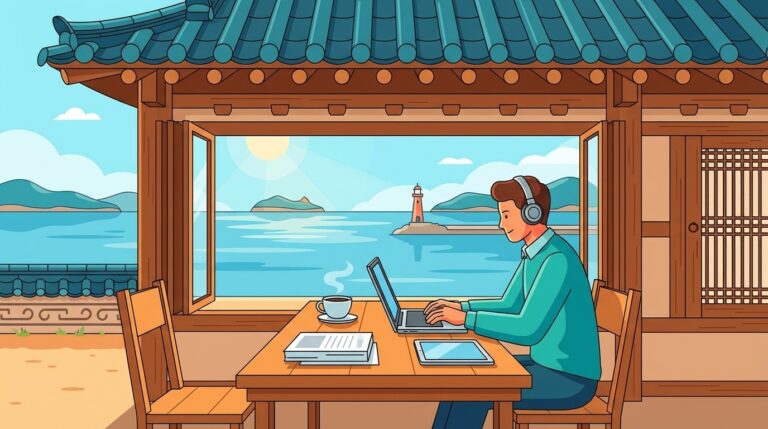
Welcome to the Next Level of K-Business: Pitching Workation to Digital Nomads
Hello, C2 learners! Welcome back to Daily Hangul. I’m your Lead Editor, your veteran tutor, and your personal local culture navigator here in Seoul.
Picture this: You’re sitting in a sleek, glass-walled cafe overlooking the turquoise waters of Jeju Island’s Aewol coast. To your left, a local barista is brewing a Hallabong-infused cold brew. To your right, your laptop is open to a Zoom call with your team back in London, New York, or Singapore. In K-Dramas like Welcome to Samdal-ri or Hometown Cha-Cha-Cha, leaving the exhausting city for a serene coastal town is highly romanticized. But what if you could sell this dream to international digital nomads as a B2B Tourism & MICE (Meetings, Incentives, Conferences, and Exhibitions) package?
At the C2 level, you’re no longer just saying, “Korea is a beautiful place to travel.” You are persuading government officials, local tourism boards, and global tech companies. You need the exact sophisticated, high-impact business vocabulary that Korean professionals use in the boardroom.
If you don’t master these nuances, your multi-million dollar pitch might sound like a middle schooler’s travel diary. But if you nail it? You’ll be treated as an absolute insider—a true global MICE expert. Let’s dive into the language of the modern Korean digital nomad.
Phase 2: Core Expressions Deep Dive
Let’s unpack the high-level vocabulary you need to pitch a “Workation” (Work + Vacation) product in Korea.
1. 업무 효율과 힐링을 동시에 잡다
- Pronunciation: [eop-mu hyo-yul-gwa hil-ling-eul dong-si-e jap-da]
- Sound-alike guide: up-moo hyo-yool-gwa heeling-eul dong-shee-eh jap-da (The ‘jap’ sounds like a sharp catch, emphasizing the action).
- Meaning: Literally “To catch both work efficiency and healing at the same time.” (Real nuance: Striking the perfect balance between high productivity and profound relaxation).
- K-Culture Moment: This is the ultimate Korean business marketing trope. You’ll see this plastered across brochures for Gangwon-do retreats or Jeju tech-hubs. It taps directly into the Korean psyche that even rest (“healing”) must be paired with productivity (“efficiency”).
- Editor’s Insight: The word ‘힐링’ (healing) in Korea doesn’t necessarily mean recovering from an illness. It’s a cultural buzzword for mental detox from the intense Ppalli-Ppalli (hurry-hurry) lifestyle. When you use “동시에 잡다” (to catch at the same time / kill two birds with one stone), you instantly sound like a seasoned Korean marketer.
- Situation Spectrum:
[🚫 절대 금지] ———— [⚠️ 주의] ———— [✅ 자유롭게]- Pitching to a Client/Boss (Formal): ✅
- Marketing Copywriting (Professional): ✅
- Casual Chat with Friends: ⚠️ (A bit too formal, they might tease you for sounding like a TV commercial).
- 🤔 Think About It: Why does Korean culture obsess over the word “healing” (힐링)? Does the constant need for “efficiency” (효율) even during vacations reflect the underlying pressure of modern Korean society?
2. 체류형 관광 인프라를 구축하다
- Pronunciation: [che-ryu-hyeong gwang-wang in-peu-ra-reul gu-chu-ka-da]
- Sound-alike guide: che-ryoo-hyong gwang-wang in-pu-ra-rul goo-choo-kah-da
- Meaning: Literally “To build infrastructure for stay-oriented tourism.” (Real nuance: Developing long-term stay facilities and systems to keep digital nomads in one city for weeks/months, rather than just passing through).
- K-Culture Moment: In recent years, local Korean governments (like Busan, Jeju, and Yangyang) are fighting 소멸 위기 (the crisis of population decline in rural areas). Their savior? Digital nomads. By using the academic/bureaucratic prefix ‘-형’ (type/oriented), you match the exact tone of government MICE proposals.
- Editor’s Insight: At C2, you must master Sino-Korean (Hanja) words. Using ‘구축하다’ (to establish/build up systems) instead of ‘만들다’ (to make) elevates your Korean from a casual speaker to an industry expert.
- Situation Spectrum:
[🚫 절대 금지] ———— [⚠️ 주의] ———— [✅ 자유롭게]- Government Proposals/B2B Meetings: ✅
- Casual Travel Blogs: 🚫 (Way too bureaucratic).
3. 현지 밀착형 경험을 제공하다
- Pronunciation: [hyeon-ji mil-cha-kyeong gyeong-heom-eul je-gong-ha-da]
- Sound-alike guide: hyun-jee mil-chak-hyong gyung-hum-eul je-gong-ha-da
- Meaning: Literally “To provide locally adhered-type experiences.” (Real nuance: Offering deeply immersive, authentic local experiences rather than generic tourist traps).
- K-Culture Moment: Imagine a digital nomad finishing their coding session at 5 PM, then immediately heading down to a local Haenyeo (Jeju female diver) house to learn how to prepare fresh abalone. That is ‘현지 밀착형’ (closely adhered to the local).
- Editor’s Insight: Global digital nomads hate feeling like “tourists.” They want to be “temporary locals.” Use this phrase to assure stakeholders that your workation package offers cultural authenticity.
- Situation Spectrum:
[🚫 절대 금지] ———— [⚠️ 주의] ———— [✅ 자유롭게]- Product Pitch/Consulting: ✅
- Formal Presentations: ✅
Phase 3: Textbook vs Real Life (MICE Edition)
Let’s compare what you learn in an advanced textbook with how real MICE professionals talk in a Seoul boardroom.
| 상황 (Situation) | 📖 교과서 한국어 (Textbook) | 🗣️ 진짜 한국어 (Real Pitch/Business) | 💡 왜 다를까? (Why the difference?) |
|---|---|---|---|
| Explaining the goal | 외국인들이 일하면서 여행하기 좋습니다. | 워라밸과 업무 몰입도를 극대화하는 최적의 목적지입니다. | C2 business Korean relies heavily on impactful Hanja terms (극대화, 최적, 목적지) to sound authoritative. |
| Selling the location | 바다가 보이고 인터넷이 빠릅니다. | 퇴근 후엔 오션뷰 1열 직관, 업무는 기가 와이파이존에서 끊김 없이! | Real marketing uses trendy slang (‘1열 직관’ – front row view) mixed with tech specs (기가 와이파이). |
| Describing the vibe | 현지 문화를 체험할 수 있습니다. | 찐 로컬 바이브를 느낄 수 있는 현지 밀착형 워케이션 성지입니다. | Emphasizing authenticity (‘찐’ – real/authentic slang, ‘성지’ – holy land/mecca) appeals to the MZ generation. |
Bottom Note: When pitching to B2B clients, use the right column’s “현지 밀착형” and “최적의 목적지”. When creating social media copy for the digital nomads themselves, lean into “찐 로컬” and “오션뷰 1열 직관”!
Phase 4: Cultural Deep Dive — K-Culture & MICE
4-1. Non-verbal Communication: The Art of the Pitch
When presenting a Workation package to a Korean local government official (e.g., in Gangwon-do or Jeju), the concept of Nunchi (눈치) is paramount. Even if you are an innovative foreign digital nomad, presenting a proposal requires traditional Korean business etiquette. Hand over your iPad or printed proposal with two hands. When they ask a critical question about internet stability, do not be overly defensive; nod deeply to acknowledge their concern (“지적해주신 부분에 전적으로 동의합니다…”) before providing your solution.
4-2. K-Culture Connection: The Evolution of “Work” in Korea
The concept of “Workation” is completely disrupting traditional Korean corporate culture. Historically, Korean teamwork was built in the office and solidified during grueling, alcohol-fueled Hoesik (회식 – company dinners).
However, the pandemic and the rise of the MZ generation have shifted the paradigm. Now, tech giants like Naver and Kakao offer remote work from Jeju or Tokyo. By pitching a workation product, you are actually selling a slice of modern rebellion against the traditional Hoesik culture. You are offering the K-Drama fantasy—like the tech CEO in a drama who codes from a rustic cabin—while guaranteeing the flawless IT infrastructure (인프라) that Koreans simply cannot live without.
Phase 5: Immersive Roleplay Scenario
Scenario A: The High-Stakes Pitch
- Setting: A sleek boardroom at the Seoul Tourism Organization (STO). 10 AM. You are projecting slides of a Hanok-village workation concept.
- Characters:
- YOU: Lead MICE Planner for an international agency.
- Director Kim (50s): A senior official at STO. Pragmatic, cares about local economic impact.
- Manager Lee (30s): A trendy junior official, highly interested in global nomad trends.
Manager Lee: 이번에 제안해주신 ‘북촌 한옥마을 워케이션’ 기획안, 흥미롭네요. 글로벌 노마드들의 반응이 어떨 것 같나요?
(ibeon-e je-an-hae-ju-sin ‘buk-chon ha-nok-ma-eul wo-ke-i-syeon’ gi-hoe-gan, heung-mi-rom-ne-yo. geul-lo-beol no-ma-deu-deu-reui ban-eung-i eo-tteol geot gat-na-yo?)
[The ‘Bukchon Hanok Village Workation’ proposal you suggested this time is interesting. How do you think global nomads will react?]
YOU: 반응은 폭발적일 겁니다. 한국만의 현지 밀착형 경험을 제공하면서도, 서울의 완벽한 IT 인프라를 누릴 수 있으니까요.
(ban-eung-eun pok-bal-jeo-gil geom-ni-da. han-gung-ma-neui hyeon-ji mil-cha-kyeong gyeong-heom-eul je-gong-ha-myeon-seo-do, seo-u-reui wan-byeo-kan IT in-peu-ra-reul nu-ril su is-seu-ni-kka-yo.)
[The reaction will be explosive. Because while providing Korea’s unique locally integrated experience, they can enjoy Seoul’s flawless IT infrastructure.]
Director Kim: (Adjusting his glasses) 음… 한옥은 방음이나 냉난방이 취약해서 줌(Zoom) 미팅 같은 업무 효율이 떨어지지 않을까요? 그냥 예쁜 카페에서 사진 찍고 끝나는 단기 관광이 될까 봐 우려됩니다만.
(eum… ha-no-geun bang-eu-mi-na naeng-nan-bang-i chwi-ya-kae-seo jum mi-ting ga-teun eop-mu hyo-yu-ri tteo-reo-ji-ji a-neul-kka-yo? geu-nyang ye-ppeun ka-pe-e-seo sa-jin jjik-go kkeut-na-neun dan-gi gwang-wang-i doel-kka bwa u-ryeo-doem-ni-da-man.)
[Hmm… Hanoks have poor soundproofing and AC/heating, wouldn’t work efficiency like Zoom meetings drop? I’m concerned it might just become a short-term tourism stint where they take pictures at pretty cafes and leave.]
🔀 Your Turn! How do you respond to Director Kim’s objection?
* A) “아닙니다. 요즘 외국인들은 불편해도 예쁜 걸 더 좋아합니다.” (No. These days foreigners prefer pretty things even if it’s uncomfortable.)
* B) “지적해주신 우려에 깊이 공감합니다. 그래서 숙박은 전통 한옥에서 하되, 도보 3분 거리에 최고급 통신망을 갖춘 전용 코워킹 스페이스(공유 오피스)를 구축하는 투트랙(Two-track) 전략을 세웠습니다.”
* C) “그건 각자 알아서 해결해야 할 문제입니다. 워케이션은 자유가 핵심이니까요.”✅ Best Choice: B — You acknowledge the senior official’s concern first (눈치/존중), then counter with a highly professional business solution using terms like “구축” and “투트랙 전략”.
⚠️ Choice A & C Analysis: Both are disastrous in a Korean B2B context. A sounds condescending and dismissive, while C completely lacks accountability, ruining your credibility as a MICE planner.
Scenario B: Bonus K-Culture Scenario (The Cafe Nomad)
You are a digital nomad doing a trial run of your package in a seaside cafe. You need to plug in your laptop, but you’ve been there for 4 hours.
YOU: 사장님, 혹시 저기 구석에 있는 콘센트 좀 써도 될까요? 제가 음료랑 케이크 하나 더 주문하겠습니다!
[Boss, could I possibly use the outlet in that corner? I will order another drink and a cake!]
Owner (Smiling): 아유, 그럼요. 편하게 쓰세요. 일하시느라 고생이 많으시네요.
[Oh, of course. Use it comfortably. You’re working hard.]
(Pro-tip: Korean cafe owners are generally tolerant of ‘카공족’ (Cafe study/work tribe), but offering to buy another item after 3-4 hours is considered excellent manners and ensures a warm welcome!)
Phase 6: 10-Second Shadowing Drill
Time to sound like a Korean Tourism Director! Read this aloud, focusing on the pauses (/) and intonation.
😤 단호하고 자신감 있게 (Firm and Confident):
제주도는 / 글로벌 노마드들의 / 업무 효율과 힐링을 / 동!시!에 잡을 수 있는 / 최!적!의 / 워케이션 목적지입니다.
(Je-ju-do-neun / geul-lo-beol no-ma-deu-deu-reui / eop-mu hyo-yul-gwa hil-ling-eul / dong!si!e ja-beul su in-neun / choe!jeo!geui / wo-ke-i-syeon mok-jeok-ji-im-ni-da.)
Phase 7: K-Culture MICE Glossary
| 한국어 | Romanization | English | Context in Korea |
|---|---|---|---|
| 워라밸 | wo-ra-bael | Work-Life Balance | An abbreviation for Work-Life Balance. The ultimate goal for the MZ generation workforce in Korea. |
| 인프라 | in-peu-ra | Infrastructure | Highly used in B2B contexts. In Korea, this usually implies lightning-fast internet and convenient public transport. |
| 카공족 | ka-gong-jok | Cafe-study tribe | People who study or work in cafes for long hours. A massive cultural phenomenon in Korea. |
| 소멸 위기 지역 | so-myeol wi-gi ji-yeok | Crisis region facing extinction | Rural areas suffering from severe population decline. The main target areas for government-funded workation projects. |
| 팸투어 | paem-tu-eo | FAM Tour (Familiarization Tour) | Free promotional tours hosted by governments for travel agents or influencers to experience a new tourism product. |
Phase 8: Traveler’s Survival Kit (Digital Nomad Edition)
As a digital nomad mapping out workation products, you must know how to navigate the physical workspace. Here are your survival tools:
🆘 Survival Phrases for the Working Traveler
1. 🇰🇷 “혹시 와이파이 비밀번호가 어떻게 되나요?” (hok-si wa-i-pa-i bi-mil-beon-ho-ga eo-tteo-ke doe-na-yo?)
– English: “By any chance, what is the Wi-Fi password?”
2. 🇰🇷 “여기 콘센트 꽂을 데 있나요?” (yeo-gi kon-sen-teu kko-jeul de in-na-yo?)
– English: “Is there a place to plug into an outlet here?”
3. 🇰🇷 “한 달 살기 장기 숙박 할인되나요?” (han dal sal-gi jang-gi suk-bak ha-rin-doe-na-yo?)
– English: “Is there a discount for a one-month long-term stay?”📌 Editor’s Travel Note
* Wi-Fi Culture: You don’t usually have to ask! In 99% of Korean cafes and restaurants, the Wi-Fi password is printed on the receipt (영수증) or written on a small sign near the POS system.
* Plugs: Korea uses 220V with round pins (Type C/F). If you forgot an adapter, ask a convenience store for a “돼지코” (Pig’s nose – the slang for a travel adapter).
Phase 9: Think Deeper — “한 발 더 깊이”
🧠 Korean in the Global Era (글로벌 시대의 한국어)
Have you noticed how many English loanwords were in today’s lesson? 워케이션 (Workation), 힐링 (Healing), 인프라 (Infra), 투트랙 전략 (Two-track strategy). In the Korean B2B and MICE industry, mixing English vocabulary with advanced Sino-Korean grammar is practically a dialect of its own. It is a linguistic strategy to project a modern, global, and highly competent corporate image. However, it also creates a bifurcation in society; older generations or those outside the corporate sphere often feel alienated by this “trendy” business jargon. As a C2 learner, your superpower is recognizing this balance: knowing when to use English loanwords to sound like a cutting-edge MICE planner, and when to use pure Korean terms to build genuine emotional rapport with local stakeholders.
💬 Your Turn: How does the business language in your country treat foreign buzzwords? Are they embraced as “professional” or criticized as “pretentious”? Let me know in the comments!
Phase 10: FAQ & Troubleshooting
Q: Can I use “효율” (Efficiency) when talking about my personal vacation?
A: Yes, but with a caveat! If you say “이번 휴가는 아주 효율적이었어” (This vacation was very efficient), Koreans might laugh and ask if you were working on a spreadsheet while on the beach. Use it strictly for business planning or ironically among friends.
Q: In business meetings, how should I address the local government officials?
A: Never use “당신” (You). Always use their title + 님. For example, 국장님 (Director), 과장님 (Manager), or 담당자님 (Person in charge).
❌ Common Mistake #1: Treating a Workation pitch like a backpacker’s itinerary. Korean stakeholders are looking for economic impact (경제적 파급효과) and sustainable infrastructure (지속 가능한 인프라). Don’t just say “It’s beautiful and fun.” Say “It guarantees high immersion and stay-oriented economic growth.”
Phase 11: Wrap-up & Action Items
✨ One-Liner Summary: To successfully pitch a Workation package in Korea, you must speak the language of “Synergy between Work Efficiency and Local Healing.”
🎯 Action Missions:
* 🥉 Bronze (Solo): Stand in front of a mirror and deliver the 10-second shadowing drill with the confidence of a CEO.
* 🥈 Silver (Online): Write a 3-sentence pitch for a workation in your home country using the phrase “업무 효율과 힐링을 동시에 잡다” and post it in a Korean learning community.
* 🥇 Gold (Real-world): The next time you are in a Korean cafe with your laptop, observe the 카공족 (cafe-study tribe) and practice asking the staff for the outlet or Wi-Fi using today’s survival phrases!
* 🇰🇷 K-Culture Mission: Open Google Street View, drop yourself in Jeju Island’s Aewol Coast or Gangneung’s Coffee Street. Find a cafe and visualize presenting a “체류형 관광” proposal right there.
Phase 12: Interactive Challenge (Quiz)
Let’s test your C2 consulting instincts!
1. Situational Judgment: You are concluding your presentation to the Jeju Tourism Board about bringing 500 tech workers for a month. Which closing statement is most appropriate?
* A) 제주도는 정말 예뻐서 외국인들이 좋아할 거예요! 놀러 오라고 하세요.
* B) 제주도는 워라밸과 업무 몰입도를 극대화할 수 있는, 체류형 워케이션의 최적의 목적지입니다.
* C) 제주도 와이파이 진짜 대박이에요. 무조건 성공합니다.
2. Fill in the Blank:
단순히 하루 이틀 구경하고 떠나는 관광이 아니라, 한 지역에 오래 머무는 [ _____ ] 관광 인프라를 구축해야 합니다.
* A) 체험형 (Experience-oriented)
* B) 체류형 (Stay-oriented)
* C) 통과형 (Pass-through-oriented)
3. True or False – K-Culture Edition:
* Korean business presentations generally avoid English buzzwords to maintain language purity. (T/F)
👀 Click here for answers!
- Answer: B. A is too childish. C uses slang (“대박”) which is highly inappropriate for a formal B2B presentation.
- Answer: B (체류형). This is the core concept of workation—staying long-term.
- Answer: False. Modern Korean business and MICE industries heavily utilize English loanwords (Infra, Workation, Two-track) to project a global, professional image.
Did you enjoy today’s high-level business deep dive? What city in Korea would be your dream workation destination? Share your thoughts below!
Frequently Asked Questions (FAQ)
Q: What does "업무 효율과 힐링을 동시에 잡다" mean in Korean and how do you pronounce it?
A: In Korean, "업무 효율과 힐링을 동시에 잡다" is pronounced [eop-mu hyo-yul-gwa hil-ling-eul dong-si-e jap-da] and means: Literally "To catch both work efficiency and healing at the same time." (Real nuance: Striking the perfect balance between high productivity and profound relaxation).
Q: What does "체류형 관광 인프라를 구축하다" mean in Korean and how do you pronounce it?
A: In Korean, "체류형 관광 인프라를 구축하다" is pronounced [che-ryu-hyeong gwang-wang in-peu-ra-reul gu-chu-ka-da] and means: Literally "To build infrastructure for stay-oriented tourism." (Real nuance: Developing long-term stay facilities and systems to keep digital nomads in one city for weeks/months, rather than just passing through).
Q: What does "현지 밀착형 경험을 제공하다" mean in Korean and how do you pronounce it?
A: In Korean, "현지 밀착형 경험을 제공하다" is pronounced [hyeon-ji mil-cha-kyeong gyeong-heom-eul je-gong-ha-da] and means: Literally "To provide locally adhered-type experiences." (Real nuance: Offering deeply immersive, authentic local experiences rather than generic tourist traps).







