

Phase 1: The Immersive Hook
Hello! This is your Daily Hangul Editor. 👋
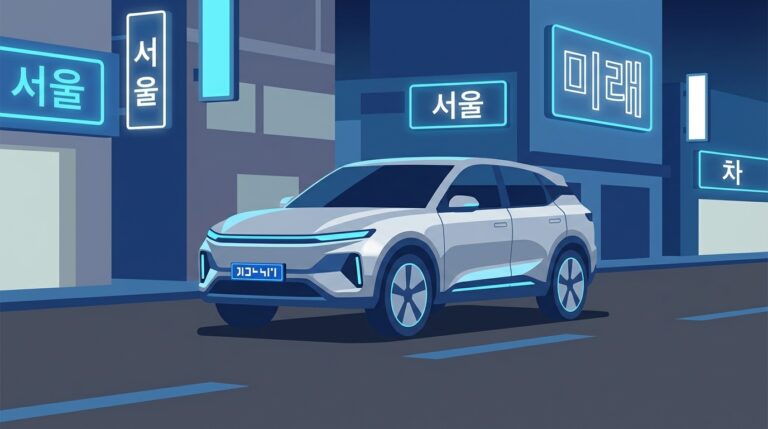
Picture this: You are cruising down the Gangnam Teheran-ro in a sleek, silent vehicle. The license plate is distinctly blue (a sign of an eco-friendly car in Korea). You feel like a protagonist in a sci-fi K-Drama set in 2050. But then, a warning light blinks: Low Fuel.
Suddenly, the genre shifts from Sci-Fi to Thriller. You check the map app. The nearest hydrogen charging station is 20km away, and there’s a rumor it’s under maintenance. 😱
Korea is aggressively betting on the Hydrogen Economy (수소 경제), led by giants like Hyundai. But for the actual drivers, it’s a mix of pride and frustration. Today, we aren’t just learning car words; we are diving into a C1-level debate on technology, infrastructure, and the Korean spirit of innovation vs. reality.
Ready to discuss the future of mobility like a true Seoulite intellectual? Let’s drive in.
Phase 2: Deep Dive into Core Expressions
To sound like a C1 speaker, you need words that express complex concepts, not just simple descriptions.
1. 인프라 구축 (Inpeura Guchuk)
- Pronunciation: [In-peu-ra Gu-chuk]
- Meaning: Establishment of infrastructure
- K-Culture Moment: You hear this constantly on the news (YTN, KBS) or in business dramas like Start-Up when they discuss scaling a business. It’s the buzzword for “We have the tech, but do we have the support system?”
- Editor’s Insight: ‘인프라’ comes from English (infrastructure), and ‘구축’ means construction or building (usually of systems or bases). Using ‘구축’ instead of just ‘만들기’ (making) instantly elevates your Korean to a professional level.
- Situation Spectrum:
[🚫 Kids] ———— [⚠️ Friends] ———— [✅ Business/News] - 🤔 Think About It: Why does Korea use the English loanword ‘infra’ so heavily instead of a pure Korean equivalent? Does this reflect the speed of modernization?
2. 시기상조 (Sigisangjo)
- Pronunciation: [Si-gi-sang-jo] sounds sharp and decisive.
- Meaning: Premature / Too early for the time
- K-Culture Moment: A cynical character in a boardroom meeting slams a file on the table and says, “지금은 시기상조입니다!” (It is too early for this now!). It’s the ultimate objection card.
- Editor’s Insight: This is a Saja-seong-eo (four-character idiom). Using this when discussing hydrogen cars implies you are analyzing the market maturity, not just the car itself.
- Situation Spectrum:
[🚫 Casual Chat] ———— [⚠️ Semi-formal] ———— [✅ Debate/Formal] - 🤔 Think About It: Koreans value timing (눈치). Why is doing something “at the right time” often considered more important than just doing it “well”?
3. 친환경 (Chin-hwangyeong)
- Pronunciation: [Chin-hwan-gyeong]
- Meaning: Eco-friendly
- K-Culture Moment: Every product in Olive Young seems to have this label lately. In K-Pop, idols now promote ‘eco-friendly’ albums without plastic packaging.
- Editor’s Insight: ‘친(親)’ means friendly/close (like in 친구), and ‘환경(環境)’ is environment. It’s the golden standard for marketing in modern Korea.
- Situation Spectrum:
[✅ All Situations]
Phase 3: Textbook vs. Real Life
| Situation | 📖 Textbook Korean | 🗣️ Real Korean (C1 Level) | 💡 Why the difference? |
|---|---|---|---|
| Discussing the car | 수소차는 공기에 좋아요. (Hydrogen cars are good for the air.) | 달리는 공기청정기라고 하잖아요. (They call it a ‘running air purifier’.) | Koreans love metaphorical nicknames for tech to highlight features vividly. |
| Complaining about charging | 충전소가 많이 없어서 불편해요. (It’s uncomfortable because there aren’t many stations.) | 충전소 찾다가 볼일 다 보겠어요. (I’ll spend my whole day just looking for a station.) | ‘볼일 다 보다’ is an idiomatic way to say you’ve wasted all your time/energy. |
| Talking about price | 가격이 너무 비싸요. (The price is too expensive.) | 보조금 없으면 엄두도 못 내죠. (Without subsidies, I wouldn’t even dare dream of it.) | ‘엄두를 못 내다’ expresses a psychological barrier, not just a financial one. |
Phase 4: Cultural Deep Dive
4-1. The “Pali-Pali” vs. “Slow Infra” Paradox
In Korea, Pali-Pali (Hurry-Hurry) is the national rhythm. We want things done yesterday. However, hydrogen infrastructure is slow to build due to safety regulations and land costs.
If you see a driver sighing deeply (💨) at a station, checking their watch, and tapping their foot, that is the non-verbal sound of structural frustration. They aren’t just bored; they are experiencing the agony of the ‘Pali-Pali’ spirit being trapped by ‘Slow Infra.’
4-2. K-Drama Connection: The “Chaebol” Car
In dramas, the futuristic hydrogen SUV (usually the Hyundai Nexo) is often driven by the smart, eco-conscious professional or the innovative CEO. It symbolizes intellectual wealth rather than just flashiness. Unlike the noisy sports car of the villain, the silent hydrogen car represents the “Quiet but Powerful” leader.
Phase 5: Immersive Roleplay
Setting: A cafe in Pangyo (Korea’s Silicon Valley). You are debating with your colleague, Jun-ho, who is a tech enthusiast but practical.
Characters:
– YOU: Interested in buying a hydrogen car for environmental reasons.
– Jun-ho (34): A realist who drives a diesel SUV.
The Dialogue:
Jun-ho: 이번에 차 바꿀 때 됐지? 수소차는 어때? 정부 보조금도 꽤 나온다던데.
(Ibeon-e cha bakkul ttae dwaetji? Suso-chaneun eottae? Jeongbu bojogeum-do kkwae naonda-deonde.)
(Isn’t it time you changed your car? How about a hydrogen car? I heard the government subsidy is quite substantial.)
YOU: (Choose your response below!)
🔀 Your Turn! How do you respond?
A) 글쎄요, 아직은 시기상조 아닐까요? 충전소 때문에 스트레스 받을 것 같아요.
(Well, isn’t it premature? I think I’d get stressed because of the charging stations.)B) 네, 디자인이 너무 예뻐서 사고 싶어요.
(Yes, the design is so pretty, I want to buy it.)C) 당연하죠! 저는 지구를 사랑하니까요.
(Of course! Because I love the Earth.)
✅ Best Choice: A
– Reason: This is a C1-level answer. You acknowledge the tech (implied) but counter with a sophisticated idiom (시기상조) and a practical concern (infrastructure). It shows you understand the context of the Korean car market.
Jun-ho’s Reply to A: 맞아, 내 친구도 충전소 찾아 삼만리라고 하더라. 인프라 구축이 더 필요해.
(Maja, nae chingu-do chungjeonso chaja sammanri-rago hadeora. Inpeura guchug-i deo piryohae.)
(Right, my friend also says he travels 30,000 li just to find a station. More infrastructure building is needed.)
Phase 6: 10-Second Shadowing Drill
Practice this sentence to sound like a concerned intellectual debating policy.
“취지는 좋지만 / 인프라가 부족해서 / 아직은 시기상조인 것 같아요.”
(Chwiji-neun jochiman / inpeura-ga bujokhaeseo / ajig-eun sigisangjo-in geot gatayo.)
Meaning: The intention is good, but due to lack of infrastructure, I think it’s still premature.
Emotion: 🤔 Skeptical & Thoughtful (Tilt your head slightly, narrow your eyes a bit).
Phase 7: K-Culture Mini Glossary
| Korean | Romanization | English | Context |
|---|---|---|---|
| 보조금 | Bojogeum | Subsidy | Essential vocabulary for EV/Hydrogen cars. Without this, no one buys them. |
| 번호판 | Beonhopan | License Plate | Blue = Eco-friendly (EV/Hydrogen). White = Regular. |
| 연비 | Yeonbi | Fuel Efficiency | Koreans are obsessed with this. “연비가 어떻게 돼요?” is a must-ask question. |
| 충전소 | Chungjeonso | Charging Station | The most critical location for hydrogen car owners. |
Phase 8: Traveler’s Survival Kit
Even if you don’t drive a hydrogen car, you might rent an EV or take a taxi.
🆘 Survival Expression #1
– 🇰🇷 “이 근처에 충전소 있나요?” (I geun-cheo-e chungjeonso innayo?)
– 🗣️ Meaning: Is there a charging station nearby?
– 📍 Use: When your rental EV is low on battery.📌 Editor’s Travel Note
– Rental Cars: If renting in Jeju Island (the EV paradise), make sure you download the charging station app (like ‘EV Infra’).
– Blue Plates: If you call a taxi via Kakao T and a car with a blue license plate shows up, you can compliment the driver: “차 정말 조용하네요!” (The car is really quiet!). They will love it.
Phase 9: Think Deeper – “Speed vs. Sustainability”
** 관점: Global Era (글로벌 시대의 한국어)**
Why is Korea pushing hydrogen cars so hard despite the lack of stations? It reflects the Korean “Fast Follower to First Mover” strategy. Korea wants to set the global standard for hydrogen tech before other nations do.
However, this creates a linguistic and cultural gap: The government uses grand words like ‘Green New Deal’ (그린 뉴딜) and ‘Innovation’ (혁신), while the actual citizens use words like ‘Inconvenience’ (불편) and ‘Waiting’ (대기).
🧠 Think Deeper: In your country, does the government push technology before the infrastructure is ready? How do people describe that frustration in your language?
Phase 10: FAQ & Troubleshooting
Q: Can I rent a hydrogen car (Nexo) as a tourist?
A: Technically yes, but practically NO. While some rental agencies offer them, the refueling network is tricky even for locals. Stick to standard EVs or gasoline cars to avoid spending your holiday waiting in line.
Q: Is it rude to ask someone how much their government subsidy was?
A: Not really. In Korea, sharing information about “smart shopping” (getting good deals/subsidies) is often seen as sharing wisdom, not just revealing finances. You can ask, “보조금은 얼마나 받으셨어요?” (How much subsidy did you get?)
❌ Common Mistake:
– Saying “Gas Station” (주유소) when looking for a charger.
– Correction: Gas = 주유소 (Ju-yu-so) / Electric/Hydrogen = 충전소 (Chung-jeon-so). Do not mix them up, or you will end up at a place that smells of petrol!
Phase 11: Wrap-up & Action Mission
Summary: Today we learned that hydrogen cars in Korea are a mix of ‘친환경’ (Eco-friendly) dreams and ‘시기상조’ (Premature) reality, struggling with ‘인프라’ (Infrastructure).
🚀 Action Mission:
– 🥉 Bronze: Say “아직은 시기상조예요” (It’s still premature) when deciding on something expensive this week.
– 🥈 Silver: Search for “Hyundai Nexo review” on YouTube and listen for the word “충전” (Charging) or “불편” (Inconvenient).
– 🥇 Gold: If you are in Korea, spot a Blue License Plate car and take a mental note. Is it an EV or Hydrogen? (Hint: The Nexo has a distinct triangular grille!).
See you on the next drive! 안전운전 하세요! (Drive safely!) 🚗💨
Frequently Asked Questions (FAQ)
Q: What does "인프라 구축 (Inpeura Guchuk)" mean in Korean and how do you pronounce it?
A: In Korean, "인프라 구축 (Inpeura Guchuk)" is pronounced [In-peu-ra Gu-chuk] and means: Establishment of infrastructure
Q: What does "시기상조 (Sigisangjo)" mean in Korean and how do you pronounce it?
A: In Korean, "시기상조 (Sigisangjo)" is pronounced [Si-gi-sang-jo] and means: Premature / Too early for the time
Q: What does "친환경 (Chin-hwangyeong)" mean in Korean and how do you pronounce it?
A: In Korean, "친환경 (Chin-hwangyeong)" is pronounced [Chin-hwan-gyeong] and means: Eco-friendly






