

Phase 1: The “San-seu-jang” Mystery — Immersive Hook
안녕하세요! Hello, Daily Hangul family! This is your editor, back from a jog along the Han River.
Have you ever watched a K-Drama where the main characters are having a serious, life-changing conversation while… swinging their hips on a colorful machine in a park? Or maybe you’ve seen a viral video of an elderly Korean lady spinning a giant wheel with the speed of a professional athlete?
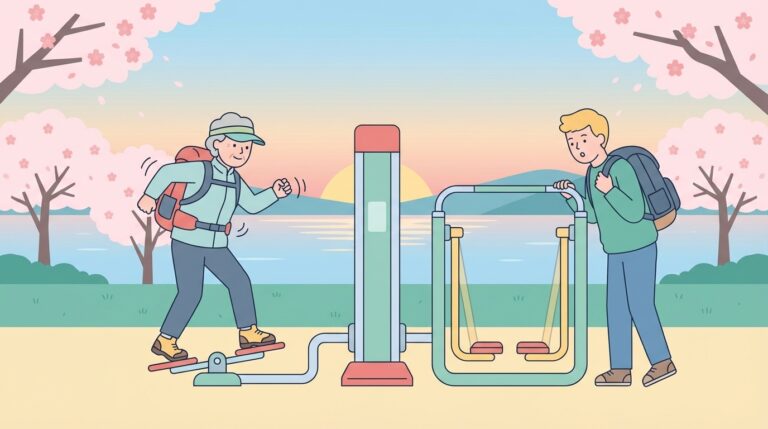
Welcome to the world of “San-seu-jang” (산스장)—a combination of San (Mountain) and Healseu-jang (Gym). In Korea, you don’t need a pricey membership to get fit. Every neighborhood park, riverside path, and hiking trail is equipped with these public outdoor gyms.
But here’s the awkward moment: You want to use the “air walker,” but someone has been on it for 20 minutes looking at their phone. Do you hover? Do you cough? Or do you say something?
Today, we’re going to master the art of claiming your spot in a Korean public park without losing your Nunchi.
Phase 2: Deep Dive into Key Expressions
Let’s break down the three most essential phrases you need to survive the Korean outdoor gym jungle.
1. 혹시 여기 쓰세요? (Hoksi yeogi sseuseyo?)
- Pronunciation: Hok-shi yeo-gi sseu-se-yo? (Imagine saying “Hock” like a hockey puck, and “She” like “She is nice.”)
- Meaning:
- Literal: By any chance, do you use here?
- Real Nuance: “Are you using this machine right now?” (implied: “Because it looks like you’re just resting.”)
- K-Culture Moment: Think of a scene in a variety show like Running Man. A member is hiding behind a machine. The chaser asks, “Are you using this spot?” before capturing them.
- Editor’s Insight: The word 혹시 (Hoksi) is magic. It softens any question. It turns “Are you using this?” into “I hate to bother you, but by any chance…”
- Situation Spectrum:
[🚫 Formal Boss] ———— [✅ Stranger in Park] ———— [✅ Friend] - 🤔 Think About It: Why does Korean often start questions with “Hoksi” (By chance)? How does this reflect the culture of indirectness to save face?
2. 금방 끝나세요? (Geumbang kkeunnaseyo?)
- Pronunciation: Geum-bang kkeun-na-se-yo?
- Meaning:
- Literal: Do you finish soon?
- Real Nuance: “Will you be done shortly?” (A polite nudge to hurry up.)
- K-Culture Moment: In a K-Drama, the male lead is waiting for the female lead to finish getting ready. He checks his watch and texts: “금방 끝나?” (Casual version).
- Editor’s Insight: Use this carefully! If you say it with a sharp tone, it sounds like “Hurry up and leave.” Smile with your eyes when you say it.
- Situation Spectrum:
[🚫 Elders/Seniors] ———— [⚠️ Strangers] ———— [✅ Friends] - 🤔 Think About It: In your culture, is it rude to ask someone when they will finish, or is it seen as efficient communication?
3. 같이 써도 될까요? (Gachi sseodo doelkkayo?)
- Pronunciation: Ga-chi sseo-do doel-kka-yo? (‘Gachi’ sounds like ‘Got-chi’, as in ‘Gotcha!’)
- Meaning: Can we use it together? (Working in sets)
- Editor’s Insight: Koreans are used to sharing. The concept of Jeong (정) extends to sharing space. If a bench is long enough, strangers will sit next to each other. The same applies to gym machines (sets/reps).
Phase 3: Textbook vs. Real Life
| Situation | 📖 Textbook Korean | 🗣️ Real Street Korean | 💡 Why the difference? |
|---|---|---|---|
| Asking if occupied | 실례하지만, 이 기구를 사용하고 계십니까? (Excuse me, are you using this machine?) | 저기요, 이거 쓰시는 거예요? (Excuse me, is this being used?) | Textbook is too stiff. “저기요” grabs attention softly. |
| Waiting your turn | 제가 기다려도 되겠습니까? (May I wait?) | (Just stand nearby and make eye contact) | Non-verbal Nunchi is often louder than words in public spaces. |
| Leaving the machine | 이제 다 썼습니다. (I have used it all.) | (Just nod and leave) or 아, 네! (Ah, yes!) | Efficiency. A quick nod acknowledges the waiter without a full speech. |
Bottom Note: In B1 level, you can mix the “Real Street” phrases with polite endings (-yo) to sound natural but respectful.
Phase 4: Cultural Deep Dive
4-1. The Art of “Nunchi” (Eye-Measure)
In a Korean park, you don’t always need to speak. If someone is standing 2 meters away from you, staring vaguely in your direction, that is Nunchi. They are virtually lining up.
* Do: Acknowledge them with a slight nod to signal “I’m almost done.”
* Don’t: Ignore them and play on your phone for another 10 minutes. That’s a “Nunchi-less” move!
4-2. The “San-seu-jang” Connection
- K-Drama Trope: The “Thinking Scene.” When a character needs to make a big decision, they often go to these parks at night. They swing back and forth on the equipment, looking at the moon.
- K-Food Link: After a workout at the Han River park, the ritual is Hangang Ramyeon (instant noodles cooked in a foil container at the convenience store). Using the exercise machines justifies the ramyeon calories!
Phase 5: Immersive Roleplay
Setting: It’s 8 PM at a neighborhood park (San-seu-jang). The cool evening breeze is blowing. You want to use the “Waist Twister,” but an energetic Ajusshi (middle-aged man) has been on it for a while, clapping his hands rhythmically.
Characters:
* YOU: A foreign resident trying to stay fit.
* Ajusshi: A local resident, very enthusiastic about his workout.
Dialogue:
(You approach the machine cautiously)
YOU: 저기요… 혹시 이거 오래 쓰세요?
(Jeogiyo… hoksi igeo orae sseuseyo?)
(Excuse me… by any chance, will you be using this for a long time?)
Ajusshi: (Stops clapping) 어? 아니요, 금방 끝나요. 왜요? 바빠요?
(Eo? Aniyo, geumbang kkeunnayo. Waeyo? Bappayo?)
(Huh? No, I’ll finish soon. Why? Are you busy?)
🔀 DECISION POINT: How do you reply?
- A) 네, 빨리 비켜주세요. (Yes, please move aside quickly.)
- B) 아, 아니에요! 천천히 하세요. (Ah, no! Take your time.)
- C) 저랑 같이 운동해요! (Let’s exercise together!)
✅ Best Choice: B) “아, 아니에요! 천천히 하세요.”
* Why? Even if you want him to hurry, Korean etiquette dictates you pretend to be patient. Hearing this, he will likely hurry up anyway because of Jeong (consideration).
Ajusshi: (Smiles) 허허, 젊은 친구가 운동을 열심히 하네. 자, 여기 써요!
(Heoheo, jeolmeun chinguga undongeul yeolsimhi hane. Ja, yeogi sseoyo!)
(Haha, young friend working out hard. Here, take it!)
YOU: 감사합니다! 수고하세요!
(Gamsahamnida! Sugohaseyo!)
(Thank you! Keep up the good work!)
Phase 6: 10-Second Shadowing Drill
Let’s practice the politeness. Listen to the rhythm. The ~~~ indicates holding the sound slightly longer to show hesitation/politeness.
🥺 Polite Request:
혹시 / 이 기구 / 다 쓰셨나요~~~?
(Hoksi / i gigu / da sseusyeonnayo~~~?)
By any chance / this machine / have you finished using?
Phase 7: K-Culture Mini Glossary
| Korean | Romanization | English | Context |
|---|---|---|---|
| 산스장 | San-seu-jang | Mountain Gym | Open-air gyms found on hiking trails or parks. |
| 몸짱 | Mom-zzang | Body Master | Slang for someone with a great physique (Mom = Body, Zzang = Best). |
| 눈치 | Nunchi | Social Sense | The art of sensing the atmosphere and others’ needs without words. |
| 약수터 | Yaksu-teo | Mineral Spring | Often located near mountain gyms; where locals drink fresh spring water. |
Phase 8: Traveler’s Survival Kit
Even if you aren’t living in Korea, you will see these parks. Here is how to survive.
🆘 Survival Expression #1
* 🇰🇷 “이거 어떻게 하는 거예요?” (Igeo eotteoke haneun geoyeyo?)
* 🗣️ Meaning: How do you do/use this?
* 📍 Where: When looking at a confusing machine that looks like a torture device.
* 💡 Pro Tip: Older Koreans love teaching foreigners. Ask this, and you might get a free 10-minute personal training session from a local grandma.📌 Editor’s Travel Note
* Safety: Most machines use your own body weight, but check the instruction pictures (usually cartoons) attached to the machine.
* Items: Bring your own water. Public fountains exist, but bottled water is safer for travelers.
* Dress Code: Casual. You’ll see everything from full hiking gear to pajamas.
Phase 9: Think Deeper — “Public Space & Shared Ownership”
🧠 Why is the gym free?
In many Western countries, gyms are private, enclosed spaces. In Korea, the government invests heavily in public health infrastructure like San-seu-jang. This reflects a societal value: Health is a collective asset.
Also, notice how people treat the equipment. They often wipe it down or use it gently. There is a strong sense of “Public Good” (공공재). However, conflicts do happen—usually solved by age hierarchy (older people get priority) or just moving to another machine.
💬 Your Turn: Does your country have free outdoor gyms? Who uses them? Share in the comments!
Phase 10: FAQ & Troubleshooting
- Q: Can I take my shirt off if it’s hot?
- NO. Even if you have a K-Pop idol body, Korea is conservative about exposing skin in public places (outside of pools/beaches). Keep your shirt on!
- Q: Is it rude to listen to music without headphones?
- YES. You will see some older people playing trot music on radios, but as a foreigner (or younger person), you are expected to use headphones. Don’t be the “loud foreigner.”
- Q: Can I drink beer while exercising?
- Technically, drinking in some parks is allowed (like Han River), but drinking while on the elliptical machine? That’s a definite weird look. Save the Chimaek (Chicken & Beer) for after the workout.
Phase 11: Wrap-up & Action Mission
One-Liner: Polite hesitation (“Hoksi…”) combined with Nunchi is your pass to using any machine in Korea.
🎯 Action Missions:
* 🥉 Bronze: Look in the mirror and practice the “Eye Smile” while saying “Hoksi…”
* 🥈 Silver: Search “Korean Outdoor Gym” on YouTube and try to identify the machines.
* 🥇 Gold: Go to a park in Korea (or a Korean-style park in your city) and ask someone “Hoksi yeogi sseuseyo?”
K-Culture Mission: Watch a scene from the drama “Weightlifting Fairy Kim Bok-joo”. Look at how they talk in the gym environment. How does the junior talk to the senior?
Phase 12: Interactive Quiz
Situation: You see a phone left on a bench press machine, but no one is there.
1. What is the most “Korean” thing to assume?
* A) Someone forgot it. I should take it to the police.
* B) It is a method of “reservation” (Jari-matgi). The owner is nearby.
* C) It’s a free phone!
2. What should you say if someone approaches you while you are looking at the phone?
* A) 이거 제 거예요! (This is mine!)
* B) 혹시 이 자리 쓰세요? (By chance, do you use this spot?)
* C) 경찰 불러주세요. (Call the police.)
Answers:
1. (B) In Korea, leaving a phone/bag is a common way to save a seat/machine while getting water or going to the restroom. Korea is very safe!
2. (B) Always start with “Hoksi…” to confirm ownership politely.
Frequently Asked Questions (FAQ)
Q: What does "혹시 여기 쓰세요? (Hoksi yeogi sseuseyo?)" mean in Korean and how do you pronounce it?
A: In Korean, "혹시 여기 쓰세요? (Hoksi yeogi sseuseyo?)" is pronounced [Hok-shi yeo-gi sseu-se-yo? (Imagine saying "Hock" like a hockey puck, and "She" like "She is nice."] and means: Literal: By any chance, do you use here?
Q: What does "금방 끝나세요? (Geumbang kkeunnaseyo?)" mean in Korean and how do you pronounce it?
A: In Korean, "금방 끝나세요? (Geumbang kkeunnaseyo?)" is pronounced [Geum-bang kkeun-na-se-yo?] and means: Literal: Do you finish soon?
Q: What does "같이 써도 될까요? (Gachi sseodo doelkkayo?)" mean in Korean and how do you pronounce it?
A: In Korean, "같이 써도 될까요? (Gachi sseodo doelkkayo?)" is pronounced [Ga-chi sseo-do doel-kka-yo? ('Gachi' sounds like 'Got-chi', as in 'Gotcha!'] and means: Can we use it together? (Working in sets)







