

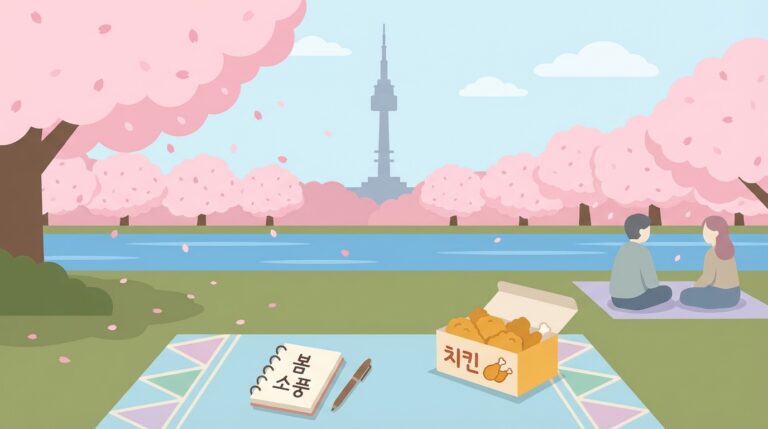
When Spring Arrives: How to Say “Flowers are Blooming” in Korea 🌸
Phase 1: The Immersive Hook
Hello! This is your Daily Hangul editor. 👋
Picture this: You are watching your favorite K-Drama. The male lead and female lead are walking down a street lined with trees. Suddenly, a gust of wind blows, and pink petals start falling like snow. The music swells. It’s the ultimate romantic trope.
In Korea, spring (봄, Bom) isn’t just a season; it’s a nationwide event. When the cherry blossoms (beotkkot) bloom, everyone—and I mean everyone—rushes outside. If you are in Korea during this time and you don’t know how to talk about flowers, you are missing out on 50% of the conversation!
Today, we aren’t just learning biology terms. We are learning the language of Korean spring dates, picnics at the Han River, and the excitement of warmer days. Let’s get you ready for your own K-Drama moment.
Phase 2: Deep Dive into Core Expressions
Here are the top 3 phrases you need when nature wakes up.
1. 꽃이 피었어요 (Kkoci pieosseoyo)
- Pronunciation: [Kkoc-i pi-eoss-eo-yo]
Sound tip: ‘Kk’ sounds like the sharp ‘k’ in ‘sky’. ‘Pieosseoyo’ flows like ‘Pee-aw-saw-yo’.- Meaning: Flowers have bloomed.
- K-Culture Moment: You’ll hear this on the news, see it on Instagram captions, and hear it from friends pointing at street trees.
- Editor’s Insight: The word 꽃 (Kkot) means flower. When we say they “bloomed,” we use the past tense because the result is visible now. It feels like an announcement of joy!
- Situation Spectrum:
[🚫 Boss (Too Casual)] ———— [✅ Stranger/Polite] ———— [✅ Friend]
(Note: This is standard polite. For friends, drop the ‘yo’ -> 꽃이 피었어!)- 🤔 Think About It: In English, we might say “The trees are blossoming.” Why does Korean focus specifically on the “flower” (Kkot) rather than the tree? It reflects a focus on the specific object of beauty.
2. 꽃 보러 갈래요? (Kkot boreo gallae-yo?)
- Pronunciation: [Kkot bo-reo gal-lae-yo?]
Sound tip: ‘Gal-lae-yo’ sounds a bit like ‘Gal-lay-yo’. Raise your tone at the end for a question.- Meaning: Shall we go to see flowers? (Literal) / Do you want to go on a date? (Real Nuance)
- K-Culture Moment: This is the classic indirect way to ask someone out in spring. If a Korean friend asks you this, they might be interested in you!
- Editor’s Insight: We don’t say “Let’s go watch trees.” We say “go to see flowers.” It implies walking, taking photos, and maybe eating street food.
- Situation Spectrum:
[🚫 Formal Boss] ———— [⚠️ Colleague] ———— [✅ Friend/Crush]3. 정말 예뻐요! (Jeongmal yeppeoyo!)
- Pronunciation: [Jeong-mal ye-ppeo-yo]
Sound tip: ‘Jeong’ rhymes with ‘Lung’. ‘Ye-ppeo’ sounds like ‘Yeh-puh’.- Meaning: It’s really pretty / beautiful.
- K-Culture Moment: Every K-Pop idol on a reality show visiting a scenic spot says this. You must say this when your friend takes a photo of the flowers (or of you!).
- Editor’s Insight: Silence in front of beauty is awkward in Korea. You need to react vocally!
- Situation Spectrum:
[✅ Everyone](Safe to use with anyone!)
Phase 3: Textbook vs. Real Life
| Situation | 📖 Textbook Korean | 🗣️ Real Korean (Inssa Style) | 💡 Why the difference? |
|---|---|---|---|
| Seeing flowers | 꽃이 아름답습니다. (Flowers are beautiful.) | 와, 대박 예뻐! (Wa, daebak yeppeo!) | “Beautiful” is too poetic. “Daebak” (Jackpot/Awesome) shows genuine excitement. |
| Asking for a photo | 사진을 찍어 주시겠습니까? (Could you take a photo?) | 사진 좀… (Sajin jom…) + 📸 gesture | Koreans value speed (Bali Bali). A gesture + “Please…” is enough context. |
| Falling petals | 꽃잎이 떨어집니다. (Petals are falling.) | 눈 온다! (It’s snowing!) | Koreans love poetic metaphors in daily speech. Falling petals look like snow. |
Bottom Note: For A1 beginners, “Yeppeoyo” (It’s pretty) is safer than slang like “Daebak,” but understanding “Daebak” helps you catch the vibe!
Phase 4: Cultural Deep Dive — K-Culture Connection 🌸
4-1. The “Spring Fever” & Photos
In Korea, if you don’t take a photo with the flowers, did it even happen?
* Non-verbal Tip: When posing, don’t just stand there. Do the Finger Heart (thumb and index finger crossed) or the Cheek Heart (making half a heart with your hand against your cheek).
* Nunchi (Eye-measure): If you see a couple taking a selfie with a tripod, do not walk between them and the camera! That is bad nunchi.
4-2. The “Zombie Song” of Korea
Every spring, one song rises from the dead on the music charts: “Cherry Blossom Ending” by Busker Busker. Koreans jokingly call it the “Cherry Blossom Zombie.” If you hear a soft acoustic guitar and a guy singing about walking together, that’s the song. Humming this while walking under trees? You are instantly 100% more Korean.
Phase 5: Immersive Roleplay 🎭
Setting: It is April at Yeouido Park by the Han River. The park is full of people. You are with your Korean friend, Minji.
Characters:
* YOU: An exchange student experiencing Korean spring for the first time.
* Minji: Your energetic Korean friend who loves taking photos.
Dialogue:
Minji: 우와! 저기 봐! 꽃이 진짜 많이 피었어! 🌸
(Uwa! Jeogi bwa! Kkoci jinjja mani pieosseo!)
(Wow! Look over there! The flowers really bloomed a lot!)
YOU: (Looking at the pink trees)
🔀 Your Turn! How do you react?
A) 네, 꽃입니다. (Yes, it is a flower.)
B) 우와, 정말 예뻐요! (Wow, it’s really pretty!)
C) 안 예뻐요. (It’s not pretty.)✅ Best Choice: B — Reaction is key! Choice A is too robotic.
Minji: 그치? 우리 사진 찍자! 여기 서 봐.
(Geuchi? Uri sajin jjikja! Yeogi seo bwa.)
(Right? Let’s take a photo! Stand here.)
(Stage Direction: Minji takes 50 photos of you in 10 seconds)
Minji: 배고프다… 우리 한강에서 치킨 먹을래?
(Baegopeuda… Uri Hangang-eseo chikin meogeullae?)
(I’m hungry… Wanna eat chicken by the Han River?)
YOU:
🔀 Your Turn! Can you really eat there?
A) 식당에 가요? (Do we go to a restaurant?)
B) 여기서요? 배달이 돼요? (Here? Can we get delivery?)✅ Best Choice: B — Cultural Shock Alert! In Korea, you can order delivery food (especially fried chicken) to a specific spot in a park! Asking this shows you know the culture.
Phase 6: 10-Second Shadowing Drill 🗣️
Listen to the rhythm. Korean is not robotic; it has waves!
😊 Emotion: Bright, happy, surprised.
Sentence: The cherry blossoms are really pretty!
Korean: 벚꽃이 / 정~~~말 / 예뻐요!
Romanization: Beot-kkoci / jeong~~~mal / ye-ppeo-yo!
(Note: Stretch the “jeong~~~mal” to emphasize how pretty it is!)
Phase 7: K-Culture Mini Glossary 📖
| Korean | Romanization | Meaning | Context |
|---|---|---|---|
| 벚꽃 | Beotkkot | Cherry Blossom | The superstar flower of Korean spring. |
| 봄 | Bom | Spring | The season of beginnings and dating. |
| 한강 | Hangang | Han River | The #1 spot for picnics and flower viewing in Seoul. |
| 치맥 | Chimaek | Chicken + Beer | The essential food combo for a spring picnic. |
| 꽃놀이 | Kkonnori | Flower Viewing | Literally “Flower Play.” Going out to enjoy the flowers. |
Phase 8: Traveler’s Survival Kit 🧳
Scenario: You are at a flower festival, and you want a photo, but your arms aren’t long enough for a selfie.
🆘 Survival Phrase #1
– 🇰🇷 “사진 좀 찍어 주세요.” (Sajin jom jjigeo juseyo.)
– 🗣️ Sounds like: Sah-jin jom jig-uh ju-say-yo.
– 📍 Where: Any tourist spot.
– 💡 Pro Tip: Koreans are arguably the best photographers in the world. They will squat, find the best angle, and take 10 versions. Just hand over your phone!📌 Editor’s Travel Note
– Best Spots: Yeouido Park (Seoul), Jinhae Gunhangje (Largest festival in the south).
– Warning: Weekends are crowded. Go on a Tuesday morning if you hate crowds.
Phase 9: Think Deeper — “Why the Obsession?” 🧠
Topic: The Philosophy of “Bali Bali” and Ephemeral Beauty
Have you noticed how intense the flower season is in Korea? It only lasts about one week. In Korea, there is a culture of “enjoying the moment before it disappears.” This connects to the “Bali Bali” (Hurry Hurry) culture. We work hard and fast, but when beauty appears, we rush to enjoy it because we know it won’t last.
💬 Your Turn: Does your country have a season or event that everyone rushes to celebrate? Tell us in the comments!
Phase 10: FAQ & Troubleshooting 🛠️
Q: Can I pick a flower from the tree to put in my hair?
A: 🛑 NO. Absolutely not. In Korea, public etiquette is very important. Picking flowers from public trees is frowned upon (and illegal in some parks). Use a fallen petal from the ground instead!
Q: Is “꽃이 피었어요” used for business?
A: Sometimes metaphorically! “사업이 꽃피다” (Business blooms/flourishes). But usually, stick to nature.
❌ Common Mistake #1: Saying “See flowers” as “꽃 봐” to an older person.
✅ Fix: Use polite endings! “꽃 보세요” (Please look at the flowers) or “꽃이 예뻐요” (The flowers are pretty).
Phase 11: Wrap-up & Action Mission 🚀
One-Liner Summary: When spring comes, say “꽃이 피었어요” and ask a friend “꽃 보러 갈래요?” to enjoy the vibe!
🎯 Action Missions:
* 🥉 Bronze: Look in the mirror and say “정말 예뻐요!” with a big smile 3 times.
* 🥈 Silver: Search “Yeouido Cherry Blossom” on Instagram/YouTube and comment “예뻐요!” on a post.
* 🥇 Gold: Go to a park (or find a tree near you), take a photo, and post it with the caption: “꽃이 피었어요!”
K-Culture Mission:
Go to YouTube and listen to Busker Busker’s “Cherry Blossom Ending”. Can you catch the word “Bom” (Spring) or “Kkot” (Flower)?
Phase 12: Interactive Quiz 📝
1. Situation: Your Korean coworker shows you a picture of their weekend trip to see flowers. What is the BEST reaction?
A) 네. (Yes.)
B) 우와! 정말 예뻐요! (Wow! It’s really pretty!)
C) 꽃이 피었어요. (Flowers have bloomed.)
2. True or False (K-Culture):
“In Korea, it is common to order fried chicken delivery to a park while watching flowers.”
[ True / False ]
Answers:
1. B (A is too cold, C is a factual statement, not a reaction.)
2. True (It’s a must-do experience!)
Frequently Asked Questions (FAQ)
Q: What does "꽃이 피었어요 (Kkoci pieosseoyo)" mean in Korean and how do you pronounce it?
A: In Korean, "꽃이 피었어요 (Kkoci pieosseoyo)" is pronounced [Kkoc-i pi-eoss-eo-yo] and means: Flowers have bloomed.
Q: What does "꽃 보러 갈래요? (Kkot boreo gallae-yo?)" mean in Korean and how do you pronounce it?
A: In Korean, "꽃 보러 갈래요? (Kkot boreo gallae-yo?)" is pronounced [Kkot bo-reo gal-lae-yo?] and means: Shall we go to see flowers? (Literal) / Do you want to go on a date? (Real Nuance)
Q: What does "정말 예뻐요! (Jeongmal yeppeoyo!)" mean in Korean and how do you pronounce it?
A: In Korean, "정말 예뻐요! (Jeongmal yeppeoyo!)" is pronounced [Jeong-mal ye-ppeo-yo] and means: It's really pretty / beautiful.






