

Phase 1: Immersive Hook
Hello there! It’s your Daily Hangul Editor.
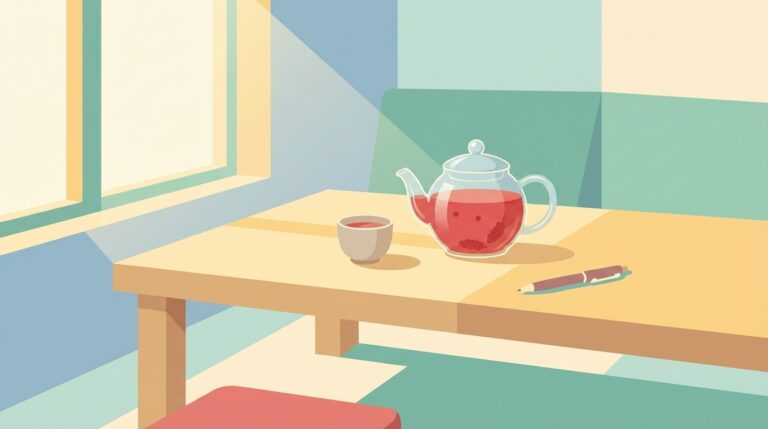
Imagine this: It’s a rainy Saturday afternoon in Seoul. You’ve invited a Korean friend over to your apartment. Instead of heading out to a crowded Starbucks, you decide to show off your new teapot. You carefully pour out a beautiful, ruby-red Omija (Five-Flavor Berry) tea into vintage glass cups. The sunlight hits the table perfectly.
Your friend takes out their phone, snaps a picture, and gasps: “와, 완전 감성 미쳤다! (Wa, wanjeon gamseong micheotda!)”
Wait… “Crazy emotion”? Did you do something wrong? Why is your tea making them crazy?
If you don’t know the exact cultural nuance of what makes a “Home Cafe” (홈카페) in Korea, you might be totally confused. Today, we’re diving deep into Korea’s massive Home Cafe and Tea Culture. As an upper-intermediate (B2) learner, it’s time to move past the textbook “차를 마십니다” (I drink tea) and learn how to truly host, praise, and romanticize the Korean tea experience like a trendy Seoulite!
Phase 2: Deep Dive into Core Expressions
Let’s upgrade your vocabulary with expressions that will make you sound like a true local.
1. 차 좀 우려낼까요?
- Pronunciation: cha jom uryeonaelkkayo? [oo-ryuh-nel-kka-yo – The ‘우려’ sounds like a soft ‘oo-ryuh’, blending smoothly into the rest.]
- Meaning: Shall I steep/brew some tea? (Literal: Shall I brew out some tea?)
- K-Culture Moment: You’re sitting in the living room after a heavy K-BBQ dinner. The mood is relaxing. You head to the kitchen and ask your guests this exact phrase. It sounds elegant and incredibly hospitable.
- Editor’s Insight: Textbooks teach you “만들다” (to make). But for tea, Koreans specifically use “우려내다” (to steep/extract the flavor) or “끓이다” (to boil). It shows you respect the process of tea making.
- Situation Spectrum:
[🚫] ———— [⚠️] ———— [✅]
- Close Friends (Casual): ✅ (차 좀 우려줄까?)
- Coworkers/Guests (Semi-formal): ✅ (차 좀 우려낼까요?)
- Boss/Elders (Formal): ✅ (차 좀 우려낼까요? / 차 한잔 올릴까요?)
- 🤔 Think About It: Koreans use “타다” (to mix/ride) for instant coffee (커피 타줄까?), but “우려내다” for tea. What does this linguistic difference tell us about how traditional tea vs. modern instant coffee is perceived in Korea?
2. 홈카페 감성 제대로네요!
- Pronunciation: homkape gamseong jedaeroneyo! [gahm-sung je-dae-ro-ne-yo – Say it with a tone of genuine admiration!]
- Meaning: The home cafe vibe is totally spot on! (Literal: The home cafe emotion is proper!)
- K-Culture Moment: This is the ultimate compliment for any millennial or Gen Z Korean. If they arranged their table nicely, put a cute coaster under the mug, and played some soft indie music, you MUST say this.
- Editor’s Insight: “감성” (gamseong) literally means sensitivity or emotion, but in modern Korean slang, it translates perfectly to “aesthetic” or “vibe.” “제대로다” means something is done to perfection or “legit.”
- Situation Spectrum:
[🚫] ———— [⚠️] ———— [✅]
- Close Friends (Casual): ✅ (완전 홈카페 감성 미쳤다! – Micheotda means crazy/insane in a good way)
- Coworkers (Semi-formal): ✅ (감성 제대로네요!)
- Boss/Elders (Formal): 🚫 (Avoid slang. Say: 분위기가 정말 좋네요.)
- 🤔 Think About It: Why has the word “emotion” (감성) evolved to mean “aesthetic” in Korea’s Instagram-driven culture?
3. 차 식기 전에 얼른 드세요.
- Pronunciation: cha sikgi jeone eolleun deuseyo. [shik-gi jeon-e ull-leun deu-se-yo]
- Meaning: Please drink the tea before it gets cold.
- K-Culture Moment: In K-Dramas, whenever a loving mother or an attentive host serves food or drink, they always urge the person to eat/drink before the temperature drops.
- Editor’s Insight: This isn’t just a suggestion; it’s a linguistic warm blanket. “얼른” (quickly/promptly) isn’t rushing them rudely; it’s showing care that they enjoy it at its peak quality.
- Situation Spectrum:
[🚫] ———— [⚠️] ———— [✅]
- Close Friends (Casual): ✅ (식기 전에 얼른 마셔!)
- Coworkers/Guests (Semi-formal): ✅ (식기 전에 얼른 드세요.)
- Boss/Elders (Formal): ✅ (차 식기 전에 드십시오.)
- 🤔 Think About It: Korean hospitality is obsessed with temperature (piping hot stews, ice-cold noodles). How does serving temperature relate to showing affection (정) in Korean culture?
Phase 3: Textbook vs. Real Life
| Situation | 📖 Textbook Korean | 🗣️ Real Korean | 💡 Why the difference? |
|---|---|---|---|
| Offering tea | 차를 마시겠습니까? | 차 한잔 할래요? / 차 좀 우려낼까요? | Textbook sounds like an airline attendant. Real Korean focuses on the shared experience (한잔 하다) or the process (우려내다). |
| Praising the vibe | 분위기가 아주 좋습니다. | 와, 완전 카페 감성인데요? / 감성 미쳤다! | Modern youth culture heavily relies on ‘감성’ (aesthetic) to describe beautifully curated spaces. |
| Suggesting to drink | 맛있게 드십시오. | 식기 전에 얼른 드세요. | Koreans express care by worrying about the food/drink losing its optimal temperature. |
Bottom Note: As a B2 learner, throwing in words like “감성” (gamseong) will immediately signal to native speakers that you don’t just know the language—you know the culture.
Phase 4: Cultural Deep Dive – K-Culture Connection
4-1. Non-verbal Communication: The Art of the Two-Handed Pour
When making tea at your home cafe, if you are serving someone older or a guest you want to show respect to, pay attention to your hands! When pouring tea from a teapot, lightly support your pouring arm by placing your free hand just under your elbow or on your forearm. It’s a subtle gesture of respect embedded deep in Korean Nunchi (눈치) and etiquette. Handing the cup over? Use two hands!
4-2. K-Culture Connection: The “Healing” Aesthetic
If you’ve watched comforting K-Dramas like Hometown Cha-Cha-Cha or vloggers on YouTube, you’ll notice the meticulous nature of the Korean Home Cafe.
It’s not just about tossing a Lipton bag into a mug. It’s about the sound of ice clinking in an aesthetic glass, the visual gradient of Matcha mixing with milk, and the quiet background music.
In K-Pop fandoms, idols often do “Home Cafe” V-Lives, attempting to make Dalgona coffee or aesthetically pleasing drinks while chatting with fans. The chat is usually flooded with comments like “우리 오빠/언니 홈카페 감성 장난 아니다!” (Our oppa/unnie’s home cafe vibe is no joke!).
A Critical View: While beautiful, the Home Cafe trend also highlights a society looking for an escape. In a fast-paced Pali-pali world, curating a perfect little cafe corner in a tiny Seoul apartment is a way for young Koreans to reclaim control, peace, and “Healing” (힐링) in their daily lives.
Phase 5: Immersive Roleplay Scenario
Scenario A: The Saturday Afternoon Tea Date
- Setting: 3 PM on a Saturday. Your cozy apartment in Seoul. Sunbeams are hitting your wooden table. You’ve set up a vintage glass teapot and two cute coasters.
- Characters:
- YOU: An expat living in Korea, very proud of your new traditional Korean teas (like Yuja-cha and Omija-cha) you bought at a local market.
- Minji (28): Your trendy Korean friend who practically lives on Instagram and loves visiting aesthetic cafes.
Minji: 와, 집 진짜 예쁘게 꾸며놨네! 초대해 줘서 고마워.
(Wa, jip jinjja yeppeuge kkumyeonwatne! Chodaehae jwoseo gomawo.)
[Wow, you decorated your house so beautifully! Thanks for inviting me.]
YOU: 와줘서 고마워요. 오느라 고생했어요. 앉아요!
(Wajwoseo gomawoyo. Oneura gosaenghaesseoyo. Anjayo!)
[Thanks for coming. You had a long trip here. Have a seat!]
Minji: 헐, 테이블 세팅 뭐야? (Takes out her phone) 여기 완전 연남동 카페 아냐?
(Heol, teibeul seting mwoya? Yeogi wanjeon Yeonnam-dong kape anya?)
[OMG, what is this table setting? Isn’t this totally a cafe in Yeonnam-dong?]
YOU: 하하, 과장하지 마요. 커피 마실래요, 아니면 차 좀 우려낼까요?
(Haha, gwajanghaji mayo. Keopi masillaeyo, animyeon cha jom uryeonaelkkayo?)
[Haha, don’t exaggerate. Do you want coffee, or shall I steep some tea?]
Minji: 나 요즘 커피 줄이고 있어서, 차 마실래! 무슨 차 있어?
(Na yojeum keopi jurigo isseoseo, cha masillae! Museun cha isseo?)
[I’m cutting down on coffee these days, so I’ll have tea! What kind of tea do you have?]
(🎭 Stage Direction: You bring out a beautiful red Omija tea and pour it gracefully.)
Minji: 색깔 진짜 영롱하다. 홈카페 감성 제대로네요! 사진 찍어도 돼?
(Saekkkal jinjja yeongnonghada. Homkape gamseong jedaeroneyo! Sajin jjigeodo dwae?)
[The color is so radiant. The home cafe vibe is totally legit! Can I take a picture?]
🔀 Your Turn! How should you respond to Minji’s compliment?
– A) “네, 찍으세요. 저는 감성이 많아요.” (Yes, take a picture. I have a lot of emotion.)
– B) “마음껏 찍어요! 근데 차 식기 전에 얼른 드세요.” (Take all the pictures you want! But please drink it before it gets cold.)
– C) “아니요, 사진 찍지 마세요. 부끄러워요.” (No, don’t take pictures. I’m shy.)✅ Best Choice: B — It perfectly balances being a gracious host while using the caring phrase we learned!
⚠️ Choice A Analysis: Saying “저는 감성이 많아요” sounds very unnatural, as if you are saying “I am a highly emotional person” rather than “I have a good aesthetic sense.”
YOU: 마음껏 찍어요! 근데 차 식기 전에 얼른 드세요.
(Maeumkkeot jjigeoyo! Geunde cha sikgi jeone eolleun deuseyo.)
Minji: 응, 잘 마실게! 와, 새콤달콤하고 진짜 맛있다. 힐링 그 자체야.
(Eung, jal masilge! Wa, saekomdalkomhago jinjja masitda. Hilling geu jacheya.)
[Yeah, I’ll enjoy it! Wow, it’s sweet and sour and really delicious. It’s healing itself.]
Scenario B: Bonus K-Culture Scenario (Buying Home Cafe Props)
You are at a trendy “Prop Shop” (소품샵) in Mangwon-dong to buy beautiful cups for your home cafe.
YOU: 사장님, 혹시 이 유리잔 뜨거운 차 담아도 되나요?
(Sajangnim, hoksi i yurijan tteugeoun cha damado doenayo?)
[Excuse me, can I pour hot tea into this glass cup?]
Owner: 아, 그건 내열 유리가 아니라서 뜨거운 거 부으시면 깨질 수 있어요.
(Ah, geugeon naeyeol yuriga aniraseo tteugeoun geo bueusimyeon kkaejil su isseoyo.)
[Ah, that’s not heat-resistant glass, so if you pour hot things in it, it might break.]
YOU: 아, 그렇군요. 그럼 홈카페용으로 쓸 만한 머그컵 추천해 주실 수 있나요?
(Ah, geureokunyo. Geureom homkapeyong-euro sseul manhan meogeukeop chucheonhae jusil su innayo?)
[Ah, I see. Then could you recommend a mug suitable for a home cafe?]
Phase 6: 10-Second Shadowing Drill
Time to practice speaking like a native! Pay attention to the pauses (/) and the emotion.
😊 밝게 (Brightly):
와! / 완전 / 홈카페 감성 / 제대로네요!
(Wa! / wanjeon / homkape gamseong / jedaeroneyo!)
🥺 다정하게 (Affectionately):
차 / 식기 전에 / 얼른 드세요.
(Cha / sikgi jeone / eolleun deuseyo.)
Phase 7: K-Culture Glossary (Mini Dictionary)
| 한국어 (Korean) | Romanization | English | Cultural Context |
|---|---|---|---|
| 감성 | gamseong | Aesthetic / Vibe | Originally ‘emotion/sensibility’, now the ultimate buzzword for anything visually pleasing and atmospheric. |
| 홈카페 | homkape | Home Cafe | The culture of making cafe-quality drinks at home, heavily focused on aesthetic presentation. |
| 힐링 | hilling | Healing | Used to describe anything that relieves stress or brings peace (e.g., drinking tea, petting a cat, taking a break). |
| 소품샵 | sopumpsyap | Prop Shop | Small, trendy boutiques selling cute stationery, glassware, and interior props perfect for Home Cafes. |
| 다도 | dado | Tea Ceremony | The traditional art and etiquette of brewing and drinking tea in Korea. |
Phase 8: Traveler’s Survival Kit
Even if you’re hosting a “Home” cafe, you need to go out and buy your supplies! Here are survival phrases for navigating Korean traditional markets (like Namdaemun) or trendy tea shops to buy your ingredients.
🆘 Survival Phrases for Tea/Prop Shopping
– 🇰🇷 “이거 뜨거운 물 부어도 되는 유리예요?” (igeo tteugeoun mul bueodo doeneun yuriyeyo?)
– English: Is this glass safe for hot water?
– 📍 Where to use: Prop shops, lifestyle stores.
– 🇰🇷 “선물할 건데 포장해 주실 수 있나요?” (seonmulhal geonde pojanghae jusil su innayo?)
– English: It’s for a gift, could you wrap it for me?
– 📍 Where to use: Buying premium tea boxes at a department store.
– 🇰🇷 “오미자차 제일 잘나가는 걸로 주세요.” (omijacha jeil jallaganeun geollo juseyo.)
– English: Please give me your best-selling Omija tea.
– 📍 Where to use: Traditional markets.📌 Editor’s Travel Note:
When buying tea in Korea, you’ll see “청” (Cheong – preserved fruit syrups like Yuja-cheong) very often. You just mix these with hot water or sparkling water! Also, Korea is heavily a card-paying society, but if you go to Namdaemun market to buy vintage tea sets, bringing some cash or having a local bank transfer app can sometimes get you a small discount (에누리)!
Phase 9: Think Deeper – Critical Thinking
Media vs. Reality: The “Aesthetic” Pressure
🧠 Think Deeper:
If you watch Korean vlogs or K-Dramas, every Home Cafe seems effortless, perfectly lit, and spotlessly clean. However, behind those aesthetic Instagram posts (감성스타그램), there is often a hidden pressure to make even one’s private rest time look “productive” and visually perfect to the outside world. The Home Cafe culture is a beautiful expression of self-care, but it also reflects how deeply visual standards and social media validation are woven into modern Korean society.💬 Your Turn: Do you think making an everyday activity “aesthetic” for social media ruins the relaxation, or does it enhance the experience? How does your culture view this?
Phase 10: FAQ & Troubleshooting
Q: Can I use “감성 미쳤다” (The aesthetic is crazy) with my older coworkers or boss?
NO! 🚫 “미쳤다” literally means crazy. Among friends, it means “insanely good.” But to a boss or an elder, it sounds unprofessional and potentially rude. Stick to “분위기가 정말 좋네요” (The atmosphere is really nice) instead.
Q: Can I just say “차 마실래요?” instead of “차 좀 우려낼까요?”
YES! ✅ “차 마실래요?” is perfectly fine and polite. However, “차 좀 우려낼까요?” just elevates your Korean to that B2 native-like fluency, showing you understand the specific verb used for steeping tea.
❌ Common Mistake Alert:
Foreign learners often translate “I will make tea” directly to “차를 만들게요.” While understood, Koreans rarely “make” (만들다) tea.
✅ Do this instead: Say “차를 탈게요” (for instant tea/coffee) or “차를 우려낼게요” (for brewing loose leaf/tea bags).
Phase 11: Wrap-up & Action Items
One-Liner Summary: To master the Korean Home Cafe, you need to steep the tea properly (우려내다), appreciate the aesthetic vibe (감성), and care enough to tell your guest to drink it while it’s hot (식기 전에)!
Action Mission:
– 🥉 Bronze: Stand in your kitchen, hold your favorite mug, and say out loud: “홈카페 감성 제대로네요!” 3 times.
– 🥈 Silver: Make a cup of tea today and post a photo on your Instagram story with the caption: “나만의 홈카페 ☕ (My own home cafe)”.
– 🥇 Gold: Invite a friend over (Korean or not!), serve them a warm drink, and try using the phrase: “식기 전에 얼른 드세요!”
K-Culture Mission:
Go to YouTube and search “한국 홈카페 브이로그” (Korean Home Cafe Vlog). Watch the first 3 minutes of a video and notice how much emphasis is put on the visual presentation and ASMR sounds!
Phase 12: Interactive Quiz
1. Fill in the blank: You just spent 20 minutes arranging a beautiful tray with Matcha tea and macarons. Your Korean friend walks in and says: “와, 완전 홈카페 [_______] 제대로네요!”
a) 감동 (Emotion/Being touched)
b) 감성 (Aesthetic/Vibe)
c) 감사 (Thankfulness)
2. Situational Judgment: You invite your boss over for a quick meeting at your home office. You want to offer them some premium green tea. What is the BEST phrase to use?
a) 부장님, 차 좀 우려낼까요?
b) 부장님, 차 완전 미쳤어요.
c) 부장님, 차 만들어요.
3. True or False – K-Culture Edition:
“Telling someone to eat/drink quickly (얼른 드세요) is considered rude in Korea because it implies you want them to leave.”
👀 Click here for Answers!
1. b) 감성. It perfectly captures the aesthetic vibe!
2. a) 부장님, 차 좀 우려낼까요? (Shall I steep some tea, Boss?). It’s polite and uses the advanced verb ‘우려내다’.
3. False. “얼른 드세요” (Eat/drink quickly) is a sign of affection, showing you want them to enjoy the food/drink before it loses its optimal temperature!
Frequently Asked Questions (FAQ)
Q: What does "차 좀 우려낼까요?" mean in Korean and how do you pronounce it?
A: In Korean, "차 좀 우려낼까요?" is pronounced [cha jom uryeonaelkkayo? [oo-ryuh-nel-kka-yo - The '우려' sounds like a soft 'oo-ryuh', blending smoothly into the rest.] and means: Shall I steep/brew some tea? (Literal: Shall I brew out some tea?)
Q: What does "홈카페 감성 제대로네요!" mean in Korean and how do you pronounce it?
A: In Korean, "홈카페 감성 제대로네요!" is pronounced [homkape gamseong jedaeroneyo! [gahm-sung je-dae-ro-ne-yo - Say it with a tone of genuine admiration!] and means: The home cafe vibe is totally spot on! (Literal: The home cafe emotion is proper!)
Q: What does "차 식기 전에 얼른 드세요." mean in Korean and how do you pronounce it?
A: In Korean, "차 식기 전에 얼른 드세요." is pronounced [cha sikgi jeone eolleun deuseyo. [shik-gi jeon-e ull-leun deu-se-yo] and means: Please drink the tea before it gets cold.







