

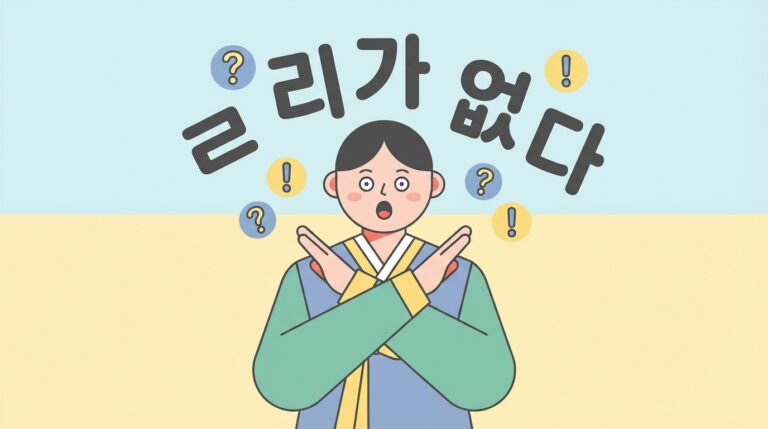
“That Can’t Be True!” How to Express Strong Doubt Like a K-Drama Lead 😲
Phase 1: The Hook — Welcome to “Daily Hangul”
Annyeonghaseyo! This is your Daily Hangul Editor.
Picture this: You are watching a suspenseful K-Drama. The rich mother-in-law receives a phone call saying her son is dating a poor girl. She stands up, her hand shaking, and shouts, “That makes no sense! There is no way my son would do that!”
Or imagine you’re scrolling through Twitter (X) during a K-Pop comeback season. A rumor spreads that your bias is dating someone. The entire fandom explodes: “No way. That rumor can’t be true.”
In English, we say “No way,” “Can’t be,” or “Impossible.” In Korean, if you just say “No” (aniyo), you sound too calm. To truly express that shock and disbelief found in Korean culture, you need a specific grammar structure.
Today, we are learning the art of Strong Denial. Let’s stop sounding like a textbook robot and start sounding like a passionate local!
Phase 2: Deep Dive into Core Expressions
Here are the top 3 ways to say “That’s impossible” in real Korean.
1. ~(으)ㄹ 리가 없다 [(eu)l li-ga eop-da]
- Pronunciation: [eul-li-ga-op-ta] Sounds like: “Eul” (like seoul) + “Li” (like Lee) + “Ga” + “Op-ta”
- Meaning: “There is no reason/logic for that to happen” (Strongest logical denial)
- K-Culture Moment: Used in detective movies when the detective finds a clue that contradicts the suspect’s alibi. “The suspect can’t be at home!”
- Editor’s Insight: The word ‘리’ (li) means ‘reason’ or ‘logic’. You are literally saying, “The logic for that action does not exist.” It’s 100% certainty.
- Situation Spectrum:
[🚫 Formal(Boss)] ———— [⚠️ Semi-formal] ———— [✅ Casual]
Note: To make it polite for semi-formal situations, add ‘요’ or use ‘없습니다’ at the end.- 🤔 Think About It: Why does Korean appeal to “logic” (리) when expressing emotional disbelief? It suggests that the situation breaks the laws of the universe!
2. 설마 [Seol-ma]
- Pronunciation: [Seol-ma] Rhymes with “Thelma”
- Meaning: “Surely not…” / “Don’t tell me…”
- K-Culture Moment: Every time a K-Drama character has a bad feeling. “Seolma, did you lose the concert tickets?”
- Editor’s Insight: This isn’t a sentence ending, but a magic word you put at the start. It sets the mood of suspicion.
- Situation Spectrum:
[🚫 Formal] ———— [⚠️ Semi-formal] ———— [✅ Casual]3. 말도 안 돼 [Mal-do an-dwae]
- Pronunciation: [Mal-do an-dwae] “Mal” means words/speech.
- Meaning: “That makes no sense” / “No way” (Lit: Even words don’t work)
- K-Culture Moment: When a K-Food server brings a mountain of fried chicken for a cheap price. “Wow, this price makes no sense (it’s so cheap)!”
- Situation Spectrum:
[🚫 Formal] ———— [⚠️ Semi-formal] ———— [✅ Casual]
Phase 3: Textbook vs. Real Life
Let’s see how a real Korean speaks versus what your textbook says.
| Situation | 📖 Textbook Korean | 🗣️ Real Korean | 💡 Why the difference? |
|---|---|---|---|
| Hearing a fake rumor | 그것은 사실일 수 없습니다. (It cannot be true.) |
에이, 그럴 리가 없어. (Ay, there’s no reason for that.) |
“에이 (Ay)” is a filler sound showing skepticism. “사실” is too formal for gossip. |
| A bad movie review | 그 영화는 재미없을 것입니다. (That movie will not be fun.) |
그 영화가 재미있을 리가 없어. (That movie can’t be fun.) |
Using -(으)ㄹ 리가 없다 shows you are judging based on evidence (e.g., bad actors). |
| Friend is late | 그는 늦지 않을 것입니다. (He will not be late.) |
설마 늦겠어? (Surely, he won’t be late?) |
Mixing “Seolma” with a question implies hope mixed with doubt. |
Bottom Note: In B1 level conversations, simply saying “No” isn’t enough. You need to show attitude.
Phase 4: Cultural Deep Dive — The Art of Disbelief
4-1. Non-verbal Communication: The Hand Wave
When Koreans say “에이, 그럴 리가 없어” (Ay, no way), they often use a specific hand gesture.
– The Move: Hold your hand up, palm facing sideways, and wave it back and forth near your face (like you are fanning away a bad smell).
– The Vibe: This means, “Dismiss the thought!” or “Don’t be ridiculous.”
4-2. K-Culture Connection: The “Makjang” Drama Trope
In Korean dramas, specifically “Makjang” (extreme soap operas), the phrase “말도 안 돼” (That makes no sense) is often followed by the character grabbing the back of their neck (checking their blood pressure). While you shouldn’t grab your neck in real life, knowing this trope helps you understand the intensity of the phrase.
Phase 5: Immersive Roleplay
Setting: Saturday afternoon outside a cinema in Hongdae. You and your Korean friend, Min-ji, are looking at a movie poster. The movie features a very famous actor, but the reviews are terrible.
Characters:
– YOU: A movie buff who trusts reviews.
– Min-ji: A huge fan of the lead actor (Park Seo-joon).
Dialogue:
YOU: 민지야, 이 영화 평점 1점이야. 보지 말자.
(Minji-ya, i yeonghwa pyeongjeom il-jeom-iya. Boji malja.)
(Minji, this movie’s rating is 1 star. Let’s not watch it.)
Min-ji: 뭐? 1점? 말도 안 돼! 박서준이 나오는데?
(Mwo? Il-jeom? Mal-do an-dwae! Park Seo-joon-i naoneunde?)
(What? 1 star? No way! But Park Seo-joon is in it?)
🔀 Decision Point: How do you respond using the grammar?
Option A: “재미있을 리가 없어.” (There is no way it is fun.)
Option B: “재미없어요.” (It is not fun.)
Option C: “설마 재미없겠어?” (Surely it won’t be un-fun?)
✅ Best Choice: Option A.
Why? You have evidence (the rating). You are logically denying the possibility of it being fun. Min-ji is being emotional, but you are being realistic.
Min-ji: (Pouting) 설마 진짜 재미없을까? 그래도 보고 싶은데…
(Seolma jinjja jaemieopseulkka? Geuraedo bogo sipeunde…)
(Surely it’s not really bad? I still want to see it…)
YOU: (Sighing) 그래, 네가 원한다면 보자. 하지만 실망할 거야.
(Geurae, nega wonhandamyeon boja. Hajiman silmanghal geoya.)
(Okay, if you want, let’s watch. But you’ll be disappointed.)
Phase 6: 10-Second Shadowing Drill
Practice these with the correct emotion!
- 😤 Strong Denial (Logic):
그 뉴스가 / 진짜일 / 리가 없어!
(Geu nyuseu-ga / jinjja-il / li-ga eop-seo!)
That news / can’t be / real! (Use a firm voice) -
😟 Anxious Doubt:
설마 / 오늘 / 비가 오겠어?
(Seol-ma / oneul / bi-ga o-gesseo?)
Surely / today / rain won’t come? (Look at the sky worriedly)
Phase 7: K-Culture Glossary
| Korean | Romanization | Meaning | Context |
|---|---|---|---|
| 평점 | Pyeong-jeom | Rating/Score | Vital for checking movie or delivery food reviews (Baedal Minjok). |
| 정주행 | Jeong-ju-haeng | Binge-watching | “Driving straight.” Used when you watch a drama from Ep 1 to the end without stopping. |
| 스포 | Deu-po | Spoiler | Short for “Spoiler.” Koreans are very sensitive to spoilers! |
| 믿고 보는 | Mit-go bo-neun | Trust-to-watch | An actor/director so good you trust them without checking reviews. |
Phase 8: Traveler’s Survival Kit
Even if you aren’t debating movies, you need “denial” when things go wrong on a trip.
🆘 Survival Expression: “The bus can’t have left!”
– Situation: You arrive at the bus stop at 2:00 PM for the 2:00 PM bus, but it’s gone.
– Korean: “벌써 떠났을 리가 없어요!” (Beolsseo tteonasseul li-ga eop-seoyo!)
– Meaning: “It can’t have left already!” (Polite version)
– 💡 Pro Tip: If you just look confused, people might ignore you. If you say this phrase, people around you will empathize and might check their apps to help you.📌 Editor’s Travel Note
Koreans rely heavily on apps like Naver Map or KakaoMap. If a bus “can’t be gone” but isn’t there, check the app’s real-time location. Ghost buses happen!
Phase 9: Think Deeper — “Why Logic?”
Topic: Logic vs. Emotion in Language
Korean is often called an emotional language (Jeong/Hahn), yet this grammar -(으)ㄹ 리가 없다 relies entirely on the word Logic/Reason (리). Why?
It’s a fascinating paradox. In a high-context society where saving face is important, directly shouting “You are wrong!” can be rude. But by saying “The logic doesn’t exist,” you are shifting the blame from the person to the situation or universal logic. It’s a way to be incredibly strong in your denial without necessarily attacking the speaker’s character—you’re just attacking the facts.
💬 Your Turn: Does your language express doubt by questioning the person (“You’re lying”) or the situation (“That’s impossible”)? Tell us in the comments!
Phase 10: FAQ & Troubleshooting
Q: Can I use 말도 안 돼 to my boss if they give me too much work?
A: ABSOLUTELY NOT! 🚫
That would imply their instruction is nonsense. It will sound rebellious. Instead, just say “알겠습니다” (Understood) and cry internally, or politely ask for a deadline adjustment.
Q: Is 설마 rude?
A: Not rude, but casual. Avoid using it alone with elders. With elders, use full sentences like “설마 아니겠죠?” (Surely that isn’t the case, right?).
❌ Common Mistake:
Don’t confuse -(으)ㄹ 수 없다 (Cannot do / Ability) with -(으)ㄹ 리가 없다 (Cannot be true / Possibility).
– 갈 수 없어 = I can’t go (physically).
– 갈 리가 없어 = There’s no way he is going (logic).
Phase 11: Wrap-up & Action Mission
Summary: Today we learned how to be a drama queen (or king) by using -(으)ㄹ 리가 없다 to express strong, logical doubt.
🔥 Action Mission:
– 🥉 Bronze: Stand in front of a mirror, make a shocked face, and say “말도 안 돼!” three times.
– 🥈 Silver: Go to a Korean movie trailer on YouTube (maybe a scary one). Comment: “이게 재미있을 리가 없어!” (No way this is fun – if it looks bad) or “이게 재미없을 리가 없어!” (No way this isn’t fun – if it looks good).
– 🥇 Gold: Next time a friend tells you a crazy story, react with “에이, 설마! 거짓말!” (Ay, surely not! Lies!)
K-Culture Mission: Watch a clip of the show “I Can See Your Voice” (너의 목소리가 보여). The whole show is about guessing who can sing. You will hear “저 사람이 음치일 리가 없어!” (There’s no way that person is tone-deaf!) a hundred times!
Phase 12: Interactive Quiz
1. Situation: Your friend says, “I heard the subway stops running at 9 PM today.”
You know Seoul subways run until midnight. What do you say?
– A) 지하철이 9시에 끊길 리가 없어.
– B) 지하철이 9시에 끊길 수 없어.
– hint: Are you talking about ability or logical possibility?
2. Fill in the blank:
“_______, did you eat all the kimchi?” (Surely…)
– Answer: [ _______ ]
3. True or False:
It is polite to wave your hand in your boss’s face and say “Ay, no way!”
– Answer: ( T / F )
Answers: 1. A (It’s about logic), 2. 설마 (Seol-ma), 3. False (You will get fired!)
Frequently Asked Questions (FAQ)
Q: What does "~(으)ㄹ 리가 없다 [(eu)l li-ga eop-da]" mean in Korean and how do you pronounce it?
A: In Korean, "~(으)ㄹ 리가 없다 [(eu)l li-ga eop-da]" is pronounced [eul-li-ga-op-ta] and means: "There is no reason/logic for that to happen" (Strongest logical denial)
Q: What does "설마 [Seol-ma]" mean in Korean and how do you pronounce it?
A: In Korean, "설마 [Seol-ma]" is pronounced [Seol-ma] and means: "Surely not..." / "Don't tell me..."
Q: What does "말도 안 돼 [Mal-do an-dwae]" mean in Korean and how do you pronounce it?
A: In Korean, "말도 안 돼 [Mal-do an-dwae]" is pronounced [Mal-do an-dwae] and means: "That makes no sense" / "No way" (Lit: Even words don't work)







