

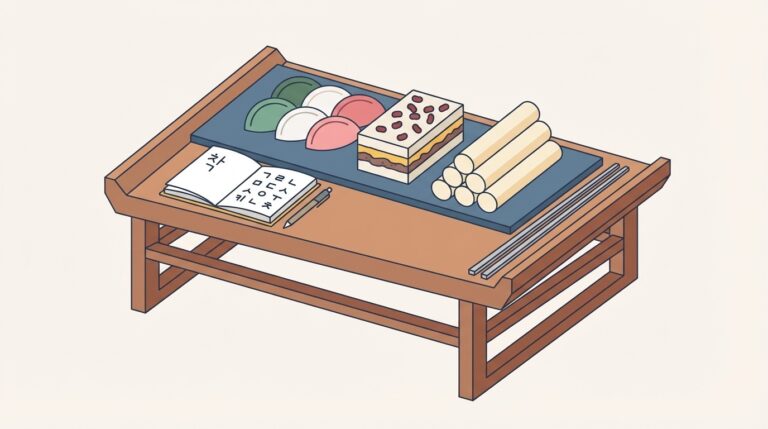
Phase 1: Immersive Hook
Hello! This is your Senior Editor at Daily Hangul. 👋
Picture this: You are watching your favorite K-Drama. The main character just moved into a humble rooftop apartment. The first thing they do isn’t unpacking—it’s visiting neighbors with a steaming hot box of red stuff. Is it cake? Is it bread? No, it’s Sirutteok (시루떡).
Or maybe you were confused during a Lunar New Year special when your favorite K-Pop idol said, “I ate a bowl of soup, so now I’m one year older!” Wait, does soup accelerate aging? 🤔
To the untrained eye, it’s all just “chewy rice cake.” But in Korea, Tteok (떡) is the language of celebration, grief, and new beginnings. If you don’t know your Songpyeon from your Injeolmi, you’re missing out on half the cultural context.
Today, we are going beyond Tteokbokki. We are diving into the sticky, chewy world of ceremonial rice cakes. By the end of this, you won’t just know what to eat—you’ll know why we eat it. Let’s get sticky! (That sounded better in my head.)
Phase 2: Deep Dive into Key Expressions
Here are the top 3 Tteok varieties you’ll encounter in intermediate (B2) conversations.
1. 떡국을 먹다 (To eat Tteokguk)
- Pronunciation: [Tteok-guk-eul meok-da] (Sounds like Tuck-gook-eul)
- Meaning: Literally “to eat rice cake soup,” but culturally, “to turn one year older.”
- K-Culture Moment: On Seollal (Lunar New Year), everyone eats this. The long, white cylinder rice cake (Garaetteok) symbolizes longevity. Cutting it into coin shapes symbolizes wealth.
- Editor’s Insight: If someone asks, “떡국 드셨어요?” (Did you eat Tteokguk?) in January or February, they are indirectly asking if you’ve had a good New Year’s celebration.
- Situation Spectrum:
[🚫 Don't Use] ———— [⚠️ Careful] ———— [✅ Go Ahead]- Casual/Formal: ✅ (Safe for everyone)
- 🤔 Think About It: Koreans calculate age differently (or used to). Why do you think a food item became the marker for aging, rather than just a calendar date?
2. 송편을 빚다 (To make/shape Songpyeon)
- Pronunciation: [Song-pyeon-eul bit-da]
- Meaning: To shape half-moon rice cakes. Note the verb 빚다 (bit-da). We don’t say “make” (만들다); we say “sculpt/shape” because it requires artistry.
- K-Culture Moment: Chuseok (Korean Thanksgiving). Families gather, sit in a circle, and make these. There is a famous saying: “If you shape pretty Songpyeon, you will meet a pretty spouse or have a pretty daughter.”
- Editor’s Insight: If you see idols on a variety show wearing Hanbok and playing with dough, 99% of the time, they are making Songpyeon.
- Situation Spectrum:
[🚫 Don't Use] ———— [⚠️ Careful] ———— [✅ Go Ahead]- Chuseok Season: ✅
- 🤔 Think About It: Songpyeon is shaped like a half-moon, not a full moon. In Korean philosophy, a half-moon is better because it has room to become full (progress), whereas a full moon only wanes.
3. 시루떡을 돌리다 (To hand out Sirutteok)
- Pronunciation: [Si-ru-tteok-eul dol-li-da]
- Meaning: To distribute Red Bean Rice Cake to neighbors.
- K-Culture Moment: Moving in (Isah) or Opening a Business (Gae-eop). The red beans are believed to chase away evil spirits and bad luck.
- Editor’s Insight: Although this culture is fading in big apartment complexes due to privacy concerns, in smaller neighborhoods or business districts, it is still the ultimate sign of Jeong (affection/bond).
- Situation Spectrum:
[🚫 Don't Use] ———— [⚠️ Careful] ———— [✅ Go Ahead]- New Business Opening: ✅
- Apartment Living: ⚠️ (Some people don’t open doors for strangers now)
- 🤔 Think About It: Why is the color red associated with protection in Korea, whereas in some cultures it signifies danger?
Phase 3: Textbook vs. Real Life
Let’s see how a textbook robot speaks versus a localized pro.
| Situation | 📖 Textbook Korean | 🗣️ Real Korean | 💡 Why the difference? |
|---|---|---|---|
| Eating Tteok | 떡을 먹어요. (I eat rice cake.) |
떡보단 밥이지! (I prefer rice over tteok!) |
Koreans distinguish clearly between “Rice (Meal)” and “Tteok (Snack/Treat).” |
| Describing Texture | 떡이 부드러워요. (The tteok is soft.) |
와, 완전 쫄깃쫄깃해! (Wow, it’s totally chewy/bouncy!) |
Onomatopoeia is crucial for food. “Soft” doesn’t capture the elasticity of tteok. |
| At a Cafe | 떡이 있어요? (Do you have tteok?) |
여기 디저트 뭐 있어요? (What desserts do you have?) |
In modern cafes, Tteok is considered a “K-Dessert.” |
💡 Editor’s Note: “Jjol-git Jjol-git” (쫄깃쫄깃) is the gold standard word for Tteok. Memorize this sound!
Phase 4: Cultural Deep Dive
4-1. Non-verbal: The “Hand” Rule
When receiving a piece of Tteok (or any food) from an elder or at an event:
1. Receive with two hands. (Left hand supporting the right elbow/wrist).
2. Eat it with relish. Tteok is often a gift of celebration. Refusing it can be seen as rejecting their good fortune.
4-2. K-Drama Connection: The Exam Gift
Have you seen scenes where high school seniors are given Chapssaltteok (Sticky Rice Cake) before the big college exam (Suneung)?
* The Logic: The rice cake is sticky (buteo). The verb “to pass an exam” is also 붙다 (buteo).
* The Trope: Parents praying while sticking Tteok to the school gates. It implies, “Stick to the university you want!” Don’t give seaweed soup (Miyeokguk) before an exam—it’s slippery, implying you’ll “slip” (fail)!
Phase 5: Immersive Roleplay
Setting: It’s late September. You are visiting your Korean friend, Min-ji’s, house for a casual Chuseok gathering. The table is full of food.
Characters:
* YOU: An expat invited to experience Chuseok.
* Min-ji (29): Your close Korean friend, excited to share culture.
Dialogue:
Min-ji: 와, 진짜 잘 빚었다! 너 한국 사람 다 됐네? 🥟
(Wa, jinjja jal bit-eot-da! Neo Hanguk saram da dwaet-ne?)
(Wow, you shaped it really well! You’ve basically become Korean!)
(🎭 Stage Direction: Min-ji looks impressed at your half-moon rice cake)
🔀 Decision Point: How do you respond?
* A) “아니에요, 아직 멀었어요.” (No, I still have a long way to go.)
* B) “내가 손재주가 좀 좋지?” (I’m pretty good with my hands, right?)
* C) “이거 먹으면 예쁜 딸 낳을 수 있어?” (If I eat this, can I have a pretty daughter?)
✅ Best Choice: C — This shows you know the specific myth about Songpyeon. It’s witty and culturally relevant.
⚠️ Choice A: Too formal/humble for a close friend.
⚠️ Choice B: A bit boastful, though acceptable as a joke.
YOU (Option C): 이거 예쁘게 빚으면 예쁜 딸 낳는다면서? 나 기대해도 돼?
(Igeo yeppeuge bijeumyeon yeppeun ttal nanneundamyeonseo? Na gidaehaedo dwae?)
(I heard if you shape this prettily, you have a pretty daughter. Can I get my hopes up?)
Min-ji: ㅋㅋㅋ 그럼! 나중에 딸 낳으면 이름은 ‘송편’이라고 짓자.
(Kkk geureom! Najunge ttal nameun ireumeun ‘Songpyeon’-irago jitja.)
(Haha, of course! Later if you have a daughter, let’s name her ‘Songpyeon’.)
Phase 6: 10-Second Shadowing Drill
Practice this sentence to use when you receive Tteok from a neighbor or friend.
“Please share this good fortune with me!” (Context: Receiving event tteok)
😊 우와, / 떡이 / 정말 / 쫄깃쫄깃해요!
(Uwa, / tteogi / jeongmal / jjol-git-jjol-githaeyo!)
“Wow, / the rice cake / is really / chewy and delicious!”
Emphasize: Stretch the “Jeong~~~mal” and bounce on “Jjol-git-jjol-git.”
Phase 7: K-Culture Mini Glossary
| Korean | Romanization | Meaning | Context |
|---|---|---|---|
| 인절미 | Injeolmi | Bean powder rice cake | Classic savory/sweet tteok. Used in Bingsu (shaved ice) too. |
| 백설기 | Baekseolgi | White Snow Cake | Steamed white rice cake. Symbolizes purity. Eaten at a baby’s 100th day (Baek-il). |
| 가래떡 | Garaetteok | Cylinder rice cake | The raw material for Tteokbokki and Tteokguk. Roasted over fire, it’s a winter delicacy. |
| 꿀떡 | Kkul-tteok | Honey Rice Cake | Small balls filled with sesame syrup. Kids’ favorite. |
Phase 8: Traveler’s Survival Kit
Buying Tteok isn’t like buying bread. It’s often sold in traditional markets (Sijang) or specialized cafes.
🆘 Survival Expression #1: Buying at a Market
* 🇰🇷 “이거 무슨 떡이에요? 안에 뭐 들었어요?”
* (Igeo museun tteogieyo? Ane mwo deureosseoyo?)
* “What kind of rice cake is this? What’s inside?”
* Why: Many tteok look similar but have different fillings (red bean, honey, chestnut). Surprise red bean paste can be shocking if you expected chocolate!📌 Editor’s Pro Tip:
Traditional Tteok goes hard (stiff) very quickly. Unlike bread, you must eat it on the day you buy it. If you can’t, freeze it immediately. Do not refrigerate (it dries out)!
Phase 9: Think Deeper — Food & Identity
Why do Koreans share Tteok with strangers?
In Western culture, giving food to a neighbor you’ve never met might seem intrusive or risky. In Korea, Tteok represents “Nanum” (Sharing). Historically, rice was precious. Turning it into Tteok meant a surplus or a special occasion. Keeping that fortune to yourself was considered greedy. By sharing the Tteok (especially the red bean Sirutteok), you are essentially saying, “Please help protect my household from bad luck, and let me share my joy with you.”
💬 Your Turn: Does your country have a specific food that brings good luck? Or a food you must eat on New Year’s? Tell us below!
Phase 10: FAQ & Troubleshooting
Q: Can I give Tteok as a birthday gift?
A: Generally, yes! Nowadays, “Rice Cake Cakes” (Tteok-cake) are popular for parents’ birthdays because they are less sweet/greasy than flour cakes. However, don’t just give a random pack of supermarket tteok; presentation matters!
Q: Is Tteok vegan?
A: Mostly, yes! Tteok is rice, salt, and water. However, some Songpyeon or Kkul-tteok might use honey, and some savory versions might use beef broth (in Tteokguk). Always ask: “Gogi (meat) or Kkul (honey) deureosseoyo?”
❌ Common Mistake:
Don’t call all chewy things “Mochi.” Mochi is Japanese. While similar, using the correct term “Tteok” shows respect for the culture.
Phase 11: Wrap-up & Action Mission
Today’s Takeaway: Tteok is not just a snack; it’s a time capsule of Korean age, wishes, and community bonding. 🍡
🚀 Your Mission:
* 🥉 Bronze: Look in the mirror and practice saying “Jjol-git Jjol-git” five times with a happy face.
* 🥈 Silver: Go to a Korean bakery or supermarket (H-Mart etc.) and find Songpyeon or Injeolmi. Take a photo!
* 🥇 Gold: Taste it! If it’s plain Injeolmi, try dipping it in honey. Post your review on social media.
Phase 12: Interactive Quiz
- True or False? You should eat slippery Seaweed Soup (Miyeokguk) before an exam to help your brain flow smoothly.
- Situation: You are moving into a new house. Which Tteok is traditionally appropriate to give to neighbors?
- A) Songpyeon
- B) Sirutteok (Red Bean)
- C) Tteokbokki
- Vocabulary: What is the Korean word for the “chewy/bouncy” texture of rice cakes?
⬇️ Scroll for Answers
.
.
.
.
Answers:
1. False! Slippery soup implies you will “slip” (fail). Stick to sticky Tteok (Chapssaltteok)!
2. B) Sirutteok. The red beans ward off bad luck.
3. Jjol-git Jjol-git (쫄깃쫄깃).
Frequently Asked Questions (FAQ)
Q: What does "떡국을 먹다 (To eat Tteokguk)" mean in Korean and how do you pronounce it?
A: In Korean, "떡국을 먹다 (To eat Tteokguk)" is pronounced [Tteok-guk-eul meok-da] and means: Literally "to eat rice cake soup," but culturally, "to turn one year older."
Q: What does "송편을 빚다 (To make/shape Songpyeon)" mean in Korean and how do you pronounce it?
A: In Korean, "송편을 빚다 (To make/shape Songpyeon)" is pronounced [Song-pyeon-eul bit-da] and means: To shape half-moon rice cakes. Note the verb 빚다 (bit-da). We don't say "make" (만들다); we say "sculpt/shape" because it requires artistry.
Q: What does "시루떡을 돌리다 (To hand out Sirutteok)" mean in Korean and how do you pronounce it?
A: In Korean, "시루떡을 돌리다 (To hand out Sirutteok)" is pronounced [Si-ru-tteok-eul dol-li-da] and means: To distribute Red Bean Rice Cake to neighbors.







