

Phase 1: The Immersive Hook
Greeting: 안녕하세요! This is your Daily Hangul Senior Editor. 🖊️
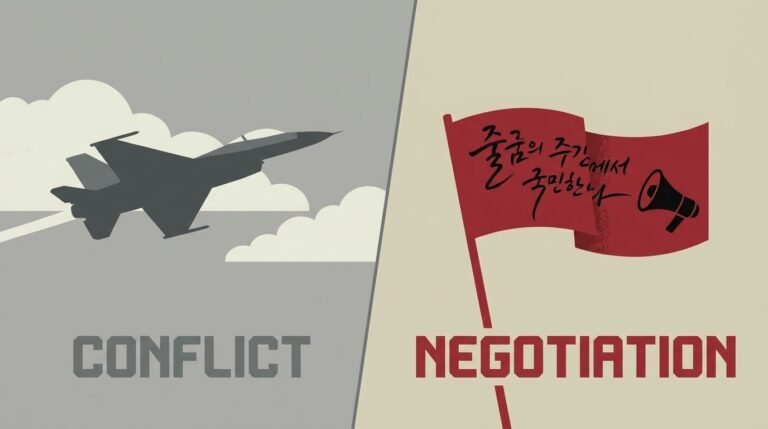
Imagine this scene from a gritty Korean political thriller or a documentary: A quiet rural village is suddenly covered in red banners. Residents with headbands are shouting slogans, and a government official in a suit looks nervous behind a podium. You hear the roar of fighter jets in the background.
In K-Dramas like Designated Survivor: 60 Days or movies tackling social issues, you often see conflicts between “National Security” and “Individual Sacrifice.”
The subtitles might just say “We oppose the airport!” but the actual Korean being used is a complex mix of legal terminology, emotional appeal, and political strategy. Today, we are stepping away from the romantic streets of Seoul to look at a serious, advanced topic that defines modern Korean society: The conflict over military airport relocation (군 공항 이전) and noise damage compensation (소음 피해 보상).
Understanding this topic isn’t just about military vocabulary; it’s about understanding how Koreans debate, protest, and negotiate democracy. Let’s dive into the deep end.
Phase 2: Deep Dive into Core Expressions (C2 Level)
These terms are frequent in news broadcasts (KBS News 9) and newspaper editorials.
1. 소음 피해 (So-eum pi-hae)
- Pronunciation: [so-eum pi-hae] (Sounds like ‘Saw-eum’ + ‘Pee-heh’)
- Meaning: Noise damage / Noise pollution (specifically causing harm)
- Context: In a legal or formal complaint context. It’s not just “loud” (시끄럽다); it implies a violation of rights that requires restitution.
- Editor’s Insight: You’ll hear this collocated with verbs like 호소하다 (to appeal/complain emotionally) or 입증하다 (to prove/substantiate).
- Situation Spectrum:
[🚫 Casual Chat] ———— [⚠️ Discussion] ———— [✅ News/Debate]- 🤔 Think About It: Why does Korean distinguish so clearly between simple noise (소음) and suffering/damage (피해)? In your country, is noise pollution considered a compensable injury?
2. 이주 대책 (I-ju dae-chaek)
- Pronunciation: [i-ju dae-chaek]
- Meaning: Relocation measures / Migration countermeasures
- Context: Used when the government plans to move a population due to public works or military needs.
- Editor’s Insight: 대책 (Dae-chaek) is a keyword in Korean society. Whenever a problem arises, everyone asks, “What is the dae-chaek?” It implies a concrete, systemic solution, not just a verbal promise.
- Situation Spectrum:
[🚫 Dating] ———— [⚠️ Business] ———— [✅ Policy Meeting]- 🤔 Think About It: The word I-ju (Migration) feels heavier than Isa (Moving house). It suggests forced or large-scale movement. How does language shape our empathy for displaced people?
3. 결사 반대 (Gyeol-sa ban-dae)
- Pronunciation: [gyeol-sa ban-dae]
- Meaning: Desperate opposition / Opposing to the death
- Context: You will see this written in bold calligraphy on banners (placards) at protest sites.
- Editor’s Insight: Gyeol-sa literally means “resolving to die.” It shows the sheer intensity of Korean protests. It’s not just “I disagree”; it’s “Over my dead body.”
- Situation Spectrum:
[🚫 Restaurant Order] ———— [⚠️ Serious Debate] ———— [✅ Protest/Rally]- 🤔 Think About It: Why is extreme hyperbole (like “to the death”) so common in Korean political expression? Does it dilute the meaning, or emphasize the urgency?
Phase 3: Textbook vs. Real Life
| Context | 📖 Textbook/News (Formal) | 🗣️ Real Life (The Protest Line) | 💡 Why the difference? |
|---|---|---|---|
| Objecting | 이전을 반대합니다. (We oppose the relocation.) |
군 공항 이전, 결사 반대! 😡 (Military airport relocation, over my dead body!) |
Standard Korean is polite, but Protest Korean needs short, punchy, 4-syllable idioms (Saja-seong-eo style) for impact. |
| Demanding | 보상을 요구합니다. (We request compensation.) |
생존권을 보장하라! ✊ (Guarantee our right to live!) |
“Compensation” sounds like money; “Right to Live” (생존권) frames it as a human rights issue. |
| Noise | 소음 수치가 높습니다. (Noise levels are high.) |
못 살겠다, 갈아엎자! 😤 (Can’t live like this, let’s overturn everything!) |
Used to express raw frustration and mobilize the crowd. |
Bottom Note: Unless you are actually leading a protest, stick to the formal expressions in discussions. Using “결사 반대” at a dinner table regarding a menu choice is a dad joke (아재 개그) at best.
Phase 4: Cultural Deep Dive
4-1. The Visual Language of Protests (Sibi)
In Korea, a protest regarding NIMBY (Not In My Backyard) issues like airport relocation has a specific visual code:
* Red Headbands (머리띠): Symbolize determination and urgency.
* Shaving Heads (삭발식): Leaders often shave their heads in public to show they are sacrificing their dignity and body for the cause. It is the ultimate non-violent display of Han (deep resentment/sorrow).
4-2. K-Drama Trope: The “Town Hall Meeting”
In dramas like Lawless Lawyer or Vincenzo, you often see a chaotic town hall meeting (공청회). The corrupt official tries to use PowerPoint slides with complex words (like I-ju dae-chaek) to confuse elders, while the hero steps in to translate it into plain language. This reflects a real social gap between bureaucratic language and the public.
Phase 5: Immersive Roleplay Scenario
Setting: A tense Public Hearing (공청회) in a rural community center. The air is thick with distrust. A government representative is trying to persuade residents to accept the new airbase.
Characters:
* YOU (Foreign Journalist/Observer): Fluent in Korean, observing the conflict for a report.
* Mr. Kim (Head of Resident Committee): 60s, wearing a red headband, very emotional but logical.
The Dialogue:
Govt Official: 국가 안보를 위해 불가피한 선택입니다. 소음 피해에 대해서는 적절한 보상을 약속드립니다.
(Gukga anbo-reul wihae bulgapihan seontaek-imnida…)
[It is an inevitable choice for national security. We promise appropriate compensation for noise damage.]
Mr. Kim: (slamming the table) 보상? 돈 몇 푼으로 우리 귀를 막으란 말이요? 우리는 생존권을 원한다 이 말입니다!
(Bosang? Don myeot pun-euro uri gwi-reul mageuran mariyo? Urineun saengjongwon-eul wonhanda i marimnida!)
[Compensation? Are you telling us to plug our ears with a few pennies? We want the right to live, that’s what I’m saying!]
(The room turns to YOU, the observer, for an opinion)
🔀 Your Turn! How do you respond to the official?
- A) “주민들의 의견을 무시하면 안 됩니다.” (Polite, standard objection)
- B) “이주 대책 없는 개발은 폭력입니다.” (Strong, socially conscious C2 expression)
- C) “진짜 너무 시끄러울 것 같아요.” (Too casual/childish)
✅ Best Choice: B — “Development without relocation measures is violence.” This uses high-level vocabulary (dae-chaek, pok-ryeok) and strikes at the ethical core of the issue, earning respect from the residents.
Phase 6: 10-Second Shadowing Drill
Practice this sentence used by news anchors. Focus on the grave and objective tone.
“Residents are strongly urging practical measures for noise damage.”
😐 News Tone:
주민들은 / 소음 피해에 대한 / 실질적인 대책 마련을 / 강력히 촉구하고 있습니다.
(Ju-min-deul-eun / so-eum pi-hae-e dae-han / sil-jil-jeok-in dae-chaek ma-ryeon-eul / gang-nyeok-hi chok-gu-ha-go it-seum-ni-da.)
Key Point: Don’t drag the vowels. Keep it crisp. “촉구하다 (chok-gu-ha-da)” is a formal way to say “strongly urge/demand.”
Phase 7: K-Culture Mini Dictionary (Military & Protest)
| Korean | Romanization | English | Context |
|---|---|---|---|
| 전투기 | jeontugi | Fighter Jet | The main source of the noise complaint. |
| 민원 | minwon | Civil Complaint | Official complaints filed to the government office. |
| 님비 | nimbi | NIMBY | “Not In My Backyard” – often used in news to describe regional selfishness. |
| 상생 | sangsaeng | Co-existence / Win-win | The ideal goal politicians always talk about. |
| 혈세 | hyeolse | Taxpayer’s Money | Literally “Blood Tax.” Used to criticize government waste. |
Phase 8: Traveler’s Survival Kit (Protest Edition)
Even if you are a tourist, you might encounter large protests in Gwanghwamun or near government buildings. Here is how to read the room.
🆘 Survival Context: Reading Banners
If you see red banners with “결사 반대” (Oppose to death) or “철회하라” (Withdraw/Cancel):
– Meaning: Tension is high. This is not a festival.
– Action: Do not take photos of people’s faces close up. It can be seen as provocative or gathering intelligence.
– Traffic: Expect heavy traffic delays. Check KakaoMap for bus detours.📌 Editor’s Note:
Ironically, some protests have very good music trucks. If you see people dancing, it’s a “Culture Festival” style protest. If heads are being shaved, it’s serious.
Phase 9: Think Deeper — “Language & Power”
Why does the government use “Transfer” (이전) while residents say “Expulsion” (추방)?
In Korean conflicts, the choice of vocabulary defines the frame. The government uses neutral, administrative hanja words like 이전 (Relocation) or 추진 (Propulsion/Implementation) to make the project seem like a natural administrative process. Residents use visceral, emotional words like 폭거 (Tyranny), 죽음 (Death), or 투쟁 (Struggle) to humanize their plight.
🧠 Think Deeper: In your language, how do politicians “soften” controversial projects? Do they use euphemisms like “Urban Renewal” instead of “Eviction”?
Phase 10: FAQ & Troubleshooting
Q: Is it dangerous to walk near these protests?
A: Generally, no. Korean protests are highly organized and usually peaceful. However, noise levels (loudspeakers) can be physically painful.
Q: Can I use the word “님비 (NIMBY)” to a Korean friend?
A: Be careful. Calling someone’s objection “NIMBY” implies they are being selfish. It can be offensive. Better to say “지역 갈등 (Regional conflict).”
❌ Common Mistake: confusing 보상 (Compensation) with 배상 (Reparation).
* 보상 (Bosang): Payment for legal acts (e.g., the government legally taking land).
* 배상 (Baesang): Payment for illegal acts or wrongdoings.
* Tip: In this context, residents usually want 보상, but if they claim the government lied or broke the law, they might demand 배상.
Phase 11: Wrap-up & Action Mission
One-Liner: When discussing military airports, it’s not just about noise—it’s about the clash between National Security (안보) and Right to Live (생존권).
Your Mission:
– 🥉 Bronze: Practice saying “소음 피해” and “이주 대책” out loud until they sound natural.
– 🥈 Silver: Search for “군 공항 이전” on YouTube and watch a Korean news clip. Can you hear the word “촉구하다”?
– 🥇 Gold: Next time you see a construction site or protest banner in Korea, try to read the Saja-seong-eo (4-character idioms) on it. Are they asking for Bosang?
💬 Discussion: How does your country handle noise complaints from military bases? Let us know in the comments!
Phase 12: Quiz — Interactive Challenge
1. Which word fits best in the blank?
“Our village cannot tolerate this anymore! We demand a fundamental _______ for the noise!”
(우리 마을은 더 이상 참을 수 없다! 소음에 대한 근본적인 _______을 마련하라!)
- A) 쇼핑 (Shopping)
- B) 대책 (Measure/Countermeasure)
- C) 취미 (Hobby)
2. True or False (Culture):
If you see a red banner saying “결사 반대”, it means the residents are welcoming the new airport development with passion.
(Answers: 1. B – 대책 is the standard term for solving policy issues. / 2. False – It means “Absolute Opposition.”)
Frequently Asked Questions (FAQ)
Q: What does "소음 피해 (So-eum pi-hae)" mean in Korean and how do you pronounce it?
A: In Korean, "소음 피해 (So-eum pi-hae)" is pronounced [so-eum pi-hae] and means: Noise damage / Noise pollution (specifically causing harm)
Q: What does "이주 대책 (I-ju dae-chaek)" mean in Korean and how do you pronounce it?
A: In Korean, "이주 대책 (I-ju dae-chaek)" is pronounced [i-ju dae-chaek] and means: Relocation measures / Migration countermeasures
Q: What does "결사 반대 (Gyeol-sa ban-dae)" mean in Korean and how do you pronounce it?
A: In Korean, "결사 반대 (Gyeol-sa ban-dae)" is pronounced [gyeol-sa ban-dae] and means: Desperate opposition / Opposing to the death







