

Phase 1: Immersive Hook
Greeting: 안녕하세요! (Hello!) This is your Daily Hangul Senior Editor. 👋
The K-Culture Scene:
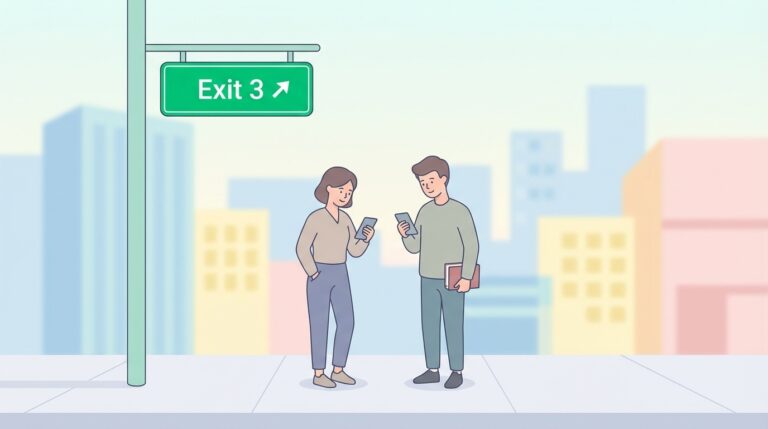
Picture this: It’s a K-Drama moment. You are standing in front of a busy subway station exit in Seoul. You’re holding your phone tightly, scanning the crowd. You make eye contact with someone holding a toaster.
Is this a spy movie exchange? A blind date gone wrong?
No! It’s “Danggeun” (Carrot Market) time—Korea’s obsession with local second-hand trading.
The ‘Why’:
If you live in Korea, you will eventually buy or sell something used. It’s a rite of passage. But the most nerve-wracking part isn’t the price—it’s the meet-up. If you don’t know how to set a location, you might end up waiting at Exit 1 while your seller is at Exit 10. Let’s make sure you meet the right person at the right place!
(Transparency Note: This guide is built on real panic moments from my students who got lost in Gangnam station trying to buy a used BTS album.)
Phase 2: Deep Dive (Key Expressions)
1. 어디서 만날까요? (Where shall we meet?)
- Pronunciation: [Eo-di-seo man-nal-kka-yo?] -> Aud-ee-saw man-nal-ka-yo?
- Meaning:
- Literal: Where / meet / shall we?
- Real nuance: “Where is a good place for us to meet up?”
- K-Culture Moment:
In variety shows like Running Man, when members get separated, they frantically call each other screaming, “Eodiseo mannalkkayo?!” before the spy catches them. - Editor’s Insight:
This is the standard, polite way to start the logistics. It respects the other person’s convenience. - Situation Spectrum:
[🚫 Formal Boss] ———— [⚠️ Colleagues] ———— [✅ Strangers/Friends]
(Perfect for polite strangers on trading apps!) - 🤔 Think About It:
Why do we ask “Shall we?” (-l-kkayo) instead of “Where do you want to meet?” Korean culture values collective decision-making over direct individual demand.
2. [Place] 어때요? (How about [Place]?)
- Pronunciation: [Place] + [Eo-ttae-yo?] -> Uh-tae-yo?
- Meaning: How is [Place]? / How about [Place]?
- K-Culture Moment:
In romantic K-Dramas, the male lead tentatively asks, “Han River… eottaeyo?” hoping for a date. - Editor’s Insight:
This is a soft suggestion. It’s not a command. It gives the other person space to say “No.” - Situation Spectrum:
[🚫 Army General] ———— [⚠️ Boss] ———— [✅ Everyone Else]
3. [Place] 앞에서 봐요. (See you in front of [Place].)
- Pronunciation: [Place] + [A-pe-seo bwa-yo] -> Ah-peh-saw bwa-yo.
- Meaning: Let’s see (meet) in front of [Place].
- Editor’s Insight:
“See” (boda) is often used instead of “meet” (mannada) in casual spoken Korean because it sounds lighter and friendlier. - 🤔 Think About It:
Why “in front of”? In densely populated Korea, entering a building (like a station) might mean losing signal or getting lost in a maze. “In front” is the safest bet.
Phase 3: Textbook vs. Real Life
| Situation | 📖 Textbook Korean | 🗣️ Real Street Korean | 💡 Why different? |
|---|---|---|---|
| Suggesting a spot | 강남역에서 만납시다. (Let’s meet at Gangnam Station.) |
강남역 어때요? (How about Gangnam Stn?) |
“~bsida” sounds like a military order. “Eottaeyo?” is softer. |
| Fixing the spot | 1번 출구 앞에서 만나요. (Let’s meet in front of Exit 1.) |
1번 출구여. (Exit 1, please.) |
In text chats (App), speed and efficiency rule. |
| Confirming | 네, 알겠습니다. (Yes, I understand.) |
넵 / 넹 (Yep / Yeap) |
Cute endings (b/ng) soften the tone in text. |
Bottom Note for A1: Stick to the “Real Street Korean” phrases when texting on the app, but use full sentences if you meet in person!
Phase 4: Cultural Deep Dive
4-1. The “Danggeun” Signal (Non-verbal)
When you arrive at the spot, you don’t just shout names. You do the “Passive Scan.”
* Stand still.
* Look at your phone, then look up.
* Look for the “Item.” (If you are buying a fan, look for someone holding a fan).
* Nunchi (Eye-measure): If you make eye contact with someone else doing the “Passive Scan,” 99% chance that’s your partner.
4-2. K-Culture Connection: The Phrase “Are you Carrot?”
There is a famous meme-turned-reality in Korea. When you approach the stranger, you don’t ask “Are you Minji?” You ask:
“당근이세요?” (Danggeun-iseyo?)
(Lit: Are you a Carrot? / Meaning: Are you from the Carrot Market app?)
This phrase is so iconic it’s practically a greeting now. It shows you are part of the “tribe.”
Phase 5: Immersive Roleplay
Setting:
Friday, 6 PM. Hongik Univ. Station, Exit 3. It’s crowded with young people. You are buying a used textbook. You see a girl holding a book.
Characters:
* YOU: A foreign student who needs a cheap book.
* Seller: A university student in a hurry.
Dialogue:
YOU: (Approaching cautiously) 저기요… 혹시 당근…?
(Jeogiyo… hoksi Danggeun…?)
(Excuse me… by any chance, Carrot…?)
Seller: 아! 네! 안녕하세요. 여기 책이요.
(Ah! Ne! Annyeonghaseyo. Yeogi chaegiyo.)
(Ah! Yes! Hello. Here is the book.)
🔀 Decision Point: The seller hands you the book. What do you say?
- Choice A: (Take it silently and transfer money)
- Choice B: 감사합니다! 잠시만요, 상태 좀 봐도 될까요? (Thank you! Wait, can I check the condition?)
- Choice C: 사랑해요! (I love you!)
✅ Best Choice: B. In second-hand trade, it is standard etiquette to check the item briefly before parting ways. Even if you are shy!
⚠️ Choice C: Please don’t. This isn’t a fan meeting. 😂
Phase 6: 10-Second Shadowing Drill
Let’s practice! Read the / as a short pause.
- 😊 Suggesting nicely:
홍대입구역 / 어때요?
(Hong-dae-ip-gu-yeok / eo-ttae-yo?) -
😤 Confirming the spot:
3번 출구 / 앞에서 / 봐요!
(Sam-beon chul-gu / a-pe-seo / bwa-yo!) -
🥺 Can’t find them:
어디 / 계세요?
(Eo-di / gye-se-yo?)
Phase 7: K-Culture Glossary (Mini Dictionary)
| Korean | Romanization | Meaning | Context |
|---|---|---|---|
| 당근 | Danggeun | Carrot | Short for “Dangsin-geuncheo” (Your Neighborhood). The #1 trading app name. |
| 쿨거래 | Cool-georae | Cool Deal | A quick transaction with no haggling/questions. Highly preferred. |
| 직거래 | Jik-georae | Direct Trade | Meeting in person to trade (vs. shipping). |
Phase 8: Traveler’s Survival Kit
Since you are meeting someone, you need to know WHERE. In Korea, Subway Exits (출구 – Chul-gu) are the holy grail of meeting spots.
🆘 Survival Expression #1
* 🇰🇷 “몇 번 출구예요?” (Myeot beon chul-gu-yeyo?)
* 🗣️ Sound: Myut bun chul-gu-yay-yo?
* Meaning: Which number exit is it?
* Use: When the app map is confusing.📌 Editor’s Travel Note
* KakaoMap is King: Google Maps often fails in Korea. Use KakaoMap or Naver Map to find the exact exit number.
* Safe Zones: Subway exits, convenience stores (CU, GS25), and bank entrances are the safest, well-lit places for trading.
Phase 9: Think Deeper (Critical Thinking)
Topic: Safety & Community
Unlike many countries where second-hand trades happen at police stations or private homes, Koreans prefer Subway Exits. Why?
Because the Korean subway is the “vein” of the city. It’s public, it has CCTV everywhere, and it’s neutral ground. It reflects a society that values accessibility and public safety. Also, the app “Danggeun” limits trades to your local neighborhood (GPS verified).
🧠 Think About It: How does this “neighborhood-only” restriction change the trust level between strangers? Does it feel safer than trading with an anonymous person from across the country?
Phase 10: FAQ & Troubleshooting
Q: Can I change the location last minute?
A: Avoid it. Koreans value punctuality and efficiency (‘Palli-palli’ culture). Changing the location 5 minutes before is considered very rude (Bad Manner Temperature 📉).
Q: Should I bring small talk?
A: No. Unlike Western culture where you might chat about the weather, Korean trades are often silent. Greeting -> Check Item -> Pay -> Bye. Being “Cool” (quick) is the best compliment.
❌ Common Mistake: asking “How are you?” (Jal jinaesyeosseoyo?)
✅ Do this: Just say “Annyeonghaseyo” (Hello) and get straight to business.
Phase 11: Wrap-up & Action Mission
Summary: Today we learned how to suggest a place (~eottaeyo?) and fix a spot (~apeseo bwayo) for a safe trade.
🚀 Action Mission:
* 🥉 Bronze: Look at a Seoul Subway Map online. Pick a station and say out loud: “[Station Name] apeseo bwayo.”
* 🥈 Silver: Download “Karrot” (Danggeun) just to see the interface. Try to read the location names.
* 🥇 Gold: Meet a friend today and text them in Korean: “[Place] 앞에서 만나!” (Drop the ‘yo’ for close friends!)
💬 Your Turn: In your country, where do people usually meet for online trades? A gas station? A mall? Tell me in the comments!
Phase 12: Quiz — Interactive Challenge
Situation: You are waiting at Exit 5, but the seller says they are at Exit 7. You want to say “I will go there.”
- 제가 갈게요. (Jega gal-ge-yo)
- 가지 마세요. (Gaji ma-se-yo)
- 당근이세요? (Danggeun-i-se-yo?)
Correct Answer: 1. 제가 갈게요.
* (2 means “Don’t go,” 3 means “Are you Carrot?”)
* Culture Tip: Offering to move to the other person’s location is a huge “Manner” plus!
Frequently Asked Questions (FAQ)
Q: What does "어디서 만날까요? (Where shall we meet?)" mean in Korean and how do you pronounce it?
A: In Korean, "어디서 만날까요? (Where shall we meet?)" is pronounced [Eo-di-seo man-nal-kka-yo?] and means: Literal: Where / meet / shall we?
Q: What does "[Place] 어때요? (How about [Place]?)" mean in Korean and how do you pronounce it?
A: In Korean, "[Place] 어때요? (How about [Place]?)" is pronounced [Place] and means: How is [Place]? / How about [Place]?
Q: What does "[Place] 앞에서 봐요. (See you in front of [Place].)" mean in Korean and how do you pronounce it?
A: In Korean, "[Place] 앞에서 봐요. (See you in front of [Place].)" is pronounced [Place] and means: Let's see (meet) in front of [Place].







